


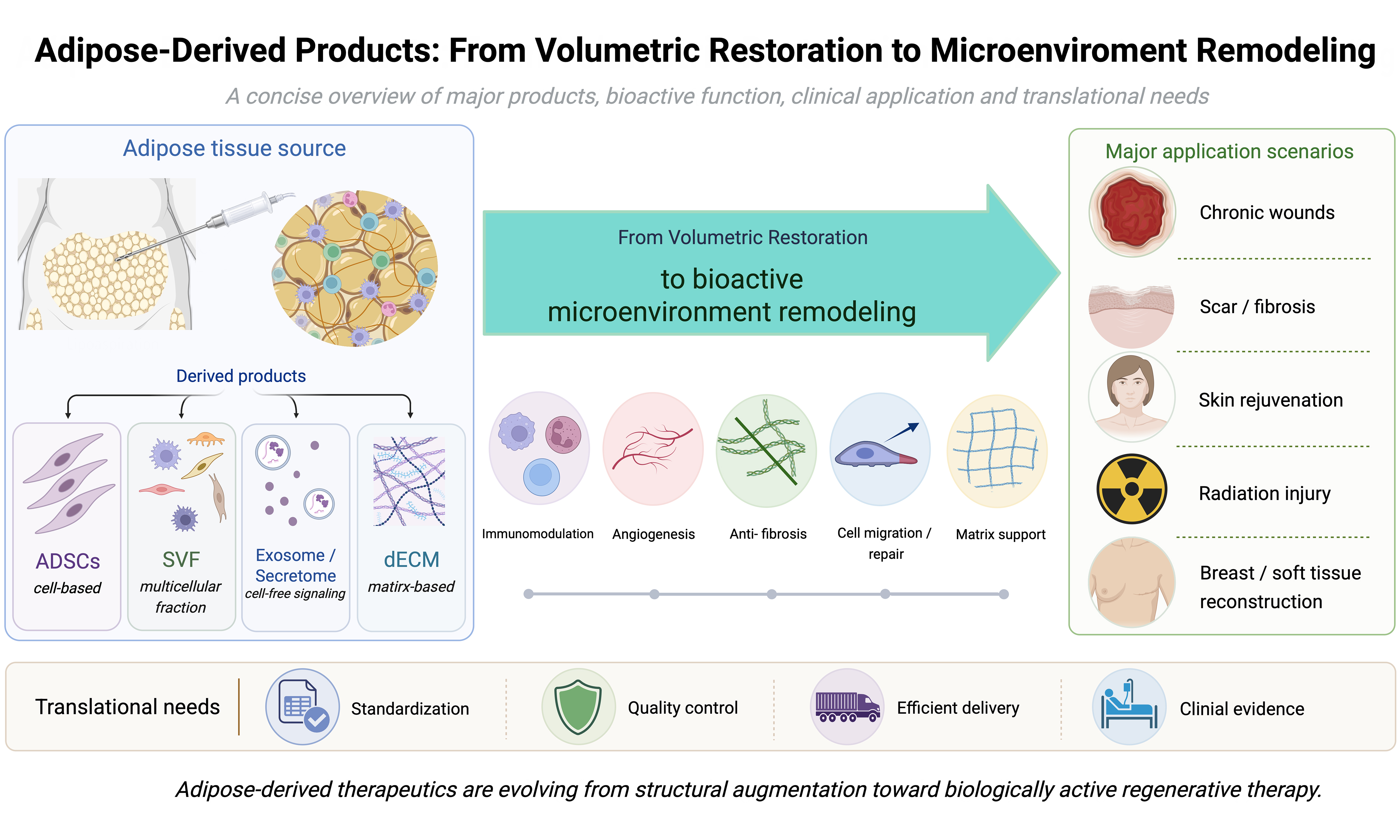
Adipose-derived products: from volumetric restoration to microenvironment remodeling
 0
0 
Abstract
Adipose tissue is a dynamic biological system with endocrine, immunomodulatory, and tissue-repair functions. Beyond conventional fat grafting for volume restoration and structural support, adipose-derived therapeutics increasingly aim to remodel the local microenvironment through paracrine signaling, intercellular communication, and matrix-mediated regulation. Major products include adipose-derived stem/stromal cells (ADSCs), stromal vascular fraction (SVF), extracellular vesicles (EVs), and secretome, and decellularized extracellular matrix (dECM). This structured narrative review searched PubMed/MEDLINE, Web of Science Core Collection, and Scopus for English-language publications from January 1, 2015, to June 30, 2026, using predefined terms related to product categories, clinical indications, mechanisms, safety, manufacturing, quality control, biomaterial-assisted delivery, and regulatory translation. Eligible studies were selected according to prespecified criteria and synthesized by product type, clinical indication, evidence maturity, efficacy, safety, and translational relevance. Current evidence indicates that adipose-derived products may promote angiogenesis, modulate inflammation and fibrosis, support tissue regeneration, and improve local repair in chronic wounds, scar and fibrotic disorders, skin rejuvenation, radiation-induced injury, and soft tissue reconstruction. However, heterogeneity in product definition and preparation, incomplete mechanistic characterization, limited standardization and quality control, delivery limitations, and insufficient high-quality clinical evidence remain major barriers. Future translation will require indication-specific product selection, standardized manufacturing and release criteria, validated potency assays, optimized delivery systems, and rigorous clinical evaluation.
Keywords
INTRODUCTION
Adipose tissue has long been regarded as merely a site of energy storage. However, accumulating basic and translational evidence has shown that it is a biologically active tissue composed of mature adipocytes, progenitor cells, vascular-associated cells, immune cells, and extracellular matrix (ECM) components, all of which contribute to a highly plastic local microenvironment[1,2]. This cellular and matrix complexity enables adipose tissue to participate not only in systemic metabolic homeostasis, but also in inflammation regulation, tissue regeneration, and injury repair[1].
In plastic surgery and regenerative medicine, the clinical use of adipose tissue has shifted from a primarily volumetric or structural application toward bioactive therapeutic application. Conventional fat grafting primarily aims to restore volume, improve contour, and provide structural support. In contrast, adipose-derived approaches may also improve the local microenvironment through paracrine signaling, immunomodulation, pro-angiogenic activity, and anti-fibrotic effects, thereby promoting tissue repair and functional recovery[1,3-6]. This understanding has driven the rapid development of research on adipose-derived products.
Conceptually, adipose-derived products can be organized into three interconnected biological levels. At the cellular level, adipose-derived stem/stromal cells (ADSCs) and stromal vascular fraction (SVF) represent viable cell-based products derived from adipose tissue. At the secretory level, extracellular vesicles (EVs), including exosomes, together with the broader secretome, represent cell-free paracrine products that mediate intercellular communication. At the matrix level, decellularized extracellular matrix (dECM) represents the structural and biochemical scaffold derived from adipose tissue. This hierarchical classification helps clarify that these products are not parallel or interchangeable entities, but rather distinct yet interconnected components derived from the same tissue source[2]. These components may be applied alone or combined with hydrogels, scaffold materials, and nano-delivery systems to construct more complex regenerative therapeutic platforms[7-9]. Existing studies have shown the potential clinical value of adipose-derived products in multiple fields, including chronic wounds, pathological scars, radiation-induced fibrosis, skin aging, and breast reconstruction[10-12].
Nevertheless, adipose-derived therapeutics remain at a critical stage of transition from a “research hotspot” to a “standardized product”. Considerable differences remain among different adipose-derived products in terms of definition, preparation methods, functional evaluation, and clinical positioning. Their key effector molecules, major signaling pathways, and synergistic relationships among different products have not yet been fully clarified. Meanwhile, quality control, delivery strategies, and regulatory pathways also remain to be standardized[13-15]. Therefore, it is necessary to systematically summarize the current research progress on adipose-derived products, analyze the challenges they face, and discuss future directions for development.
Accordingly, this review is organized around four aspects: first, the major types of adipose-derived products and their mechanisms of action; second, the current application status of adipose-derived products in plastic/reconstructive surgery and regenerative medicine; third, the key issues facing their clinical translation; and fourth, future research and application perspectives.
METHODS
Review design and scope
This article was designed as a structured narrative review rather than a formal systematic review or meta-analysis because the available literature is highly heterogeneous in product type, preparation method, study design, clinical indication, administration strategy, comparator, and outcome measure. The review focused on adipose-derived therapeutic approaches relevant to plastic surgery, reconstructive surgery, aesthetic medicine, and regenerative medicine, including conventional fat grafting and mechanically processed adipose products, ADSCs, SVF, adipose-derived EVs, including studies specifically describing exosomes, as well as broader secretome-based products, and adipose-derived dECM or acellular adipose matrix. Evidence concerning product definition, preparation, biological mechanisms, clinical efficacy, safety, manufacturing and quality control, biomaterial-assisted delivery, and regulatory translation was synthesized.
Information sources and search strategy
A structured literature search was conducted in PubMed/MEDLINE, Web of Science Core Collection, and Scopus to identify studies relevant to adipose-derived therapeutics in plastic surgery, reconstructive surgery, aesthetic medicine, and regenerative medicine. English-language publications dated from January 1, 2015, to June 30, 2026, were considered. The exact search date, database-specific restrictions, and number of records retrieved from each database were reported in Supplementary Tables 1-3.
The search strategy comprised three main concept groups. The first group covered adipose-derived product terms, including “adipose-derived stem cells”, “adipose-derived stromal cells”, “ADSCs”, “adipose-derived regenerative cells”, “stromal vascular fraction”, “SVF”, “extracellular vesicles”, “EVs”, “exosomes”, “secretome”, “conditioned medium”, “decellularized adipose matrix”, “decellularized extracellular matrix”, “dECM”, “acellular adipose matrix”, “fat grafting”, “autologous fat transfer”, “lipofilling”, “nanofat”, “microfat”, “mechanically processed adipose tissue”, and “cell-assisted lipotransfer”.
The second group included clinical and reconstructive indication terms, such as “plastic surgery”, “reconstructive surgery”, “aesthetic medicine”, “regenerative medicine”, “wound healing”, “chronic wounds”, “non-healing wounds”, “diabetic foot ulcers”, “pressure ulcers”, “scars”, “hypertrophic scars”, “keloids”, “fibrosis”, “scleroderma”, “systemic sclerosis”, “skin regeneration”, “skin rejuvenation”, “photoaging”, “radiation-induced injury”, “radiation fibrosis”, “soft tissue defects”, “soft tissue reconstruction”, “breast reconstruction”, and “breast augmentation”.
The third group included translational, manufacturing, safety, and delivery-related terms, including “safety”, “adverse events”, “complications”, “manufacturing”, “processing”, “preparation”, “standardization”, “quality control”, “release criteria”, “potency”, “potency assay”, “good manufacturing practice”, “GMP”, “clinical translation”, “clinical trials”, “regulatory”, “biomaterials”, “hydrogels”, “scaffolds”, “microneedles”, “nanoparticles”, “delivery systems”, “controlled release”, and “sustained release”.
Synonyms and related terms within each concept group were combined using the Boolean operator “OR”, whereas product-related terms were combined with indication- or translation-related terms using “AND”. The principal search structure was therefore: adipose-derived product terms AND (clinical indication terms OR translational terms).
Search syntax, field tags, phrase searching, truncation symbols, publication-date limits, and language restrictions were adapted to each database. PubMed/MEDLINE searches used database-specific title and abstract field tags; Web of Science Core Collection searches were performed using the Topic field; and Scopus searches were conducted using the TITLE-ABS-KEY field. The complete database-specific search histories, applied filters, search dates, and retrieved record numbers were provided in Supplementary Table 1 for PubMed/MEDLINE, Supplementary Table 2 for Web of Science Core Collection, and Supplementary Table 3 for Scopus.
Backward citation searching was performed by screening the reference lists of eligible reviews and relevant primary studies, and forward citation searching was conducted for selected foundational publications when necessary. Seminal articles published before 2015 were additionally included when they established key product definitions, consensus criteria, terminology, or historically important mechanistic concepts. These earlier publications were used primarily for conceptual or methodological background and were not considered representative of current clinical efficacy unless supported by more recent evidence.
Targeted supplementary searches were also performed for artificial exosomes, exosome-mimetic vesicles, biomimetic nanovesicles, and non-adipose-derived biomaterial delivery systems when these studies provided directly transferable engineering or delivery principles relevant to adipose-derived products. Such studies were not treated as direct evidence of the clinical efficacy of adipose-derived therapeutics.
Eligibility criteria
Studies were eligible if they: (1) investigated an adipose-derived cellular, secretory, matrix-based, mechanically processed, or fat-grafting-related therapeutic product; (2) were relevant to plastic surgery, reconstructive surgery, aesthetic medicine, regenerative medicine, or one of the prespecified clinical indications; and (3) addressed at least one of the following domains: product definition or preparation, biological mechanisms, efficacy, safety, manufacturing, quality control, biomaterial-assisted delivery, clinical translation, or regulatory considerations.
Eligible publications included in vitro studies, animal studies, translational investigations, randomized and non-randomized clinical trials, prospective or retrospective observational studies, systematic or scoping reviews, consensus statements, and relevant regulatory or technical documents. Clinical studies and systematic reviews were prioritized when evaluating clinical efficacy, safety, and translational maturity. Preclinical studies were used mainly to explain mechanisms, product engineering, and delivery strategies. Narrative reviews were used for contextual synthesis and identification of relevant primary studies rather than as substitutes for original clinical evidence.
Studies were excluded if they: (1) focused exclusively on adipocyte metabolism, obesity, energy storage, or basic adipose biology without therapeutic relevance; (2) investigated products unrelated to adipose tissue without providing directly relevant comparative, engineering, or delivery information; (3) were unrelated to the prespecified clinical fields or indications; (4) were conference abstracts, editorials, letters, commentaries, news reports, or other publications without sufficient study data; (5) represented duplicate or substantially overlapping reports without additional relevant information; (6) lacked accessible full text; or (7) were not published in English.
Studies of artificial exosomes, exosome-mimetic vesicles, or non-adipose-derived biomaterial delivery systems were included only when they provided directly transferable engineering or delivery principles relevant to the development of adipose-derived products. Such studies were not considered direct evidence of the clinical efficacy of adipose-derived therapeutics.
Study selection and data extraction
Records retrieved from the three databases were combined and deduplicated before screening. Titles and abstracts were screened according to the predefined eligibility criteria, followed by full-text assessment of potentially relevant publications. Two authors independently conducted study selection, and disagreements were resolved through discussion or consultation with the senior author. Publications identified through backward or forward citation searching were assessed using the same eligibility criteria.
Extracted information included product category, adipose tissue source, preparation or processing method, autologous or allogeneic origin, study design, experimental or clinical population, sample size, clinical indication, intervention and comparator, administration method, follow-up duration, efficacy outcomes, safety findings, manufacturing and quality-control information, delivery strategy, and regulatory relevance. When multiple publications reported overlapping clinical populations or experimental cohorts, the most complete report was prioritized unless related publications provided additional mechanistic, safety, methodological, or follow-up information.
Evidence synthesis and methodological considerations
Evidence was synthesized narratively at two complementary levels. Product definitions, biological mechanisms, manufacturing requirements, quality-control needs, and regulatory risks were analyzed according to product category, whereas efficacy, safety, and clinical positioning were compared across major indications.
Clinical findings were interpreted with consideration of study design, sample size, comparator, follow-up duration, directness to the target indication, consistency across studies, and clinical relevance. Greater caution was applied when conclusions were based mainly on preclinical studies, uncontrolled clinical studies, small samples, or indirect evidence. Direct head-to-head comparisons were prioritized when available; when such comparisons were absent, conclusions regarding the relative clinical value of different products were presented as indirect, indication-specific interpretations rather than claims of superiority.
No quantitative meta-analysis was performed because of substantial heterogeneity in product definitions, preparation methods, clinical indications, administration strategies, comparators, follow-up periods, and outcome measures. No formal risk-of-bias tool was applied because this was a structured narrative review; however, methodological limitations were considered during evidence interpretation. Restriction to English-language publications and the inclusion of heterogeneous preclinical, clinical, and translational evidence may have introduced language, publication, and selection biases.
MAJOR TYPES OF ADIPOSE-DERIVED PRODUCTS AND THEIR MECHANISMS OF ACTION
Adipose-derived therapeutics do not represent a single product category, but rather encompass multiple bioactive entities distributed across cellular, secretory, and matrix levels. ADSCs and SVF constitute cell-based products; EVs, including exosomes, and the broader secretome constitute cell-free secretory products; and dECM constitutes a matrix-based product that preserves adipose tissue-derived structural and biochemical cues. This hierarchical framework provides the basis for understanding their differences in source, composition, biological behavior, mechanisms of action, and translational characteristics. Their derivation pathways and interrelationships are illustrated in Figure 1. For ease of comparison, the major biological features, mechanisms of action, and translational characteristics of the principal adipose-derived products are summarized in Table 1.
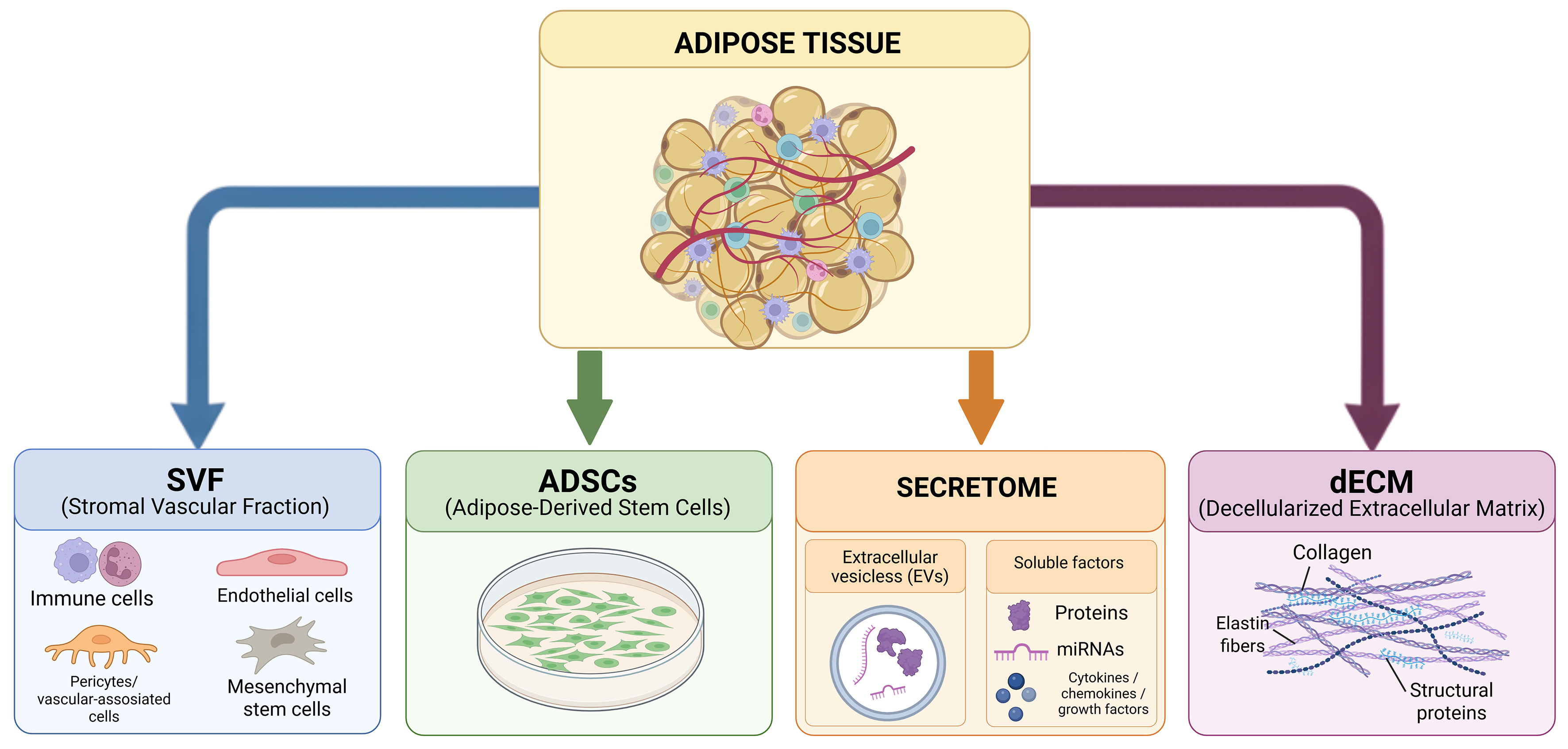
Figure 1. Hierarchical relationships among major adipose-derived products. SVF and ADSCs represent cellular products, EVs and the broader secretome represent secretory products, and dECM represents the matrix-based component. Created in BioRender. Lu, R. (2026) https://BioRender.com/0m5c3vh. SVF: Stromal vascular fraction; ADSCs: adipose-derived stem cells; dECM: decellularized extracellular matrix; EVs: extracellular vesicles; miRNAs: microRNAs.
Core characteristics of major adipose-derived products
| Product | Product level and preparation | Key components | Primary biological role | Main translational feature |
| ADSCs | Cell-based; plastic-adherent cells isolated from adipose tissue and expanded in vitro | Relatively defined MSC-like cells; CD73+/CD90+/CD105+; expandable population[17,113] | Paracrine signaling; angiogenesis; immunomodulation; anti-fibrotic regulation | Suitable for controlled cell-product development; requires ex vivo expansion[16,25] |
| SVF | Cell-based; freshly isolated by enzymatic or mechanical processing without culture expansion | ADSC-like progenitors, endothelial cells, pericytes, fibroblasts, and immune cells[26,35] | Multicellular synergy; vascular support; inflammatory regulation | Same-day autologous use; marked compositional heterogeneity[26,35] |
| EVs and secretome | Cell-free secretory products derived from adipose-resident cells or cultured adipose-derived cells | EVs contain miRNAs, proteins, lipids, and other molecular cargos, whereas the broader secretome additionally includes soluble cytokines, chemokines, and growth factors[36,37,41] | Intercellular communication; pro-angiogenic, anti-inflammatory, and anti-fibrotic signaling | Amenable to storage, engineering, and biomaterial-assisted delivery[13,36]; identity, composition, and potency remain insufficiently standardized[14] |
| dECM/acellular adipose matrix | Matrix-based; produced by decellularization of adipose tissue | Collagen, laminin, fibronectin, glycosaminoglycans, and matrix-bound cues[55-57] | Matrix support; mechanotransduction; host-cell infiltration; local delivery | Tissue-specific scaffold platform; decellularization efficiency, residual cellular components, mechanical properties, and batch consistency require careful control[5,114] |
ADSCs and SVF
Although ADSCs and SVF are both obtained from adipose tissue and share certain regenerative properties, they represent two distinct cell-based product forms rather than interchangeable entities. ADSCs are generally defined as a relatively purified mesenchymal stromal/stem-like cell population after isolation, plastic adherence, and in vitro expansion, whereas SVF refers to a freshly isolated heterogeneous cell fraction that retains multiple stromal, vascular, progenitor, and immune-related cell populations from adipose tissue.
ADSCs are among the most extensively studied adipose-derived products and have one of the most established translational foundations. Compared with bone marrow-derived mesenchymal stem cells, ADSCs have several advantages, including relatively convenient harvesting, abundant tissue sources, higher yield upon isolation, and strong in vitro expansion capacity[4,16]. In general, ADSCs are obtained after adipose tissue processing, cell isolation, plastic adherence, and in vitro expansion, resulting in a relatively purified mesenchymal stromal/stem-like cell population. According to the minimal criteria proposed by the International Society for Cellular Therapy (ISCT), mesenchymal stromal/stem cells (MSCs) should meet three basic requirements: plastic adherence under standard culture conditions; positive expression of CD73, CD90, and CD105; lack of expression of hematopoietic, endothelial, and immune-related markers including CD45, CD34, CD14 or CD11b, CD79α or CD19, and HLA-DR; and the capacity for osteogenic, adipogenic, and chondrogenic differentiation in vitro. Therefore, culture-expanded ADSCs are commonly characterized as CD73+/CD90+/CD105+ and CD45-/CD34-/CD14- or CD11b-/CD79α- or CD19-/HLA-DR-, together with trilineage differentiation potential[17]. However, ADSCs should not be considered completely identical to bone marrow-derived MSCs. Compared with bone marrow-derived MSCs, ADSCs are generally easier to harvest, available in larger quantities, and often show stronger proliferative and angiogenic/paracrine activity, whereas bone marrow-derived MSCs have historically been more extensively studied and may show stronger osteogenic or chondrogenic tendencies in some experimental settings[18,19]. These differences suggest that ADSCs and bone marrow-derived MSCs share a core MSC phenotype but may differ in tissue source, yield, differentiation bias, transcriptomic/proteomic features, and functional behavior[4,16]. However, the phenotype of ADSCs is still influenced by multiple factors, including tissue source, harvesting method, enzymatic digestion procedures, culture conditions, and passage number; therefore, their “standardized definition” remains not entirely stable[14,20].
Classically, the therapeutic foundation of ADSCs lies first in their multilineage differentiation capacity. ADSCs can differentiate into adipogenic, osteogenic, chondrogenic, and myogenic lineages, thereby providing a basis for soft tissue reconstruction, osteochondral repair, and tissue-engineering applications[4,16,21]. However, growing evidence suggests that the principal therapeutic effects of ADSCs in vivo do not depend entirely on terminal differentiation, but rather on their paracrine and microenvironment-regulating functions[22,23]. ADSCs secrete vascular endothelial growth factor (VEGF), C-X-C motif chemokine ligand 12 (CXCL12), and other bioactive factors involved in intercellular communication, thereby contributing mainly to paracrine regulation, angiogenesis, immunomodulation, and tissue remodeling[21-23].
Functionally, ADSCs regulate several repair-related processes, including macrophage polarization, T-cell responses, fibrogenic signaling, and endothelial activation. Through factors such as CXCL12 and VEGF, ADSCs may improve local microcirculation and contribute to tissue repair in chronic wounds, radiation-induced injury, and recipient-site optimization[21-24].
Despite these clear advantages, ADSCs also have limitations in clinical application. First, donor age, obesity, diabetes, and chronic inflammatory states may significantly affect ADSC proliferation, migration, and secretory profiles[4,25]. Second, while in vitro expansion increases cell numbers, it may also lead to senescence, functional drift, and safety concerns[4,16]. Therefore, the future development of ADSCs depends not simply on “broader use”, but rather on “more precise definition and more standardized application”.
As another cellular source for adipose-derived therapy, SVF is a heterogeneous cell population obtained after enzymatic or mechanical processing of adipose tissue, without long-term in vitro culture expansion. It contains ADSC-like progenitor cells, endothelial cells, pericytes, fibroblasts, and various immune-related cells[26-28]. Compared with culture-expanded and relatively purified ADSCs, the major feature of SVF is that it more closely preserves the native cellular composition and local interactions within adipose tissue. Therefore, SVF is better understood as a freshly isolated, niche-preserving cellular fraction with characteristics of “multicomponent synergistic repair”[26,28].
The biological advantages of SVF mainly lie in its integrated cellular composition. ADSC-like progenitors may provide regenerative potential, endothelial cells and pericytes may support vascular reconstruction, and immune-related cells may participate in local inflammatory regulation[26,29]. Therefore, unlike culture-expanded ADSCs, SVF does not rely on a single relatively purified cell population, but acts through coordinated interactions among multiple cell types[26,28]. This makes SVF particularly attractive in clinical scenarios requiring rapid acquisition of autologous bioactive components.
Thus, the distinction between ADSCs and SVF is not only a matter of terminology, but also reflects differences in preparation, composition, and mechanism. ADSCs are culture-expanded and relatively more defined, which makes them useful for mechanistic studies and standardized phenotypic characterization. Their therapeutic effects are commonly attributed to paracrine signaling, extracellular vesicle release, immunomodulation, angiogenesis, and differentiation potential. In contrast, SVF is prepared without long-term culture expansion and functions as a heterogeneous cellular mixture that retains progenitor, vascular, stromal, and immune-related components. Its effects are more dependent on the coordinated actions of multiple cell types rather than a single purified cell population[26,27]. This distinction also influences their clinical positioning: ADSCs are more suitable for controlled cell-product development, whereas SVF has greater point-of-care applicability in scenarios requiring rapid autologous use, such as chronic wounds, scars, hand lesions in systemic sclerosis, and adjunctive fat grafting[29-32].
Direct clinical comparisons between culture-expanded ADSCs and freshly isolated SVF remain limited. In patients with knee osteoarthritis, Yokota et al. directly compared intra-articular cultured adipose-derived stromal cells with noncultured SVF and found that both treatments improved pain and functional outcomes, although the cultured-cell group showed earlier symptom improvement and greater pain reduction at 6 months. A subsequent 2-year comparison showed sustained improvement with both approaches, with greater proportions of patients in the cultured-cell group achieving clinically meaningful improvement at 12 months, but these differences were no longer significant at 24 months. These findings provide preliminary comparative clinical evidence but are limited to a nonrandomized orthopedic setting and therefore do not establish general superiority of ADSCs over SVF across indications[33,34].
However, the limitations of SVF are also evident. Its heterogeneity is both an advantage and an obstacle: different donors, anatomical sites, processing methods, and cellular proportions can all affect its final performance[26,35]. Moreover, unified standards for the definition, functional stratification, and release criteria of SVF are still lacking, which remains a key barrier to its further standardized application.
Adipose-derived EVs and secretome
Adipose-derived EVs and secretome represent important cell-free components of adipose-derived therapeutics[36,37]. EVs are membrane-enclosed particles released by cells and carry bioactive cargo such as miRNAs, mRNAs, proteins, and lipids that mediate intercellular communication[36,37]. Exosomes represent a subtype of EVs associated with the endosomal pathway and are referred to specifically in this review when supported by the terminology and characterization used in the cited studies[36,37]. In contrast, the secretome is used as a broader term encompassing EVs together with soluble cytokines, chemokines, growth factors, and other paracrine mediators[15,37].
Adipose-derived EVs have demonstrated clear potential in anti-inflammatory, pro-angiogenic, and anti-fibrotic regulation. Mechanistically, ADSC-derived exosomes can suppress hypertrophic scar fibrosis through the miR-192-5p/IL-17RA/Smad axis[38]. In wound-repair models, exosomal miR-125a-3p directly targets phosphatase and tensin homolog (PTEN), thereby enhancing endothelial-cell migration, tube formation, and angiogenesis[39]. In keloid fibroblasts, ADSC-derived exosomes inhibit phosphoinositide 3-kinase/protein kinase B/mammalian target of rapamycin (PI3K/AKT/mTOR) signaling and enhance mitophagy, thereby reducing inflammatory and fibrotic responses and attenuating keloid progression[40]. These representative miRNA-mediated and pathway-level mechanisms are summarized in Figure 2. Meanwhile, as a more complete paracrine product, the secretome is thought to form a broader network of effects in anti-inflammation, re-epithelialization, antioxidation, and matrix remodeling[15,37].
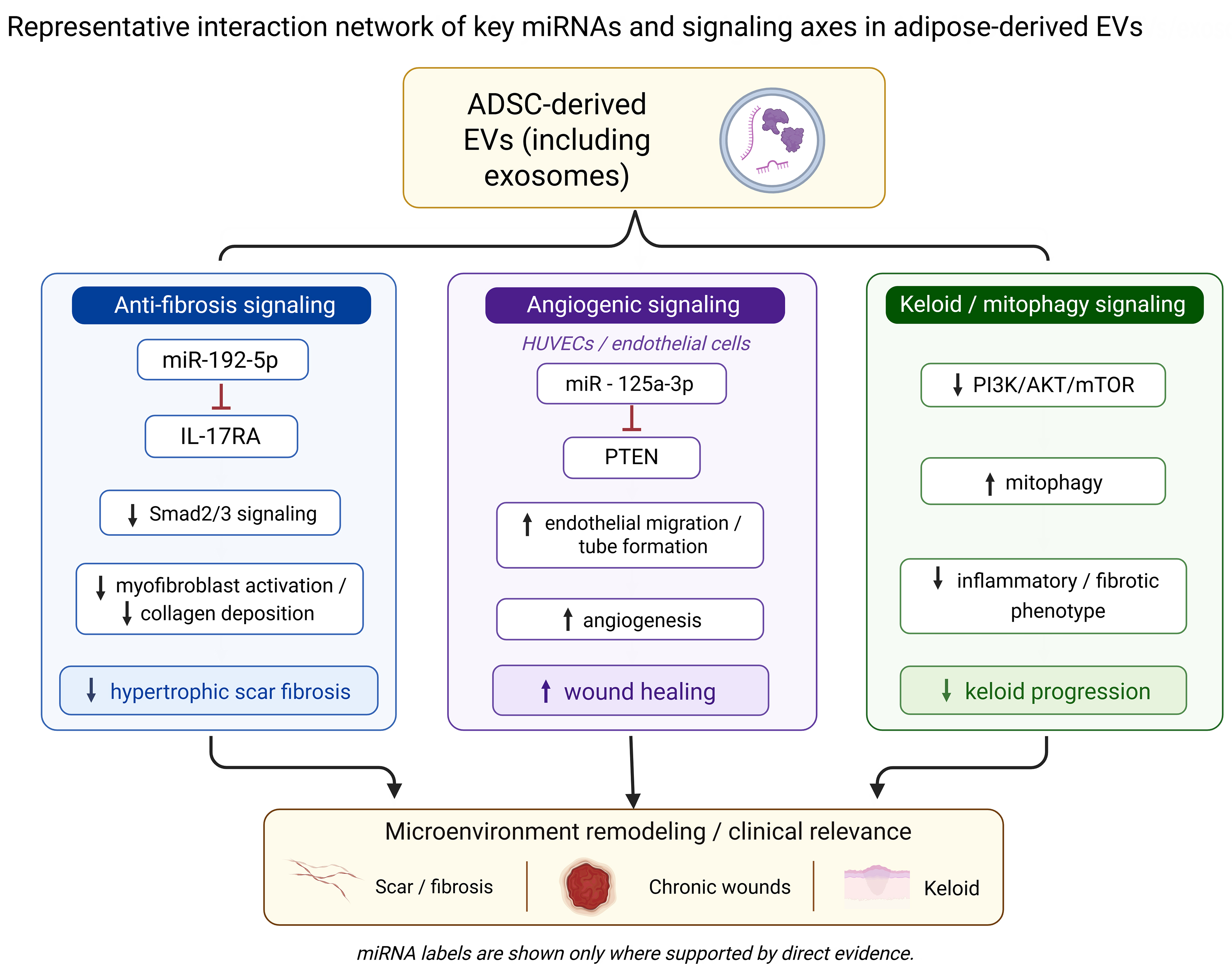
Figure 2. Representative interaction network of key miRNAs and signaling axes in adipose-derived EVs. Representative pathways include miR-192-5p/IL-17RA/Smad signaling, miR-125a-3p/PTEN-mediated angiogenesis, and PI3K/AKT/mTOR-related mitophagy. Created in BioRender. Lu, R. (2026) https://BioRender.com/rx8rgpc. ADSCs: Adipose-derived stem cells; EVs: extracellular vesicles; HUVECs: human umbilical vein endothelial cells; miRNAs: microRNAs; PI3K: phosphoinositide 3-kinase; AKT: protein kinase B; mTOR: mechanistic target of rapamycin; IL-17RA: interleukin-17 receptor A; PTEN: phosphatase and tensin homolog.
Mechanistically, adipose-derived exosomes and secretome regulate tissue repair through three interrelated levels. First, at the level of intercellular communication, exosomes deliver miRNAs, mRNAs, proteins, and lipids to recipient cells, whereas the broader secretome provides soluble cytokines, chemokines, growth factors, and other paracrine mediators[36,37]. This enables adipose-derived secretory products to influence macrophages, endothelial cells, fibroblasts, keratinocytes, and other local effector cells in the injured microenvironment. Second, at the level of functional remodeling, these cargos participate in inflammatory resolution, angiogenesis, oxidative-stress control, anti-apoptotic signaling, epithelial repair, and ECM remodeling[13,35-37,41]. Third, at the level of disease-specific regulation, different cargos may act through relatively defined pathways. For example, ADSC-derived exosomes have been reported to attenuate hypertrophic scar fibrosis through the miR-192-5p/IL-17RA/Smad axis and to alleviate keloid progression by activating PI3K/AKT/mTOR-related mitophagy[38,40]. In wound repair models, adipose-derived exosomes can further promote inflammatory resolution, vascular regeneration, and epithelial-stromal repair, thereby providing the mechanistic basis for their subsequent applications in chronic wounds, scar modulation, skin regeneration, and radiation-induced injury[36,42,43].
Compared with cell therapy, exosomes and secretome have several notable advantages. First, cell-free products are theoretically less immunogenic, thereby avoiding potential risks associated with living cells, including tumorigenicity, aberrant differentiation, and long-term uncontrollability. Second, exosomes and secretome are more suitable for batch production, storage, and transportation, and are therefore easier to develop into “off-the-shelf” therapeutic products. Third, under certain conditions, they are better suited as carriers for drugs or nucleic acids and can be integrated with biomaterials to build functional therapeutic platforms[13,36,37].
Recent advances have further expanded adipose-derived exosomes and secretome from naturally secreted paracrine products toward engineered, biomimetic, and delivery-optimized cell-free therapeutic platforms. For wound repair, recent systematic evidence suggests that the secretome can mediate multiple regenerative effects through soluble factors, EVs, cytokines, chemokines, growth factors, and regulatory RNAs, thereby supporting its role as a cell-free alternative to conventional cell therapy[44]. In diabetic foot ulcers, ADSC secretome has been increasingly recognized to promote wound healing by improving neuropathy, angiogenesis, inflammatory regulation, immune balance, tissue remodeling, and re-epithelialization[45]. More mechanistically, ADSC-derived EVs, particularly exosomes, were recently shown to promote diabetic wound repair by restoring epidermal autophagy, improving keratinocyte proliferation and migration, and upregulating autophagy-related genes such as NAMPT, CD46, VAMP7, VAMP3, and EIF2S1[46].
In addition to native ADSC-EVs, functional optimization of EVs has become an important frontier. Preconditioning strategies, including hypoxia, pharmacological stimulation, cytokine priming, genetic modification, and biomaterial-assisted culture, may enrich pro-angiogenic, anti-inflammatory, and tissue-repair-related cargos in stem cell-derived exosomes[47]. Engineered exosome systems can further improve therapeutic specificity and local retention. For example, anti-TNF-α antibody-engineered ADSC-EVs delivered by microneedles enhanced anti-inflammatory and regenerative effects in chemical corneal injury[48]. Similarly, thymosin β4 (Tβ4)-engineered ADSC-derived EVs delivered through separable microneedle patches alleviated cellular senescence through the PTEN/PI3K/AKT pathway, promoted angiogenesis and collagen deposition, and accelerated diabetic wound healing[49]. These studies indicate that adipose-derived exosomes are evolving from passive paracrine vesicles into modifiable nanotherapeutic platforms.
Artificial exosomes, exosome-mimetic vesicles, and other biomimetic nanovesicles also provide new strategies to overcome the limited yield, cargo heterogeneity, and targeting insufficiency of naturally secreted vesicles. Although these systems are not necessarily adipose-derived, they are relevant to the future engineering of adipose-derived cell-free therapeutics because they offer improved controllability, scalable production, and flexible drug-loading potential[50-52]. Moreover, EV-based scaffold or hydrogel systems have shown advantages in tissue engineering by combining biological signaling with structural support and sustained release[53]. Therefore, future adipose-derived cell-free therapy may gradually shift from direct administration of conditioned medium or native EVs toward standardized, engineered, biomimetic, and biomaterial-integrated therapeutic systems.
However, this field also faces major challenges. Exosomes obtained from different cell sources, culture conditions, and purification procedures differ substantially, leading to instability in cargo composition and function[15]. In addition, exosome products still face problems of purity control, subtype heterogeneity, short local retention time, limited targeting ability, and lack of standardized activity evaluation[13,15,35]. Thus, although adipose-derived exosomes and secretome have strong translational appeal, they are still in the stage of transitioning from proof-of-concept studies toward product-oriented development.
dECM
dECM is an ECM scaffold obtained after the removal of cellular components from adipose tissue using physical, chemical, or enzymatic methods. It retains adipose tissue-specific collagen, glycosaminoglycans, laminin, fibronectin, and part of the microenvironmental signals, and is therefore regarded as one of the scaffold materials most closely resembling the native adipose tissue niche[54-57]. Unlike conventional synthetic scaffolds, dECM not only provides structural support but also participates in tissue regeneration through biochemical signaling.
The core advantage of dECM lies in its natural microenvironment-supportive role. Studies have shown that dECM can promote cell adhesion, migration, proliferation, and differentiation and provide a more physiologically relevant mechanical and biochemical environment during tissue repair[55,56]. For adipose-related repair, such tissue specificity is particularly important because ECM derived from different tissues differs substantially in structural composition, stiffness, and signaling molecule reservoirs; adipose-derived dECM is therefore more suitable for soft tissue reconstruction and adipose regeneration[54-57].
In recent years, dECM has shown considerable potential in skin repair, alleviation of radiation-induced injury, soft tissue engineering, and construction of composite scaffolds[54,57]. For example, decellularized adipose matrix has been shown to improve the immune microenvironment of photoaged skin and to alleviate radiation-induced skin fibrosis[57]. In addition, dECM can serve as a local delivery platform for bioactive components, combining with exosomes, nucleic acids, small-molecule drugs, or cells to construct more complex and efficient tissue-engineering systems[7,9,54,56]. Therefore, dECM should not be viewed merely as a “passive scaffold”, but rather as a bioactive material capable of actively regulating the microenvironment.
Nevertheless, dECM also presents challenges, including incomplete decellularization, residual immunogenicity, variability in biomechanical properties, and insufficient batch consistency[55,56].
Recent progress in dECM-based biomaterials has emphasized that the translational value of dECM depends on a balance between sufficient decellularization and preservation of matrix bioactivity. Common decellularization strategies include physical methods such as freeze-thaw cycling and sonication, chemical methods such as detergents and acids/bases, and enzymatic methods such as DNase, RNase, or trypsin treatment[58,59]. However, overly aggressive processing may damage collagen architecture, remove glycosaminoglycans and matrix-bound growth factors, and alter mechanical properties, whereas insufficient processing may leave residual DNA, cellular debris, lipids, or organelle components that increase immunogenicity[58,59]. Therefore, optimized dECM preparation should be assessed not only by DNA reduction, but also by ECM composition, ultrastructural preservation, residual detergent content, endotoxin level, mechanical properties, degradation behavior, sterility, and biological activity[59].
Residual immunogenicity and batch-to-batch variability are major barriers to clinical translation. Residual cellular components may trigger inflammatory responses, while residual detergents such as SDS can impair cell viability, adhesion, infiltration, and recellularization[60]. Recent studies also suggest that dECM should not be regarded as a passive scaffold only, because matrix-derived signals can modulate macrophage phenotype, inflammatory resolution, angiogenesis, and tissue remodeling during wound healing[60]. For adipose-derived dECM, these issues are particularly important because adipose tissue contains abundant lipids and has relatively soft mechanical features; thus, delipidation efficiency, matrix preservation, injectability, mechanical stability, and reproducible batch preparation should be carefully controlled.
From a biomaterials perspective, dECM provides both structural support and tissue-specific biochemical cues. It can support cell adhesion, migration, proliferation, vascular ingrowth, and matrix remodeling, and can also be processed into sheets, powders, hydrogels, electrospun materials, 3D-printed scaffolds, or
Taken together, adipose-derived products regulate tissue repair through overlapping but not identical mechanisms[4]. ADSCs and SVF mainly provide cellular and multicellular paracrine regulation, including CXCL12/VEGF-related angiogenesis, macrophage modulation, and anti-fibrotic signaling[62,63]. Exosomes and secretome deliver miRNAs, proteins, growth factors, and cytokines to target cells, thereby influencing pathways such as transforming growth factor-beta (TGF-β)/Smad, PI3K/AKT/mTOR, inflammatory resolution, and epithelial-stromal repair[40,64]. In contrast, dECM mainly acts through matrix-derived cues, including collagen, laminin, fibronectin, glycosaminoglycans, and mechanical signals, which regulate cell adhesion, infiltration, matrix remodeling, and local tissue integration[65]. Therefore, these pathways should be viewed as partially overlapping and potentially synergistic rather than completely independent[2]. Synergy is most evident when secretory products provide active signaling while dECM or biomaterials provide structural support and sustained release; Partial overlap is most common in angiogenesis, inflammation control, and fibrosis modulation, where ADSCs, SVF, and exosomes may converge on similar downstream repair processes through different upstream effectors[4,66,67] [Table 2].
Mechanistic comparison of major adipose-derived products
| Product | Representative effectors | Main target cells or processes | Dominant biological outputs |
| ADSCs | CXCL12, VEGF, soluble paracrine factors, and EVs | Endothelial cells, macrophages, fibroblasts, and keratinocytes | Angiogenesis[21,24]; immunomodulation; anti-apoptosis; anti-fibrotic regulation[22,23] |
| SVF | ADSC-like progenitors, endothelial cells, pericytes, and immune cells | Vascular niche, inflammatory cells, and injured tissue microenvironment | Multicellular synergy; vascular support[26,28]; inflammatory regulation and early microenvironment modulation[26,28] |
| EVs and secretome | EV cargo (including miRNAs, proteins, and lipids); soluble cytokines, chemokines, and growth factors in the broader secretome | Macrophages, fibroblasts, endothelial cells, and keratinocytes | Cell-free paracrine signaling; TGF-β/Smad modulation[38]; PI3K/AKT/mTOR-related signaling[40]; promotion of re-epithelialization and wound repair[46] |
| dECM/acellular adipose matrix | Collagen, laminin, fibronectin, glycosaminoglycans, and matrix-bound signals | Infiltrating host cells, fibroblasts, endothelial cells, and transplanted cells | Cell adhesion and host-cell infiltration; tissue integration and matrix-mediated niche remodeling[57,60] |
CURRENT APPLICATIONS OF BIOACTIVE THERAPY BASED ON ADIPOSE-DERIVED PRODUCTS
Although adipose-derived products share several regenerative mechanisms, their clinical value is not equivalent across indications. The following sections therefore compare ADSCs, SVF, EVs and secretome, dECM, and fat grafting-related approaches according to the dominant pathological barrier, maturity of efficacy evidence, feasibility of preparation and delivery, and product-specific translational burden. Because direct head-to-head trials remain scarce, these comparisons are intended to clarify the relative clinical positioning of different products rather than establish definitive superiority. An indication-oriented summary of the main pathological barriers and preferred product strategies is provided in Table 3, whereas their shared mechanisms and major clinical applications are illustrated in Figure 3.
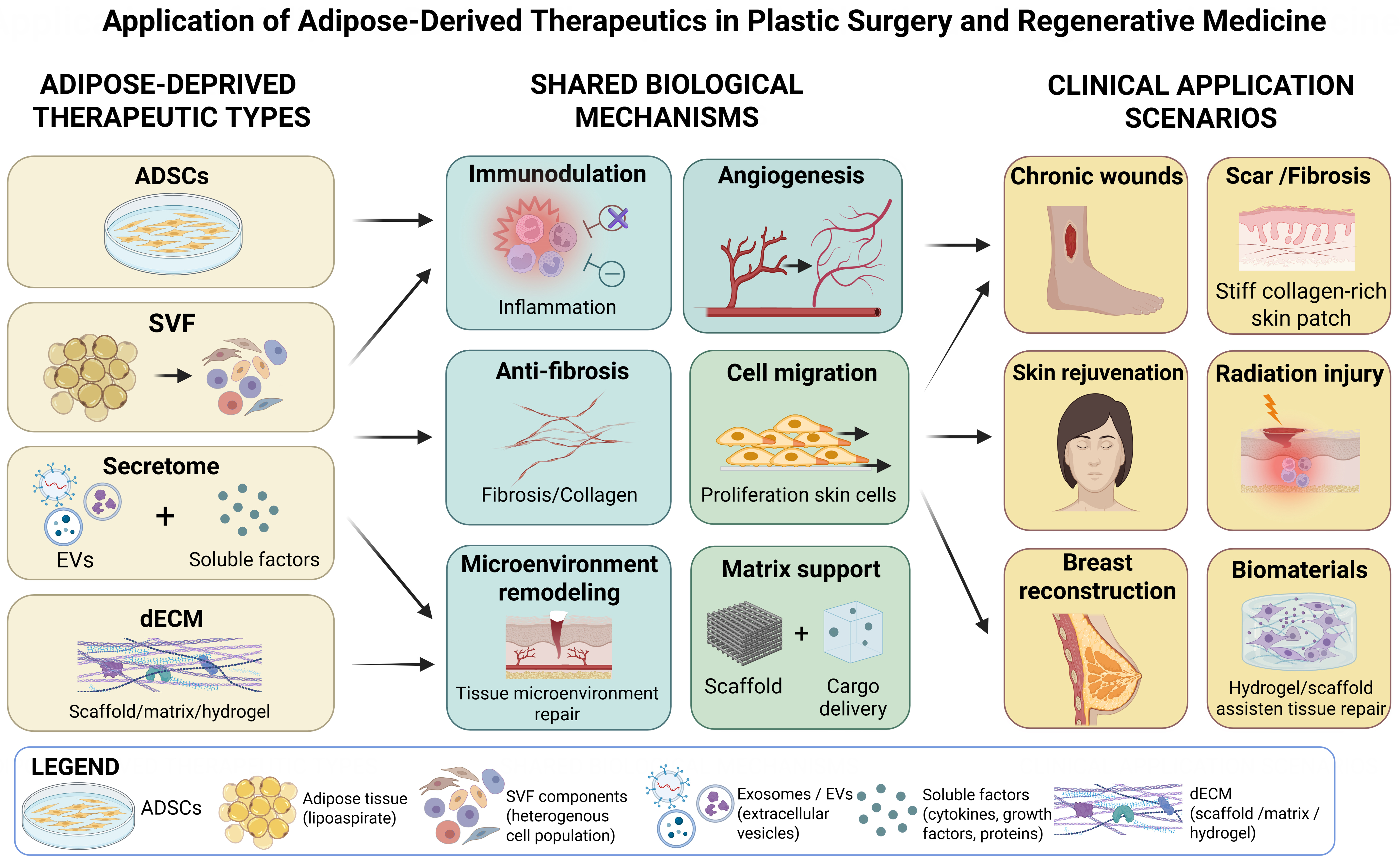
Figure 3. Major clinical applications and shared mechanisms of bioactive therapy based on adipose-derived products. Although adipose-derived therapeutics differ in form - including ADSCs, SVF, exosomes, and dECM - they all contribute to tissue repair through common mechanisms such as anti-inflammation, angiogenesis, anti-fibrosis, promotion of cell migration, and microenvironment remodeling, and are further applied in chronic wound repair, scar and fibrosis intervention, skin regeneration and rejuvenation, repair of radiation-induced injury, breast reconstruction, and biomaterial-assisted regenerative therapy. Created in BioRender. Lu, R. (2026) https://BioRender.com/mmdhdf7. ADSCs: Adipose-derived stem cells; SVF: stromal vascular fraction; EVs: extracellular vesicles; dECM: decellularized extracellular matrix.
Indication-oriented selection of adipose-derived products
| Clinical indication | Main pathological barrier | Preferred product strategy |
| Chronic wounds/diabetic foot ulcers | Persistent inflammation; impaired angiogenesis; oxidative stress; defective re-epithelialization | SVF for point-of-care autologous use[30]; EV-loaded patches or microneedles for sustained delivery[42,49]; dECM or hydrogels for matrix support[115] |
| Scar and fibrotic diseases | Excessive ECM deposition; myofibroblast activation; chronic inflammation | ADSC-derived exosomes for anti-fibrotic signaling [38,40]; SVF or fat grafting for vascularity and tissue quality[1,77]; dECM for matrix remodeling[92] |
| Skin rejuvenation/photoaging | Oxidative stress; collagen degradation; cellular senescence; inflammation | ADSC-derived EVs for photoaging and skin rejuvenation[81,88]; mechanically processed adipose products for facial rejuvenation[32] |
| Radiation-induced injury | Hypovascularity; oxidative stress; chronic inflammation; fibrosis | ADSC-derived exosomes for radiation-induced skin injury[64]; fat grafting for reconstruction of irradiated tissue[94]; dECM for radiation-associated fibrosis and matrix remodeling[89,92] |
| Soft tissue reconstruction | Volume loss; poor vascularization; insufficient matrix support | Conventional fat grafting for volume restoration[100]; SVF-enriched fat grafting for graft retention[98]; acellular adipose matrix for soft-tissue augmentation[99] |
| Biomaterial-assisted tissue repair | Poor local retention; insufficient structural support; need for sustained release | ADSC-EV-loaded patches or microneedles for sustained local delivery[42,49]; adipose-matrix-containing biomaterial systems for combined structural support and bioactive delivery[115] |
Chronic wounds and non-healing wound repair
Chronic wounds are among the most extensively studied and best-supported application areas for adipose-derived products. Diabetic foot ulcers, pressure ulcers, radiation ulcers, and other chronic non-healing wounds are typically characterized by persistent inflammation, local ischemia and hypoxia, impaired fibroblast function, insufficient keratinocyte migration, and abnormal ECM remodeling[11,12,23,30,68,69]. Adipose-derived products are naturally suited to intervene at multiple levels of this pathological process.
The role of ADSCs in promoting wound healing has been widely supported. Their mechanisms mainly include stimulation of angiogenesis, modulation of local inflammation, enhancement of fibroblast and keratinocyte proliferation and migration, and inhibition of apoptosis[11,12,23,30]. SVF also has practical value in chronic wound repair because of its retained multicellular synergism and point-of-care applicability. Clinical studies have shown that injection of autologous adipose-derived SVF in diabetic foot ulcers and other chronic ulcers demonstrates good safety and some evidence of efficacy, suggesting that it may serve as an adjunctive approach to improve the local microenvironment[30]. Compared with culture-expanded ADSCs, SVF currently has more direct clinical relevance for point-of-care autologous treatment because it can be prepared rapidly and retains vascular, stromal, progenitor, and immune-related components. ADSCs, in contrast, provide a more defined and expandable cell population, but their clinical advantage over SVF has not been established, while culture expansion introduces additional manufacturing and quality-control requirements[4,16,23,25]
In recent years, exosomes have attracted particular attention in wound repair. ADSC-derived exosomes can accelerate healing by inducing IL-33 release from macrophages, regulating inflammatory resolution, and promoting angiogenesis[11]. Exosome-loaded microneedle patches, self-healing hydrogels, and local sustained-release materials further improve the local retention time and therapeutic duration of exosomes[42,70,71]. Although dECM is less often used alone in this setting, it can serve as a matrix-support platform for wound repair and enhance overall efficacy when combined with exosomes, cells, or active factors[68].
From a product-selection perspective, however, current evidence does not support a single universally optimal adipose-derived product for chronic wounds. For diabetic foot ulcers, SVF currently has relatively more direct clinical evidence than culture-expanded ADSCs because it can be prepared rapidly at the point of care and retains vascular, stromal, progenitor, and immune-related components that may jointly correct ischemic and inflammatory wound microenvironments[28,72]. In contrast, ADSCs provide a more defined and expandable cell product, but their use in chronic wounds is limited by culture expansion, phenotypic drift, manufacturing requirements, and less direct comparative clinical evidence[4,16,23,25]. Exosomes and secretome are attractive for cell-free microenvironment modulation, especially for inflammation resolution, angiogenesis, and re-epithelialization; however, most adipose-derived EV evidence remains preclinical, and the available clinical evidence for EV therapy in diabetic foot ulcers is not adipose-derived[71]. Biomaterial-assisted EV delivery, such as hydrogel or microneedle systems, is likely superior to simple EV suspension in terms of local retention and sustained release, but this advantage is still mainly supported by preclinical or early translational studies rather than head-to-head clinical trials[42,49,69,73]. Therefore, in current practice-oriented interpretation, SVF may be more suitable for autologous point-of-care treatment of ischemic or inflammatory chronic wounds, whereas EV- and secretome-based systems remain investigational candidates for future standardized cell-free therapy. Early clinical translation is reflected by a registered pilot study of adipose tissue-derived EVs for wound healing (ClinicalTrials.gov: NCT05475418), together with additional EV-based trials in diabetic foot ulcers (e.g., NCT06812637 and NCT06825884), although the latter are not adipose-derived. Larger controlled studies are therefore required before adipose-derived EV- or secretome-based therapy can be considered clinically established. dECM or hydrogel-based platforms may be most useful when matrix support, prolonged release, or combined delivery is required. From a safety perspective, chronic wounds, especially diabetic foot ulcers, require particular attention to infection risk, impaired perfusion, diabetes-related immune dysfunction, and repeated local administration; therefore, SVF should be evaluated for sterility, endotoxin level, residual enzyme contamination, and cellular heterogeneity, whereas ADSC-based products require additional control of culture expansion, viability, potency, and batch consistency[25,26,28-30,74,75].
Overall, chronic wound repair is one of the most promising translational scenarios for adipose-derived therapeutics because its endpoints are relatively clear, tissue changes are easier to observe, and local delivery routes are relatively mature. Nevertheless, higher-quality clinical studies are still needed to define the target populations, comparative efficacy, and optimal administration strategies for different products.
Scar and fibrotic diseases
Scars and fibrotic diseases remain important challenges in plastic/reconstructive surgery and regenerative medicine. Their essential pathology involves persistent inflammatory responses, abnormal fibroblast activation, myofibroblast accumulation, and imbalance in collagen deposition and remodeling, ultimately leading to abnormal tissue structure and function[1,31,32,76-78]. The advantage of adipose-derived products in this context lies in their ability to simultaneously regulate inflammation, microcirculation, and matrix remodeling rather than targeting a single pathological pathway.
ADSC-derived exosomes have shown promising mechanistic evidence for anti-fibrotic effects. They can reduce hypertrophic scarring by modulating the IL-17RA/Smad axis and suppress keloid fibrosis through PI3K/AKT/mTOR-related mitophagy[38,40]. However, these findings are derived predominantly from preclinical studies, and clinical evidence supporting routine use of adipose-derived EVs for scar modulation remains insufficient. Beyond pathological scars, adipose-derived regenerative cells and SVF have also shown positive effects in systemic sclerosis, localized scleroderma, and other fibrotic diseases. Several clinical studies indicate that autologous fat grafting or adipose-derived regenerative cell transplantation can improve skin softness, pain, blood supply, and local function[1,32,77]. However, these findings represent different levels of evidence. Exosome-based approaches currently have stronger pathway-specific mechanistic support, but their anti-fibrotic efficacy remains predominantly supported by in vitro and animal studies. In contrast, fat grafting, adipose-derived regenerative cells, and SVF have more direct human evidence, although most studies are small, involve heterogeneous patient populations, and use variable clinical endpoints. Therefore, greater clinical experience with fat- or SVF-based approaches should not be interpreted as proof of greater biological efficacy, while the mechanistic specificity of exosomes should not be interpreted as established clinical effectiveness.
Importantly, the intervention of adipose-derived products in fibrotic microenvironments is not limited to simply “reducing collagen”, but also includes multidimensional improvements in inflammation resolution, vascular repair, and restoration of tissue plasticity[1,77,78]. This gives them a more integrated regenerative profile compared with traditional anti-scar or anti-fibrotic drugs. Moreover, early scar-intervention studies suggest that adipose-derived cells or SVF may be used not only to treat established pathological scars but also to modulate abnormal scar formation at an early stage[78]. From a product-positioning perspective, EV- and secretome-based products may be suitable for developing targeted cell-free anti-fibrotic strategies. In contrast, SVF and fat grafting are currently better positioned for clinical settings in which vascularity, tissue pliability, and local tissue quality need to be improved simultaneously. Culture-expanded ADSCs provide a more defined cell population but have not yet demonstrated a consistent clinical advantage sufficient to offset the additional manufacturing and regulatory burden. dECM may support matrix remodeling or serve as a delivery scaffold, but its stand-alone clinical anti-fibrotic efficacy remains insufficiently established.
However, important challenges remain in this field. Different fibrotic diseases have distinct pathological bases, and localized scleroderma, systemic sclerosis, keloids, and radiation-induced fibrosis cannot simply be treated as one unified indication. The reported benefits of one product in a particular fibrotic disease therefore should not be directly extrapolated to other fibrotic conditions. In addition, direct head-to-head comparisons among ADSCs, SVF, exosomes, secretome, fat grafting, and dECM remain scarce, preventing firm conclusions regarding product superiority. Future studies therefore need to more precisely define the therapeutic role of adipose-derived products in different fibrotic settings. Safety evaluation in scar and fibrotic indications should focus on persistent swelling, nodularity, excessive inflammation, and inconsistent fibrosis modulation, particularly after SVF treatment, fat grafting, or repeated administration of EV- or secretome-based products[31,38,40,76,77,79,80].
Skin regeneration and rejuvenation
The application of adipose-derived products in skin regeneration and rejuvenation has expanded rapidly in recent years. Unlike conventional aesthetic approaches, which mainly focus on improving external appearance, adipose-derived therapy aims to intervene in skin aging through dermal remodeling, improvement of blood supply, regulation of inflammation, and restoration of collagen homeostasis[81-86].
The potential of ADSCs in skin aging and photoaging repair was recognized relatively early. ADSCs can promote dermal fibroblast recovery, enhance collagen reconstruction, and improve microcirculation through the release of active factors such as VEGF, fibroblast growth factor (FGF), TGF-β, and insulin-like growth factor (IGF)[85]. More recently, exosomes have become the central focus in this area. Multiple studies have shown that adipose-derived or mesenchymal stem cell-derived exosomes can alleviate photoaging changes and promote epidermal repair and dermal regeneration through mechanisms involving TIMP1/Notch signaling, collagen metabolism regulation, and antioxidative pathways[81-83,86]. Some studies have further enhanced exosome stability and activity by engineering modification or carrier-based delivery, making them more suitable for skin-regeneration applications[83,86]. However, these products differ substantially in their translational positioning. Culture-expanded ADSCs provide a relatively defined and biologically active cell population, but their use requires cell expansion, more complex manufacturing, and stricter quality control. In contrast, exosomes and secretome are more compatible with cell-free, storage-oriented, and engineering-based product development, although their dose, potency, purity, and long-term clinical efficacy remain insufficiently standardized. Nanofat and mechanically processed adipose products are more familiar in procedural practice and retain mixed cellular, secretory, and matrix components, but their composition and active-dose definition are less precise than those of a controlled cell or EV product[32,81,82,85-88].
In aesthetic medicine, potential applications of adipose-derived products include photoaging repair, improvement of skin texture, post-scar skin remodeling, adjuvant repair after laser treatment, and barrier restoration in sensitive skin[81-86]. However, it should be emphasized that this field is still dominated by experimental studies and early clinical observations, and lacks unified endpoint evaluation systems and large-scale long-term follow-up. In other words, skin rejuvenation is one of the areas in which adipose-derived therapeutics are easiest to introduce into clinical practice, but it is also one of the areas most vulnerable to “application preceding evidence”. Because aesthetic indications have a lower tolerance for adverse events, repeated use of EVs, secretome, nanofat-derived products, or biomaterial-assisted delivery should be accompanied by careful assessment of local inflammation, pigmentation change, nodularity, immune activation, product purity, and dose-response consistency[79-82,85-88]. From a comparative perspective, nanofat and other fat-derived preparations currently have greater procedural familiarity, whereas exosomes and secretome offer greater potential for standardized and engineered cell-free therapy. ADSCs retain a strong mechanistic basis but carry a greater manufacturing burden, while dECM and other biomaterials are better positioned as supportive carriers that improve local retention or delivery rather than as independently validated rejuvenation products. Current evidence is therefore insufficient to establish the superiority of any single product, particularly because direct head-to-head studies and long-term comparative follow-up remain lacking.
Repair of radiation-induced injury and soft tissue damage
The core pathological processes of radiation-induced tissue injury include endothelial damage, microcirculatory dysfunction, chronic low-grade inflammation, increased oxidative stress, local ischemia, and progressive fibrosis[64,89-91]. This persistently injurious microenvironment substantially reduces normal repair capacity and therefore provides a rational target for adipose-derived intervention.
Existing studies indicate that ADSC-derived exosomes have considerable potential in radiation-injury repair. They can alleviate acute radiation dermatitis by reducing oxidative stress, suppressing inflammation, protecting surviving cells, and promoting local matrix repair[89,90]. At the stage of chronic injury, dECM also shows unique value. Studies suggest that adipose-derived dECM can alleviate radiation-induced skin fibrosis to some extent, indicating that it may participate in long-term repair by reconstructing the local microenvironment and improving tissue mechanical properties[92]. In addition, autologous fat grafting and its enhanced strategies are often used for optimization of irradiated recipient sites to improve soft tissue conditions and the basis for subsequent reconstruction[64,91,93]. These approaches, however, differ in therapeutic roles and evidence maturity. EV-based strategies, including exosome-based approaches when specifically supported by the cited studies, may be particularly relevant to acute inflammatory, oxidative, and epithelial injury, although their supporting evidence remains predominantly preclinical. dECM is more closely aligned with chronic matrix remodeling and scaffold support, although its clinical efficacy in radiation fibrosis remains insufficiently established. In contrast, autologous fat grafting currently has greater direct clinical experience in chronically irradiated soft tissues, particularly for improving tissue pliability, vascularity, and recipient-site quality; however, these clinical observations should not be interpreted as proof of superiority over cell-free or matrix-based products.
From a translational perspective, radiation-induced injury may be one of the fields most in need of a stage-specific therapeutic strategy: the acute phase requires anti-inflammatory, antioxidative, and tissue-protective approaches, whereas the chronic phase requires anti-fibrotic, microenvironment-remodeling, and soft tissue regenerative approaches. The multi-level characteristics of adipose-derived therapeutics are particularly suitable for supporting such a staged strategy. Accordingly, EVs and secretome-based products may be better positioned for early bioactive regulation, fat grafting and related cellular components for chronic recipient-site optimization, and dECM for structural support and long-term matrix remodeling. Culture-expanded ADSCs may provide broader cellular and paracrine activity, but their added clinical benefit relative to fat grafting or SVF has not been clearly established and must be balanced against greater manufacturing and regulatory complexity. Direct head-to-head comparisons among these strategies remain lacking; therefore, current evidence supports stage-specific product positioning rather than a definitive efficacy ranking. Safety considerations in irradiated tissues are closely linked to prior malignancy, hypovascularity, impaired wound healing, and the need for long-term surveillance; therefore, EV-based strategies, including exosome-based approaches, require attention to biodistribution and repeated-dose safety, dECM-based strategies require assessment of residual DNA, endotoxin, degradation, and host integration, and fat grafting-based reconstruction should be monitored for fat necrosis, calcification, imaging interpretation, and oncologic safety[64,89-91,94].
Adjunctive applications in breast reconstruction and related plastic repair
In breast reconstruction, particularly after breast cancer surgery, adipose-derived therapeutics have become important adjunctive strategies. Their value lies not only in volume restoration but also in improving recipient-site perfusion, alleviating radiation-induced tissue damage, modulating fibrotic reactions, and promoting restoration of tissue plasticity[93,94].
Autologous fat grafting has been widely used as an adjunct in breast reconstruction, whereas fat grafting enhanced with SVF, platelet-rich plasma, or other regenerative active components has been explored to further improve graft retention and local reparative effects[94,95]. In irradiated recipient sites, adipose-derived products can improve local skin and subcutaneous tissue quality, making them more suitable as a foundation for secondary repair or contour optimization[1,93]. In addition, fat-related therapies have shown favorable value in the repair of local contour deformities and soft tissue defects after breast-conserving surgery[96]. Among these strategies, conventional fat grafting currently has the most established clinical foundation for volume restoration and contour correction. SVF-assisted fat grafting may provide additional vascular and regenerative support, particularly in compromised recipient sites, but the reported improvement in graft retention is not fully consistent across studies. Culture-expanded ADSC-enriched approaches provide a more defined cellular component, but their added clinical benefit remains uncertain and must be weighed against the greater manufacturing, release-testing, and regulatory burden[95,97,98]. dECM or acellular adipose matrix may offer scaffold-like support for selected soft tissue defects, although its clinical evidence remains less mature than that of conventional fat grafting[6,99].
The key to this field is to correctly understand the role of adipose-derived therapeutics: they should not be regarded merely as replacement materials, but as bioactive adjuncts capable of improving the biological condition of the recipient site and enhancing reconstructive outcomes. Accordingly, the current evidence hierarchy is relatively clear: conventional fat grafting remains the primary clinically established option for volume restoration, whereas SVF-assisted grafting, ADSC-enriched strategies, and dECM-based products should be regarded as adjunctive or indication-specific approaches rather than universal replacements. Greater biological complexity should not automatically be interpreted as greater clinical efficacy, particularly because direct head-to-head comparisons remain limited. Future studies should further clarify their optimal timing and objectives under different reconstructive approaches and radiotherapy backgrounds.
In breast reconstruction and soft tissue volume restoration, safety evaluation should be directly linked to the reconstructive goal: fat grafting requires monitoring of graft retention, fat necrosis, oil cysts, calcification, infection, and imaging follow-up, whereas ADSC- or SVF-assisted strategies require additional attention to enzymatic processing, culture expansion, product heterogeneity, release testing, potency, and long-term oncologic surveillance[93-95,97,98,100]. Therefore, product selection should balance the expected reconstructive benefit against evidence maturity, manufacturing complexity, and long-term safety requirements.
Combined application of adipose-derived products and biomaterials
The combined application of adipose-derived products and biomaterials has become an important direction in regenerative medicine in recent years. The use of cells, exosomes, or secretome alone often faces problems such as short local retention time, rapid diffusion, insufficient bioavailability, and limited duration of effect, whereas biomaterial carriers can play key roles in protecting active components, controlling release, and improving local localization[13,73]. However, different biomaterials address different therapeutic limitations and should not be regarded as interchangeable delivery platforms.
For example, dECM can be combined with other biomaterials to create a microenvironment closer to native tissue, while exosomes can be loaded into hydrogels, microneedle patches, nanoparticles, or multifunctional scaffolds to prolong retention and improve targeted release[7,9,12,42,101]. In tendon-to-bone interface repair, soft tissue regeneration, and complex wound treatment, such combined systems have already demonstrated synergistic effects superior to those of single components[8,9]. Mechanistically, their advantages are not merely additive; rather, they arise from the integrated coordination of active molecules, cell behavior, local microenvironment, and material mechanics. More specifically, biomaterials can compensate for several intrinsic limitations of adipose-derived products. Hydrogels and microneedle patches can improve the local retention and sustained release of exosomes, secretome, or active molecules, thereby reducing rapid diffusion and repeated administration[73]. dECM-based scaffolds can provide tissue-specific structural and biochemical cues, creating a matrix environment that is more compatible with adipose regeneration and soft tissue remodeling[102]. Nanoparticles and multifunctional scaffolds may further allow spatially controlled delivery, sequential release, or combination loading of cells, EVs, nucleic acids, and small molecules[72]. Accordingly, hydrogels and microneedles are better positioned for localized and sustained delivery of cell-free products, whereas dECM is more suitable when tissue-specific structural support and niche reconstruction are required. Nanoparticles and multifunctional scaffolds provide greater control over targeting and sequential release, but also introduce greater manufacturing, characterization, and regulatory complexity. Therefore, the integration of adipose-derived products with biomaterials should be viewed not only as a delivery strategy, but also as a way to reconstruct a more favorable regenerative niche.
Nevertheless, improved retention or release kinetics should not automatically be interpreted as superior clinical efficacy. Most evidence supporting these combination systems remains preclinical, and direct clinical comparisons with free EVs, isolated cells, or conventional scaffolds are limited. Their translational value must therefore be evaluated by balancing biological benefit against material safety, degradation behavior, manufacturing reproducibility, and the complexity of the final combined product.
The significance of this direction is that it is driving adipose-derived therapeutics from “single-product development” toward “integrated therapeutic system construction”. In the future, the integration of adipose-derived therapeutics with functional biomaterials, delivery engineering, and tissue-engineering strategies may become critical for achieving high-level clinical translation. At present, however, these systems should be regarded as indication-specific enabling platforms rather than universally superior alternatives to single adipose-derived products.
Application-oriented comparison of adipose-derived products
Although ADSCs, SVF, exosomes, secretome, dECM, and fat grafting-based approaches originate from adipose tissue, they differ substantially in product complexity, evidence maturity, delivery feasibility, and clinical positioning. No single product has demonstrated consistent superiority across indications; therefore, selection should be guided by the therapeutic objective and the balance between expected benefit, manufacturing burden, safety, and regulatory requirements. The major translational characteristics, standardization challenges, and indication-specific clinical efficacy of these products are summarized in Table 4.
Translational characteristics and indication-specific clinical efficacy of major adipose-derived products
| Product type | Key translational advantages | Key standardization challenges | Evidence by indication |
| Conventional fat grafting | Established autologous technique; direct volume restoration and contour correction; extensive clinical experience[100,116] | Variable graft retention; risk of fat necrosis, oil cysts, calcification, and recipient-site-dependent outcomes[94,116] | Breast/soft-tissue reconstruction: established clinical efficacy for volume restoration[100,116]. Irradiated recipient sites: clinical evidence as an adjunctive reconstructive strategy[93,94] |
| ADSCs | Expandable; relatively defined MSC phenotype[17,117]; compatible with controlled cell-product development[16,25] | Culture expansion; donor/batch variability; senescence and phenotypic drift; increased manufacturing and regulatory burden[4,25] | Fat-graft enhancement: no added benefit in one RCT[97] Breast/cell-assisted grafting: possible retention benefit; limited clinical evidence[95] Wounds/fibrosis: inconsistent early evidence[25,75] |
| SVF | Same-session autologous use; preserves a heterogeneous stromal/vascular cellular compartment[26,35] | Donor- and process-dependent heterogeneity; variable composition and incomplete standardization[26,35] | Diabetic foot ulcers/chronic wounds: possible healing and perfusion benefit[30] Fat-graft assistance: possible graft-survival benefit[98] Scar/systemic sclerosis: mixed clinical outcomes[28,76,77] |
| Exosomes and secretome | Cell-free; amenable to engineering and biomaterial-assisted local delivery[13,42] | Variable isolation, identity, cargo composition, potency, and local retention[14,36] | Skin rejuvenation/photoaging: early human efficacy signal[88] Diabetic foot ulcers/wounds: clinical evidence remains indirect and non-adipose-derived[71] Scar/fibrosis/radiation injury: predominantly preclinical evidence[38,40,64] |
| dECM | Tissue-specific scaffold supporting tissue integration and matrix remodeling[57,99] | Decellularization efficiency, residual cellular components, mechanical variability, and batch consistency require control[5] | Soft-tissue augmentation: early clinical evidence[99] Skin regeneration: predominantly preclinical evidence[57] Wound repair/radiation fibrosis: preclinical or early translational evidence[89,92,115] |
Among cell-based approaches, SVF offers the greatest point-of-care feasibility because it can be prepared rapidly for autologous use while retaining stromal, vascular, progenitor, and immune-related components. Its clinical relevance is therefore relatively direct in settings requiring immediate local microenvironment support, although cellular heterogeneity and processing variability limit reproducibility[28,30,76,77,98]. ADSCs provide a more defined and expandable cell population and are better suited for controlled cell-product development. However, culture expansion introduces additional requirements for manufacturing, release testing, phenotypic stability, and long-term safety, and current evidence does not consistently demonstrate superior clinical efficacy over SVF or conventional fat-based approaches[16,23,25,95,97]. Conventional fat grafting remains the most established strategy when volume restoration and contour correction are the primary objectives, whereas SVF- or ADSC-assisted approaches should presently be regarded as adjunctive or indication-specific options.
Exosomes and secretome have substantial potential as storable, engineerable, and cell-free bioactive products, particularly when the therapeutic objective is modulation of inflammation, fibrosis, oxidative stress, or intercellular communication. Nevertheless, their clinical readiness remains limited by predominantly preclinical or early clinical evidence and unresolved issues involving identity, purity, dose, potency, stability, and delivery[38,42,69,71,81,82]. dECM is more appropriately positioned as a tissue-specific scaffold or delivery platform that provides matrix support, niche reconstruction, and sustained presentation of bioactive components, rather than as a universally effective stand-alone therapy[6,59,60,92].
Overall, current evidence supports indication-specific product positioning rather than a fixed efficacy hierarchy: fat grafting for established volume restoration, SVF for rapid autologous intervention, ADSCs for controlled cell-product development, exosomes, secretome for emerging cell-free regulation, and dECM for structural support and local delivery. Because direct head-to-head comparisons remain scarce, these positions should be interpreted as practical translational guidance rather than definitive claims of product superiority.
CURRENT KEY CHALLENGES
Although adipose-derived therapeutics have shown promising effects in anti-inflammation, pro-angiogenesis, anti-fibrosis, and tissue repair, their clinical translation still faces a series of interrelated barriers. These problems do not exist in isolation; rather, they run through the entire chain of “product definition - mechanistic understanding - process development - delivery application - clinical validation - regulatory translation”.
Issues of definition, heterogeneity, and mechanisms of action
Adipose tissue itself is highly heterogeneous, and different anatomical sites, donor states, and cellular subpopulations may all affect the final properties of its derivatives[14,20]. Although ADSCs, SVF, exosomes, secretome, and dECM all belong to the spectrum of adipose-derived therapeutics, they differ fundamentally in source, composition, isolation methods, and functional characteristics. Without clear classification and unified terminology, not only is it difficult to compare results across studies, but the standardized definition of clinical products is also directly affected. At the same time, although adipose-derived therapeutics have shown clear promise in anti-inflammation, pro-angiogenesis, anti-fibrosis, and tissue repair, their key effector molecules, major pathways, and synergistic relationships among different products remain incompletely understood[14,20]. Most current studies still remain at the level of observed therapeutic phenomena, while systematic explanations are lacking regarding why different products work in different disease stages and which mechanisms dominate. In other words, issues of definition and heterogeneity not only affect product characterization, but also constrain the depth and reproducibility of mechanistic studies.
Issues of manufacturing, quality control, and delivery optimization
Insufficient standardization is one of the core barriers restricting the clinical translation of adipose-derived therapeutics. More specifically, the lack of standardization involves several linked issues, including non-unified preparation protocols, insufficiently defined release criteria, incomplete quality control indicators, batch-to-batch heterogeneity, and unclear regulatory classification[103,104]. These problems are particularly important because different adipose-derived products have distinct product attributes: ADSCs require control of culture expansion and phenotypic stability; SVF requires characterization of cellular composition and processing variability; EV-based products require standardized isolation and purification, particle and cargo characterization, and validated potency assays, whereas secretome-based products additionally require control of soluble-factor composition and batch consistency[105,106]. For secretome, even under conventional culture conditions, the number of proteins reproducibly shared among different studies is very limited, indicating that culture systems, donor information, collection procedures, and data-processing methods can all markedly affect the final results[15]. SVF, ADSCs, and dECM likewise face problems such as non-unified isolation workflows, differences in storage and transport conditions, lack of clearly defined activity evaluation criteria, and insufficient batch stability[75,107,108]. In addition, dosage, route of administration, and in vivo delivery efficiency also remain to be optimized. These issues are particularly prominent for cell-free products such as exosomes and secretome, in which short local retention time, poor targeting, rapid diffusion, and degradation often necessitate higher doses or repeated administration[13,35,65]. Thus, the challenge for adipose-derived therapeutics is no longer simply whether they can be prepared, but whether they can be reproducibly manufactured, precisely delivered, and maintained at effective levels.
Safety profiles and risk considerations
Safety evaluation of adipose-derived therapeutics should be product-specific because cellular, secretory, and matrix-based products carry different risks. For culture-expanded ADSCs, the major concerns are related to ex vivo expansion, including senescence, phenotypic drift, altered secretory function, and potential chromosomal or genomic instability. Although current clinical evidence has not confirmed a clear tumorigenic signal, theoretical risks remain after repeated passaging or use in patients with prior malignancy, chronic inflammation, or irradiated recipient sites[4,16,25,75]. Therefore, ADSC products should be assessed by passage-number control, cell viability, sterility, mycoplasma and endotoxin testing, surface-marker profiling, functional potency assays, and, when extensive expansion is used, karyotype or genomic stability evaluation.
For SVF, the main safety issue is product heterogeneity rather than culture-induced instability. SVF contains progenitor cells, endothelial cells, pericytes, fibroblasts, leukocytes, macrophages, and other immune-related cells, and its composition is affected by donor status, harvest site, and enzymatic or mechanical processing[26,35]. Excessive immune-cell content, red blood cell contamination, tissue debris, residual enzymes, endotoxin, or non-standardized processing may contribute to local pain, swelling, prolonged inflammation, infection risk, or inconsistent tissue remodeling. Therefore, SVF safety control should include cell viability, sterility, endotoxin level, residual enzyme assessment when enzymatic digestion is used, and basic cellular composition analysis.
For exosomes and secretome, the absence of living cells reduces risks related to uncontrolled cell survival or differentiation, but does not eliminate safety concerns. Insufficient purification may leave contaminating proteins, serum-derived particles, lipoproteins, nucleic acids, cytokines, or non-vesicular components. Engineered EVs, drug-loaded EVs, antibody-modified EVs, artificial exosomes, and exosome-mimetic vesicles may further introduce risks of off-target biodistribution, unexpected immune activation, excessive cargo activity, or toxicity related to loaded drugs, surface ligands, or manufacturing reagents[48-52,79,80]. Thus, EV-based products require evaluation of particle identity, purity, cargo consistency, potency, sterility, endotoxin level, storage stability, biodistribution, immunogenicity, and dose-response relationships.
For dECM and acellular adipose matrix, safety mainly depends on the balance between complete decellularization and preservation of matrix bioactivity. Incomplete decellularization may leave residual DNA, cellular debris, lipids, detergents, enzymes, or endotoxins, which may induce inflammation, foreign-body reactions, fibrosis, infection risk, or impaired integration with host tissue[55,56,58-60]. However, overly aggressive decellularization may damage collagen architecture, remove glycosaminoglycans and matrix-bound bioactive cues, and alter mechanical properties. Therefore, dECM safety evaluation should include residual DNA, lipid and detergent residue, endotoxin and sterility testing, ECM composition, mechanical properties, degradation behavior, and batch-to-batch consistency.
Clinical evidence and translational maturity
Although research on adipose-derived therapeutics is highly active, most studies are still at the stage of basic exploration, animal experiments, or small-sample clinical trials[20]. Recent clinical studies have begun to clarify the different translational positions of adipose-derived therapeutics. In breast reconstruction, the BREAST randomized clinical trial showed that autologous fat transfer with external expansion improved patient-reported quality-of-life outcomes compared with implant-based reconstruction, supporting fat transfer as a procedure-based reconstructive option[100]. However, a double-blind randomized trial of expanded ADSC-enriched fat grafting for breast augmentation found no improvement in 1-year magnetic resonance imaging (MRI)-measured graft retention compared with placebo-enriched fat grafting, suggesting that cell enrichment does not necessarily lead to superior clinical efficacy[97]. In chronic wounds, sublesional fat grafting produced only temporary improvement in chronic leg ulcers in a prospective randomized trial, while SVF injection and EV-based therapy have shown preliminary but still heterogeneous evidence in diabetic foot ulcers[30,71,109]. For secretory and matrix-based products, an investigator-blinded split-face trial showed that adipose mesenchymal stem cell-derived exosomes were non-inferior to platelet-rich plasma for photoaged facial skin[88], whereas allograft/acellular adipose matrix has shown acceptable safety and early volume-restoration potential in pilot or systematic clinical evidence[6,99]. Together, these studies indicate that adipose-derived therapeutics have moved beyond purely preclinical exploration in several localized indications, but the strength of evidence differs substantially among product categories. When these findings are compared across product categories, the apparent clinical advantages are strongly indication-dependent rather than consistent across products. For volume restoration and breast reconstruction, conventional fat grafting currently has the most mature clinical evidence, whereas enrichment with culture-expanded ADSCs has not consistently improved graft retention and therefore cannot be considered superior on the basis of current randomized evidence[97,100]. SVF may provide additional vascular or wound-healing benefits in selected settings, including diabetic foot ulcers and adjunctive fat grafting, although the reported benefits remain indication- and study-dependent[30,98]. Cell-free approaches, including adipose-derived EVs and studies specifically describing exosomes, show encouraging signals in wound repair and skin rejuvenation, but the available human evidence remains limited and substantially less mature than that for conventional fat transfer[71,88]. dECM and acellular adipose matrix currently show their greatest clinical potential as scaffold or volume-supporting platforms, although evidence is still largely based on early clinical studies and remains insufficient for direct efficacy comparisons with established fat-grafting procedures[6,99]. Thus, greater biological complexity or mechanistic specificity has not yet translated into consistently greater clinical efficacy. Variability in reported patient outcomes is likely driven by both product-related and patient-related factors. Product-level sources of heterogeneity include donor characteristics, adipose tissue source, harvesting and processing methods, cell composition, culture conditions and passage number for ADSCs, isolation and purification methods for EVs, dose and delivery route, and decellularization or mechanical properties for dECM. Patient-level factors, including age, metabolic comorbidities, vascular status, wound severity, fibrosis stage, prior irradiation, and recipient-site quality, may further influence therapeutic responses. In addition, substantial differences in outcome definitions, assessment methods, follow-up duration, and reporting of adverse events limit comparison across studies. Future clinical research should therefore adopt indication-specific core outcome sets, standardized baseline severity criteria, predefined product-characterization and dose-reporting requirements, uniform administration protocols, and harmonized follow-up schedules. Objective outcome measures, including imaging-based graft retention, standardized wound-healing endpoints, validated scar or fibrosis scores, perfusion measurements, and patient-reported outcomes, should be incorporated where appropriate. Such standardization would improve reproducibility and enable more reliable cross-study and cross-product comparisons. Procedure-based fat transfer and selected SVF or matrix-based approaches have accumulated more clinical experience, whereas expanded cell-enhanced products and EV-based therapies still require further validation through standardized, adequately powered, and longer-term clinical trials. At present, multicenter, large-scale, high-quality clinical studies with unified endpoint design are still lacking, as are long-term safety data and evidence for sustained efficacy. This situation means that, in many scenarios, adipose-derived therapeutics remain in a state of “clear potential but insufficient evidence”. None of the authors of this review were involved in the design, conduct, analysis, or reporting of the clinical trials cited in this manuscript, including the BREAST trial.
A product-specific, risk-based regulatory framework
The regulatory considerations discussed below are not intended to define a finalized or jurisdiction-specific approval pathway. Rather, they constitute a product-specific, risk-based translational framework derived from the recurrent manufacturing, quality-control, safety, and delivery challenges identified across the literature. The proposed measures should therefore be interpreted as priorities for future validation and regulatory alignment rather than as established regulatory standards. Systematically addressing these product-specific barriers may help advance adipose-derived therapeutics from heterogeneous experimental preparations toward more reproducible, quality-controlled, and clinically deployable products.
From a practical translational perspective, regulatory planning should begin with product definition and sequential risk assessment rather than treating all adipose-derived therapeutics as a single category. Five questions are particularly useful. First, what is the final therapeutic product: transplanted adipose tissue, a viable-cell product, a cell-free secretory product, a tissue-derived matrix, or a combination product? Second, how extensively has the source material been manipulated, including mechanical processing, enzymatic digestion, culture expansion, genetic modification, cargo loading, or biomaterial integration? Third, is the product intended for autologous point-of-care use or for allogeneic/off-the-shelf administration? Fourth, is the intended application homologous or non-homologous to the original biological function of the source tissue? Fifth, does the final product contain multiple active components whose interactions, release kinetics, or primary mode of action require additional evaluation? Together, these factors determine the appropriate level of manufacturing control, release testing, potency assessment, preclinical evaluation, clinical-trial design, and long-term safety surveillance[15,75,107].
Standard fat grafting and selected mechanically processed adipose products are generally closest to procedure-based autologous tissue transfer when they are prepared and reinjected during the same session without culture expansion or the addition of other active components. Their risk profile is driven less by extensive ex vivo manufacturing than by donor and harvest-site variability, aseptic handling, processing consistency, tissue viability, injection technique, and indication-specific follow-up. Accordingly, translational improvement should prioritize standardized harvesting, processing, and injection protocols; documentation of tissue source and processing parameters; assessment of tissue integrity and viability; infection control; and standardized clinical and imaging follow-up. In breast indications, long-term surveillance should additionally address graft retention, fat necrosis, oil cysts, calcification, imaging interpretation, and oncologic safety. These measures may improve reproducibility while preserving the procedural advantages of autologous same-session use. In contrast, culture-expanded ADSCs and products enriched with expanded ASCs should be regarded as higher-complexity cell-based products because ex vivo expansion substantially changes both product characteristics and manufacturing risk. Although expansion enables the production of a more defined and scalable cell population, it also introduces additional concerns related to donor variability, contamination, passage-dependent senescence, phenotypic drift, genomic instability, altered functional potency, and batch-to-batch inconsistency. Their translational development should therefore prioritize standardized donor and tissue-source documentation, good manufacturing practice (GMP)-compatible manufacturing, predefined passage limits, cell identity and purity assessment, viability and sterility testing, mycoplasma and endotoxin monitoring, genomic stability evaluation, and indication-relevant potency assays. These controls may help advance ADSCs from broadly defined experimental cell preparations toward reproducibly characterized and clinically deployable cell-based therapeutic products[25,75,97].
SVF occupies an intermediate and context-dependent regulatory position because it avoids long-term culture expansion but remains highly heterogeneous and sensitive to the processing method. Mechanically processed tissue-derived SVF may be closer to autologous point-of-care use, whereas enzymatically isolated cellular SVF involves tissue dissociation and a greater degree of manipulation. The principal risks include donor- and harvest-site variability, method-dependent cellular composition, inconsistent viable cell yield, red blood cell or tissue-debris contamination, residual enzymes, microbial contamination, and endotoxin exposure. Translational development should therefore clearly distinguish mechanical from enzymatic preparations, document tissue source and processing parameters, and establish minimum release criteria covering total nucleated cell yield, cell viability, sterility, endotoxin levels, residual enzyme content when applicable, and basic cellular-composition profiling. Although these measures cannot eliminate the inherent biological heterogeneity of SVF, they may reduce operator dependence and improve product traceability, reproducibility, and comparability across clinical studies[26-29,74]. EVs and secretome represent a distinct and currently less standardized category of cell-free biologic products. The absence of living cells avoids some risks associated with cell survival, differentiation, and long-term engraftment, but does not by itself ensure product consistency or safety. A primary regulatory requirement is to define whether the final product is a purified EV preparation or a broader secretome containing both vesicular and soluble components, because these products differ in composition, dose definition, and release criteria. Their major risks arise from variability in source cells and culture conditions, inconsistent isolation and purification methods, contamination by non-vesicular proteins or particles, cargo heterogeneity, uncertain dose-potency relationships, limited storage stability, and insufficiently characterized biodistribution. Translational development should therefore prioritize standardized source-cell and culture documentation; product-specific identity, purity, and impurity testing; EV particle-size and concentration measurements where applicable; cargo and batch-consistency assessment; sterility and endotoxin testing; validated storage conditions; and indication-relevant potency assays linked to a defined dose unit. Engineered or cargo-loaded EVs additionally require evaluation of off-target distribution, unintended immune activation, cargo-related toxicity, and repeated-dose safety. These measures may help advance adipose-derived EVs and secretome from variably defined experimental preparations toward reproducibly characterized and clinically deployable cell-free therapeutic products[79,80,107]. dECM and acellular adipose matrix should be considered tissue-derived biomaterial or scaffold products whose regulatory risk depends on both decellularization safety and preservation of matrix function. Insufficient processing may leave residual DNA, cellular debris, lipids, detergents, enzymes, or endotoxins, thereby increasing the risks of inflammation, foreign-body reactions, fibrosis, impaired host integration, or infection. Conversely, overly aggressive decellularization may damage collagen architecture, remove glycosaminoglycans and matrix-bound bioactive cues, and alter mechanical or degradation properties. Translational development should therefore prioritize source-tissue traceability, validated decellularization and delipidation procedures, residual DNA, lipid, detergent, enzyme, endotoxin, and sterility testing, as well as assessment of ECM composition, ultrastructural preservation, mechanical properties, degradation behavior, biological activity, and batch consistency. Product specifications should also be matched to the intended application, because injectable matrices, hydrogels, sheets, powders, and load-bearing scaffolds require different mechanical and degradation profiles. Establishing these controls may help advance dECM from variably processed tissue-derived preparations toward reproducibly manufactured and indication-specific biomaterial products[55-60].
Combination products, such as EV-loaded hydrogels or microneedles, cell-seeded dECM scaffolds, and matrices incorporating drugs, growth factors, or nucleic acids, represent a higher level of product complexity because their safety and efficacy depend on both the individual components and their interactions within the final formulation. Major risks include component incompatibility, altered biological activity after loading, uncontrolled or inconsistent release kinetics, carrier degradation, loss of sterility or stability during assembly, and unexpected local or systemic effects. Regulatory evaluation should therefore characterize not only each individual component, but also the final combined product, including component identity and dose, loading efficiency, release profile, material degradation, biological activity, sterility, stability, biocompatibility, biodistribution when relevant, and repeated-dose safety. Clarifying the primary mode of action is also important because it helps determine whether therapeutic performance is driven mainly by the cellular, secretory, pharmacological, or material component. These controls may help advance biomaterial-integrated adipose-derived systems from experimentally assembled combinations toward reproducible and indication-specific therapeutic platforms[7,9,35,53,61,73,101,107].
A practical regulatory strategy should therefore proceed from product definition to risk identification and then to product-specific control. The proposed sequence includes classification of the final therapeutic product, assessment of the extent of manipulation and intended use, identification of critical quality attributes, establishment of appropriate release criteria and indication-relevant potency assays, selection of clinically meaningful efficacy and safety endpoints, and long-term post-treatment surveillance. This framework does not replace jurisdiction-specific regulatory consultation and should not be interpreted as an established approval pathway. Rather, it identifies the principal translational priorities that should be addressed before adipose-derived preparations can progress toward reproducible and clinically deployable products. For clinicians, it provides a basis for distinguishing routine tissue-transfer procedures from investigational cell, EV, matrix, and combination products and for evaluating whether the expected therapeutic benefit justifies the associated processing and safety burden. For researchers, it helps align product design, manufacturing, quality control, preclinical testing, and clinical evaluation with the specific risks of the final therapeutic product.
FUTURE DIRECTIONS AND PERSPECTIVES
Future development of adipose-derived therapeutics should be understood as a systematic response to the above translational bottlenecks. The core goal is to gradually establish a complete translational framework extending from product definition to clinical application [Figure 4].
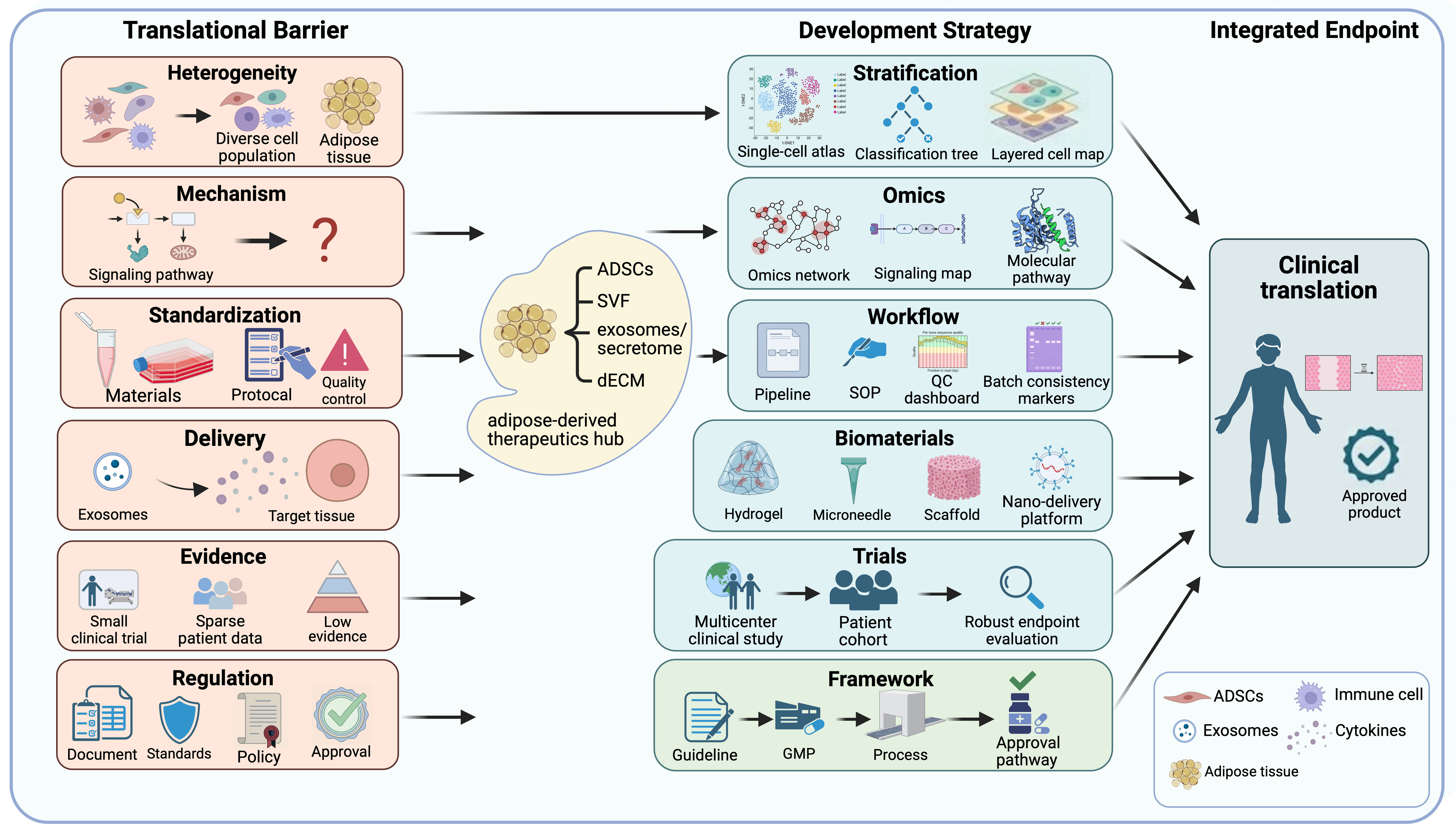
Figure 4. Key barriers and developmental pathways for the clinical translation of adipose-derived therapeutics. The clinical translation of adipose-derived therapeutics is mainly constrained by heterogeneity, incomplete mechanistic understanding, insufficient standardization, limited delivery efficiency, weak clinical evidence, and unclear regulatory pathways. To address these issues, progress is needed in stratified characterization, multi-omics-based mechanistic studies, standardized manufacturing and quality control systems, biomaterial-assisted delivery, multicenter clinical studies, and translational/regulatory framework development, ultimately enabling the standardized clinical application of adipose-derived therapeutics. Created in BioRender. Lu, R. (2026) https://BioRender.com/oer6jwb. ADSCs: Adipose-derived stem cells; SVF: stromal vascular fraction; dECM: decellularized extracellular matrix; SOP: standard operating procedure; GMP: good manufacturing practice.
Deepening mechanistic studies and advancing stratified characterization
Future research should move beyond merely “observing efficacy” toward “deciphering mechanisms”. In particular, single-cell omics, spatial transcriptomics, proteomics, and functional validation approaches should be used to identify the key cellular subpopulations, secreted cargos, and signaling pathways that truly determine therapeutic effects in adipose tissue[14,20]. This direction directly addresses the problems of “definition, heterogeneity, and unclear mechanisms”, and will also help establish functional stratification and indication matching for different adipose-derived therapeutics at a deeper level. Only when mechanistic understanding becomes clearer can adipose-derived therapeutics truly move from empirical use toward precision design.
Strengthening cell-free therapy and integration with functional biomaterials
Exosomes and secretome represent one of the most promising future directions in adipose-derived therapeutics. Future efforts should focus on screening functional cargos of exosomes, constructing engineered exosomes, developing artificial exosomes or biomimetic vesicles, and improving the standardization and translational feasibility of cell-free therapeutic systems[13,35]. At the same time, combining adipose-derived therapeutics with hydrogels, dECM, microneedles, nano-delivery systems, and multifunctional scaffolds will be an important way to improve local retention, treatment durability, targeted control, and niche reconstruction. These integrated systems may be particularly useful for products with limited in vivo persistence, such as exosomes and secretome, and for indications requiring both biological signaling and structural support, such as chronic wounds, radiation-induced injury, and soft tissue reconstruction[7,9,35,59,101]. These two directions are highly consistent in essence: the former emphasizes “optimization of product form”, while the latter emphasizes “optimization of delivery systems”, and both serve the goal of improving in vivo utilization and local therapeutic performance. A major future trend in regenerative medicine is not the isolated development of any single adipose-derived product, but the construction of composite therapeutic systems centered on adipose-derived therapeutics and supported by functional biomaterials.
Tissue-level reprogramming and organoid construction from adipose tissue: a new frontier in adipose-derived bioactive therapy
Beyond conventional cellular, secretory, and matrix-derived products, recent studies suggest that adipose tissue itself may also serve as a direct source for tissue-level reprogramming and organoid construction. Huang et al. reported that reaggregated microfat (RMF), generated from adult human adipose tissue through mechanical processing and suspension culture, could differentiate into functional organoids and tissue-like constructs representing all three germ layers without single-cell isolation, long-term in vitro expansion, or genetic manipulation[110]. These included bone marrow organoids capable of supporting human hematopoiesis, insulin-producing islet organoids that reversed hyperglycemia in streptozotocin-induced diabetic mice, and neural-like tissues expressing neuronal and neuroglial markers[110]. These findings suggest that adipose tissue, when preserving a certain degree of structural integrity and microenvironmental information, may not only serve as a source of ADSCs, SVF, exosomes, and dECM, but may also function as a tissue-level reprogramming platform, thereby extending adipose-derived bioactive therapy from “structural filling and microenvironmental regulation” toward “organoid construction and functional replacement[111]”.
Conceptually, this emerging direction extends the scope of microenvironment remodeling. If ADSCs, SVF, exosomes, and dECM mainly act by regulating cell behavior, paracrine communication, and matrix support, tissue-level direct reprogramming implies that adipose-derived therapeutics may eventually enter a stage of organized tissue construction[112]. This may be particularly relevant in settings requiring complex tissue replacement, long-term functional restoration, or disease modeling, where strategies that preserve tissue integrity and exploit native-like niche signals could complement conventional single-cell-based induction routes.
Nevertheless, this field remains at an early exploratory stage. Differentiation efficiency, long-term safety, functional stability, batch consistency, clinical indication selection, and regulatory classification still require further investigation. If future studies achieve progress in source standardization, reprogramming optimization, long-term functional evaluation, and compliant manufacturing systems, direct organoid generation from adipose tissue may become a highly innovative extension of adipose-derived therapeutic strategies.
Advancing product-specific quality control and risk-based regulatory translation
Future translation should move beyond applying a single standardized framework uniformly across all adipose-derived therapeutics. Because fat grafting-related preparations, ADSCs, SVF, EVs, secretome, dECM, and combination products differ substantially in composition, degree of manipulation, mechanism of action, and risk profile, each category requires product-specific critical quality attributes, release criteria, potency assays, and safety-monitoring strategies[15,20,75]. For conventional fat grafting and mechanically processed adipose products, priorities include procedural standardization, tissue-source traceability, processing consistency, infection control, and indication-specific imaging follow-up[15,75]. For ADSCs, key requirements include cell identity, purity, viability, predefined passage limits, genomic stability, sterility, and indication-relevant potency assays[25,75,97]. SVF requires clear differentiation between mechanical and enzymatic processing, together with assessment of cellular composition, viable cell yield, processing reproducibility, residual enzymes, sterility, and endotoxin levels[26-28]. EVs and secretome require precise product definition, purity and impurity assessment, dose specification, cargo and batch consistency, storage stability, and validated potency assays[15,35,79,80,107]. For dECM, translational priorities include decellularization and delipidation efficiency, residual-component testing, preservation of matrix structure and bioactivity, mechanical and degradation properties, and batch consistency[55,60]. Combination products should be evaluated both at the level of their individual components and as final assembled therapeutic products, with particular attention to loading efficiency, release kinetics, material degradation, sterility, stability, and component interactions[7,9,53,101]. These priorities should be regarded as areas requiring further validation and regulatory alignment rather than as established or jurisdiction-independent regulatory standards.
On this basis, priority clinical translation should focus on indications characterized by localized pathology, measurable clinical outcomes, and substantial unmet needs. Chronic wounds are particularly suitable for early translation because wound closure, healing time, perfusion, recurrence, and adverse events can be evaluated using relatively direct clinical endpoints[34]. Radiation-induced injury and fibrotic diseases also represent important targets because adipose-derived products may simultaneously address inflammation, vascular impairment, fibrosis, and microenvironmental dysfunction[1,36,77,90]. Breast reconstruction and other reconstructive applications provide clinically relevant settings for evaluating recipient-site quality, tissue pliability, graft retention, contour improvement, and long-term safety[1,90]. Skin regeneration and rejuvenation may offer accessible local-delivery and follow-up models, although their clinical endpoints and safety assessment require greater standardization. Future studies should combine product-specific manufacturing and release criteria with multicenter clinical designs, standardized indication-specific endpoints, predefined safety monitoring, and sufficiently long follow-up. Such an approach may generate evidence that is more reproducible, comparable, and clinically generalizable while avoiding premature expansion into poorly defined applications.
CONCLUSION
Adipose-derived products constitute the principal cellular, secretory, and matrix-based components through which adipose tissue exerts regenerative and reparative effects. Together, they are shifting the clinical use of adipose tissue from simple volume restoration toward microenvironment remodeling and regenerative regulation. However, these products are not interchangeable, and no single product has demonstrated consistent superiority across indications. Conventional fat grafting currently has the strongest clinical foundation for volume restoration and contour correction; SVF offers greater feasibility for rapid autologous point-of-care use; ADSCs are better suited for controlled cell-product development but involve greater manufacturing and regulatory complexity; exosomes and secretome provide promising cell-free and engineerable strategies but remain supported mainly by preclinical or early clinical evidence; and dECM is most appropriately positioned as a tissue-specific scaffold or delivery platform.
Accordingly, the clinical value of adipose-derived therapeutics should be judged according to the target indication, therapeutic objective, evidence maturity, delivery feasibility, manufacturing requirements, and safety burden rather than product origin or presumed biological superiority. Overall, the field remains in a critical transition from heterogeneous experimental interventions to standardized therapeutic products. Further progress will require indication-specific comparative studies, reproducible manufacturing and quality-control systems, validated potency and release criteria, optimized delivery strategies, risk-based regulatory pathways, and long-term clinical safety evaluation. Addressing these priorities may enable adipose-derived therapeutics to progress toward more precise, reproducible, and clinically applicable bioactive therapies in plastic/reconstructive surgery and regenerative medicine.
DECLARATIONS
Acknowledgments
The Graphical Abstract was created in BioRender. Lu, R. (2026) https://BioRender.com/te39tfq.
Authors’ contributions
Made substantial contributions to the conception and design of the review: Lu L, Lu C, Dong Z
Performed literature search and manuscript drafting: Lu L, Lu C
Contributed to manuscript revision and intellectual content: Dong Z
Supervised the study and critically revised the manuscript: Dong Z
All authors read and approved the final manuscript.
Availability of data and materials
Not applicable.
AI and AI-assisted tools statement
Not applicable.
Financial support and sponsorship
This work was supported by the National Natural Science Foundation of China (82372543, 82572909) and the Guangdong College Students’ Science and Technology Innovation Cultivation Special Fund Project (pdjh2024a089).
Conflicts of interest
All authors declared that there are no conflicts of interest.
Ethical approval and consent to participate
Not applicable.
Consent for publication
Not applicable.
Copyright
© The Author(s) 2026.
Supplementary Materials
REFERENCES
1. Liu J, Wang J, Zhang Q, Lu F, Cai J. Clinical, histologic, and transcriptomic evaluation of sequential fat grafting for morphea: a nonrandomized controlled trial. JAMA Dermatol. 2024;160:425-33.
2. Yang S, Sun Y, Yan C. Recent advances in the use of extracellular vesicles from adipose-derived stem cells for regenerative medical therapeutics. J Nanobiotechnology. 2024;22:316.
3. Feng H, Gong S, Liu J, et al. Adipose-derived stem cell exosomes: mechanisms and therapeutic potentials in wound healing. Biomark Res. 2025;13:88.
4. Qin Y, Ge G, Yang P, et al. An update on adipose-derived stem cells for regenerative medicine: where challenge meets opportunity. Adv Sci. 2023;10:e2207334.
5. Cui L, Lyu TJ, Fu B, et al. Advances and challenges in decellularized adipose tissue based composite hydrogels for adipose tissue regeneration: a review over the last fifteen years. Theranostics. 2025;15:9508-32.
6. Mehta MKS, Englander HE, Rao A, Jarostchuk N, Giatsidis G. Acellular adipose matrices seem to be an effective and safe strategy for soft tissue regeneration and volume restoration: a systematic review of clinically relevant literature. Adv Wound Care. 2025;14:513-27.
7. Zeng R, Xiong Y, Lin Z, et al. Novel cocktail therapy based on multifunctional supramolecular hydrogel targeting immune-angiogenesis-nerve network for enhanced diabetic wound healing. J Nanobiotechnology. 2024;22:749.
8. Zhu L, Yuhan J, Yu H, Zhang B, Huang K, Zhu L. Decellularized extracellular matrix for remodeling bioengineering organoid’s microenvironment. Small. 2023;19:e2207752.
9. Yuan M, Dai X, Yang Y, et al. An injectable BMP-2-releasing porous hydrogel regulating the paracrine effects of ADSCs promotes tendon-to-bone healing in rotator cuff repair. Adv Sci. 2025;12:e15923.
10. Stachura A, Paskal W, Pawlik W, Mazurek MJ, Jaworowski J. The use of adipose-derived stem cells (ADSCs) and stromal vascular fraction (SVF) in skin scar treatment-a systematic review of clinical studies. J Clin Med. 2021;10:3637.
11. Wang Y, Ding H, Bai R, et al. Exosomes from adipose-derived stem cells accelerate wound healing by increasing the release of IL-33 from macrophages. Stem Cell Res Ther. 2025;16:80.
12. Yao WD, Zhou JN, Tang C, et al. Hydrogel microneedle patches loaded with stem cell mitochondria-enriched microvesicles boost the chronic wound healing. ACS Nano. 2024;18:26733-50.
14. Pinheiro-Machado E, Getova VE, Harmsen MC, Burgess JK, Smink AM. Towards standardization of human adipose-derived stromal cells secretomes. Stem Cell Rev Rep. 2023;19:2131-40.
15. Li YJ, Wu JY, Liu J, et al. Artificial exosomes for translational nanomedicine. J Nanobiotechnology. 2021;19:242.
16. Al-Ghadban S, Artiles M, Bunnell BA. Adipose stem cells in regenerative medicine: looking forward. Front Bioeng Biotechnol. 2021;9:837464.
17. Dominici M, Le Blanc K, Mueller I, et al. Minimal criteria for defining multipotent mesenchymal stromal cells. The International Society for Cellular Therapy position statement. Cytotherapy. 2006;8:315-7.
18. Strioga M, Viswanathan S, Darinskas A, Slaby O, Michalek J. Same or not the same? Comparison of adipose tissue-derived versus bone marrow-derived mesenchymal stem and stromal cells. Stem Cells Dev. 2012;21:2724-52.
19. Mohamed-Ahmed S, Fristad I, Lie SA, et al. Adipose-derived and bone marrow mesenchymal stem cells: a donor-matched comparison. Stem Cell Res Ther. 2018;9:168.
20. Trzyna A, Banaś-Ząbczyk A. Adipose-derived stem cells secretome and its potential application in “stem cell-free therapy”. Biomolecules. 2021;11:878.
21. Hutchings G, Janowicz K, Moncrieff L, et al. The proliferation and differentiation of adipose-derived stem cells in neovascularization and angiogenesis. Int J Mol Sci. 2020;21:3790.
22. Li ZJ, Wang LQ, Li YZ, et al. Application of adipose-derived stem cells in treating fibrosis. World J Stem Cells. 2021;13:1747-61.
23. Mazini L, Rochette L, Admou B, Amal S, Malka G. Hopes and limits of adipose-derived stem cells (ADSCs) and mesenchymal stem cells (MSCs) in wound healing. IJMS. 2020;21:1306.
24. Xie Y, Ni X, Wan X, et al. KLF5 enhances CXCL12 transcription in adipose-derived stem cells to promote endothelial progenitor cells neovascularization and accelerate diabetic wound healing. Cell Mol Biol Lett. 2025;30:24.
25. Su H, Chau H, Li Q, et al. Bridging the gap: clinical translation of adipose-derived stem cells - a scoping review of clinical trials. Stem Cell Res Ther. 2025;16:288.
26. Goncharov EN, Koval OA, Igorevich EI, et al. Analyzing the clinical potential of stromal vascular fraction: a comprehensive literature review. Medicina. 2024;60:221.
27. Gandolfi S, Pileyre B, Drouot L, Dubus I, Auquit-Auckbur I, Martinet J. Stromal vascular fraction in the treatment of myositis. Cell Death Discov. 2023;9:346.
28. Wu J, Wang Y, Chen W, et al. Harnessing stromal vascular fraction-based therapies for wound healing: mechanisms, synergies, and clinical translation. Regen Ther. 2025;30:692-709.
29. Gentile P, Sterodimas A, Pizzicannella J, et al. Systematic review: allogenic use of stromal vascular fraction (SVF) and decellularized extracellular matrices (ECM) as advanced therapy medicinal products (ATMP) in tissue regeneration. Int J Mol Sci. 2020;21:4982.
30. Carstens MH, Quintana FJ, Calderwood ST, et al. Treatment of chronic diabetic foot ulcers with adipose-derived stromal vascular fraction cell injections: Safety and evidence of efficacy at 1 year. Stem Cells Transl Med. 2021;10:1138-47.
31. Daumas A, Magalon J, Jouve E, et al. Adipose tissue-derived stromal vascular fraction for treating hands of patients with systemic sclerosis: a multicentre randomized trial Autologous AD-SVF versus placebo in systemic sclerosis. Rheumatology. 2022;61:1936-47.
32. Quan Y, Wang J, Lu F, Yuan Y, Cai J. Sequential grafting of fresh and cryopreserved fat after mechanical processing is a safe and effective facial rejuvenation strategy. Aesthetic Plast Surg. 2022;46:1432-8.
33. Yokota N, Hattori M, Ohtsuru T, et al. Comparative clinical outcomes after intra-articular injection with adipose-derived cultured stem cells or noncultured stromal vascular fraction for the treatment of knee osteoarthritis. Am J Sports Med. 2019;47:2577-83.
34. Yokota N, Lyman S, Hanai H, Shimomura K, Ando W, Nakamura N. Clinical safety and effectiveness of adipose-derived stromal cell vs stromal vascular fraction injection for treatment of knee osteoarthritis: 2-year results of parallel single-arm trials. Am J Sports Med. 2022;50:2659-68.
35. Zia S, Roda B, Zannini C, et al. Quality control platform for the standardization of a regenerative medicine product. Bioengineering. 2022;9:142.
36. Zhou C, Zhang B, Yang Y, et al. Stem cell-derived exosomes: emerging therapeutic opportunities for wound healing. Stem Cell Res Ther. 2023;14:107.
37. Cai Y, Li J, Jia C, He Y, Deng C. Therapeutic applications of adipose cell-free derivatives: a review. Stem Cell Res Ther. 2020;11:312.
38. Li Y, Zhang J, Shi J, et al. Exosomes derived from human adipose mesenchymal stem cells attenuate hypertrophic scar fibrosis by miR-192-5p/IL-17RA/Smad axis. Stem Cell Res Ther. 2021;12:221.
39. Pi L, Yang L, Fang BR, Meng XX, Qian L. Exosomal microRNA-125a-3p from human adipose-derived mesenchymal stem cells promotes angiogenesis of wound healing through inhibiting PTEN. Mol Cell Biochem. 2022;477:115-27.
40. Liu C, Khairullina L, Qin Y, Zhang Y, Xiao Z. Adipose stem cell exosomes promote mitochondrial autophagy through the PI3K/AKT/mTOR pathway to alleviate keloids. Stem Cell Res Ther. 2024;15:305.
41. Sendera A, Kubis H, Pałka A, Banaś-Ząbczyk A. Therapeutic and clinical potential of adipose-derived stem cell secretome for skin regeneration. Cells. 2025;14:1727.
42. Tao Y, Liu T, Jing F, et al. Adipose-derived stem-cell-derived exosomes encapsulated patch for modulating inflammation and promoting tissue regeneration. ACS Nano. 2025;19:21271-89.
43. Mao J, Qian S, Zhao Q, et al. Balancing macrophage polarization via stem cell-derived apoptotic bodies for diabetic wound healing. Med. 2024;5:148-68.e8.
44. Prado-Yupanqui JW, Ramírez-Orrego L, Cortez D, et al. The hidden power of the secretome: therapeutic potential on wound healing and cell-free regenerative medicine-a systematic review. Int J Mol Sci. 2025;26:1926.
45. Wan X, Ni X, Xie Y, et al. Research progress and application prospect of adipose-derived stem cell secretome in diabetes foot ulcers healing. Stem Cell Res Ther. 2024;15:279.
46. Ren H, Su P, Zhao F, et al. Adipose mesenchymal stem cell-derived exosomes promote skin wound healing in diabetic mice by regulating epidermal autophagy. Burns Trauma. 2024;12:tkae001.
47. Zhao H, Yang K, Wang X, et al. Preconditioning strategies for stem cells and exosomes: Transformative potential in diabetic wound treatment: a review. Int J Biol Macromol. 2026;338:149504.
48. Yu F, Zhao X, Wang Q, et al. Engineered mesenchymal stromal cell exosomes-loaded microneedles improve corneal healing after chemical injury. ACS Nano. 2024;Epub ahead of print.
49. Ding Y, Wang J, Li J, et al. Tβ4-engineered ADSC extracellular vesicles rescue cell senescence through separable microneedle patches for diabetic wound healing. Adv Sci. 2025;12:e2505009.
50. Liu X, Teng X, Wang J, et al. Exosome-based mucosal therapeutic and diagnostic system: towards clinical translation. J Control Release. 2025;385:113966.
51. Liu H, Dong T, Dong C, et al. Plant-derived exosome-like nanovesicles: a novel therapeutic perspective for skin diseases. J Nanobiotechnology. 2025;23:640.
52. Song Y, Wang F, Xia J, et al. Bioactivity and multi-omics profiling of purslane-derived nanovesicles with therapeutic implications in diabetic wounds. J Adv Res. 2025;Epub ahead of print.
53. Lu Z, Chen H, Chang H, et al. Therapeutic effects of mesenchymal stem cells and their secretomes (extracellular vesicles) with bone-implant scaffolds for bone regeneration: a systematic review and network meta-analysis of preclinical studies. Acta Biomater. 2026;213:88-102.
54. Li Q, Yu H, Zhao F, et al. 3D printing of microenvironment-specific bioinspired and exosome-reinforced hydrogel scaffolds for efficient cartilage and subchondral bone regeneration. Adv Sci. 2023;10:e2303650.
55. Zhang X, Chen X, Hong H, Hu R, Liu J, Liu C. Decellularized extracellular matrix scaffolds: Recent trends and emerging strategies in tissue engineering. Bioact Mater. 2022;10:15-31.
56. Golebiowska AA, Intravaia JT, Sathe VM, Kumbar SG, Nukavarapu SP. Decellularized extracellular matrix biomaterials for regenerative therapies: advances, challenges and clinical prospects. Bioact Mater. 2024;32:98-123.
57. Zhou J, Jiang S, Wang L, et al. Decellularized adipose matrix rejuvenates photoaged skin through immune microenvironment modulation. BME Front. 2025;6:0166.
58. Liu J, Song Q, Yin W, et al. Bioactive scaffolds for tissue engineering: a review of decellularized extracellular matrix applications and innovations. Exploration. 2025;5:20230078.
59. Laude M, Kolliopoulos V, Mikos AG, White LJ, Cosgriff-Hernandez E. Extracellular-matrix-based materials from decellularized tissue: opportunities, challenges, and future directions in regenerative medicine. Adv Healthc Mater. 2026;15:e02107.
60. Savitri C, Park HS, Kim Y, et al. Immunomodulatory role of decellularized extracellular matrix in skin wound healing. Mater Today Bio. 2026;36:102672.
61. Polyakova E, de Haan MJA, van Gils JM, et al. Biological tissue engineering for Fontan failure using decellularized extracellular matrix: a systematic review. J Transl Med. 2026;24:534.
62. Wang Y, Zhang Y, Zhou L, et al. ADSC-derived extracellular vesicles loaded with VEGF mRNA delivered by antibacterial hydrogel promote angiogenesis and reconstruction of prefabricated flaps. Small. 2025;21:e08210.
63. Zeng X, Gan J, Huang D, Zhao Y, Sun L. Recombinant human collagen hydrogels with different stem cell-derived exosomes encapsulation for wound treatment. J Nanobiotechnology. 2025;23:241.
64. Li M, Tian Y, Wang X, et al. Exosomes derived from adipose-derived stem cells alleviate acute radiation-induced dermatitis through up-regulating hyaluronic acid synthase 1 expression. Stem Cell Res Ther. 2025;16:253.
65. Kang R, Shin S, Choi Y, et al. Bioengineered skin grafts from patient-derived decellularized extracellular matrix and autologous cells for personalized regenerative. Adv Sci. 2025;12:e11889.
66. Gong Y, Ma H, Zheng Z, Wang X, Zhang J, Zhao X. Adipose-derived stem cell exosomes: emerging roles and therapeutic application. Front Pharmacol. 2025;16:1637342.
67. Li J, Ke H, Wu D, et al. Bilayer book- like decellularized extracellular matrix scaffold with bioactive coatings for rotator cuff repair. Mater Today Bio. 2025;33:102038.
68. Moriyama M, Sahara S, Zaiki K, et al. Adipose-derived stromal/stem cells improve epidermal homeostasis. Sci Rep. 2019;9:18371.
69. Wang C, Wang M, Xu T, et al. Engineering bioactive self-healing antibacterial exosomes hydrogel for promoting chronic diabetic wound healing and complete skin regeneration. Theranostics. 2019;9:65-76.
70. Özsezer G, Arslan YE. Immunomodulatory tissue-engineering strategies for diabetic foot ulcer management: a systematic review. Wound Repair Regen. 2026;34:e70149.
71. Kishta MS, Hafez AM, Hydara T, et al. The transforming role of wharton's jelly mesenchymal stem cell-derived exosomes for diabetic foot ulcer healing: a randomized controlled clinical trial. Stem Cell Res Ther. 2025;16:559.
72. Meng Y, Sun J, Ma Y, Kong C. Exo-hydrogel therapy: a revolutionary approach to managing diabetic complications. J Nanobiotechnology. 2025;23:558.
73. Wang B, Ren Y, Xiao X, Liu X, Wang Y, Wang Y. An emerging MSC-exosome delivery strategy: injectable temperature-sensitive hydrogels encapsulate exosomes for enhanced therapeutic efficacy. Drug Discov Today. 2026;31:104586.
74. Jafarzadeh A, Pour Mohammad A, Keramati H, Zeinali R, Khosravi M, Goodarzi A. Regenerative medicine in the treatment of specific dermatologic disorders: a systematic review of randomized controlled clinical trials. Stem Cell Res Ther. 2024;15:176.
75. Kostecka A, Kalamon N, Skoniecka A, et al. Adipose-derived mesenchymal stromal cells in clinical trials: insights from single-cell studies. Life Sci. 2024;351:122761.
76. Khanna D, Caldron P, Martin RW, et al. Adipose-derived regenerative cell transplantation for the treatment of hand dysfunction in systemic sclerosis: a randomized clinical trial. Arthritis Rheumatol. 2022;74:1399-408.
77. van Dongen JA, van Boxtel J, Uguten M, et al. Tissue stromal vascular fraction improves early scar healing: a prospective randomized multicenter clinical trial. Aesthet Surg J. 2022;42:NP477-88.
78. Chen S, He Z, Xu J. Application of adipose-derived stem cells in photoaging: basic science and literature review. Stem Cell Res Ther. 2020;11:491.
79. Greening DW, Xu R, Rai A, Suwakulsiri W, Chen M, Simpson RJ. Clinical relevance of extracellular vesicles in cancer - therapeutic and diagnostic potential. Nat Rev Clin Oncol. 2025;22:924-52.
80. Dave KM, Pinky PP, S Manickam D. Molecular engineering of extracellular vesicles for drug delivery: Strategies, challenges, and perspectives. J Control Release. 2025;386:114068.
81. Zhang H, Xiao X, Wang L, et al. Human adipose and umbilical cord mesenchymal stem cell-derived extracellular vesicles mitigate photoaging via TIMP1/Notch1. Signal Transduct Target Ther. 2024;9:294.
82. Li AN, Sun JH, Saidin S, et al. Regenerative potential nanomedicine of adipocyte stem cell-derived exosomes in senescent skin tissue. Int J Nanomedicine. 2024;19:13149-63.
83. Liu YX, Sun JM, Ho CK, et al. Advancements in adipose-derived stem cell therapy for skin fibrosis. World J Stem Cells. 2023;15:342-53.
84. Zawrzykraj M, Deptuła M, Kondej K, Tymińska A, Pikuła M. The effect of chemotherapy and radiotherapy on stem cells and wound healing. Current perspectives and challenges for cell-based therapies. Biomed Pharmacother. 2023;168:115781.
85. Liang C, Yi Y, Li J, et al. Unveiling exosomes in combating skin aging: insights into resources, mechanisms and challenges. Stem Cell Res Ther. 2025;16:474.
86. Nguyen DDN, Vu DM, Vo N, et al. Skin rejuvenation and photoaging protection using adipose-derived stem cell extracellular vesicles loaded with exogenous cargos. Skin Res Technol. 2024;30:e13599.
87. Wang YW, Tan PC, Li QF, Xu XW, Zhou SB. Adipose tissue protects against skin photodamage through CD151- and AdipoQ- EVs. Cell Commun Signal. 2024;22:594.
88. Estupiñan B, Ly K, Goldberg DJ. Adipose mesenchymal stem cell-derived exosomes versus platelet-rich plasma treatment for photoaged facial skin: an investigator-blinded, split-face, non-inferiority trial. J Cosmet Dermatol. 2025;24:e70208.
89. Adem S, Abbas DB, Lavin CV, et al. Decellularized adipose matrices can alleviate radiation-induced skin fibrosis. Adv Wound Care. 2022;11:524-36.
90. Burke OM, Bilik SM, Dodson C, et al. Radiotherapy-induced skin fibrosis: pathophysiology, emerging therapeutics, and the role of dermatology. Am J Clin Dermatol. 2026;27:297-316.
91. Liu Z, Gu J, Gao Y, Hu H, Jiang H. ADSC-derived exosomes mitigate radiation-induced skin injury by reducing oxidative stress, inflammation and cell death. Front Public Health. 2025;13:1603431.
92. Berry CE, Brenac C, Kendig C, et al. Prophylactic decellularized adipose matrix treatment mitigates development of radiation-induced cutaneous fibrosis. Ann Plast Surg. 2025;94:688-94.
93. Golara A, Kozłowski M, Lubikowski J, Cymbaluk-Płoska A. Types of breast cancer surgery and breast reconstruction. Cancers. 2024;16:3212.
94. Begic A, Tolli J, Hegard W, Stark B. Secondary breast reconstruction in irradiated patients: prospective trial comparing DIEP to brava expansion and fat transplantation. Plast Reconstr Surg. 2023;152:205e-16.
95. Shimizu Y, Inoue Y, Sowa Y, et al. Adipose-derived stem cell-enhanced versus conventional fat grafting for breast reconstruction: a systematic review and meta-analysis. Plast Reconstr Surg. 2026;157:338e-49.
96. Morel SBA, Vranis N, Perez J, Nikolis A, Ghavami A, Safran T. Current applications and indications of allograft adipose matrix: a systematic review. Plast Reconstr Surg. 2026;157:658-65.
97. Vester-Glowinski PV, Herly M, Ørholt M, et al. Fat grafting with expanded adipose-derived stromal cells for breast augmentation: a randomized controlled trial. Aesthet Surg J. 2022;42:1279-89.
98. Wufuer M, Choi TH, Najmiddinov B, et al. Improving facial fat graft survival using stromal vascular fraction-enriched lipotransfer: a multicenter randomized controlled study. Plast Reconstr Surg. 2024;153:690e-700.
99. Gold MH, Kinney BM, Kaminer MS, Rohrich RJ, D’Amico RA. A multi-center, open-label, pilot study of allograft adipose matrix for the correction of atrophic temples. J Cosmet Dermatol. 2020;19:1044-56.
100. Piatkowski AA, Wederfoort JLM, Hommes JE, et al. ; Breast Reconstruction With External Preexpansion & Autologous Fat Transfer vs Standard Therapy (BREAST) Trial Investigators. Effect of total breast reconstruction with autologous fat transfer using an expansion device vs implants on quality of life among patients with breast cancer: a randomized clinical trial. JAMA Surg. 2023;158:456-64.
101. Liu W, Liu Q, Li Z, et al. Multifunctional magneto-electric and exosome-loaded hydrogel enhances neuronal differentiation and immunoregulation through remote non-invasive electrical stimulation for neurological recovery after spinal cord injury. Bioact Mater. 2025;48:510-28.
102. Li W, Gao X, Zhang P. Modulating cell-scaffold interaction via dECM-decorated melt electrowriting PCL scaffolds. Polymers. 2025;17:3133.
103. Kuo PJ, Rau CS, Hsieh CH. Advances in stem cell-derived exosome therapy for radiation-induced skin injury. Int J Surg. 2025;111:8336-48.
104. Fecskeova LK, Matejova J, Slovinska L, Bzdilova J, Kozovská Z, Harvanova D. Chorion tissue- and plasma-derived extracellular vesicles exhibit superior anti-inflammatory and chondroprotective effects. Stem Cell Res Ther. 2025;16:423.
105. Lian L, Xie M, Luo Z, et al. Rapid volumetric bioprinting of decellularized extracellular matrix bioinks. Adv Mater. 2024;36:e2304846.
106. Liu W, Zhang X, Jiang X, Dai B, Zhang L, Zhu Y. Decellularized extracellular matrix materials for treatment of ischemic cardiomyopathy. Bioact Mater. 2024;33:460-82.
107. Xu G, Jin J, Fu Z, et al. Extracellular vesicle-based drug overview: research landscape, quality control and nonclinical evaluation strategies. Signal Transduct Target Ther. 2025;10:255.
108. Han X, Liao R, Li X, et al. Mesenchymal stem cells in treating human diseases: molecular mechanisms and clinical studies. Signal Transduct Target Ther. 2025;10:262.
109. Thamm OC, Eschborn J, Zimmermann L, et al. Sublesional fat grafting leads to a temporary improvement of wound healing in chronic leg ulcers: a prospective, randomised clinical trial. Wound Repair Regen. 2023;31:663-70.
110. Huang R, Yang J, Yan Y, et al. Direct differentiation of human adult adipose tissue into multilineage functional organoids. Engineering. 2025;53:286-300.
111. Dahdah N, Tercero-Alcázar C, Malagón MM, Garcia-Roves PM, Guzmán-Ruiz R. Interrelation of adipose tissue macrophages and fibrosis in obesity. Biochem Pharmacol. 2024;225:116324.
112. Hade MD, Suire CN, Suo Z. Mesenchymal stem cell-derived exosomes: applications in regenerative medicine. Cells. 2021;10:1959.
113. Matsuo Y, Morita H, Yamagishi H, et al. Isolation of adipose tissue-derived stem cells by direct membrane migration and expansion for clinical application. Hum Cell. 2021;34:819-24.
114. Ma X, Yue Q, Fu S, Liu C, Luan J. Decellularized adipose-derived matrix from Superficial layers of abdominal adipose tissue exhibits superior capacity of adipogenesis compared to deep layers. Mater Today Bio. 2024;28:101235.
115. Chen Z, Zhang B, Shu J, et al. Human decellularized adipose matrix derived hydrogel assists mesenchymal stem cells delivery and accelerates chronic wound healing. J Biomed Mater Res A. 2021;109:1418-28.
116. Yu W, Wang Z, Dai Y, et al. Autologous fat grafting for postoperative breast reconstruction: a systemic review. Regen Ther. 2024;26:1010-7.
Cite This Article
 Open Access
How to Cite
Download Citation
Export Citation File:
Type of Import
Tips on Downloading Citation
Citation Manager File Format
Type of Import
Direct Import: When the Direct Import option is selected (the default state), a dialogue box will give you the option to Save or Open the downloaded citation data. Choosing Open will either launch your citation manager or give you a choice of applications with which to use the metadata. The Save option saves the file locally for later use.
Indirect Import: When the Indirect Import option is selected, the metadata is displayed and may be copied and pasted as needed.
About This Article
Copyright

Data & Comments
Data
0






Comments
Comments must be written in English. Spam, offensive content, impersonation, and private information will not be permitted. If any comment is reported and identified as inappropriate content by OAE staff, the comment will be removed without notice. If you have any queries or need any help, please contact us at support@oaepublish.com.