

The gut microbiome and the pathogenesis of trans-arterial chemoembolization-associated liver injury
 0
0 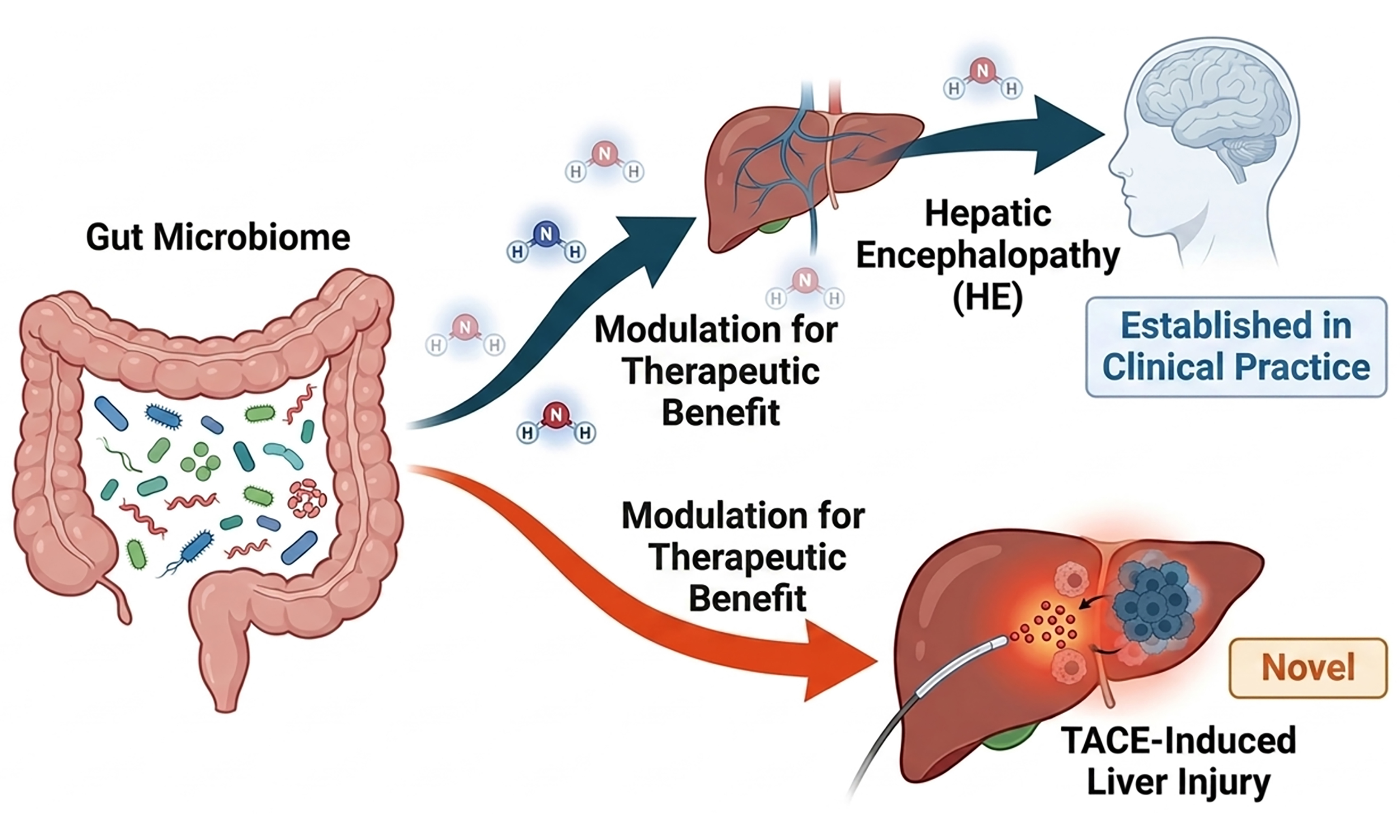


 Download PDF
Liver cancer, of which hepatocellular carcinoma (HCC) comprises about 90%, is the sixth most common malignancy and the third leading cause of cancer-related mortality worldwide[1,2]. In patients with HCC confined to the liver who are unsuitable for surgical resection or transplantation, locoregional therapies represent the mainstay of treatment. Trans-arterial chemoembolization (TACE) is one such modality, offering simultaneous ischaemic necrosis of the tumour and local chemotherapy. Despite its therapeutic benefits, liver injury attributed to off-target hepatocyte ischaemia and regional chemotherapy toxicity is the most common adverse event following TACE (TACE-LI)[3]. As repeated TACE sessions are often required for sustained tumour control, the development of TACE-LI may preclude further sessions and compromise overall efficacy[4]. Dysbiosis of the gut microbiome has been implicated in the progression of HCC[5]. Mechanistically, microbial products may promote hepatocarcinogenesis through chronic inflammation, immune dysregulation and suppression of anti-tumour immunity via the gut-liver axis[6]. Specific microbial signatures, including increased Enterococcaceae and Enterobacteriaceae and reduced Bifidobacteriaceae, have been proposed as biomarkers of dysbiosis in HCC[6]. Furthermore, dysbiosis may foster an immunosuppressive tumour microenvironment via toll-like receptor 4 (TLR4)-mediated expansion of myeloid-derived suppressor cells and inhibition of T-cell activity[7]. Conversely, a balanced microbiome appears to support anti-tumour immunity via cytotoxic T-cells and natural killer cell activation[8]. Gut microbiome modulation has been successfully used as part of the treatment armamentarium in decompensated cirrhosis and collectively, these new findings identify the gut microbiome as a potential therapeutic target in HCC through strategies including probiotics, synbiotics, and faecal microbiota transplantation[9,10]
In this context, Li et al. present an interesting study on the pathogenesis of TACE-LI, focusing on disturbance of the gut microbiome, specifically depletion of Limosilactobacillus reuteri (L. reuteri) and its tryptophan metabolite indole-3-lactic acid (ILA) in an experimental animal model[11]. These findings build on evidence that certain post-TACE gut microbial alterations correlate with improved intestinal barrier function and reduced lipopolysaccharide (LPS)-mediated TLR4 and cyclooxygenase-2 (COX-2) signalling, suggesting TACE benefits may be partially mediated through gut microbial restoration, rather than solely through tumour devascularization and chemotoxicity[12]. Conversely, TACE-related ischaemia in the acute post-procedural period can transiently disrupt gut barrier integrity and worsen dysbiosis, especially in pre-existing cirrhosis. This may amplify the inflammatory cascade and systemic LPS burden in the short term, a vulnerability which Li et al. highlight through their description of the L. reuteri-ILA axis in TACE-LI[11-13]. In particular, Li et al. propose a novel pathway whereby the L. reuteri-ILA axis exerts hepatoprotective effects through inhibition of macrophage-driven inflammation. Mechanistically, Li et al. show that L. reuteri uses the enzyme phenyllactate dehydrogenase (fldH) to convert tryptophan into ILA, which binds the adenosine triphosphate (ATP)-binding pocket of heat shock protein 90 (HSP90) and inhibits its adenosine triphosphatase (ATPase) activity. This prevents HSP90 from stabilising NOD-, LRR- and pyrin domain-containing protein 3 (NLRP3) in hepatic macrophages, reducing formation of the HSP90-NLRP3 inflammasome complex and downstream pro-inflammatory cytokine release. Depleting hepatic macrophages, or selectively silencing HSP90 within them, abolishes the protective effects of both L. reuteri and ILA, confirming hepatic macrophages as the key cell type through which this pathway limits TACE-LI[11]. Li et al. substantiate this paradigm using a robust, multi-layered experimental framework spanning germ-free (GF) rat models, human-to-rat faecal microbiota transplantation, multi-omics profiling, genetically engineered probiotic strains, macrophage-targeted nanotherapeutics and a large retrospective clinical cohort[11]. Taken together, this multi-dimensional experimental design lends strong support to the hypothesis that gut microbial homeostasis is a critical and under-recognised regulatory factor of TACE-LI.
Li et al. demonstrate that reduced pre-TACE levels of L. reuteri and ILA are associated with increased severity of TACE-LI and poorer overall survival[11]. Using retrospective clinical cohort data from 145 TACE-treated patients, Li et al. verify that higher pre-procedural L. reuteri abundance and elevated ILA levels independently correlate with milder post-procedural liver injury, faster hepatic function recovery and prolonged overall survival, even after adjusting for tumour burden[11]. These findings, observed in a human cohort, suggest that L. reuteri abundance and ILA levels are promising novel biomarkers for pre-intervention risk stratification of TACE-LI and are potential novel therapeutic targets to mitigate TACE-related toxicity. Despite the strong correlation seen within the retrospective cohort, the mechanism by which TACE modulates intestinal microbiota composition remains uncertain and warrants further investigation to elucidate the pathway by which gut dysbiosis contributes to TACE-LI. Follow-up research, ideally in well-designed prospective studies, should clarify these mechanisms, and explore potential driving and confounding factors such as TACE-induced portal hemodynamic changes and bile acid perturbations, before L. reuteri or ILA supplementation can be clinically justified. Notably, the study by Li et al. observed that prophylactic antibiotics may worsen TACE-LI through depletion of beneficial Gram-positive bacteria[11]. This challenges the paradigm in some treatment centres to utilise prophylactic antibiotics to limit bacterial translocation post-TACE, suggesting a need for a more nuanced approach to antimicrobial use in this setting[14].
The reliance on animal models limits the translational applicability of Li et al.’s findings, given known interspecies differences in gut microbiome composition, bile acid metabolism and immune responses[15]. Moreover, substantial inter-individual variability in the human microbiome, shaped by geography, diet and prior antibiotic exposure among other factors, raises questions regarding the generalisability of these findings across diverse patient populations[16]. Prospective, multi-centre human studies will, therefore, be essential to validate the clinical relevance of these findings. Additionally, while the identification of a single microbial species and metabolite provides a mechanistic pathway, it may oversimplify the complexity of the gut microbiome and its full impact on TACE-LI. The observed changes in other bacterial taxa, such as Ruminococcus and Bifidobacteriaceae, suggest that hepatoprotective effects described may represent only one component of a broader gut microbial phenomenon.
In summary, the gut microbiome is emerging as a dynamic and potentially clinically significant factor in HCC pathogenesis and its management. The study by Li et al. represents a substantial advance in our understanding of microbial influences on TACE-LI. Despite the methodological and translational limitations of Li et al.’s findings, targeting the gut microbiome to mitigate TACE-LI represents a novel strategy for an important and currently unmet clinical need, warranting further investigation in appropriately designed clinical trials.
DECLARATIONS
Authors’ contributions
Contributed to the initial draft, writing and editing of the manuscript: Engelman J, Jia K, Riordan SM
Availability of data and materials
Not applicable.
AI and AI-assisted tools statement
During the preparation of this manuscript, the AI tool Figurelabs (version 1.0, released 2026-03-20) was used solely for the Graphical Abstract. The tool did not influence the study design, data collection, analysis, interpretation, or the scientific content of the work. All authors take full responsibility for the accuracy, integrity, and final content of the manuscript.
Financial support and sponsorship
None.
Conflicts of interest
All authors declared that there are no conflicts of interest.
Ethical approval and consent to participate
Not applicable.
Consent for publication
Not applicable.
Copyright
© The Author(s) 2026.
REFERENCES
1. European Association for the Study of the Liver. EASL Clinical Practice Guidelines on the management of hepatocellular carcinoma. J Hepatol. 2025;82:315-74.
2. Jaber F, Cholankeril G, El-Serag HB. Contemporary epidemiology of hepatocellular carcinoma: understanding risk factors and surveillance strategies. J Can Assoc Gastroenterol. 2024;7:331-45.
3. Lencioni R, de Baere T, Soulen MC, Rilling WS, Geschwind J-FH. Lipiodol transarterial chemoembolization for hepatocellular carcinoma: a systematic review of efficacy and safety data. Hepatology. 2016;64:106-16.
4. Li J, Liu Y, Zheng R, Qu C, Li J. Molecular mechanisms of TACE refractoriness: directions for improvement of the TACE procedure. Life Sci. 2024;342:122540.
5. Lapidot Y, Amir A, Nosenko R, et al. Alterations in the gut microbiome in the progression of cirrhosis to hepatocellular carcinoma. mSystems. 2020;5:e00153-20.
6. Zhang N, Gou Y, Liang S, et al. Dysbiosis of gut microbiota promotes hepatocellular carcinoma progression by regulating the immune response. J Immunol Res. 2021;2021:4973589.
7. Schneider KM, Mohs A, Gui W, et al. Imbalanced gut microbiota fuels hepatocellular carcinoma development by shaping the hepatic inflammatory microenvironment. Nat Commun. 2022;13:3964.
8. Huang M, Ji Q, Huang H, Wang X, Wang L. Gut microbiota in hepatocellular carcinoma immunotherapy: immune microenvironment remodeling and gut microbiota modification. Gut Microbes. 2025;17:2486519.
9. Liu Q, Duan ZP, Ha DK, Bengmark S, Kurtovic J, Riordan SM. Synbiotic modulation of gut flora: effect on minimal hepatic encephalopathy in patients with cirrhosis. Hepatology. 2004;39:1441-9.
10. Wang X, Zhang B, Jiang R. Microbiome interplays in the gut-liver axis: implications for liver cancer pathogenesis and therapeutic insights. Front Cell Infect Microbiol. 2025;15:1467197.
11. Li R, Liu J, Ye F, et al. Microbial metabolism dysfunction induced by transarterial chemoembolization aggravates postprocedural liver injury in HCC. J Hepatol. 2026;84:808-22.
12. Bian CF, Wang Y, Yu A, et al. Gut microbiota changes and biological mechanism in hepatocellular carcinoma after transarterial chemoembolization treatment. Front Oncol. 2022;12:1002589.
13. Trebicka J, Macnaughtan J, Schnabl B, Shawcross DL, Bajaj JS. The microbiota in cirrhosis and its role in hepatic decompensation. J Hepatol. 2021;75:S67-81.
14. Wang J, He XD, Zhang YC. Antibiotic prophylaxis in transarterial therapy of hepatocellular carcinoma: a meta-analysis. Can J Gastroenterol. 2012;26:85-91.
Cite This Article
 Open Access
How to Cite
Engelman J, Jia K, Riordan SM. The gut microbiome and the pathogenesis of trans-arterial chemoembolization-associated liver injury. Hepatoma Res. 2026;12:57. https://dx.doi.org/10.20517/2394-5079.2026.61
Download Citation
If you have the appropriate software installed, you can download article citation data to the citation manager of your choice. Simply select your manager software from the list below and click on download.
Export Citation File
Type of Import
Tips on Downloading Citation
Citation Manager File Format
Type of Import
Direct Import: When the Direct Import option is selected (the default state), a dialogue box will give you the option to Save or Open the downloaded citation data. Choosing Open will either launch your citation manager or give you a choice of applications with which to use the metadata. The Save option saves the file locally for later use.
Indirect Import: When the Indirect Import option is selected, the metadata is displayed and may be copied and pasted as needed.
About This Article
Copyright

Data & Comments
Data
0









Comments
Comments must be written in English. Spam, offensive content, impersonation, and private information will not be permitted. If any comment is reported and identified as inappropriate content by OAE staff, the comment will be removed without notice. If you have any queries or need any help, please contact us at support@oaepublish.com.