

MatterChat: how a structure-aware multimodal LLM bridges atomic structures and scientific reasoning in materials science
 0
0 
MAIN TEXT
In recent years, the application of artificial intelligence in materials science has gradually evolved from single-property prediction toward multimodal understanding, materials screening, and research-oriented decision support. In their article A Multimodal Large Language Model for Materials Science, published in Nature Machine Intelligence, Tang et al. proposed MatterChat, a multimodal large language model tailored for materials science[1]. The core contribution of this work lies in its attempt to bridge the gap between conventional materials machine learning models and general-purpose large language models. The former can effectively process atomic structures and predict material properties, but they generally lack natural language interaction and scientific-context understanding. The latter, while demonstrating strong capabilities in language reasoning and question answering, struggle to directly interpret crystal structures, spatial configurations, and local atomic environments. This limitation highlights the need for structure-aware multimodal models that can simultaneously perceive atomistic structures, preserve crystallographic information, and support language-based scientific reasoning. MatterChat was developed precisely in response to this challenge, and therefore represents a work of considerable academic novelty and significance.
MatterChat’s overall architecture and the chemical and crystallographic diversity of its training corpus are summarized in Figure 1. Compared with representative materials-science AI systems, MatterChat is distinguished by its structure-aware multimodal reasoning and natural-language interaction, which enable atomic structures to be directly connected with materials-related question answering[2-4].
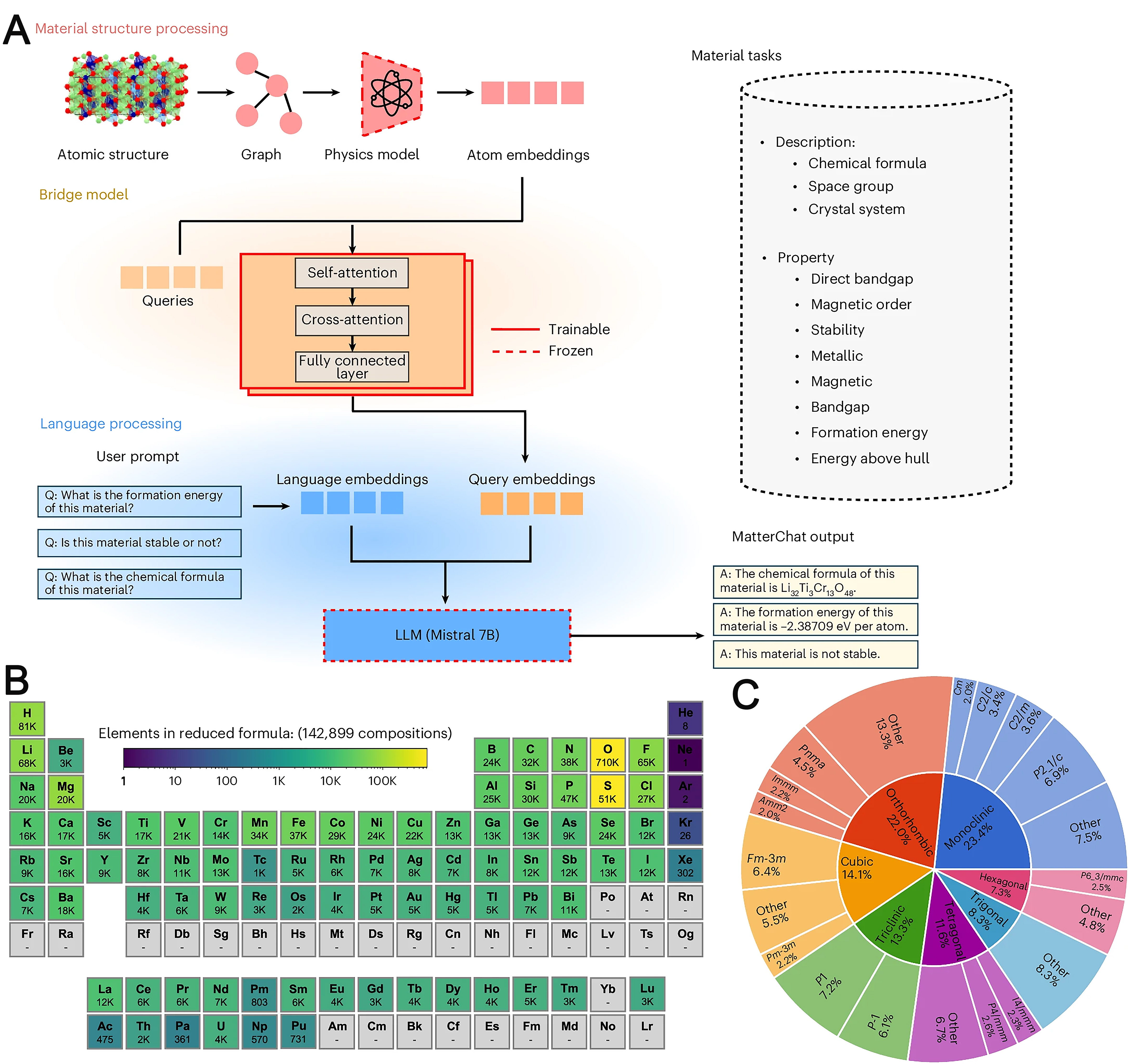
Figure 1. Overview of MatterChat: a modular multimodal LLM for material-based question answering. (A) The architecture integrates a materials structure encoder, a trainable bridge module, and a large language model to align atomic structures with natural-language reasoning; (B) The elemental distribution illustrates the chemical diversity of the training corpus; (C) The space-group and crystal-system distributions summarize its crystallographic diversity. This figure is quoted with permission from reference[1]. LLM: Large language model.
The core value of MatterChat lies in its integration of materials structure understanding with language-model reasoning. Rather than simply converting Crystallographic Information Files (CIF files) or chemical formulas into textual prompts, MatterChat uses a materials structure encoder and a trainable bridge module to align atomistic structural representations with the large language model[1,5,6]. This design allows the model to incorporate structural information into materials-related question answering and distinguishes it from conventional text-input-based large language models (LLMs)[7]. Therefore, MatterChat is better viewed as a structure-aware multimodal research assistant for materials science rather than a general materials chatbot. MatterChat also unifies diverse materials-related tasks, including structure description and property prediction, within a single interactive framework[1]. Its improved performance over general-purpose LLMs and several conventional materials models further suggests the advantage of combining structural representations with language-model reasoning.
From the perspective of AI agents, MatterChat can be reframed through three core capabilities: perception, reasoning, and interaction. Its perception capability lies in its ability to encode atomic structures into graph-based representations and preserve structural information such as local atomic environments, spatial relationships, and crystal symmetry. Its reasoning capability is reflected in its responses to materials-related scientific questions, including property prediction, structural interpretation, stability analysis, and synthesis-oriented suggestions. Its interaction capability is enabled by natural-language dialogue with researchers, allowing users to query material properties and structural features in a more accessible way. However, compared with tool-augmented scientific agents such as ChemCrow[8], MatterChat remains closer to an interactive multimodal research assistant than to a fully autonomous materials-science agent. It has not yet demonstrated autonomous tool use or executable code generation to control simulation software such as Vienna Ab initio Simulation Package (VASP) or Large-scale Atomic/Molecular Massively Parallel Simulator (LAMMPS). To evolve into a true materials-science agent, MatterChat-like systems would need to be connected with external materials databases, literature-retrieval tools, density functional theory (DFT)/molecular dynamics (MD) simulation platforms, task-planning modules, and feedback mechanisms. Such integration could support a closed-loop workflow of database retrieval, hypothesis generation, computational validation, and iterative refinement.
Synthesis-related suggestions should be interpreted more cautiously than property predictions, because practical synthesis involves precursor selection, reaction conditions, kinetic accessibility, phase competition, and experimental reproducibility. In addition, this study highlights the potential of human-AI interactive research in materials science. Researchers can use natural language to inquire about materials properties, structural features, and possible synthesis strategies, thereby lowering the barriers to materials computation and data analysis. This capability also provides new auxiliary tools for materials screening, experimental design, and research-oriented education in materials science[9,10].
Nevertheless, this work still has certain limitations. Its reasoning capability depends on the quality of the training data and the effectiveness of structure-language alignment, and strong predictive performance does not necessarily imply a full physical understanding of structure-property relationships[1,6]. In addition, open-ended synthesis suggestions, mechanistic explanations, and literature-style descriptions may still be affected by hallucinations inherent to language models, potentially generating content that appears plausible but lacks experimental validation[7]. Therefore, in practical scientific research, MatterChat is more appropriately regarded as an auxiliary tool for materials analysis and experimental design, and its outputs should still be evaluated in conjunction with expert judgment, theoretical calculations, and experimental verification.
These limitations highlight the need to combine MatterChat-generated outputs with curated databases, expert judgment, theoretical calculations, and experimental verification[8,11].
Beyond summarizing MatterChat, this Research Highlight provides additional perspectives on its role in materials AI and future AI-agent-driven research. Overall, the value of this article lies not only in improving the performance of materials property prediction, but also in proposing a structure-aware multimodal research paradigm for materials science. By integrating a materials structure encoder, physics-informed machine learning models, and a large language model, MatterChat enables AI to predict materials properties based on an understanding of atomic structures and to interact with researchers through natural language[1,9]. Compared with conventional materials prediction models, it offers stronger interactivity and better task integration; compared with general-purpose large language models, it possesses a more explicit capability for materials structure understanding. Therefore, this work can be regarded as an important exploration in the transition of materials science from data-driven prediction toward multimodal intelligent assistance for scientific research.
Looking forward, integration with materials databases, literature-retrieval tools, DFT/MD platforms, and automated experimental systems may allow MatterChat-like models to evolve from question-answering tools into closed-loop research assistants for materials design and discovery[2,8,12].
DECLARATIONS
Authors’ contributions
Made substantial contributions to conception and design of the study and performed data analysis and interpretation: Cai, X.; Pang, H.; Yu Z.
Availability of data and materials
Not applicable.
AI and AI-assisted tools statement
During the preparation of this manuscript, the AI tool ChatGPT (GPT-5.5 Thinking, released 2026-04-23) was used solely for language editing. The tool did not influence the study design, data collection, analysis, interpretation, or the scientific content of the work. All authors take full responsibility for the accuracy, integrity, and final content of the manuscript.
Financial support and sponsorship
None.
Conflicts of interest
All authors declared that there are no conflicts of interest.
Ethical approval and consent to participate
Not applicable.
Consent for publication
Not applicable.
Copyright
© The Author(s) 2026.
REFERENCES
1. Tang, Y.; Xu, W.; Cao, J.; et al. A multimodal large language model for materials science. Nat. Mach. Intell. 2026, 8, 588-601.
2. Merchant, A.; Batzner, S.; Schoenholz, S. S.; Aykol, M.; Cheon, G.; Cubuk, E. D. Scaling deep learning for materials discovery. Nature 2023, 624, 80-5.
3. Antunes, L. M.; Butler, K. T.; Grau-Crespo, R. Crystal structure generation with autoregressive large language modeling. Nat. Commun. 2024, 15, 10570.
4. Wang, Z.; Chen, A.; Tao, K.; Han, Y.; Li, J. MatGPT: a vane of materials informatics from past, present, to future. Adv. Mater. 2024, 36, e2306733.
5. Deng, B.; Zhong, P.; Jun, K.; et al. CHGNet as a pretrained universal neural network potential for charge-informed atomistic modelling. Nat. Mach. Intell. 2023, 5, 1031-41.
6. Batatia, I.; Benner, P.; Chiang, Y.; et al. A foundation model for atomistic materials chemistry. J. Chem. Phys. 2025, 163, 184110.
7. Xie, T.; Grossman, J. C. Crystal graph convolutional neural networks for an accurate and interpretable prediction of material properties. Phys. Rev. Lett. 2018, 120, 145301.
8. Zhang, D.; Bao, Z.; Chu, Y.; et al. Digital catalysis platform as a gateway to big data and AI-powered innovations in catalysis. Chem. Catalysis. 2026, 6, 101775.
9. Jain, A.; Ong, S. P.; Hautier, G.; et al. Commentary: The Materials Project: A materials genome approach to accelerating materials innovation. APL. Mater. 2013, 1, 011002.
10. Kim, S.; Jung, Y.; Schrier, J. Large language models for inorganic synthesis predictions. J. Am. Chem. Soc. 2024, 146, 19654-9.
11. Ji, Z.; Lee, N.; Frieske, R.; et al. Survey of hallucination in natural language generation. ACM. Comput. Surv. 2023, 55, 1-38.
Cite This Article
 Open Access
How to Cite
Download Citation
Export Citation File:
Type of Import
Tips on Downloading Citation
Citation Manager File Format
Type of Import
Direct Import: When the Direct Import option is selected (the default state), a dialogue box will give you the option to Save or Open the downloaded citation data. Choosing Open will either launch your citation manager or give you a choice of applications with which to use the metadata. The Save option saves the file locally for later use.
Indirect Import: When the Indirect Import option is selected, the metadata is displayed and may be copied and pasted as needed.
About This Article
Copyright

Data & Comments
Data
0




Comments
Comments must be written in English. Spam, offensive content, impersonation, and private information will not be permitted. If any comment is reported and identified as inappropriate content by OAE staff, the comment will be removed without notice. If you have any queries or need any help, please contact us at support@oaepublish.com.