



Theoretical framework and empirical evidence on population dynamics and household carbon emissions
 0
0 
Abstract
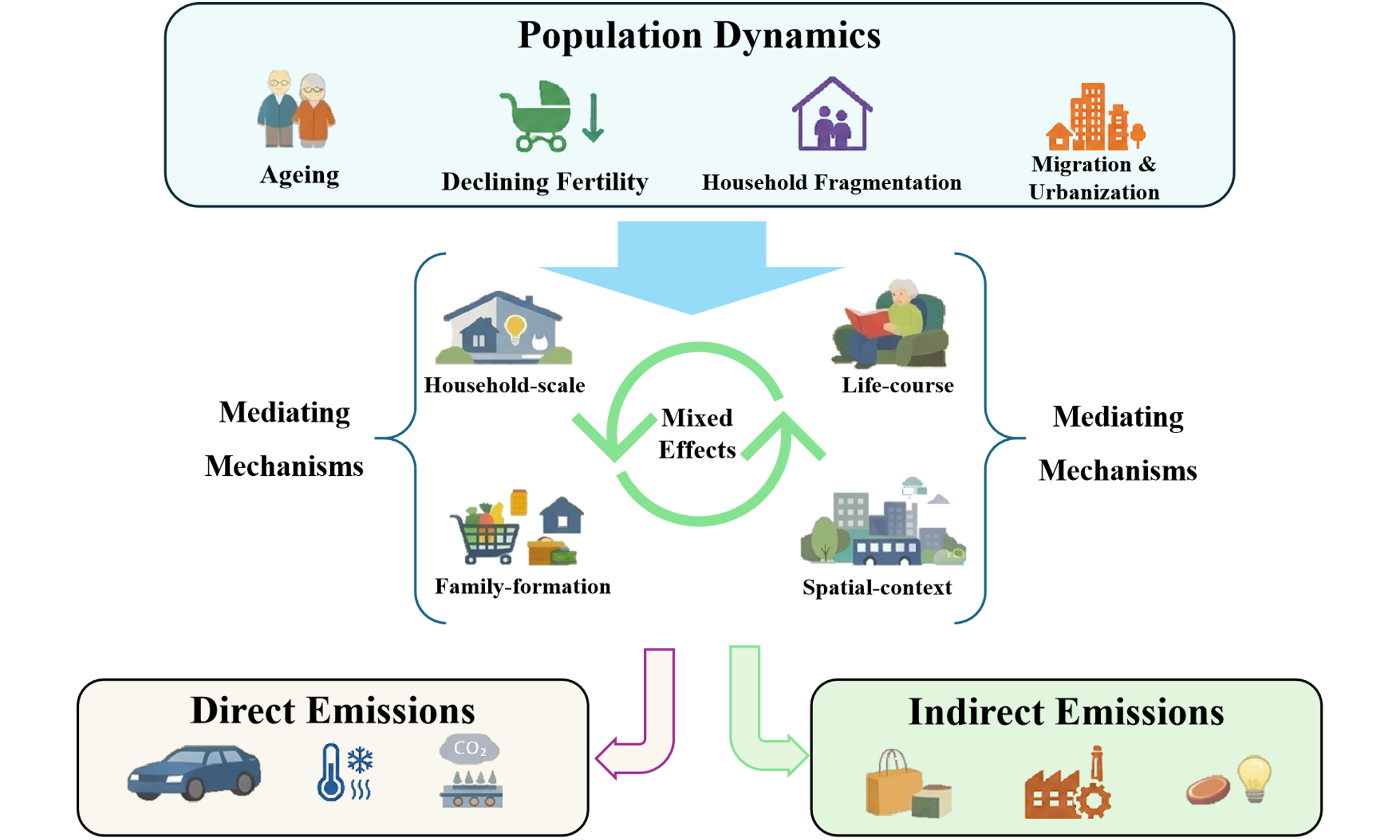
Household carbon emissions (HCEs) are an important yet comparatively underexamined area of climate mitigation. This review synthesizes theoretical and empirical evidence on how population dynamics shape HCEs beyond the effects of aggregate population size. It develops a conceptual framework linking four dimensions of population dynamics - household size and structure, population ageing, fertility and childrearing, and migration and urbanization - to direct carbon emissions (DCEs) and indirect carbon emissions (ICEs) through household-scale, life-course, family-formation, and spatial-contextual mechanisms. The empirical evidence shows that the effects of population dynamics are neither uniform nor linear. Household size exhibits a relatively consistent scale effect: larger households generally generate higher total emissions but lower emissions per capita because of resource sharing and economies of scale. By contrast, population ageing operates through competing pathways, reducing emissions through lower mobility and discretionary consumption while potentially increasing residential energy use and healthcare-related emissions. Childrearing similarly expands demand for housing, mobility, food, education, and childcare but may constrain other consumption through financial pressures and precautionary saving. Migration and urbanization reshape emissions by relocating households across different built-environment, transport, infrastructure, and energy-system contexts, with outcomes depending strongly on urban form and development stage. Divergent empirical findings also reflect differences in emission accounting boundaries, data levels, demographic measures, model specifications, and regional contexts. Overall, population dynamics should be understood as context-dependent upstream conditioning processes rather than linear determinants of HCEs. Climate mitigation strategies should therefore move beyond aggregate population indicators and account for heterogeneity in household structure, life-course transitions, and spatial and institutional contexts.
Keywords
INTRODUCTION
Climate change remains one of the most pressing challenges facing humanity, making rapid and sustained decarbonization a global imperative. Anthropogenic greenhouse gas emissions, particularly carbon dioxide, are the principal drivers of contemporary global warming and the associated intensification of climate-related risks[1,2]. In response, the Paris Agreement established the goal of limiting global warming to well below 2 °C while pursuing efforts to restrict the temperature increase to 1.5 °C. Meeting these goals requires immediate and substantial emission reductions across both production and consumption systems within this decade[3].
While mitigation efforts have traditionally focused on production sectors such as industry and energy supply, increasing attention has shifted toward the household sector, where everyday energy use and consumption decisions are associated with a substantial share of global emissions. According to the United Nations Environment Programme, approximately two-thirds of global greenhouse gas emissions are associated with household consumption activities[4]. National evidence further indicates that household carbon emissions (HCEs) account for between 40% and 80% of total emissions in various countries[5-7], underscoring the importance of understanding their underlying drivers.
Among the factors shaping HCEs, population dynamics stand out as particularly influential. A growing body of research shows that household size and composition account for a substantial share of variation in HCEs[8]. Population ageing is also increasingly recognized as an important influence, as changes in age structure reshape household composition, consumption patterns, time allocation, and life-course behaviour, thereby influencing how energy, goods, and services are consumed at the household level[9,10]. Historically, however, the population-environment relationship has been framed largely through aggregate models such as IPAT (I = P × A × T) and its stochastic extension, STIRPAT (Stochastic Impacts by Regression on Population, Affluence, and Technology), which treat population primarily as a scale variable[11]. Although these models identify population as a fundamental component of environmental impact, they tend to conceptualize it as a relatively homogeneous quantity rather than a set of dynamic and heterogeneous demographic processes.
This scale-oriented perspective overlooks the broader implications of contemporary population dynamics, as many societies are experiencing rapid population ageing, declining fertility, delayed parenthood, shrinking household sizes, a growing prevalence of single-person living, and continued spatial redistribution through migration and urbanization. These changes do not merely alter aggregate population size; they reshape how households are formed, how individuals move through different stages of the life course, and how consumption is organized across space. Population ageing may reorient demand toward residential energy, healthcare, and home-based services; fertility and childrearing reshape child-related consumption, household time allocation, and intergenerational investment; household fragmentation weakens economies of scale; and migration and urbanization embed households within different housing, infrastructure, transport, and energy systems[12-15]. The carbon implications of population dynamics are therefore unlikely to be uniform or linear but instead depend on multiple, and sometimes countervailing, mechanisms.
Compared with the extensive review literature on carbon emissions in general, reviews devoted specifically to HCEs remain relatively limited. Existing reviews of HCEs have mainly examined measurement methods, broad influencing factors, research trends, and mitigation policies[16-19], while the relationship between population dynamics and HCEs has received little systematic attention. Different demographic dimensions are generally examined separately, rather than integrated into a unified framework covering household size and structure, population ageing, fertility and childrearing, and migration and urbanization. Fertility and childrearing are particularly underrepresented, partly because the relevant empirical evidence remains limited, despite their important implications for household composition, time allocation, mobility, consumption, and saving behaviour[20]. Moreover, although HCEs are commonly divided into direct carbon emissions (DCEs), which arise from household energy use, and indirect carbon emissions (ICEs), which are embodied in the goods and services consumed by households, previous reviews rarely examine how population dynamics affect these two components differently. Treating HCEs as a single aggregate outcome may therefore obscure distinct or even offsetting demographic pathways.
Against this backdrop, this review synthesizes theoretical and empirical evidence on how population dynamics influence HCEs. Rather than treating population solely as an aggregate-scale variable, it integrates household size and structure, population ageing, fertility and childrearing, and migration and urbanization within a common analytical framework. Particular attention is given to fertility and childrearing as an overlooked family-formation and life-course dimension, and to the differential effects of population dynamics on DCEs and ICEs. In addition, the review compares accounting boundaries, units of analysis, demographic measures, model specifications, and regional contexts to explain why empirical findings are often mixed and context-dependent. By linking different dimensions of population dynamics to competing mechanisms and distinct emission components, this review seeks to provide a more critical and analytically integrated understanding of the relationship between population dynamics and HCEs.
As this mini-review aims to provide a thematic synthesis and conceptual integration rather than a systematic review or meta-analysis, we adopted a purposive narrative literature-search strategy. Relevant studies were identified through Web of Science (https://www.webofscience.com/), Google Scholar (https://scholar.google.com/), and the China National Knowledge Infrastructure (https://www.cnki.net/) using combinations of terms related to population dynamics, household carbon emissions, and household energy consumption, supplemented by backward citation tracking of key publications. Priority was given to theoretically influential reviews and representative empirical studies published mainly in the past decade, while seminal earlier research and evidence from different regional contexts were also considered. The selected literature was iteratively reviewed and organized according to the conceptual dimensions and competing mechanisms developed in this review.
CONCEPTUAL FRAMEWORK: FROM POPULATION DYNAMICS TO HCES
Defining HCEs and accounting boundaries
HCEs refer to greenhouse gas emissions attributable to household activities and final consumption and are commonly divided into two components[21]. DCEs generally refer to emissions associated with household energy use, including fuels used for cooking, heating, and private transport, as well as emissions from purchased electricity and district heating when these are allocated to household energy demand[22]. DCEs are commonly estimated using the emission coefficient method, which multiplies the physical consumption of each energy source by its corresponding carbon emission factor[22].
ICEs, by contrast, refer to emissions embodied in the goods and services consumed by households. These emissions arise across the upstream production and supply chains that support household final demand[22,23]. ICEs are commonly estimated using environmentally extended input-output analysis, which links household expenditures across consumption categories to the upstream emission intensities of corresponding production sectors[24]. Depending on data availability and classification systems, household expenditures are typically grouped into broad categories, such as food, clothing, housing, household services, transport, education and recreation, healthcare, and other goods and services[25]. Input-output sectors are then aggregated and matched to these categories to align household expenditure data with production-side emission data. The resulting estimates may vary with the system boundaries, sectoral aggregation, expenditure classifications, and allocation rules adopted.
Distinguishing between DCEs and ICEs is analytically important because the two components are shaped by different household characteristics and consumption processes. DCEs are closely tied to housing characteristics, home occupancy, thermal comfort requirements, and private mobility, whereas ICEs depend more strongly on consumption structure, expenditure allocation, and the carbon intensity of upstream production systems[26,27]. Studies focusing solely on household energy use may capture housing- and transport-related effects but overlook changes in service consumption or expenditure composition[28-30]. Conversely, consumption-based approaches may reveal mechanisms that remain invisible in energy-based analyses[31,32]. Moreover, the same dimension of population dynamics may affect DCEs and ICEs differently or even in opposite directions. Recognizing these differences in emission sources and accounting scope is therefore essential for interpreting the effects of population dynamics and explaining divergent empirical findings.
Population dynamics as upstream conditioning processes
Traditional population-environment models, such as IPAT and STIRPAT, identify aggregate population size as a key determinant of environmental impact[11]. However, the influence of population dynamics on HCEs extends beyond this aggregate scale effect. For the purposes of this review, population dynamics refer to changes in household size and structure, age structure, fertility and childrearing, and the spatial distribution of populations through migration and urbanization. These dimensions reshape household demand through distinct but interrelated pathways.
First, changes in total population do not translate proportionally into changes in the number of households. Declining household size, the increasing prevalence of single-person living, delayed marriage, and household dissolution can increase the number of households even when population growth is slow[13]. Second, changes in age structure, particularly population ageing, alter consumption patterns, time allocation, mobility, and energy-service needs across the life course[28,31,32]. Third, fertility and childrearing affect household composition, housing demand, educational expenditure, time allocation, and intergenerational financial planning[20]. Finally, migration and urbanization redistribute populations across space, thereby affecting housing density, commuting distances, infrastructure access, and local energy systems[33].
Taken together, population dynamics function as upstream conditioning processes that shape the number, composition, and spatial distribution of households, thereby influencing both the scale and composition of HCEs[34]. Their effects are neither uniform nor deterministic; rather, they depend on the socioeconomic, institutional, infrastructural, and spatial contexts in which households are embedded.
Mediating mechanisms: how population dynamics translate into HCEs
Population dynamics affect HCEs through several interrelated mechanisms. First, a household-scale mechanism reflects how changes in household size and living arrangements influence resource sharing and per-capita emissions. Larger households can share dwelling space, heating, lighting, appliances, and other energy-using equipment, thereby generating economies of scale and reducing per-capita emissions. By contrast, household fragmentation duplicates housing space and durable goods and may increase both DCEs and ICEs per person[35]. The strength of this mechanism depends on household size and co-residence patterns, which are themselves shaped by fertility, cultural norms, income, and housing conditions.
Second, a life-course mechanism emphasizes how age structure and life-course transitions reshape consumption behaviour, time use, and energy demand. For example, increased home occupancy among older adults may raise residential energy demand[36], whereas reduced mobility may lower transport-related emissions. Changes in healthcare needs and discretionary consumption may also affect ICEs. The net effect therefore depends on the relative strength of these countervailing pathways.
Third, a family-formation mechanism highlights how fertility and childrearing alter household composition, time allocation, and consumption structure. Raising children may increase expenditure on food, housing, mobility, healthcare, education, childcare, and other services, each with a different carbon intensity[12]. At the same time, the financial demands of childrearing may encourage precautionary saving and constrain adults’ discretionary consumption. Fertility and childrearing may therefore affect different components of HCEs in different directions.
Finally, a spatial-contextual mechanism situates these processes within broader geographic and infrastructural environments. Compact housing, shorter commuting distances, and access to public transport may reduce emissions, whereas income growth, motorization, suburban expansion, and consumption upgrading may increase them. Urban form, infrastructure provision, climate conditions, energy mix, and development stage therefore shape how migration and urbanization translate into DCEs and ICEs.
These mechanisms are interconnected rather than independent. Population ageing may coincide with widowhood and household fragmentation; fertility and childrearing alter household size and time allocation; and migration may reshape co-residence arrangements and access to infrastructure. Taken together, these mechanisms provide a conceptual bridge between the different dimensions of population dynamics and HCEs.
Figure 1 summarizes this integrated conceptual framework. Population dynamics operate as upstream conditioning processes that generate competing emission-increasing and emission-reducing pathways through household-scale, life-course, family-formation, and spatial-contextual mechanisms. These pathways may affect DCEs and ICEs differently, while their direction and magnitude depend on the socioeconomic, institutional, infrastructural, and spatial contexts in which households are embedded.
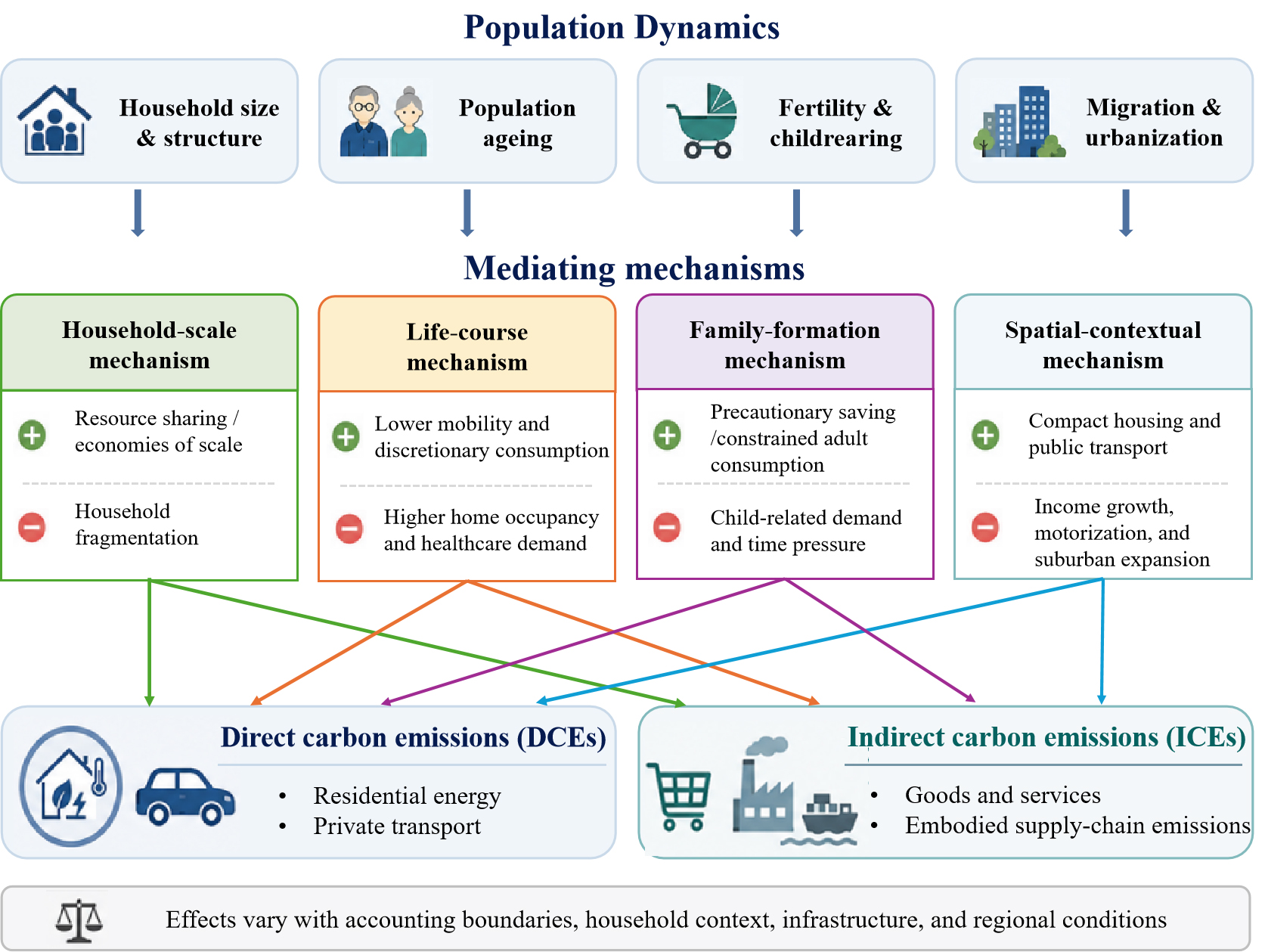
Figure 1. Conceptual framework linking population dynamics to direct and indirect HCEs. HCEs: Household carbon emissions.
EVIDENCE SYNTHESIS: KEY DEMOGRAPHIC DIMENSIONS
Household size and structure: the scale effect
Among the different dimensions of population dynamics, household size exhibits one of the clearest and most consistent relationships with HCEs because of household economies of scale[37]. A well-documented empirical pattern shows that larger households generate higher total emissions but lower emissions per capita[24,35,38]. This apparent paradox arises because many household goods and energy services can be shared among household members[13]. Dwelling space, heating, lighting, refrigeration, and major appliances function as partially shared household goods that can serve additional members at relatively low marginal cost[39]. Consequently, multi-member households distribute fixed energy and housing services across more individuals, thereby reducing per-capita energy use and associated emissions[40]. Evidence from Ireland, for example, indicates that households with three or more members generate nearly one-third lower per-capita emissions than single-person households[21].
This scale effect operates through both DCEs and ICEs. For DCEs, per-capita residential energy use generally rises as household size declines because smaller households often occupy dwellings that are not proportionally smaller than those of larger households. They therefore tend to have greater residential floor area and higher heating, cooling, and electricity demand per person[41]. Evidence from China supports this pattern, showing that a reduction of one household member was associated with a 17%-24% increase in per-capita electricity consumption between 2010 and 2016[42]. For ICEs, the shared use of housing space, appliances, and other carbon-intensive goods similarly reduces per-capita embodied emissions in multi-member households[40].
Changes in household formation may further amplify these effects. The growing prevalence of single-person households, delayed marriage, and household dissolution increases the number of dwellings and duplicates demand for housing space, appliances, and household services[13]. When one household divides into two smaller units, the additional resource requirements may generate emissions beyond those associated with population growth alone[43]. Household size and structure therefore influence HCEs not merely by changing the number of consumers, but by determining the extent to which housing, energy services, and durable goods can be shared.
Age structure and population ageing: the life-course mechanism
Whereas household size captures the scale dimension of population dynamics, age structure reflects its life-course dimension. Age affects physiological needs, economic resources, mobility, time use, and consumption preferences, thereby affecting both DCEs and ICEs[44]. Unlike the relatively consistent economies-of-scale effect associated with household size, however, the carbon implications of population ageing remain ambiguous because several countervailing mechanisms operate simultaneously.
Income declines following retirement and more conservative spending patterns may reduce household consumption[45,46], while lower mobility and less frequent participation in travel-intensive activities may lower transport-related emissions[47-49]. Conversely, longer home occupancy and greater sensitivity to temperature variation may increase heating, cooling, and electricity demand[44,50]. Older households may also adopt energy-efficient technologies or undertake housing retrofits more slowly[51], while expenditure shifts toward healthcare, medicine, and home-based services may raise ICEs in these categories[52-54]. The net effect therefore depends on whether lower mobility and discretionary consumption outweigh increased residential energy use and healthcare demand.
Empirical evidence reflects the balance between these opposing pathways. Macro-level studies report positive, negative, and nonlinear effects, depending on consumption restructuring, economic activity, residential energy demand, and interactions with urbanization[55-60]. Household-level evidence from China also reveals differences across emission components. Using CFPS (China Family Panel Studies,a nationally representative, annual longitudinal survey of Chinese communities, families, and individuals launched in 2010 by the Institute of Social Science Survey of Peking University) data, Zhang et al. found a negative association between ageing and ICEs[32], whereas Chen and Hu reported a positive association with DCEs[28]. Hu et al. identified an inverted U-shaped relationship between household age structure and HCEs[25]. Using a broader measure covering both DCEs and ICEs across 22 consumption items, Ge et al. found that the negative consumption effect of ageing outweighed its positive composition effect[61]. Although ageing reduced emissions in most categories, it increased per-capita emissions from heating, medicine, and healthcare. Thus, a negative aggregate relationship may coexist with increases in specific emission sources.
Differences in accounting boundaries, consumption classifications, and research contexts help explain these divergent results. Studies focusing primarily on residential energy are more likely to identify emission increases associated with longer home occupancy, whereas broader consumption-based studies may find reductions when lower transport and discretionary consumption dominate. Broad expenditure categories may also conceal offsetting changes across individual items[61]. Using urban household data from four Chinese regions, Yu et al. found that older adults slowed the growth of both DCEs and ICEs, although the effects varied across regions and periods[62]. Cross-country variation is also important: younger adults have higher carbon footprints than older adults in China, whereas some developed-country studies report the opposite pattern[63]. This contrast may reflect differences in the distribution of income, accumulated wealth, and purchasing power across age groups[64], although observed age differences may also capture cohort-specific lifestyles rather than ageing itself[65]. Population ageing therefore has no uniform effect on HCEs; estimates vary with emission boundaries, ageing measures, data levels, model specifications, control variables, and regional conditions.
Fertility and childrearing: the family-formation mechanism
Whereas population ageing reflects later-life transitions, fertility and childrearing represent family-formation processes that reshape household composition, consumption, and time allocation. Fertility decline contributes to population ageing and household transformation by leading to smaller families and a growing prevalence of childless households, and it often coincides with delayed parenthood[13,66]. These changes may weaken household economies of scale, but they may also reduce overall demand for child-related goods and services. The carbon implications of low fertility at the population level should therefore be distinguished from those of raising children within existing households.
Childrearing constitutes an important life-course transition that alters household consumption priorities, mobility, housing demand, and daily routines[20]. The additional needs and time pressures associated with raising children may increase reliance on convenience-oriented goods and services[67]. DCEs may rise through greater residential energy use and transport demand, while ICEs may increase through additional expenditure on food, housing, appliances, education, childcare, and other child-related services. Existing studies generally find that households with children generate higher HCEs than childless households, although the magnitude and composition of these differences vary with the number and ages of children, household income, and living context[68-70].
However, the financial demands of childrearing may partly offset these emission increases. Raising children entails substantial current and anticipated financial commitments, which may constrain adults’ discretionary consumption and encourage precautionary saving, particularly in response to future education and housing costs[14,15,71]. Reduced spending on leisure, travel, and other nonessential goods may lower emissions in some consumption categories. Panel evidence also suggests that a higher proportion of children within a household may be associated with lower ICEs when financial constraints reduce overall consumption[20].
The effects of fertility and childrearing are therefore unlikely to be uniform. Their net impact depends on whether additional child-related demand outweighs reductions in other forms of household consumption. Results may also vary with children’s ages, household income, housing conditions, urban context, and the availability and carbon intensity of childcare and education services. Compared with household size and population ageing, however, empirical evidence on these family-formation processes remains relatively limited, particularly evidence based on longitudinal data and causal research designs.
Migration, urbanization, and spatial redistribution
Beyond household formation and age composition, migration and urbanization reshape HCEs by relocating households across different spatial, infrastructural, and energy contexts. Population redistribution changes not only where households live but also the built environments, transport networks, public services, and energy systems that shape everyday consumption[72]. Its carbon implications therefore depend not simply on population movement, but on differences between origin and destination areas.
Urbanization may generate both emission-reducing and emission-increasing effects. In many high-income economies, compact urban development can lower per-capita emissions through smaller dwellings, shorter travel distances, and greater access to public transport[73,74]. By contrast, low-density expansion, larger residential floor areas, and car-dependent mobility may increase residential and transport-related DCEs. In rapidly developing economies such as China, urbanization has often coincided with income growth, housing expansion, lifestyle changes, and greater reliance on commercial energy, contributing to increases in both DCEs and ICEs[75-79]. Urbanization is therefore not inherently carbon-increasing or carbon-reducing; its effects depend on development stage, urban form, infrastructure provision, and associated changes in household consumption.
Migration adds household-restructuring and spatial-relocation effects. The migration of young adults for education and employment may create single-person households in destination cities while reducing household size or altering co-residence arrangements in origin communities. Later-life migration may similarly change housing occupancy, access to services, and residential energy needs[80]. Internal migration also redistributes emissions geographically. Evidence from China suggests that interprovincial migration shifts residential emissions toward economically developed coastal destinations as rural-to-urban migrants adopt different housing, mobility, and consumption patterns[81]. Migration may limit increases in per-capita residential energy use in some settings while increasing ICEs through income growth and consumption upgrading in destination regions[79,82,83]. Its net effect therefore depends on how migration changes household structure and on the relative carbon intensity of consumption in origin and destination areas.
These apparently divergent results reflect differences in spatial context and research design. Studies emphasizing density, dwelling size, and public transport are more likely to identify emission-reducing effects, whereas those focusing on income growth, motorization, and consumption upgrading tend to find increases. Results may also vary according to whether migration is measured by migrant status, population flows, or urban population shares, and whether emissions are attributed to the location of residence, production, or final consumption. Migration, urbanization, and urban form should therefore be distinguished analytically: migration refers to population movement, urbanization describes broader changes in settlement patterns and the urban share of the population, and urban form conditions how both processes translate into DCEs and ICEs.
POPULATION DYNAMICS IN FUTURE HCES RESEARCH
Population dynamics are increasingly recognized as an important but still underexamined influence on HCEs. The evidence reviewed in this article shows that their effects operate through multiple, interconnected pathways rather than through population scale alone. Household size and structure determine the extent of resource sharing, population ageing reshapes consumption and energy demand across the life course, fertility and childrearing alter family formation and resource allocation, and migration and urbanization relocate households across different spatial and infrastructural contexts[12-15]. Population dynamics should therefore be treated not merely as control variables or scaling factors, but as upstream conditioning processes that influence lifestyles, mobility, consumption patterns, and both DCEs and ICEs.
Future research should move beyond aggregate population projections and incorporate changes in household formation, dissolution, and living arrangements into population and emission scenarios. Ageing trajectories, low-fertility pathways, household fragmentation, and migration patterns may produce substantially different carbon outcomes even under similar total-population trends. Linking population projections with stock-cohort models would help capture longer-term effects on housing demand, infrastructure investment, and technology turnover, through which population dynamics may create carbon lock-in[28]. More comparative research across countries and regions is also needed to determine how income, welfare systems, urban form, energy infrastructure, and the distribution of wealth across generations condition these relationships.
Several methodological improvements are particularly important. Population dynamics should be incorporated directly into household-level emission models rather than treated as exogenous scaling factors. Longitudinal microdata and stronger causal designs are needed to distinguish life-course changes from cohort differences and to identify the effects of transitions such as retirement, childbirth, widowhood, and migration. Studies should also distinguish among alternative measures of ageing, fertility, and migration, while examining their interactions with household size and living arrangements. Built-environment characteristics - including density, accessibility, housing conditions, and infrastructure provision - should be modeled as mediating or moderating factors rather than simply as background controls. Finally, clearer and more harmonized reporting of DCE and ICE accounting boundaries, consumption classifications, and allocation methods would improve comparability across studies[32,84].
These research priorities have direct implications for climate policy. Household fragmentation increases the duplication of dwelling space and durable goods, suggesting a need for energy-efficient small housing, shared facilities, and resource-efficient household appliances. Population ageing calls for housing retrofits, clean heating and cooling, accessible public transport, and the decarbonization of healthcare and home-based services. For families with children, low-carbon housing, childcare, education, and mobility services can reduce the carbon intensity of childrearing without adding to households’ financial and time pressures. Migration and urbanization require compact development, energy-efficient rental housing, public transport, and infrastructure planning that avoids car-dependent and high-carbon spatial lock-in. Active-ageing strategies may further support localized mobility and sustainable consumption, although their emission effects require additional empirical evaluation[9,85,86].
More broadly, mitigation policies should recognize that older-adult households, single-person households, migrant households, and families with children face different energy needs, consumption constraints, and opportunities for behavioural adjustment. Integrating population dynamics into climate policy can therefore improve both the effectiveness and the social inclusiveness of household emission-reduction strategies.
CONCLUSION
Population dynamics shape HCEs through multiple interacting pathways that extend beyond aggregate population growth. Changes in household size and structure, age structure, fertility and childrearing, and migration and urbanization reshape resource sharing, consumption patterns, housing demand, time use, and mobility, thereby affecting both DCEs and ICEs. The evidence reviewed shows that these effects are neither uniform nor necessarily linear but depend on the balance between competing emission-increasing and emission-reducing mechanisms. Their direction and magnitude vary with household income, infrastructure, institutional arrangements, energy systems, and regional conditions.
As low fertility, population ageing, household fragmentation, and continued urbanization reshape societies across many regions, understanding the household-level implications of population dynamics is becoming increasingly important for climate mitigation. Future research should move beyond aggregate population indicators and account for household formation, life-course transitions, spatial contexts, and interactions among different dimensions of population dynamics. Climate policies should likewise recognize the heterogeneous energy needs, consumption constraints, and emission patterns of different household types rather than rely on uniform interventions. Integrating population dynamics into household carbon research and climate policy can therefore deepen understanding of the drivers of HCEs and support more effective, socially inclusive low-carbon development.
DECLARATIONS
Authors’ contributions
Writing - original draft, writing - review & editing, visualization: Wang, M.
Writing - review & editing, visualization: Zhang, C.
Writing - review & editing: He, X.; Chen, Z.; Ye, Z.
Writing - review & editing, supervision, funding acquisition: Guo, C.
Availability of data and materials
Not applicable.
AI and AI-assisted tools statement
During the preparation of this manuscript, the AI tool ChatGPT (version GPT-5.5 Thinking, OpenAI, released 2026-04-23) was used for language editing. ChatGPT’s image-generation tool (version GPT Image 2, OpenAI, released 2026-04-21) was used to assist with the initial design and refinement of Figure 1 and the Graphical Abstract. All AI-assisted text and visual materials were critically reviewed, revised, and approved by the authors. The tools did not influence the study design, data collection, analysis, interpretation, or the scientific content of the work. All authors take full responsibility for the accuracy, integrity, and final content of the manuscript.
Financial support and sponsorship
This study was supported by the Beijing Municipal Social Science Foundation [grant number 23SRA002].
Conflicts of interest
All authors declared that there are no conflicts of interest.
Ethical approval and consent to participate
Not applicable.
Consent for publication
Not applicable.
Copyright
© The Author(s) 2026.
REFERENCES
1. Nauels, A.; Nicholls, Z.; Möller, T.; et al. Multi-century global and regional sea-level rise commitments from cumulative greenhouse gas emissions in the coming decades. Nat. Clim. Chang. 2025, 15, 1198-204.
2. Tan, X.; Wu, X.; Huang, Z.; et al. Increasing global precipitation whiplash due to anthropogenic greenhouse gas emissions. Nat. Commun. 2023, 14, 2796.
3. Huang, M.; Zhai, P. Achieving Paris Agreement temperature goals requires carbon neutrality by middle century with far-reaching transitions in the whole society. Adv. Clim. Chang. Res. 2021, 12, 281-6.
4. United Nations Environment Programme. Emissions Gap Report 2020; United Nations Environment Programme: Nairobi, Kenya, 2020. https://digitallibrary.un.org/record/3894282?v=pdf&utm_source (accessed 2026-08-11).
5. Bin, S.; Dowlatabadi, H. Consumer lifestyle approach to US energy use and the related CO2 emissions. Energy. Policy. 2005, 33, 197-208.
6. Adnan, M. N.; Safeer, R.; Rashid, A. Consumption based approach of carbon footprint analysis in urban slum and non-slum areas of Rawalpindi. Habitat. Int. 2018, 73, 16-24.
7. Long, Y.; Yoshida, Y.; Zhang, R.; Sun, L.; Dou, Y. Policy implications from revealing consumption-based carbon footprint of major economic sectors in Japan. Energy. Policy. 2018, 119, 339-48.
8. Liu, G.; Zhang, F. China’s carbon inequality of households: Perspectives of the aging society and urban-rural gaps. Resour. Conserv. Recycl. 2022, 185, 106449.
9. Zhang, C.; Chen, G. Rediscovering climate gerontology: an era for older adults to contribute more to climate change. Sustain. Sci. Pract. Policy. 2024, 20, 2381875.
10. Dalton, M.; O'neill, B.; Prskawetz, A.; Jiang, L.; Pitkin, J. Population aging and future carbon emissions in the United States. Energy. Econ. 2008, 30, 642-75.
12. Wang, X.; Liu, W.; Zhu, Y.; Xiao, Y.; Lv, Y. The hidden carbon costs of aging: how household dependency burden shapes emissions in China. Ecol. Econ. 2026, 240, 108834.
13. Underwood, A.; Zahran, S. The carbon implications of declining household scale economies. Ecol. Econ. 2015, 116, 182-90.
14. Wei, S.; Zhang, X. The Competitive saving motive: evidence from rising sex ratios and savings rates in China. J. Polit. Econ. 2011, 119, 511-64.
15. Rosenzweig, M.; Zhang, J. Co-residence, life-cycle savings and inter-generational support in urban China. Economic Growth Center, Yale University: New Haven, CT, USA, 2014; Discussion Paper No. 20057.
16. Zeng, J.; Qu, J.; Ma, H.; Gou, X. Characteristics and trends of household carbon emissions research from 1993 to 2019: a bibliometric analysis and its implications. J. Clean. Prod. 2021, 295, 126468.
17. Wang, Y.; Sun, C.; Fan, Y.; et al. Household carbon emissions research from 2005 to 2024: an analytical review of assessment, influencing factors, and mitigation pathways. Buildings 2025, 15, 3172.
18. Zhang, X.; Wang, Y. How to reduce household carbon emissions: a review of experience and policy design considerations. Energy. Policy. 2017, 102, 116-24.
19. Du, J.; Zhong, Z.; Shi, Q.; Cao, Y.; Yang, C.; Wang, L. A review of household carbon footprint: measurement methods, evolution and emissions assessment. Carbon. Footprints. 2024, 3, 11.
20. Nordström, J.; Shogren, J. F.; Thunström, L. Do parents counter-balance the carbon emissions of their children? PLoS. One. 2020, 15, e0231105.
21. Kenny, T.; Gray, N. F. A preliminary survey of household and personal carbon dioxide emissions in Ireland. Environ. Int. 2009, 35, 259-72.
22. Du, Z.; Xu, J.; Lin, B. What does the digital economy bring to household carbon emissions? From the perspective of energy intensity. Appl. Energy. 2024, 370, 123613.
23. Weber, C.; Perrels, A. Modelling lifestyle effects on energy demand and related emissions. Energy. Policy. 2000, 28, 549-66.
24. Qu, J.; Zeng, J.; Li, Y.; et al. Household carbon dioxide emissions from peasants and herdsmen in northwestern arid-alpine regions, China. Energy. Policy. 2013, 57, 133-40.
25. Hu, Y.; Chen, Y.; Li, Y.; Yang, W. Age structure impacts on household carbon emissions: Based on a social interaction perspective. Ecol. Econ. 2025, 230, 108534.
26. Fan, J.; Zhou, L.; Zhang, Y.; Shao, S.; Ma, M. How does population aging affect household carbon emissions? Evidence from Chinese urban and rural areas. Energy. Econ. 2021, 100, 105356.
27. Druckman, A.; Buck, I.; Hayward, B.; Jackson, T. Time, gender and carbon: a study of the carbon implications of British adults’ use of time. Ecol. Econ. 2012, 84, 153-63.
28. Chen, Y.; Hu, Y. Pathways of population aging on household carbon emissions. Popul. J. 2022, 44, 99-112. (in Chinese).
29. Hu, Z.; Wang, M.; Cheng, Z.; Yang, Z. Impact of marginal and intergenerational effects on carbon emissions from household energy consumption in China. J. Clean. Prod. 2020, 273, 123022.
30. Zhao, Q.; Huang, S.; Wang, T.; et al. The influencing factors and future development of energy consumption and carbon emissions in urban households: a review of China’s experience. Appl. Sci. 2025, 15, 2961.
31. Cai, W.; Lin, X. The impact of population aging on household carbon emissions: evidence from china. J. Jiangnan. Univ. Humanit. Soc. Sci. 2023, 22, 18. (in Chinese).
32. Zhang, J.; Zhu, L.; Liu, J.; Yu, B.; Yu, S. How ageing shapes the relationship between working time and carbon dioxide emissions: evidence from Chinese households. Environ. Impact. Assess. Rev. 2023, 98, 106974.
33. Chen, J.; Li, X.; Geng, Y.; Liu, X.; Li, G. Mechanism analysis and empirical research on urbanization and carbon emissions in China: based on the perspective of economic development, population transfer, and urban expansion. J. Nat. Resour. 2024, 39, 1399-417.
34. O’Neill, B. C.; Dalton, M.; Fuchs, R.; Jiang, L.; Pachauri, S.; Zigova, K. Global demographic trends and future carbon emissions. Proc. Natl. Acad. Sci. U. S. A. 2010, 107, 17521-6.
35. Zhang, Y.; Wang, F.; Zhang, B. The impacts of household structure transitions on household carbon emissions in China. Ecol. Econ. 2023, 206, 107734.
36. Zhu, P.; Lin, B. Do the elderly consume more energy? Evidence from the retirement policy in urban China. Energy. Policy. 2022, 165, 112928.
37. Ellsworth-krebs, K. Implications of declining household sizes and expectations of home comfort for domestic energy demand. Nat. Energy. 2020, 5, 20-5.
38. Estiri, H. Building and household X-factors and energy consumption at the residential sector: a structural equation analysis of the effects of household and building characteristics on the annual energy consumption of US residential buildings. Energy. Econ. 2014, 43, 178-84.
39. Fremstad, A.; Underwood, A.; Zahran, S. The environmental impact of sharing: household and urban economies in CO2 emissions. Ecol. Econ. 2018, 145, 137-47.
40. Guo, F.; Zheng, X.; Wang, C.; Zhang, L. Sharing matters: household and urban economies of scale for a carbon-neutral future. Resour. Conserv. Recycl. 2022, 184, 106410.
41. Jack, T.; Ivanova, D. Small is beautiful? Stories of carbon footprints, socio-demographic trends and small households in Denmark. Energy. Res. Soc. Sci. 2021, 78, 102130.
42. Wu, W.; Kanamori, Y.; Zhang, R.; Zhou, Q.; Takahashi, K.; Masui, T. Implications of declining household economies of scale on electricity consumption and sustainability in China. Ecol. Econ. 2021, 184, 106981.
43. United Nations Population Fund (UNFPA). Facing a Changing World: Women, Population and Climate. The State of World Population 2009; UNFPA: New York, NY, USA, 2009. https://timor-leste.unfpa.org/sites/default/files/pub-pdf/SWOP2009report-English1.pdf (accessed 2026-08-11).
44. Han, X.; Wei, C.; Cao, G. Y. Aging, generational shifts, and energy consumption in urban China. Proc. Natl. Acad. Sci. U. S. A. 2022, 119, e2210853119.
45. Leung, S. F. Uncertain lifetime, the theory of the consumer, and the life cycle hypothesis. Econometrica 1994, 62, 1233-9. https://www.jstor.org/stable/2951514 (accessed 2026-08-11).
46. Battistin, E.; Brugiavini, A.; Rettore, E.; Weber, G. The retirement consumption puzzle: evidence from a regression discontinuity approach. Am. Econ. Rev. 2009, 99, 2209-26.
47. Brounen, D.; Kok, N.; Quigley, J. M. Residential energy use and conservation: economics and demographics. Eur. Econ. Rev. 2012, 56, 931-45.
48. Okada, A. Is an increased elderly population related to decreased CO2 emissions from road transportation? Energy. Policy. 2012, 45, 286-92.
49. Liddle, B. Consumption-driven environmental impact and age structure change in OECD countries: a cointegration-STIRPAT analysis. DemRes 2011, 24, 749-70.
50. Tong, Y.; Zhou, W. The impact of family population aging on carbon emissions: an empirical study based on the micro perspective of the family. Popul. J. 2020, 42, 78-88. (in Chinese).
51. Willis, K.; Scarpa, R.; Gilroy, R.; Hamza, N. Renewable energy adoption in an ageing population: heterogeneity in preferences for micro-generation technology adoption. Energy. Policy. 2011, 39, 6021-9.
52. Mao, R.; Xu, J. Population aging, consumption budget allocation and sectoral growth. China. Econ. Rev. 2014, 30, 44-65.
53. Mohapatra, G.; Arora, R.; Giri, A. K. Establishing the relationship between population aging and health care expenditure in India. J. Econ. Adm. Sci. 2024, 40, 684-701.
54. Wang, Q.; Kwan, M.; Lin, J.; Dang, N. The impacts of population aging on residential energy consumption and carbon emissions in the United States. Humanit. Soc. Sci. Commun. 2025, 12, 6025.
55. Feng, Y.; Wu, H.; Jin, Y.; Wang, L.; Zeng, B. How does population aging affect carbon emissions? Environ. Sci. Pollut. Res. Int. 2023, 30, 41419-34.
56. Zhang, C.; Tan, Z. The relationships between population factors and China’s carbon emissions: does population aging matter? Renew. Sustain. Energy. Rev. 2016, 65, 1018-25.
57. Yang, T.; Wang, Q. The nonlinear effect of population aging on carbon emission-Empirical analysis of ten selected provinces in China. Sci. Total. Environ. 2020, 740, 140057.
58. Xiang, H.; Zeng, X.; Han, H.; An, X. Impact of population aging on carbon emissions in China: an empirical study based on a kaya model. Int. J. Environ. Res. Public. Health. 2023, 20, 1716.
59. Yuan, B.; Zhong, Y.; Li, S.; Zhao, Y. The degree of population aging and living carbon emissions: Evidence from China. J. Environ. Manage. 2024, 353, 120185.
60. Zhao, Y.; Zhao, M.; Zhang, C. The impact of aging and urbanization on CO2 emission in Chinese cities: an empirical analysis. npj. Urban. Sustain. 2026, 6, 316.
61. Ge, X.; Liu, X.; Zhong, M. From aging to greener homes: understanding the link between population aging and household carbon emissions in China. Environ. Impact. Assess. Rev. 2024, 106, 107459.
62. Yu, Y.; Liang, Q.; Liu, L. Impact of population ageing on carbon emissions: a case of China’s urban households. Struct. Change. Econ. Dyn. 2023, 64, 86-100.
63. Tang, L.; Yang, J.; Zheng, J.; et al. Assessing the impacts of fertility and retirement policies on China’s carbon emissions. Nat. Clim. Chang. 2024, 14, 1261-7.
64. Zheng, H.; Long, Y.; Wood, R.; et al. Ageing society in developed countries challenges carbon mitigation. Nat. Clim. Chang. 2022, 12, 241-8.
65. Wang, H.; Wang, M.; Zhang, D.; Zhou, P. Household consumption pattern and CO2 emissions: the age and generational effects. Ecol. Econ. 2026, 240, 108820.
66. Zhang, C.; Chen, G. Antinomy of pronatalist policies: it is time to shift focusing from population sustainability to population well-being. J. Med. Ethics. 2025, 51, 386-8.
67. Shrum, T. R.; Platt, N. S.; Markowitz, E.; Syropoulos, S. A scoping review of the green parenthood effect on environmental and climate engagement. WIREs. Climate. Change. 2023, 14, e818.
68. Heinonen, J.; Olson, S. Carbon footprints of different household types: the sharing benefit illusion. Environ. Res. Commun. 2025, 7, 065010.
69. Shigetomi, Y.; Nansai, K.; Kagawa, S.; Tohno, S. Fertility-rate recovery and double-income policies require solving the carbon gap under the Paris Agreement. Resour. Conserv. Recycl. 2018, 133, 385-94.
70. Christis, M.; Breemersch, K.; Vercalsteren, A.; Dils, E. A detailed household carbon footprint analysis using expenditure accounts - Case of Flanders (Belgium). J. Clean. Prod. 2019, 228, 1167-75.
71. Yang, L.; Hu, Y.; Wei, X. Assessment of the environmental effects of China’s fertility policy: the impact from increasing numbers of children in households. Environ. Impact. Assess. Rev. 2023, 99, 107006.
72. Long, J. F. Migration and the phases of population redistribution. J. Dev. Econ. 1985, 17, 29-42.
73. Ala-mantila, S.; Heinonen, J.; Junnila, S. Relationship between urbanization, direct and indirect greenhouse gas emissions, and expenditures: a multivariate analysis. Ecol. Econ. 2014, 104, 129-39.
74. Muñoz, P.; Zwick, S.; Mirzabaev, A. The impact of urbanization on Austria’s carbon footprint. J. Clean. Prod. 2020, 263, 121326.
75. Lin, B.; Ouyang, X. Energy demand in China: comparison of characteristics between the US and China in rapid urbanization stage. Energy. Convers. Manag. 2014, 79, 128-39.
76. Zhang, M.; Song, Y.; Li, P.; Li, H. Study on affecting factors of residential energy consumption in urban and rural Jiangsu. Renew. Sustain. Energy. Rev. 2016, 53, 330-7.
77. Yuan, B.; Ren, S.; Chen, X. The effects of urbanization, consumption ratio and consumption structure on residential indirect CO2 emissions in China: a regional comparative analysis. Appl. Energy. 2015, 140, 94-106.
78. Qu, J.; Maraseni, T.; Liu, L.; Zhang, Z.; Yusaf, T. A Comparison of household carbon emission patterns of urban and rural China over the 17 year period (1995-2011). Energies 2015, 8, 10537-57.
79. Li, Y.; Zhao, R.; Liu, T.; Zhao, J. Does urbanization lead to more direct and indirect household carbon dioxide emissions? Evidence from China during 1996-2012. J. Clean. Prod. 2015, 102, 103-14.
80. Yuan, R.; Li, N.; Zheng, S. Impacts of interprovincial migration on the household energy footprints in China. Appl. Geogr. 2023, 161, 103137.
81. Qi, W.; Li, G. Residential carbon emission embedded in China’s inter-provincial population migration. Energy. Policy. 2020, 136, 111065.
82. Liu, L.; Wu, G.; Wang, J.; Wei, Y. China’s carbon emissions from urban and rural households during 1992-2007. J. Clean. Prod. 2011, 19, 1754-62.
83. Fan, J.; Liao, H.; Liang, Q.; Tatano, H.; Liu, C.; Wei, Y. Residential carbon emission evolutions in urban-rural divided China: an end-use and behavior analysis. Appl. Energy. 2013, 101, 323-32.
84. Guo, H.; Jiang, J.; Li, Y.; Long, X.; Han, J. An aging giant at the center of global warming: Population dynamics and its effect on CO2 emissions in China. J. Environ. Manage. 2023, 327, 116906.
85. Wahl, H. W.; Budnick, A. Theory-driven examination of available data on age(ing) and climate change: an explorative contribution. Z. Gerontol. Geriatr. 2025, 58, 268-74.
Cite This Article
 Open Access
How to Cite
Download Citation
Export Citation File:
Type of Import
Tips on Downloading Citation
Citation Manager File Format
Type of Import
Direct Import: When the Direct Import option is selected (the default state), a dialogue box will give you the option to Save or Open the downloaded citation data. Choosing Open will either launch your citation manager or give you a choice of applications with which to use the metadata. The Save option saves the file locally for later use.
Indirect Import: When the Indirect Import option is selected, the metadata is displayed and may be copied and pasted as needed.
About This Article
Copyright

Data & Comments
Data
0








Comments
Comments must be written in English. Spam, offensive content, impersonation, and private information will not be permitted. If any comment is reported and identified as inappropriate content by OAE staff, the comment will be removed without notice. If you have any queries or need any help, please contact us at support@oaepublish.com.