


Hydrogen-bond network boosts self-assembled molecular hole-transporters
 0
0 
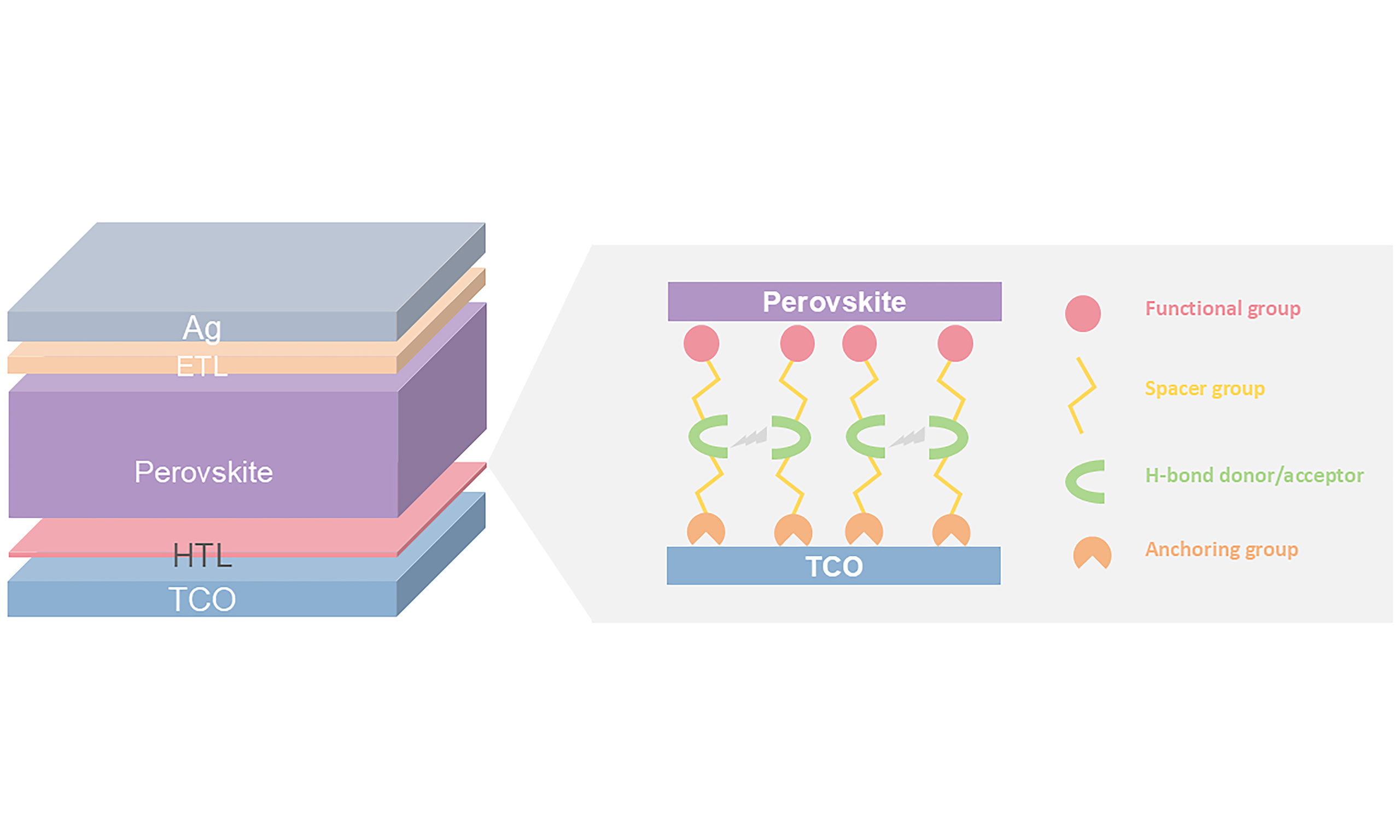
Perovskite solar cells have attracted tremendous attention over the past decade owing to the rapid increase in power conversion efficiency[1]. Among numerous innovative breakthroughs, the performance improvement of inverted perovskite devices is largely attributed to incorporation of self-assembled monolayers (SAMs)[2-4]. SAM-based hole-selective contact offers the advantages of a uniformly coated layer with minimized thickness[5,6], easily tunable energy levels, favorable surface state for perovskite deposition, and efficient passivation at buried interface[7,8], thereby supporting the enhancement of short-circuit current density (JSC), open-circuit voltage (VOC), and fill factor (FF). The molecular structure of SAMs generally consists of three parts: terminal groups with carbazole and other moieties as the core, conjugated or non-conjugated linking groups[9-11], and anchoring groups capable of chemically adsorbing onto the surfaces of metal oxides[12-14]. Each of these parts can be readily tailored for further improvement[15-17].
Intermolecular interactions of SAMs dominate molecular packing and further govern the uniformity and coverage of the hole-transporting layer (HTL), which has remained a key research focus[18,19]. Hydrogen bonds are typical strong intermolecular dipole interactions, which commonly exist among organic molecules containing heteroatoms such as N, O, and F[20]. Writing in Nature Energy, Wang et al. developed a bicarbazole-based dimeric self-assembled molecule (AOCzPA) incorporating amide units as hydrogen-bond donors and acceptors, which forms extensive hydrogen-bond networks within the molecular layer[21]. Such a design effectively promotes homogeneous molecular arrangement, minimizes hole-transport losses, and suppresses non-radiative recombination at the interface.
The authors rationally introduced amide groups as both hydrogen-bond donors and acceptors into the linker of bicarbazole-based SAM molecules [Figure 1A]. By forming intra- and intermolecular hydrogen-bond networks [Figure 1B], the modified SAM exhibits significantly enhanced binding strength within the molecular layer. Such multi-site hydrogen-bonding interactions effectively mitigate excessive molecular aggregation and promote uniform, compact molecular assembly across the substrate. As directly visualized in the 2D 1H–1H NOESY NMR spectrum [Figure 1C], distinct spatial correlations between amide protons and neighboring alkyl protons confirm the formation of the designed hydrogen-bond networks. This unique structural regulation facilitates homogeneous molecular arrangement, optimizes interfacial contact, and establishes the foundation for efficient hole extraction and interfacial stability.
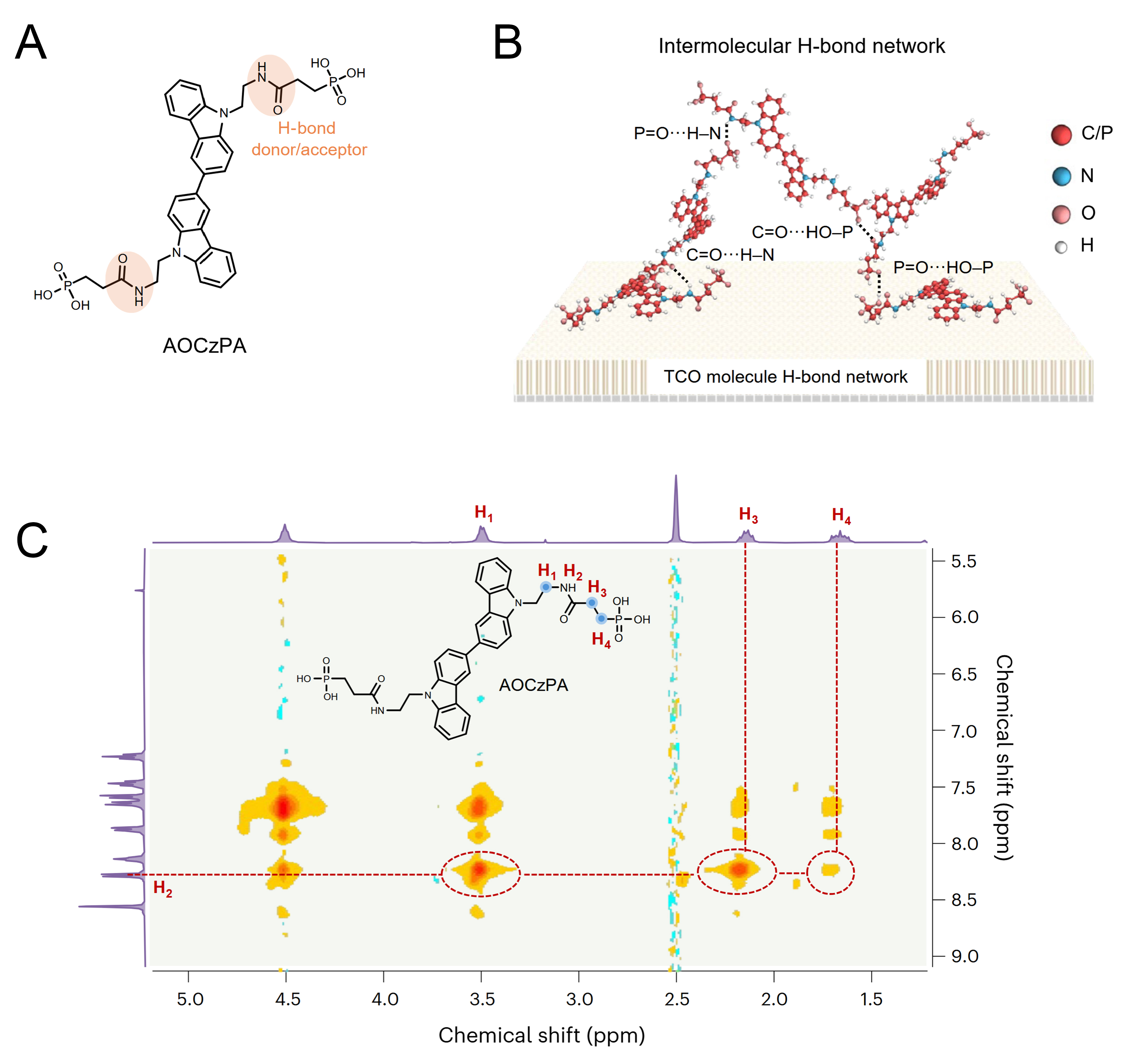
Figure 1. (A) The chemical structure and design rules of 4PACz, 4BCzPA and AOCzPA; (B) A schematic diagram of the construction of hydrogen-bond networks in AOCzPA; (C) Two-dimensional 1H–1H NOESY NMR spectra of AOCzPA in DMSO-d6. This figure is quoted with permission from[21], Copyright Springer Nature. NMR: Nuclear magnetic resonance.
Molecular dynamics simulations demonstrate that the intra- and intermolecular hydrogen-bond networks within the amide-incorporated SAM effectively regulate the entire molecular assembly process [Figure 2A]. The multi-type hydrogen-bonding interactions promote uniform molecular coverage [Figure 2B], enhance molecular stacking order, and strengthen interconnection between adjacent molecules. Notably, oligomer distribution analysis [Figure 2C] shows that AOCzPA enables the formation of larger molecular aggregates, confirming the effective intermolecular interactions enabled by hydrogen-bond networks. Four distinct types of hydrogen bonds with well-defined hydrogen-bonding modes are identified with favorable binding energies [Figure 2D and E], which synergistically enhance molecular connectivity and homogeneity, ensure optimized molecular orientation and improved interfacial contact, ultimately providing a high-quality hole-transporting interface for efficient charge extraction and reduced interfacial loss.
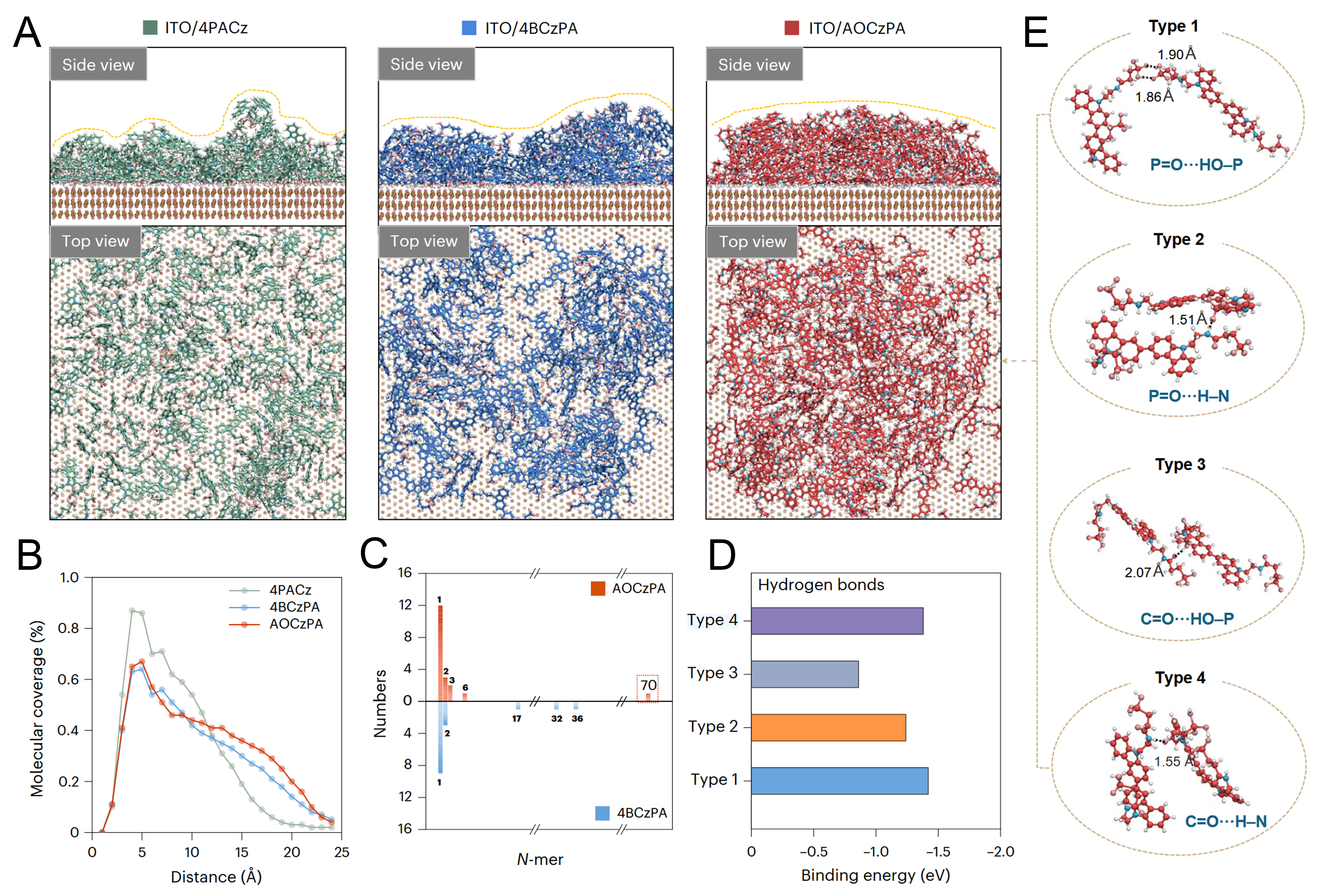
Figure 2. (A) Top and side views of equilibrated molecular representations of SAMs by simulations. The yellow dash line demonstrates the uniformity of molecular stacking height from a side view; (B) The changes of molecular coverages with the increasing distance between the molecular layer and the substrate; (C) The number and type of oligomers formed in 4BCzPA and AOCzPA; (D) The DFT-calculated binding energies of four types of hydrogen-bonds in AOCzPA; (E) The interaction models of four types of hydrogen-bonds extracted from MD simulations of (A). This figure is quoted with permission from[21]. Copyright Springer Nature. SAMs: Self-assembled monolayers; DFT: density functional theory; MD: molecular dynamics; ITO: indium tin oxide.
Confocal photoluminescence (PL) mapping [Figure 3A] directly visualizes the uniform carrier extraction of the perovskite film deposited on AOCzPA- based HTL, presenting remarkably reduced and homogeneous PL intensity compared to 4PACz and 4BCzPA references. Time-resolved photoluminescence (TRPL) measurements further verify that AOCzPA accelerates hole extraction with a significantly shortened carrier lifetime, which indicates that the well-established hydrogen-bonding interactions decrease charge-transport losses [Figure 3B]. Benefiting from these improvements, the 1.77 eV wide-bandgap perovskite solar cell delivers a champion efficiency of 21.56% and the integrated all-perovskite tandem solar cell yields an outstanding efficiency of 30.19% [Figure 3C], with negligible hysteresis and excellent operational stability that retains 90% of its initial efficiency after 638 h of continuous 1-sun illumination. More importantly, the hydrogen-bonding design strategy demonstrates remarkable universality, achieving high performance in perovskite solar cells with bandgaps of 1.56 and 1.68 eV, all exceeding 87% of the Shockley–Queisser limit for the open-circuit voltage-fill factor (VOC–FF) product [Figure 3D]. This study provides a reliable and versatile interfacial engineering route toward highly efficient and stable perovskite single-junction and tandem photovoltaic devices.
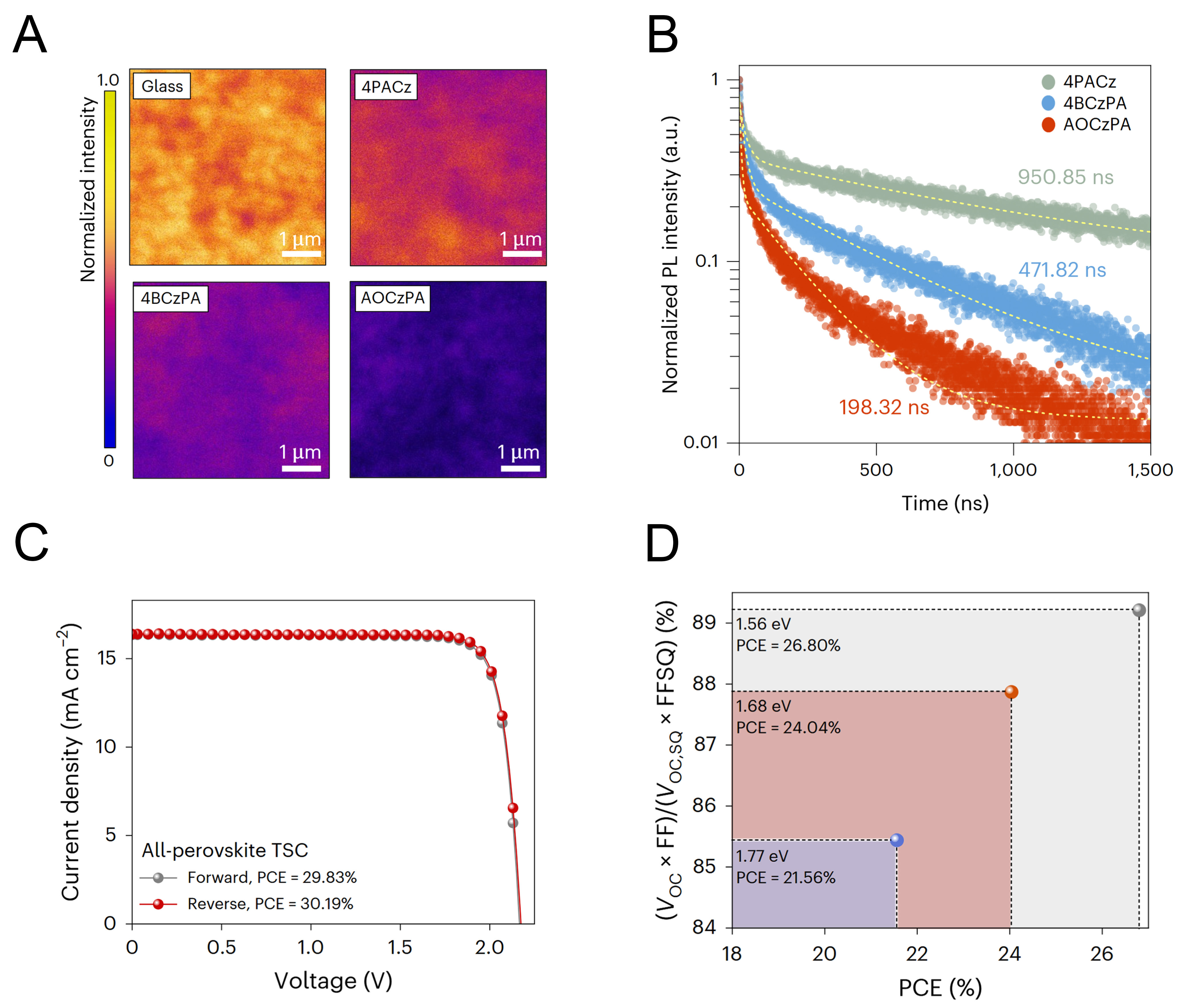
Figure 3. (A) Confocal PL mapping (5 μm × 5 μm) of perovskite films deposited on glass and varying SAM substrates; (B) TRPL spectra of perovskite films prepared on varying SAMs; (C) J–V curves of the champion tandem cell under reverse and forward scans; (D) The PCE of PSCs with bandgaps of 1.56, 1.66 and 1.77 eV, respectively. This figure is quoted with permission from[21], Copyright Springer Nature. PL: Photoluminescence; SAM: self-assembled monolayer; TRPL: time-resolved photoluminescenc; PCE: power conversion efficiency; PSCs: perovskite solar cells; TSC: tandem solar cell; VOC: open-circuit voltage; FF: fill factor; FFSQ: the Shockley-Queisser limit of FF.
This work by Wang et al. reveals a critical insight: hydrogen-bond diversity governs the assembly dynamics of SAMs[21]. The amide–phosphonic acid synergy creates a hydrogen-bonding network that opens a new dimension for molecular design: programming hydrogen-bond topology to control molecular arrangement and charge dynamics, offering a route to enhance efficiency and stability in single-junction and tandem perovskite devices. Building on the above discussion, it becomes clear that hydrogen-bonding emerges as an applicable principle in SAM design. Such hydrogen-bond engineering provides evidence for a transferable strategy, rather than a case-specific phenomenon.
Recently, our team also reported a dual-function hydrogen-bonding design in SAMs [Figure 4A], which similarly shows that incorporating hydrogen bonds into anchoring groups reduces aggregation in the SAM solution, accelerates condensation with indium tin oxide (ITO), and promotes ordered intermolecular packing, ultimately strengthening interfacial thermal stability[21]. The tailored structure imposes steric constraints, enabling a favorable mono-anchored configuration that promotes uniform packing [Figure 4B]. Upon heating, the H-bonds temporarily break to relieve thermal stress, and they fully restore upon cooling, contributing to enhanced thermal stability and improved structural stability of the SAM [Figure 4C].
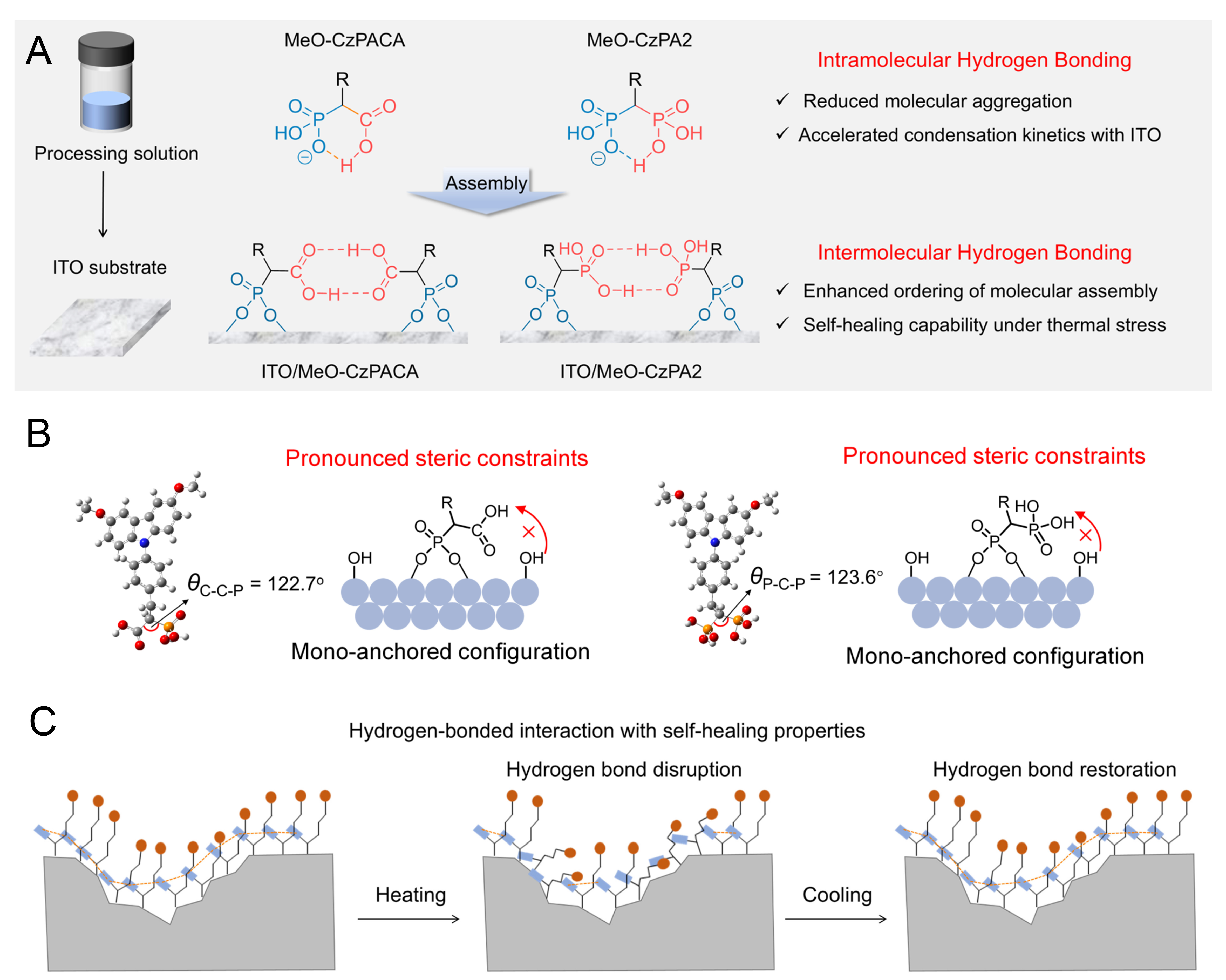
Figure 4. (A) The cooperative effect of intramolecular hydrogen-bonding in processing solution and intermolecular hydrogen-bonding on ITO surface leads to the formation of a molecular layer with both increased assembly density and enhanced assembly stability; (B) SAMs Structure of MeO-CzPACA and MeO-CzPA2 binding to ITO surfaces; (C) Schematic illustration of structure changes for SAMs with or without intermolecular hydrogen bonds after heating and cooling. This figure is quoted with permission from[22], Copyright American Chemical Society. ITO: Indium tin oxide; SAMs: self-assembled monolayers.
From the perspective of rational molecular engineering, tuning hydrogen-bond networks represents a powerful method for constructing reliable buried interfaces toward high performance perovskite optoelectronic devices. While hydrogen-bond engineering has demonstrated advantages in optimizing interfacial properties and boosting the performance of perovskite solar cells, some limitations that hinder its widespread application remain to be solved. First, whether the same molecular design yield different interfacial effects on different substrates with varying roughness requires further exploration. Second, the impact of strong intermolecular hydrogen bonds on the aggregation behavior of SAM molecules in solution still should be further investigated. Third, the inherent stability of hydrogen bonds is expected to withstand rigorous testing under extreme conditions such as elevated temperatures and continuous electrical operation. Finally, extensive exploration is still required to clarify how broadly this design strategy can be transferred to diverse SAM molecular structures and state-of-the-art perovskite compositions.
The rational design of hydrogen bonds within SAM delivers multiple functions. On one side, it enables SAM to distribute more uniformly and densely on the substrate, thereby achieving superior hole transport performance. On the other side, it can boost Brønsted acidity to facilitate condensation reactions between the SAM and the substrate. Meanwhile, it strengthens the ordering of molecular self-assembly, which serves to resist damage to HTL induced by external stress. The work by Wang et al. and us underscores the potential of rational hydrogen-bond engineering, offering new insights into advancing efficient, stable, and scalable hole-transporting materials for next-generation perovskite optoelectronic devices[21].
DECLARATIONS
Authors’ contributions
Conception: Wu, Y.; Zhang, L.; Yang, H.
Study design: Wu, Y.; Zhang, L.
Writing the original drafts: Zhang, L.
Funding acquisition: Wu, Y.
Technical support: Zhang, L.
Revision: Wu, Y.; Yang, H.
Availability of data and materials
Not applicable.
AI and AI-assisted tools statement
Not applicable.
Financial support and sponsorship
This work is financially supported by the National Natural Science Foundation of China (No. 22425502).
Conflicts of interest
Yang, H. is affiliated with NingDe Advanced Material Tech Co., LTD. The other authors declared no conflicts of interest.
Ethical approval and consent to participate
Not applicable.
Consent for publication
Not applicable.
Copyright
© The Author(s) 2026.
REFERENCES
1. Green, M. A.; Dunlop, E. D.; Yoshita, M.; et al. Solar cell efficiency tables (Version 67). Prog. Photovolt. Res. Appl. 2026, 34, 482-96.
2. Al-Ashouri, A.; Köhnen, E.; Li, B.; et al. Monolithic perovskite/silicon tandem solar cell with >29% efficiency by enhanced hole extraction. Science 2020, 370, 1300-9.
3. Al-Ashouri, A.; Magomedov, A.; Roß, M.; et al. Conformal monolayer contacts with lossless interfaces for perovskite single junction and monolithic tandem solar cells. Energy. Environ. Sci. 2019, 12, 3356-69.
4. Magomedov, A.; Al‐Ashouri, A.; Kasparavičius, E.; et al. Self‐assembled hole transporting monolayer for highly efficient perovskite solar cells. Adv. Energy. Mater. 2018, 8, 1801892.
5. He, R.; Wang, W.; Yi, Z.; et al. Improving interface quality for 1-cm2 all-perovskite tandem solar cells. Nature 2023, 618, 80-6.
6. Li, Z.; Sun, X.; Zheng, X.; et al. Stabilized hole-selective layer for high-performance inverted p-i-n perovskite solar cells. Science 2023, 382, 284-9.
7. Tian, C.; Sun, A.; Chen, J.; et al. Photostable donor–acceptor interface for minimizing energy loss in inverted perovskite solar cells. Nat. Photon. 2026, 20, 287-95.
8. Liu, S.; Li, J.; Xiao, W.; et al. Buried interface molecular hybrid for inverted perovskite solar cells. Nature 2024, 632, 536-42.
9. Tang, H.; Shen, Z.; Shen, Y.; et al. Reinforcing self-assembly of hole transport molecules for stable inverted perovskite solar cells. Science 2024, 383, 1236-40.
10. Truong, M. A.; Funasaki, T.; Ueberricke, L.; et al. Tripodal triazatruxene derivative as a face-on oriented hole-collecting monolayer for efficient and stable inverted perovskite solar cells. J. Am. Chem. Soc. 2023, 145, 7528-39.
11. Zhao, K.; Liu, Q.; Yao, L.; et al. peri-Fused polyaromatic molecular contacts for perovskite solar cells. Nature 2024, 632, 301-6.
12. Fei, C.; Kuvayskaya, A.; Shi, X.; et al. Strong-bonding hole-transport layers reduce ultraviolet degradation of perovskite solar cells. Science 2024, 384, 1126-34.
13. Fei, C.; Zhang, Y.; Wang, M.; et al. Limiting phosphonic acid interlayer-perovskite reactivity to stabilize perovskite solar modules. Science 2026, 391, eadz7969.
14. Yang, Y.; Shi, X.; Stein, A. N.; Lockett, M. R.; Huang, J. Understanding phosphonic‐acid molecules based hole transport layers in perovskite solar cells. Adv. Energy. Mater. 2026, 16, e05937.
15. Jiang, W.; Li, F.; Li, M.; Qi, F.; Lin, F. R.; Jen, A. K. π‐Expanded carbazoles as hole‐selective self‐assembled monolayers for high‐performance perovskite solar cells. Angew. Chem. Int. Ed. Engl. 2022, 61, e202213560.
16. Wu, H.; Wu, J.; Zhang, Z.; et al. Tailored lattice-matched carbazole self-assembled molecule for efficient and stable perovskite solar cells. J. Am. Chem. Soc. 2025, 147, 8004-11.
17. Zhu, J.; Luo, Y.; He, R.; et al. A donor–acceptor-type hole-selective contact reducing non-radiative recombination losses in both subcells towards efficient all-perovskite tandems. Nat. Energy. 2023, 8, 714-24.
18. Feng, Q.; Liu, K.; Wang, D.; et al. Amorphous self-assembled multilayers for perovskite solar cells with improved reverse bias stability. Nat. Energy. 2026, 11, 830-42.
19. Yang, W.; Guan, X.; Cai, Q.; et al. Axially chiral molecular contacts with low isomerization barriers for perovskite solar cells. Nat. Photon. 2026, 20, 232-40.
20. Liu, Y.; Wang, L.; Zhao, L.; Zhang, Y.; Li, Z. T.; Huang, F. Multiple hydrogen bonding driven supramolecular architectures and their biomedical applications. Chem. Soc. Rev. 2024, 53, 1592-623.
21. Wang, D.; Liu, Z.; Gao, Z.; et al. Self-assembled molecules with hydrogen-bond networks enable efficient all-perovskite tandem solar cells. Nat. Energy. 2026, 11, 436-48.
Cite This Article
 Open Access
How to Cite
Download Citation
Export Citation File:
Type of Import
Tips on Downloading Citation
Citation Manager File Format
Type of Import
Direct Import: When the Direct Import option is selected (the default state), a dialogue box will give you the option to Save or Open the downloaded citation data. Choosing Open will either launch your citation manager or give you a choice of applications with which to use the metadata. The Save option saves the file locally for later use.
Indirect Import: When the Indirect Import option is selected, the metadata is displayed and may be copied and pasted as needed.
About This Article
Copyright

Data & Comments
Data
0








Comments
Comments must be written in English. Spam, offensive content, impersonation, and private information will not be permitted. If any comment is reported and identified as inappropriate content by OAE staff, the comment will be removed without notice. If you have any queries or need any help, please contact us at support@oaepublish.com.