
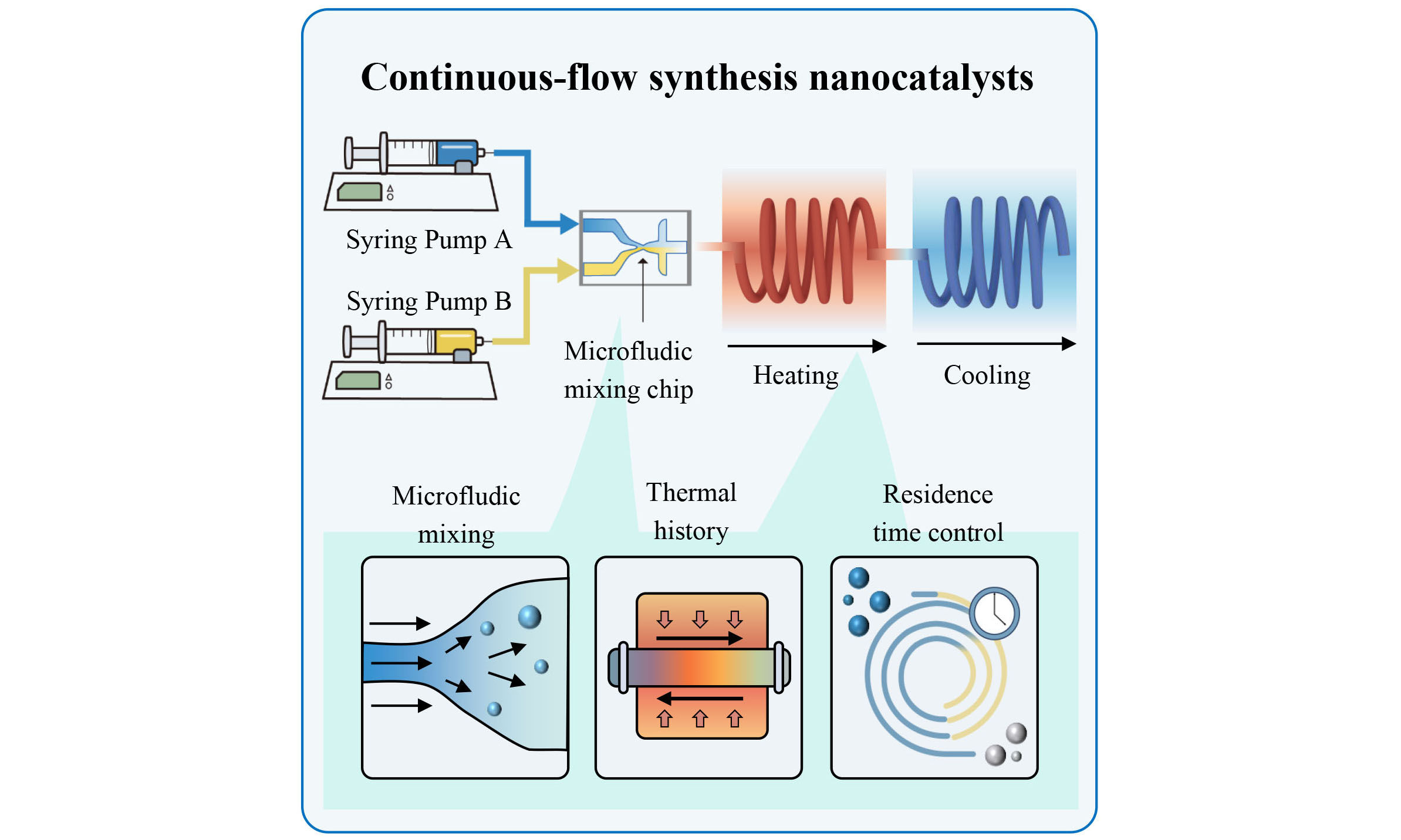
Continuous-flow nanocatalyst synthesis from reaction engineering to scalable manufacturing
 0
0 
Abstract
Nanocatalysts are critical to energy, chemical, and environmental technologies, but their broader use requires scalable and reproducible manufacturing with precise structural control. Continuous-flow synthesis provides a compelling method that enables programmable reaction environments with well-defined mixing and heat transfer conditions, thereby allowing tighter control over nanostructure formation. In this study, a reaction engineering approach is used to investigate the continuous-flow synthesis of nanocatalysts. First, we elaborate on how key factors, such as mixing dynamics, residence time distribution, thermal history, interfacial confinement and external energy input, regulate nucleation, crystal growth, defect formation, interface construction and multicomponent assembly. Second, we then discuss how this flow environments support structural control across increasing levels of complexity, from primary nanostructures to interfacial and multicomponent structures and ultimately to catalyst-level structural integration. Last, we consider the main challenges to manufacturing translation, such as reactor fouling and clogging, process drift, loss of reproducibility during sustained operation, and difficulties preserving structural fidelity during scale-up and downstream catalyst handling. These advancements make continuous-flow synthesis a critical bridge between reaction engineering, nanocatalyst design, and scalable catalyst manufacturing.
Keywords
INTRODUCTION
Catalysts are critical in a wide range of chemical processes, including organic synthesis[1], environmental remediation[2], energy conversion[3] and emerging biorelated systems[4]. Nanocatalysts have garnered much attention because reducing catalyst dimensions to the nanoscale alters surface atomic configurations and electronic structures, which improves catalytic activity, selectivity, and stability[5-9]. Notably, the performance of nanocatalysts is highly sensitive to structural features such as particle size and size distribution, exposed crystal facets, defect density, composition, and interfacial structure[10-14]. Therefore, precise control of these structural attributes during synthesis is essential to the rational design of catalytic materials.
This requirement also makes nanocatalyst synthesis a reaction engineering challenge. Catalytic nanostructures form via a series of transient and closely coupled processes, such as precursor mixing, supersaturation development, nucleation, crystal growth, and interfacial reconstruction. All these processes are controlled by local reaction conditions[15-19]. In conventional batch systems, these processes are often poorly controlled because limited heat and mass transfer generate nonuniform temperature and concentration fields, broadening local reaction histories and promoting temporal and spatial overlap between nucleation and growth[20-24]. As a result, batch synthesis often produces materials with broad structural distributions, limited reproducibility and poor scalability, whereas harsh conditions, long reaction times and safety concerns further limit practical production.
Continuous-flow synthesis provides a compelling approach to overcome these limitations by enabling programmable reaction environments with well-defined mixing and heat transfer conditions. Precisely regulating nanostructure formation - via improved control of residence time, reactant delivery, interfacial confinement, and external energy input - expands the design space for catalytic materials[25,26]. Several excellent studies have summarized the application of microfluidics and continuous-flow technologies for nanoparticle synthesis, focusing on reactor configurations[27], synthesis methodologies[28], material categories[29], and the advantages of flow processing[30] over conventional batch approaches. These studies provide useful examples for nanomaterial synthesis using flow systems. However, the present study gives minimal attention to the reaction engineering principles in terms of nanostructure formation and their application in large-scale manufacturing.
In this study, we use a reaction engineering approach to examine continuous-flow nanocatalyst synthesis. Rather than classifying synthesis examples according to material type or reactor design, we focus on how key reaction engineering factors, such as mixing dynamics, residence-time distribution, thermal history, interfacial confinement, and external energy input, control nucleation, growth, defect formation, interface construction, and multicomponent assembly. Furthermore, we extend the discussion beyond nanoparticle synthesis itself to consider how these structure-forming mechanisms affect catalyst-level structural integration, process stability, and scalable manufacturing. By connecting nanostructure formation to manufacturing requirements, we provide a conceptual framework that links reaction engineering, nanocatalyst design, and industrially relevant catalyst production.
WHY NANOCATALYST SYNTHESIS IS A REACTION ENGINEERING PROBLEM
The catalytic performance of nanocatalysts is highly sensitive to structural features formed during synthesis. Unlike bulk catalysts, whose properties are often controlled by their composition and average phase structure, nanocatalysts have size-dependent and interface-dependent characteristics, such as particle size and size distribution[31], exposed crystal facets[32], defect density[33], compositional homogeneity and heterointerfacial structure[34,35]. These characteristics directly affect not only the density, accessibility and electronic structure of active sites but also activity, selectivity and stability in catalytic reactions[36]. Therefore, the synthesis of nanocatalysts involves not only the production of the target material but also the construction of specific structural states to yield the required catalytic function.
These structural states emerge through dynamic processes that evolve across short spatial and temporal scales. The formation of nanoparticles typically involves precursor accumulation, supersaturation development, nucleation, crystal growth, and subsequent structural evolution [Figure 1], all of which are significantly affected by local reaction conditions[37-39]. In idealized solution-phase synthesis, a rapid and temporally concentrated nucleation event followed by a separate growth stage can generate particles with narrow size distributions and uniform structures. In practice, the formation of catalytic nanostructures relies not only on the basic composition of precursors but also on the order, duration, and spatial distribution of the above basic reactions. With respect to nanocatalysts, minor changes in growth kinetics, local redox atmosphere, or interfacial evolution may change the exposed crystal facets, vacancy density, alloy state, and interfacial structure and cause distinct catalytic performance[40-42].
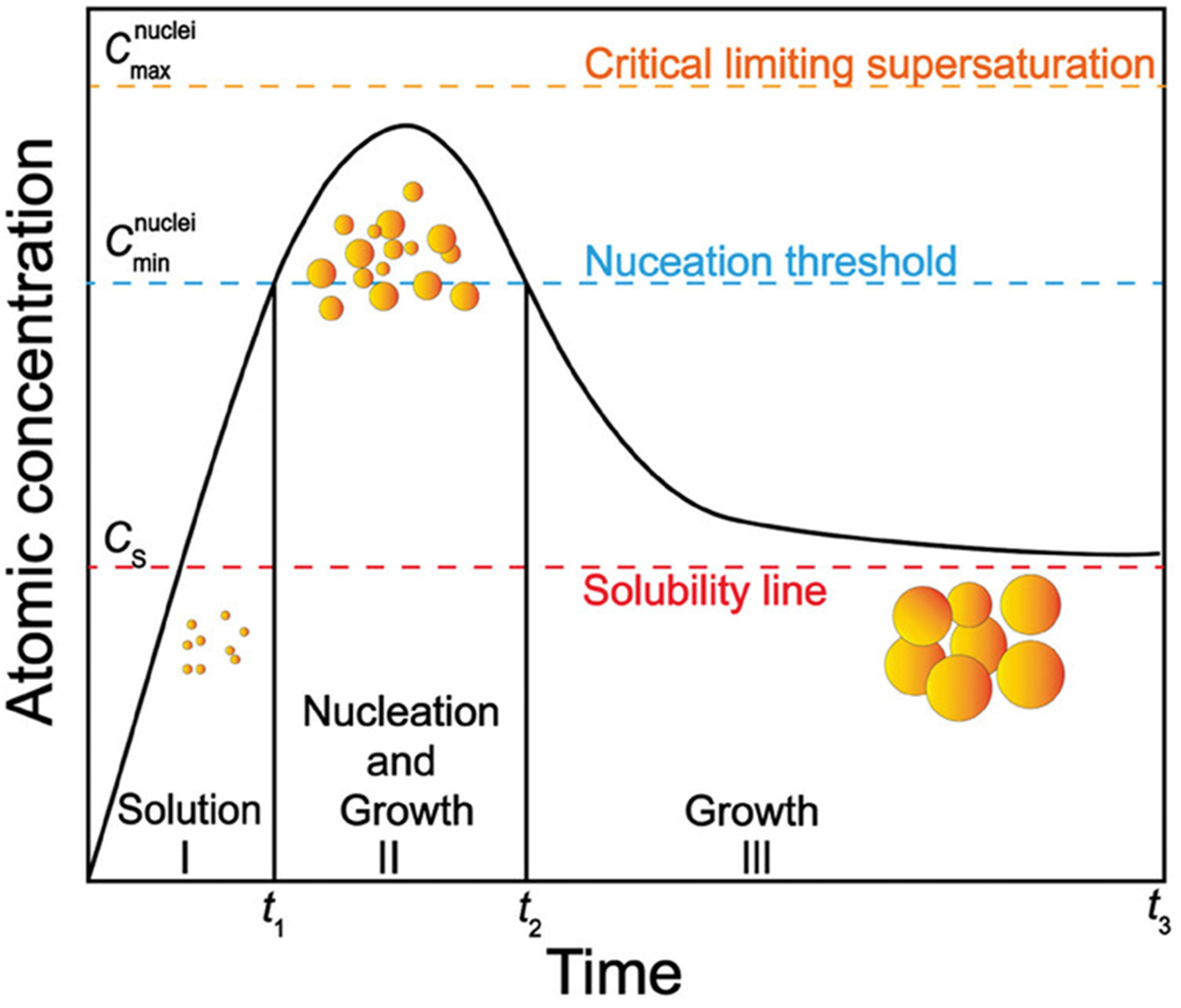
Figure 1. Illustration of the nanoparticle formation process based on the LaMer model. Adapted with permission from ref.[37]. Copyright 2024, Wiley.
In conventional batch systems, these processes are often difficult to accurately control. Limited heat and mass transfer can generate nonuniform temperature and concentration fields throughout the reactor, resulting in extensive local supersaturation distributions and asynchronous precursor conversion. Under these conditions, nucleation may begin earlier in some regions, whereas others remain in the precursor accumulation stage, resulting in temporal and spatial overlap between nucleation and growth[38]. This often results in extensive particle growth histories and increases structural heterogeneity. In multicomponent systems, the problem becomes even more distinct because differences in precursor reactivity, reduction kinetics, or deposition pathways can further complicate the formation of well-defined interfaces and compositional order[43]. Therefore, many of the limitations associated with batch nanocatalyst synthesis stem not only from chemical complexity but also from insufficient control of the local environments in which structure formation occurs.
Nanocatalyst synthesis is a reaction engineering problem. The key challenge is to define and regulate the local reaction histories that control supersaturation, nucleation, growth, defect generation, and interface evolution rather than merely selecting appropriate precursor chemistries[44]. This requirement places transport processes, thermal management, residence time and interfacial conditions at the center of catalyst synthesis. This requirement also explains why conventional batch approaches often fail to yield both precise structural control and scalable reproducibility. Continuous-flow synthesis has been given much attention because it provides more programmable reaction environments in which these variables can be better controlled. Understanding nanocatalyst synthesis in terms of reaction engineering provides a conceptual basis for analyzing why flow systems are particularly suitable for the controllable and scalable production of catalytic nanostructures.
REACTION ENGINEERING MECHANISMS THAT GOVERN NANOSTRUCTURE FORMATION
Continuous-flow synthesis provides more than a reduction in reactor size or a change in operating mode. The main advantage of continuous-flow synthesis is the ability to define the local reaction environment more accurately than in conventional batch systems. This advantage is particularly important for nanocatalyst synthesis, where particle formation is highly sensitive to transient concentration fields, transport processes, and thermal fluctuations[45,46]. Several key factors control nanostructure evolution under flow, such as mixing and supersaturation, residence time and residence-time distribution, thermal history, interfacial confinement and external energy input[47]. These factors determine the sequence and uniformity of nucleation, growth, defect formation and interface evolution.
Mixing is a primary determinant because it controls how rapidly precursor species come into contact and how quickly local supersaturation is established. In systems that involve fast reduction, hydrolysis, or precipitation, small differences in mixing time can significantly affect the nucleation density and width of the particle size distribution [Figure 2A-C][48,49]. Rapid and homogeneous mixing can compress the nucleation window and promote more synchronized particle formation, whereas slow or nonuniform mixing expands local concentration fields and allows continuous nucleation and uneven growth to occur simultaneously [Figure 2D][50,51]. Mixing and supersaturation jointly define the initial reaction history of nanocatalyst formation. Owing to the variability of precursor chemistries and particle formation pathways, a universal quantitative correlation between mixing efficiency and nucleation rate has not been established. Nevertheless, several reaction engineering descriptors, including mixing time, micromixing efficiency, Damköhler-type analyses, and supersaturation evolution, are typically used to analyze this relationship. In particular, the relative timescales of mixing and nucleation play a critical role in determining supersaturation development and nucleation kinetics[52,53]. When mixing occurs faster than nucleation, supersaturation can be generated more uniformly throughout the reactor, resulting in a temporally compressed nucleation event and narrower particle size distributions. Conversely, insufficient or nonuniform mixing may result in local concentration gradients, sustained nucleation periods, and increased structural heterogeneity[54,55].
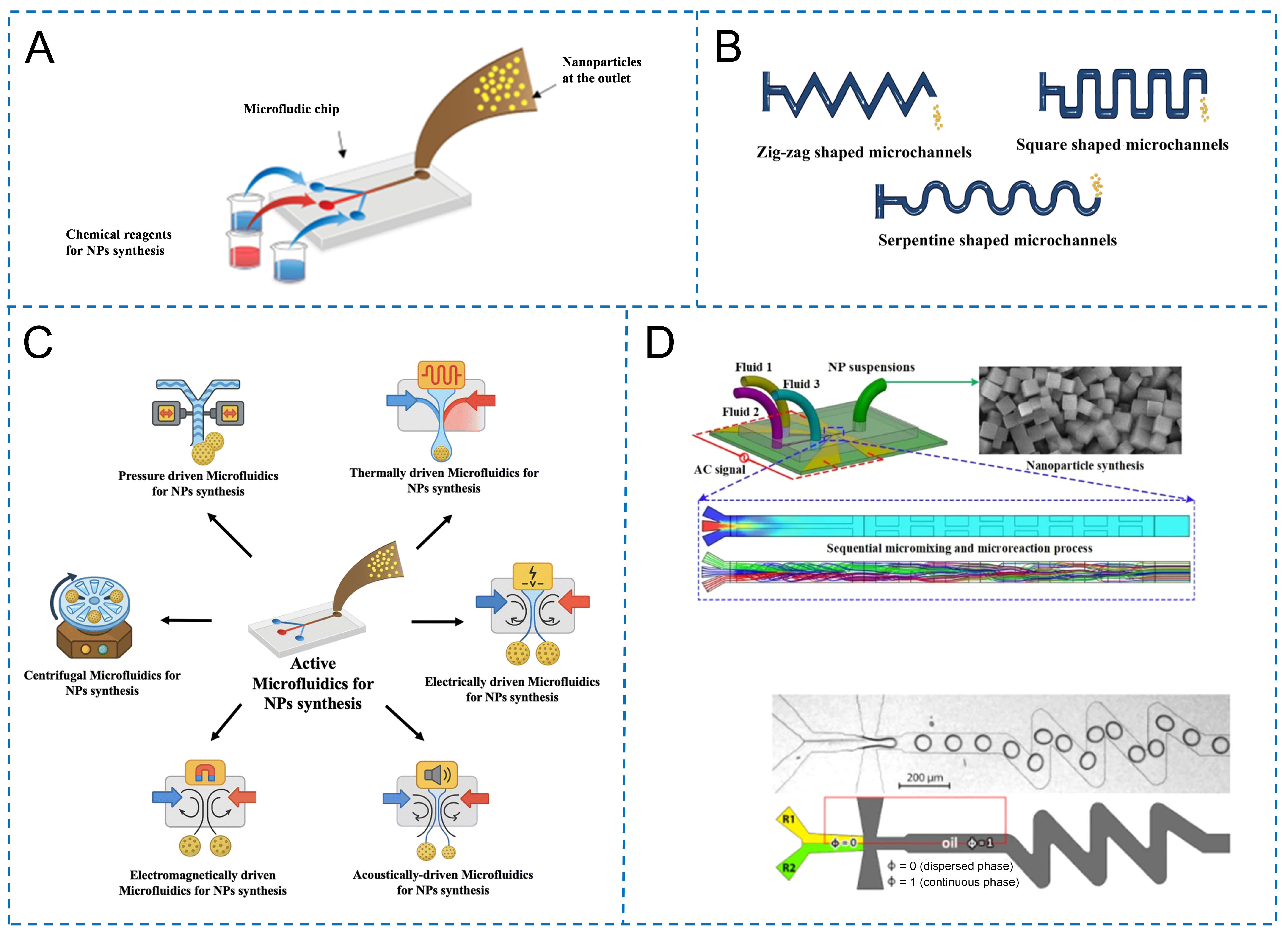
Figure 2. (A) Schematic of NP synthesis in a microfluidic channel; (B) schematic of differently shaped microchannels; and (C) schematic description of NP generation in different passive and active microfluidic devices. (A-C) adapted from ref.[49]. Copyright 2025, The Royal Society of Chemistry; (D) Microchannel reactor for nanoparticle preparation. Adapted with permission from ref.[51]. Copyright 2022, Springer Nature. NP: Nanoparticle; AC: alternating current.
Residence time and residence-time distribution provide a second level of control by determining how long particles experience a given reaction environment and how uniformly those histories are shared across the system[56]. A narrow residence-time distribution is especially valuable because it reduces disparities in growth duration and produces more uniform nanostructures [Figure 3A and B][57,58]. Thermal history significantly affects precursor decomposition, crystallization, phase transformation, and defect generation, specifically for oxide and multicomponent catalysts [59,60]. Compared with traditional batch reactors, continuous-flow reactors involve faster heat transfer and more stable temperature conditions, thus enabling better control of the above processes and greater structural reproducibility.
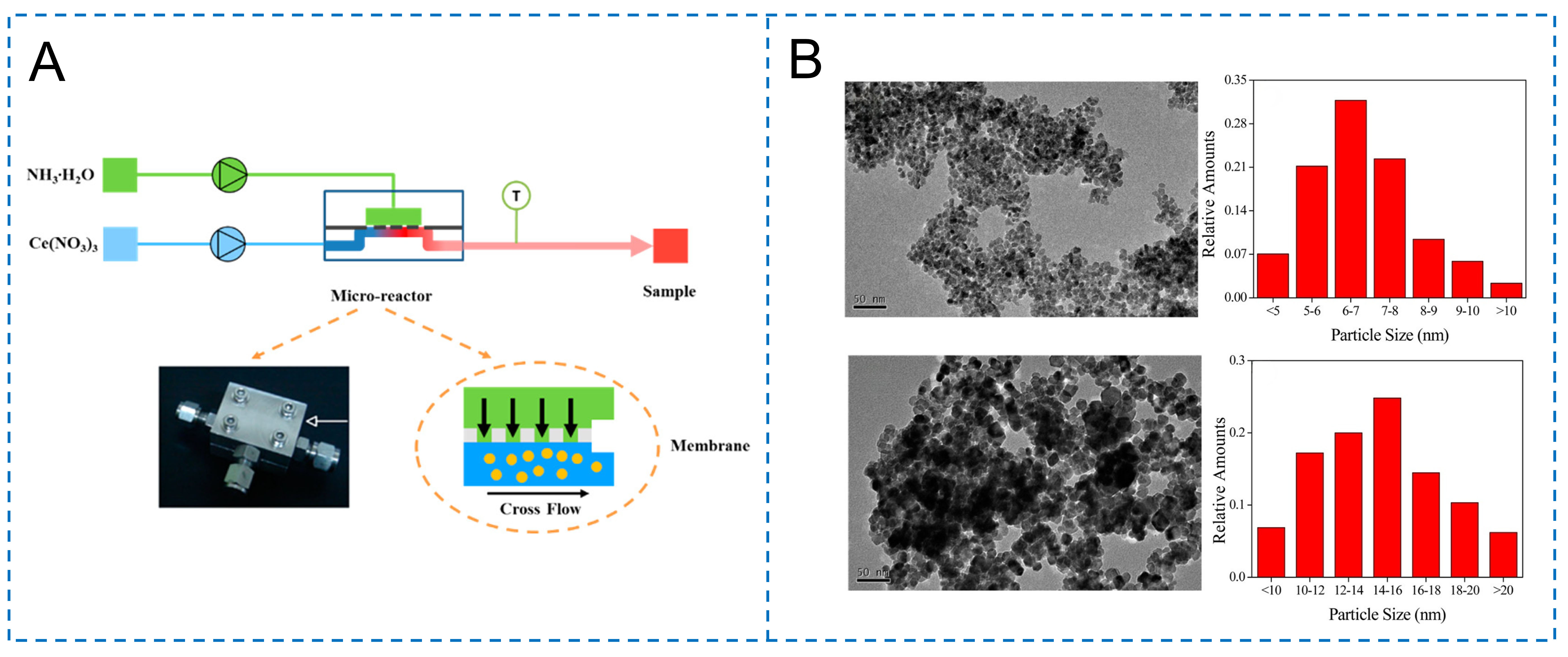
Figure 3. (A) Continuous-flow experimental setup for CeO2 nanoparticle preparation; (B) HRTEM images and SAED pattern of CeO2 nanoparticles. (A and B) adapted from ref.[58]. Copyright 2017, American Chemical Society. HRTEM: High-resolution transmission electron microscopy; SAED: selected area electron diffraction.
Thermal history is critical role in defect formation and stabilization in oxide nanocatalysts. Continuous-flow synthesis involves rapid heating and quenching. The short thermal treatment time promotes kinetically controlled crystallization, so defects, such as oxygen vacancies, lattice distortion, and nonstoichiometric domains, can be retained before the system reaches thermodynamic equilibrium[61,62]. Consequently, flow-synthesized oxides often have higher concentrations of metastable defects that can improve catalytic activity. In contrast, batch crystallization typically involves slower heating rates and longer residence times at higher temperatures, promoting atomic diffusion, defect migration, and lattice reorganization[63-65]. These processes facilitate defect annihilation and structural ordering, resulting in lower defect densities and more thermodynamically stable crystal structures. Therefore, thermal history controls the balance between defect generation and defect annihilation, directly affecting defect concentration, local electronic structure, and ultimately catalytic performance.
Interfacial confinement and external energy input further expand the controllable synthesis space in flow systems. In multiphase or segmented-flow reactors, droplets, slugs, and fluid interfaces create confined reaction domains that regulate transport, inhibit aggregation, and facilitate the formation of more uniform particles, shells, and heterointerfaces [Figure 4A-C][66-68]. External inputs [Figure 4D][69], such as ultrasound, microwave irradiation, light and laser fields, use additional kinetic and thermal control, allowing access to nonequilibrium growth pathways that are difficult to achieve under conventional conditions. Collectively, these factors define the local reaction histories experienced by the formation of nanocatalysts in flow and provide a basis for understanding how continuous-flow synthesis can be used to control specific structural targets.
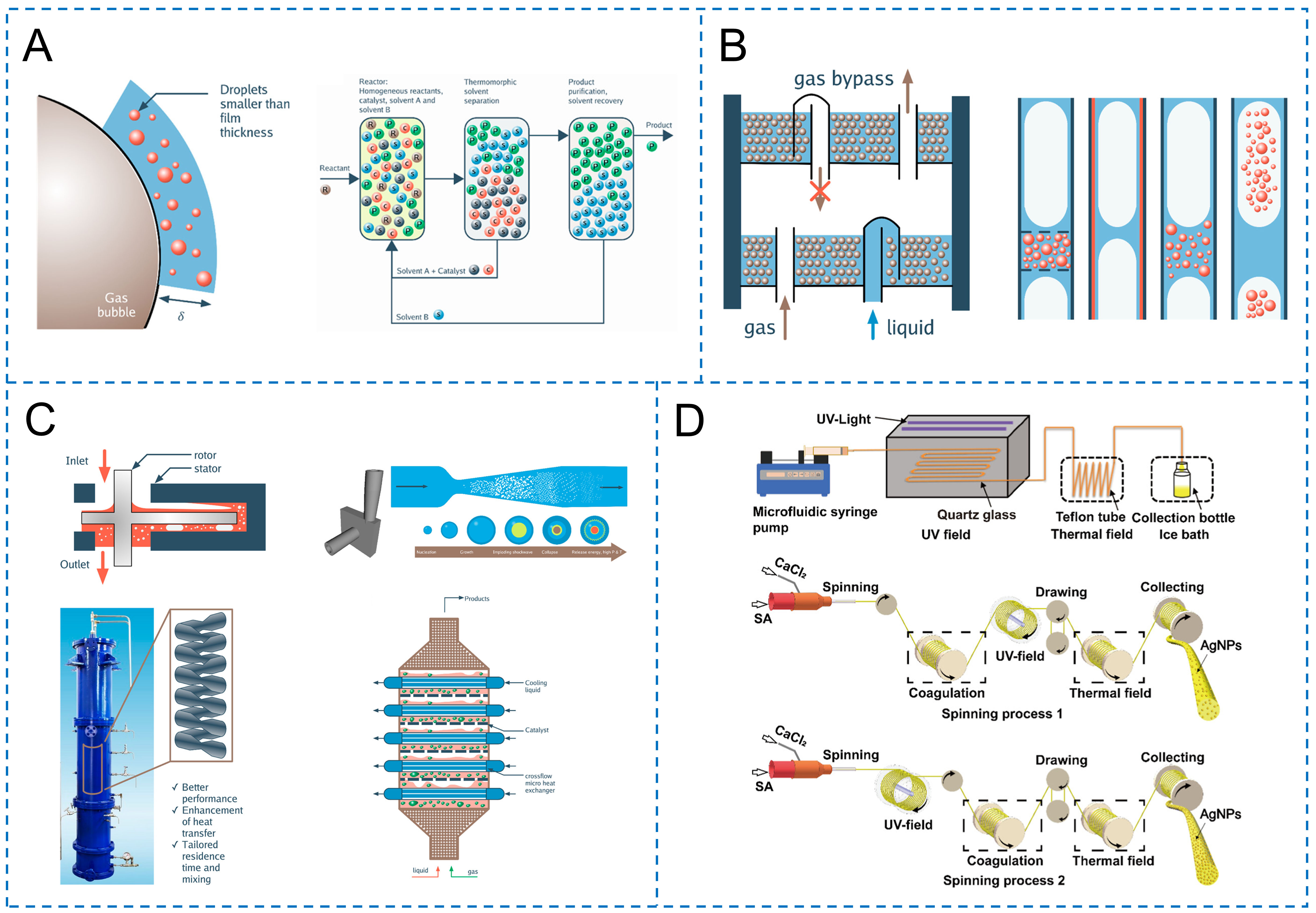
Figure 4. (A) Schematic showing the addition of a solvent to increase the reaction efficiency; (B) schematic showing increased interphase contact; and (C) multiphase reactors for improved reactions. (A-C) adapted from ref.[68]. Copyright 2006, American Chemical Society; (D) Schematic of a microfluidic system coupled with UV/thermal fields for Ag NP synthesis. Adapted with permission from ref.[69]. Copyright 2025, American Chemical Society. NP: Nanoparticle; UV: ultraviolet.
These mechanistic differences in local reaction histories can be further substantiated and quantitatively evaluated by comparing key performance indicators between batch and continuous-flow synthesis under otherwise identical chemical systems. Maintaining consistent chemical system and reaction parameters is essential. Under identical precursors and reaction conditions, parallel experimental studies demonstrate that batch synthesis inevitably produces nanocatalysts with a larger particle size coefficient of variation, which is a direct consequence of expanded concentration and temperature fields inside the reactor[70,71]. More importantly, the asynchronous precursor conversion in batch reactors causes substantial temporal overlap between nucleation and growth. Owing to the rapid and uniform mixing as well as the well-defined residence-time distribution, continuous-flow synthesis results in synchronous nucleation across the entire reactor. Continuous-flow synthesis not only decreases the particle size coefficient of variation to obtain highly monodisperse nanoparticles but also reduces the overlap between nucleation and growth[53,70,72,73]. These differences in key performance indicators clearly indicate that continuous-flow technology can accurately control the elementary steps of nanostructure formation in terms of reaction engineering.
STRUCTURE-ORIENTED REACTOR DESIGN IN CONTINUOUS-FLOW NANOCATALYST SYNTHESIS
Reaction engineering factors control the local concentration, thermal and transport histories during continuous-flow synthesis. These factors determine the structural outcomes. The catalytic performance of nanocatalysts is controlled not only by nominal composition but also by structural states formed across multiple levels of organization, from individual particles to coupled nanoscale domains and, ultimately, to integrated catalyst structures. Continuous-flow synthesis is important not because all flow reactors provide the same advantages but because different flow environments provide different degrees of control over the structure-forming tasks that become dominant at each level of complexity. Accordingly, this section considers reactor–structure relationships in terms of three progressively more demanding synthetic objectives: primary nanostructure control, interfacial and multicomponent nanostructure control, and catalyst-level structural integration.
Primary nanostructure control
Primary nanostructure control represents the most essential level at which continuous-flow synthesis affects the formation of nanocatalysts. At this level, the key structural targets include particle size and size distribution, particle shape and exposed crystal facets, and defect or vacancy states within individual nanostructures[47]. Although these features are often described separately, they are different indicators of the same underlying problem: how nucleation, growth and internal structure development are distributed across local reaction histories. The significance of flow is not only in generating smaller or more uniform particles but also in reducing the distributions of concentration, temperature and residence time that control the formation of individual nanostructures.
Among these structural attributes, particle size and size distribution provide the most immediate readout of flow-controlled synthesis. In many nanocatalyst systems, the decisive requirement is not only rapid precursor conversion but also temporal compression of the nucleation event and a reduction in disparities in subsequent growth histories[74]. Continuous-flow environments can meet this requirement by improving mixing homogeneity, accelerating supersaturation and inhibiting secondary nucleation or aggregation, thereby enabling more synchronized particle birth and narrower size distributions than are typically accessible in batch reactors. Specifically in monometallic systems, catalytic behavior is often highly sensitive to small variations in particle dimensions, but similar principles apply to oxide nanocatalysts that are formed through hydrolysis or precipitation pathways[75]. When the dominant synthetic task is to decrease local reaction history distributions without requiring strong compartmentalization, single-phase flow reactors are often sufficient and particularly effective because they reduce concentration and thermal heterogeneity during particle formation[76].
Control at the primary structural level, however, covers far more than particle size alone. Synchronized nucleation can be realized in continuous-flow systems. By adjusting the precursor feeding rate, growth time, and local reaction conditions during crystal growth, researchers can further control the particle morphology and exposed crystal facets[77]. This is particularly important for nanocatalysts whose activity and selectivity are determined by anisotropic growth or by the preferential exposure of catalytically distinct crystal planes. In these scenarios, flow is critical because it provides more reproducible growth conditions rather than only faster synthesis. Continuous-flow environments can convert structural control from a largely empirical outcome into a more programmable consequence of precursor transport and growth-path regulation. Another advantage of flow is that catalytic function is determined by internal structural states rather than by external particle geometry. Defect incorporation, vacancy formation, and local crystallographic disorder are often sensitive to thermal history, redox conditions, and nonequilibrium growth pathways, all of which are difficult to control uniformly in conventional batch systems[78]. Because flow reactors can better limit these local histories, they can also provide a way to catalytically tune nonstoichiometry and metastable internal structure. This is particularly relevant in oxide and multivalent systems, where vacancy concentration or local electronic disorder can affect adsorption energetics, charge transport, and reaction pathways as strongly as particle size or morphology [Figure 5][79-81]. When this internal structural control requires rapid crystallization or intensified activation beyond what only hydrodynamic regulation can provide, field-assisted flow can provide an additional layer of control by more selectively perturbing local kinetic or thermal environments.
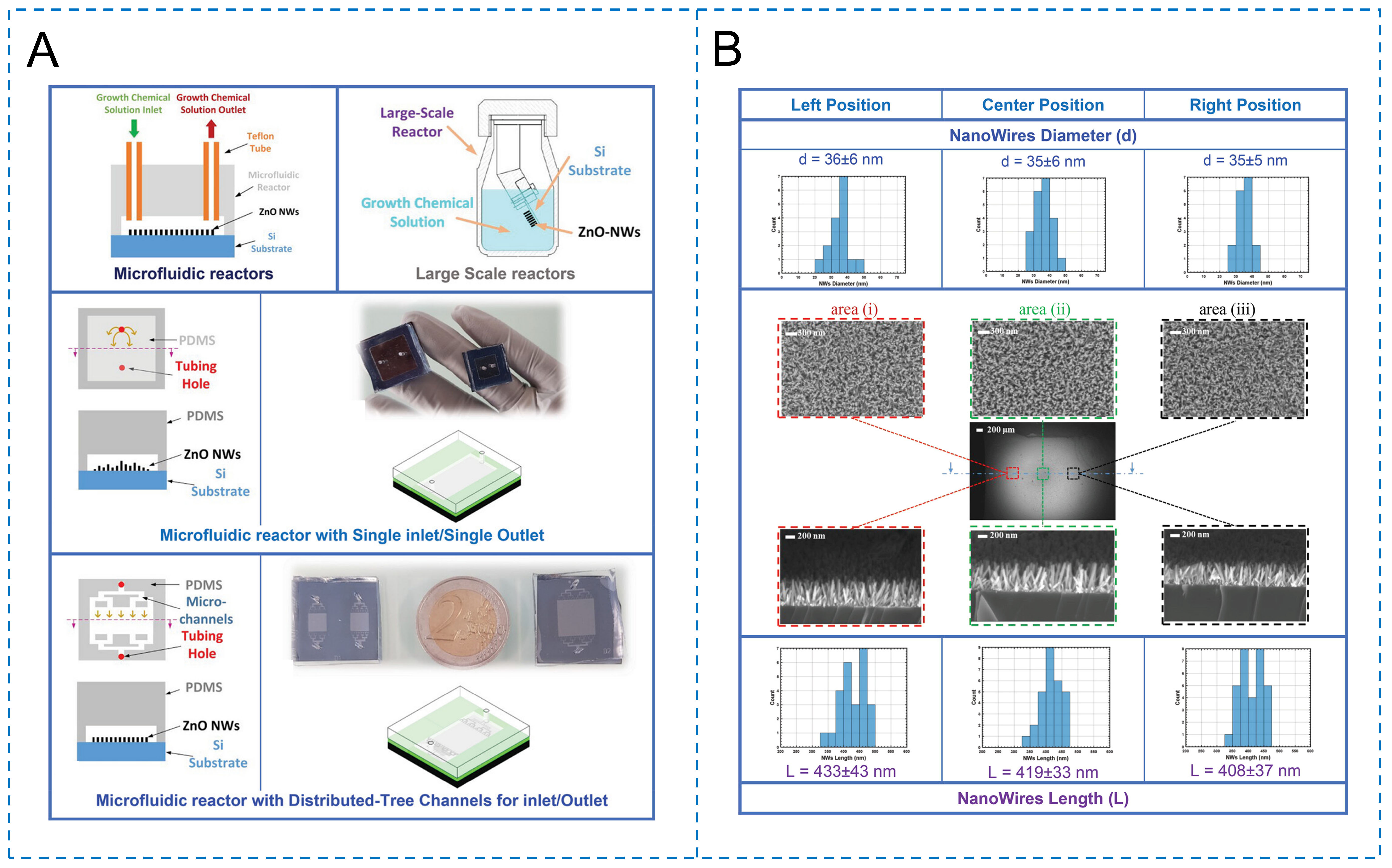
Figure 5. (A) Different types of reactors for dynamic microfluidic synthesis of zinc oxide nanowires; (B) uniformity of the grown ZnO-NWs. (A and B) adapted from ref. 81. Copyright 2025, Wiley. NW: Nanowire; PDMS: polydimethylsiloxane.
These examples reveal the overall importance of continuous-flow synthesis at the primary nanostructure level, which can reorganize the timing and conditions of particle formation itself. Continuous-flow synthesis not only produces more uniform nanoparticles but also regulates how size, morphology, and internal structural states emerge from coupled nucleation and growth processes. The catalytic significance of primary nanostructure control has distinct limits. In many advanced nanocatalysts, performance is determined not only by the properties of individual particles but also by the spatial arrangement and kinetic coordination of their multiple components. At higher levels of complexity, the synthetic challenge shifts from controlling isolated particle histories to controlling interfaces and multicomponent formation pathways.
Interfacial and multicomponent nanostructure control
As catalytic nanostructures evolve beyond isolated particles, the central synthetic challenge shifts from controlling individual formation histories to coordinating the spatial and temporal relationships between multiple domains or components. At this level, the relevant structural targets include core-shell structures, heterointerfaces, alloy nanoparticles, intermetallic phases, and other compositionally coupled nanostructures whose catalytic performance is determined by the properties of each constituent but also by how they are arranged, connected, and formed relative to one another[82-86]. Continuous-flow synthesis is particularly important because it can regulate not only when particles form but also how distinct formation pathways are sequenced, confined and synchronized across interfaces and components. The transition from primary nanostructure control to interfacial and multicomponent control indicates a shift from single-particle precision to coordinated nanoscale organization.
This higher-order control is most immediately observed in interfacial nanostructures, where catalytic behavior is often controlled by the proximity, sharpness, and mutual coupling of distinct domains rather than by a single nanocrystal. This phenomenon is particularly evident in core-shell structures and related heterostructures because their synthesis requires shell growth to proceed on preformed cores within a defined time window while avoiding secondary nucleation, uncontrolled overgrowth, or aggregation[84,86]. It is difficult for batch reactors to meet the above requirements because of uneven concentration distributions and inconsistent particle growth processes. In contrast, continuous-flow systems can accurately control the contact time of precursors, add stepwise reagents, and maintain uniform growth environments to unify the growth conditions of particles. As a result, shell thickness, interfacial sharpness, and compositional gradients can be regulated more reproducibly, allowing the formation of interfacial nanostructures with greater structural fidelity than is typically possible under less controlled conditions.
In addition to controlling shell thickness and overall composition, the atomic structure of the core-shell interface itself can determine catalytic performance[87,88]. In many bimetallic nanocatalysts, the interface is not atomically abrupt but contains an interdiffusion region whose thickness is determined by the precursor reduction kinetics, deposition pathways, thermal history, and postsynthesis restructuring[89,90]. These compositional gradients can significantly alter the electronic interactions between adjacent domains through ligand and strain effects, which alter the structure and catalytic selectivity. In terms of engineering, continuous-flow synthesis provides unique opportunities for controlling interfacial evolution because precursor delivery, reduction kinetics, temperature profiles, and residence times can be regulated more accurately than in conventional batch systems. Rapid mixing and short reaction times may inhibit undesired interdiffusion and facilitate the formation of more sharply defined interfaces. Nevertheless, achieving truly atomically sharp interfaces remains challenging because atomic diffusion, surface reconstruction, and thermodynamic equilibration continue to occur during nanoparticle growth and postsynthesis processing. Future advancements will likely require the integration of continuous-flow synthesis with in situ characterization and atomic-scale modeling to establish quantitative relationships among reaction history, interfacial sharpness, and catalytic performance.
This advantage becomes even more distinct when structural precision requires compartmentalization or localized interfacial growth. In these scenarios, multiphase and segmented-flow systems are particularly powerful because droplets, slugs or other limited domains can serve as isolated reaction units that localize nucleation and deposition while reducing particle-particle interference across the broader reactor volume [Figure 6][91,92]. In the multicomponent synthesis process, the material stream begins with the controlled use of multiple precursors in the microfluidic reactor, where precise mixing ensures uniform local supersaturation for each component. Nucleation events are subsequently initiated in a temporally synchronized manner, reducing overlapping growth and allowing for predictable particle size distributions. The growth stage occurs under confined flow conditions, which regulate interfacial interactions and facilitate the formation of core-shell and heterostructured nanoparticles. The assembly of these components is coordinated to create multicomponent nanostructures with well-defined interfaces and controlled compositional gradients.
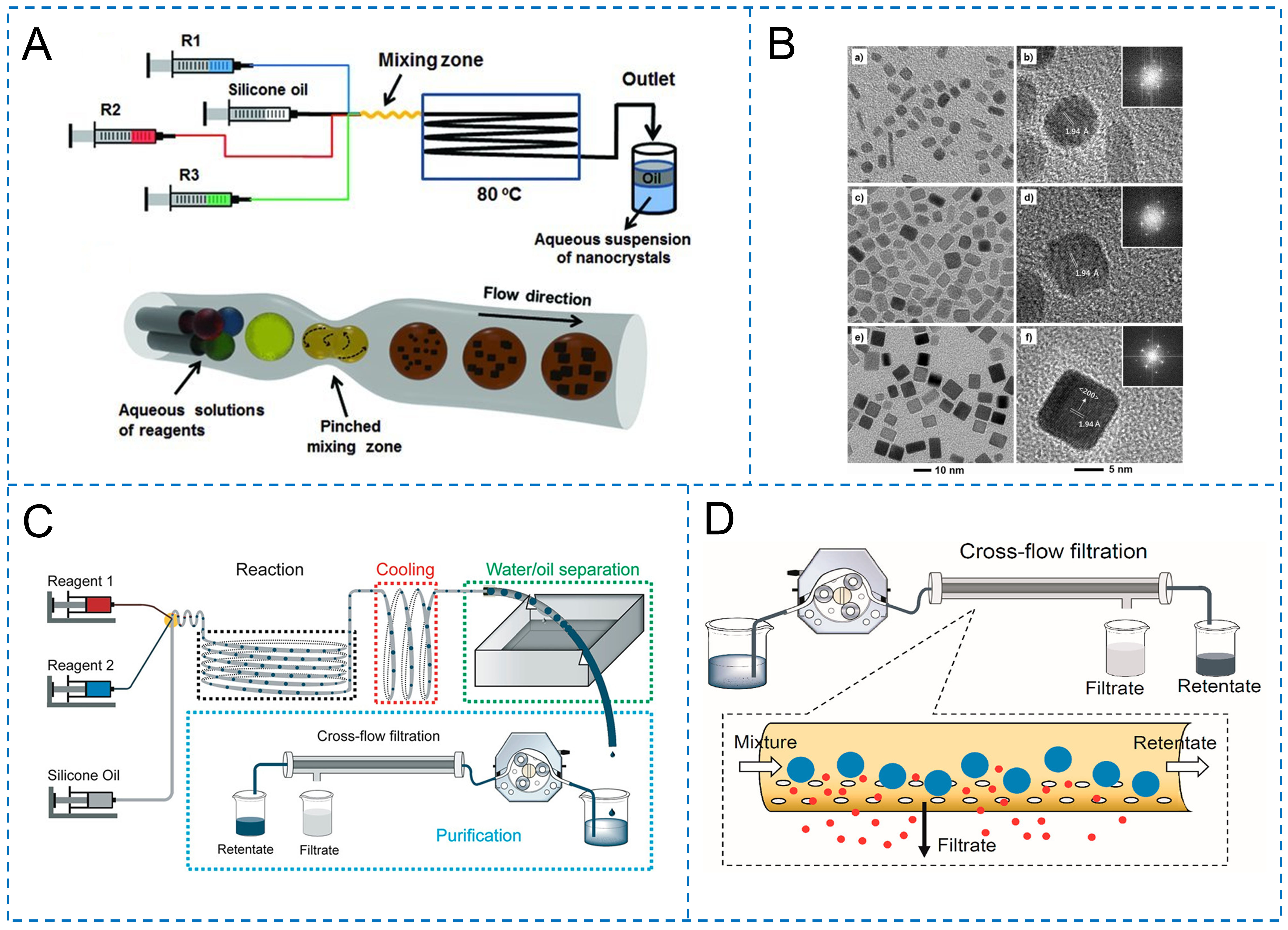
Figure 6. (A) Schematic of the experimental setup with water-in-oil droplets to prepare Pd nanoparticles; B: TEM and HRTEM images of Pd nanocrystals. (A and B) adapted from ref.[91]. Copyright 2013, Wiley. (C) Schematic of the droplet-reactor system; (D) Setup for cross-flow filtration. (C and D) adapted from ref.[92]. Copyright 2018, American Chemical Society. TEM: Transmission electron microscopy; HRTEM: high-resolution transmission electron microscopy.
These nanostructures are important not only for integrating a more complex flow pattern but also for creating synthetic environments in which growth can be spatially isolated, sequentially organized, and less vulnerable to wall deposition or uncontrolled aggregation. This compartmentalization is particularly useful when distinct phases must be assembled in close proximity without allowing competing growth pathways to overlap excessively. Segmented-flow and droplet-based methods therefore become important not only as intensified reactor formats but also as control tools for interfacial organization when structural precision depends on localized confinement.
As structural complexity increases, the challenge shifts from controlling predefined interfaces to synchronizing the formation of multiple components with intrinsically different chemistries and kinetics. This is the main difficulty in multicomponent nanostructure control. The main challenge is not complex compositions but rather the coordination of multiple coupled formation pathways. These pathways differ greatly in terms of precursor reactivity, reduction order, hydrolysis rate, diffusion performance, and postsynthesis structural reconstruction[93,94]. In batch systems, these differences result in asynchronous nucleation, uneven growth, local compositional heterogeneity, partial segregation, or incomplete ordering. As a result, structures intended to create homogeneous alloys may instead evolve into compositionally graded particles, whereas systems that target ordered intermetallic phases may fail to achieve the desired atomic arrangement. Continuous-flow synthesis can mitigate these problems by reducing local reaction histories, staging precursor addition more precisely, and maintaining more stable thermal and transport conditions throughout the synthesis pathway. Under these conditions, the balance between coreduction and sequential deposition, between alloying and segregation, or between ordering and phase separation can be directed more reproducibly towards the desired structural outcome.
In this multicomponent regime, the importance of flow stems from pathway synchronization rather than transport enhancement. Rapid and reproducible mixing can align the earliest stages of multicomponent formation, whereas segmented-flow environments can isolate competing pathways and reduce cross-interference during coupled growth. Field-assisted flow can further expand the accessible structural space when multicomponent assembly requires rapid crystallization, selective activation or nonequilibrium restructuring, which cannot be achieved reliably through only hydrodynamic control[95]. These different flow environments should not be considered parallel reactor categories of equal relevance in every scenario. Instead, they provide different levels of control over how multiple components are brought together, transformed, and stabilized during nanostructure formation. Their significance therefore depends on which step in the coupled formation pathway is most structurally decisive.
Consequently, controlling interfacial and multicomponent nanostructures reveals that continuous-flow synthesis extends beyond improving the uniformity of individual particles. At these higher levels of structural complexity, catalytic function increasingly depends on the coordination of multiple domains whose arrangement, compositional distribution, and coupling must be established during synthesis rather than corrected afterward. Continuous-flow systems are particularly important because they provide programmable environments for organizing these coupled formation pathways with greater temporal and spatial precision. However, even when nanoscale precision is achieved, its practical value remains limited unless it can be transformed during catalyst assembly into larger, functionally usable structures. The challenge therefore shifts from the formation of coordinated nanostructures to catalyst-level structural integration.
Although interfacial and multicomponent nanostructures can provide improved catalytic functionality through synergistic interactions, their practical effect ultimately depends on whether these structural features can be retained during catalyst assembly and deployment. Therefore, the challenge shifts from nanoscale organization to ensuring structural fidelity and accessibility at larger scales, linking nanostructure design directly to catalyst-level integration and manufacturing.
Catalyst-level structural integration
While the previous discussions have focused on generating increasingly complex nanostructures through reaction engineering control, the practical importance of these structural attributes ultimately depends on whether they can be effectively maintained during catalyst integration and manufacturing. At this stage, structural fidelity is critical to preserving catalytically relevant features generated at the nanoparticle level - such as particle size distributions, defect states, heterointerfaces, active-site accessibility, and spatial organization - rather than focusing on particle morphology during integration and processing[96,97]. Depending on the catalyst system, structural fidelity can be assessed through complementary descriptors such as particle size retention, dispersion index, accessible active-site density, interface preservation, pore accessibility, and catalyst-level structural uniformity, which together determine whether nanoscale design features remain functional after deposition, shaping, drying, calcination, or support integration[98-100]. Catalyst manufacturing is a cross-scale structure-transfer problem that requires translating nanoparticle-level descriptors (e.g., size, defect concentration, and interface structure) into catalyst-level properties, including active-phase dispersion, site accessibility, mass-transfer characteristics, and operational stability. Ultimately, this translation determines whether the advantages of continuous-flow nanostructure control are retained in practical systems.
The importance of continuous-flow nanostructure control is its ability to achieve nanoscale precision, which occurs only when this precision is translated into catalyst structures that remain functional under practical conditions. In most catalytic applications, active nanophases are not used as freely dispersed particles. Instead, they are incorporated into supported, composite or coprecipitated materials, where catalytic behavior is controlled by the larger structural environment. At this level, the challenge shifts from generating particles with controlled size, interfaces or composition to preserving these features during deposition, assembly and integration into a macroscopic catalyst body [Figure 7][45,101-103]. Catalyst-level structural integration therefore represents a distinct stage of synthesis, shifting the focus from the formation of nanostructures to the retention of their catalytic properties within a usable material.
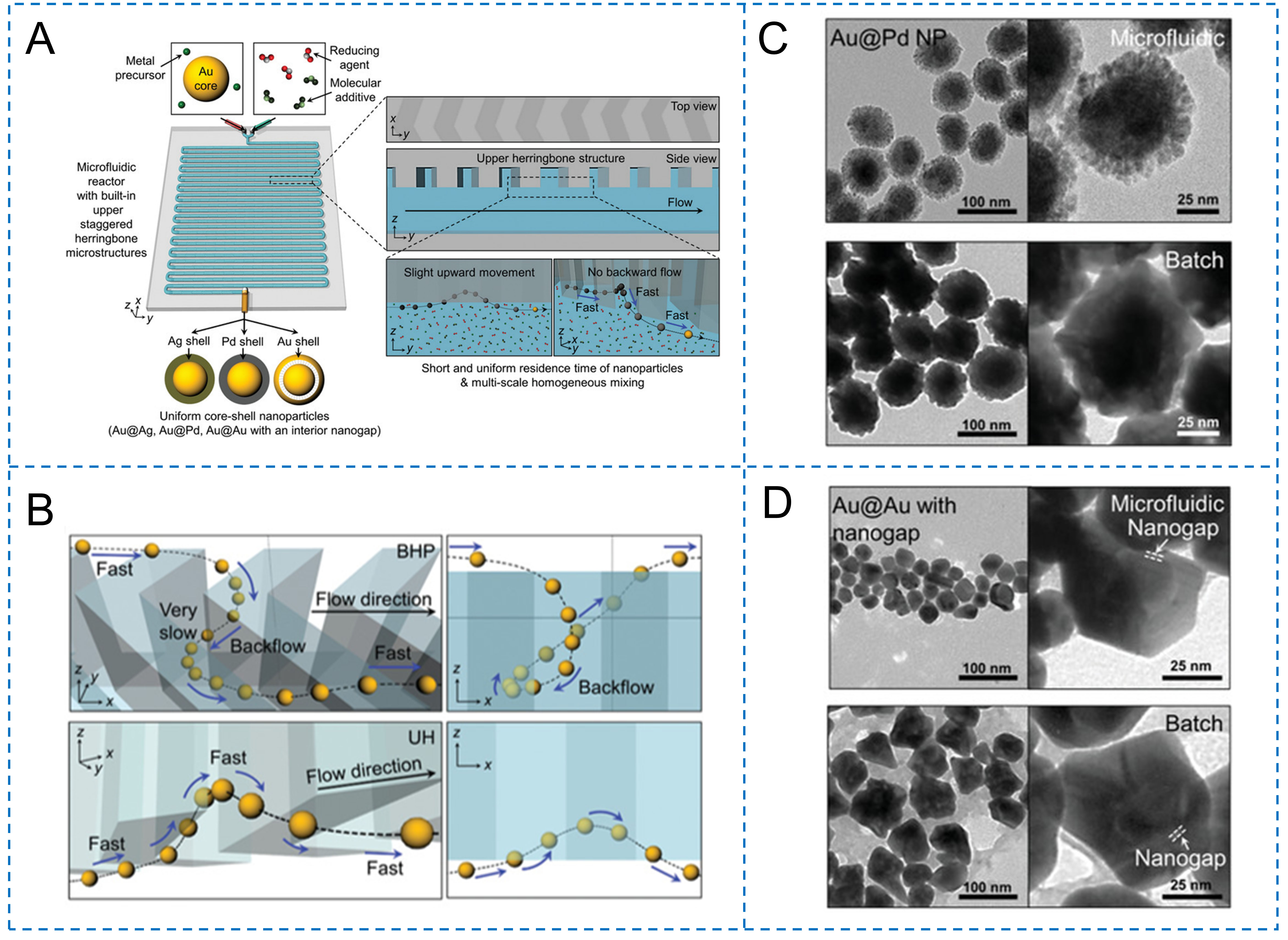
Figure 7. (A) Synthesis of core-shell-structured composite catalysts in continuous-flow reactors.; (B) Representative trajectories of single cores; (C) SEM images of Au@Pd core-shell nanoparticles synthesized via the microfluidic/batch process; (D) SEM images of Au@Au core-shell nanoparticles synthesized via a microfluidic/batch process. (A-D) adapted from ref.[45]. Copyright 2021, Wiley. NP: Nonoparticle; BHP: bottom herringbone positive; UH: upper herringbone; SEM: scanning electron microscopy.
This shift is important because catalyst performance at the structural level depends on structural variables that are not determined by only particle descriptors. The most important variables are the dispersion of active domains, the accessibility of interfacial active sites, the strength and uniformity of active phase-support coupling, and the resistance of the integrated catalyst to aggregation or structural drift during handling and operation[104-107]. These variables are highly sensitive to local concentration fields, precipitation pathways, deposition kinetics, and thermal histories during synthesis. Therefore, even nanostructures that are well controlled in isolation may lose much of their function if they become unevenly deposited, partially buried, weakly coupled to the support or poorly distributed throughout the final catalyst structure. The challenge at this stage is therefore retaining not only morphology but also structure-function relationships across a change in scale.
Continuous-flow synthesis has distinctive advantages because it allows catalyst assembly to be treated as a coordinated formation process rather than as an unorganized sequence of separate steps. In supported and composite catalysts, improved control over precursor mixing, local supersaturation, deposition timing and thermal exposure can reduce the distribution of formation histories experienced during active-phase integration[108]. This is particularly important in coprecipitation and continuous deposition pathways, where small variations in pH, concentration or conversion can determine whether active phases are finely dispersed, unevenly clustered or partially embedded within an inaccessible support matrix (for example, the synthesis of ZIF-8; Figure 8)[109]. Under flow, these variables can often be held within a narrower operating window, making the catalyst-level structure more reproducible and less dependent on uncontrolled local fluctuations than in conventional batch preparation. Instead of only accelerating synthesis, flow is critical for translating nanoscale designs into catalyst structures with consistent functional organization.
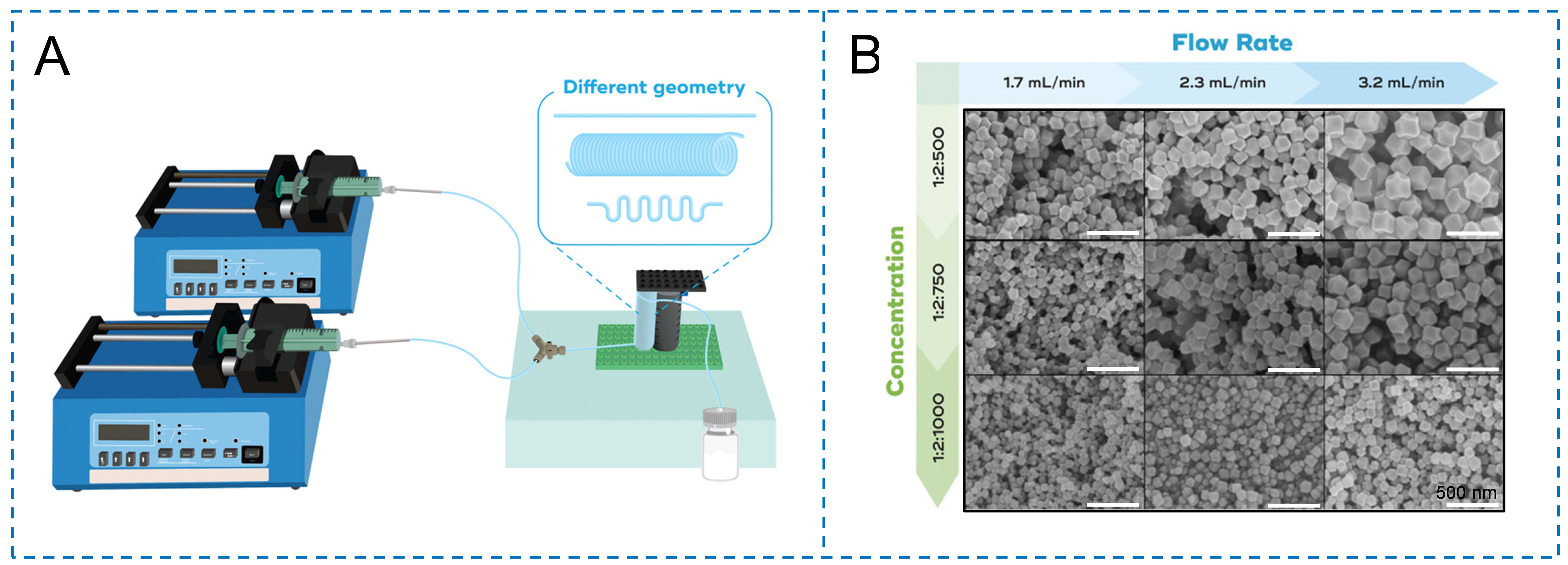
Figure 8. (A) Schematic representation of the experimental setup used for ZIF-8 synthesis; (B) SEM images of ZIF-8 particles showing the size dependence of the concentration and flow rate (all SEM images are presented at the same scale; scale bar: 500 nm). (A and B) adapted from ref. 109. Copyright 2024, Wiley. ZIF: Zeolitic imidazolate framework; SEM: scanning electron microscopy.
In multicomponent catalyst systems, this structural design is essential for integrating several domains while maintaining nanoscale precision, accessibility, stability, and mutual coupling in the final material. Catalysts such as Cu/ZnO/ Al2O3 and CuO-ZnO-ZrO2 are particularly effective because their catalytic properties depend not only on their composition but also on how multiple components are spatially organized and remain mutually accessible after synthesis [Figure 9][110-112]. Similar considerations apply to supported noble-metal catalysts, where the benefits of particle size control, facet regulation or multicomponent design can be achieved only if the active nanophase remains exposed, well dispersed and structurally stable after support integration. During catalyst-level structural integration, nanoscale design becomes functionally explicit: particle size determines active-site density, interface quality dictates cooperative catalysis, compositional order determines reaction selectivity, and support coupling controls accessibility and durability. Continuous-flow synthesis is particularly important here, because it enables the formation of nanostructures with greater precision while yielding catalyst structures that are more coherent, reproducible, and compatible with manufacturing translation.
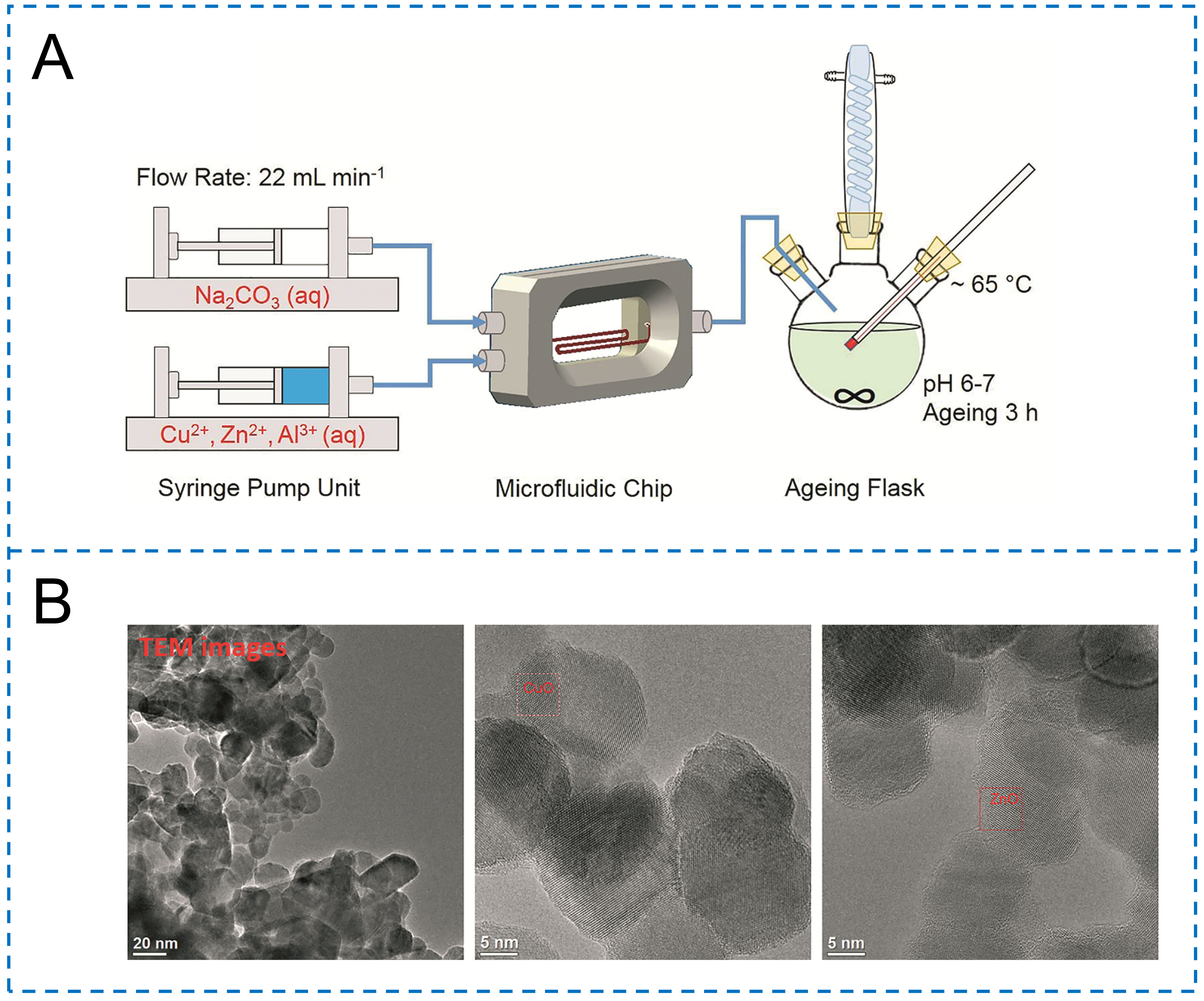
Figure 9. (A) Microfluidic synthesis of Cu/ZnO/Al2O3 via coprecipitation; (B) TEM images of calcined Cu/ZnO nanoparticles produced in the batch reactor. (A and B) adapted from ref.[111]. Copyright 2022, The Royal Society of Chemistry. TEM: transmission electron microscopy.
Across these different levels of structural control, the importance of continuous-flow synthesis gradually becomes more explicit. At the primary nanostructure level, flow reduces local reaction history distributions and improves the reproducibility of particle formation. Shifting structural target to interfaces and multicomponent domains requires coordinating coupled formation pathways with greater spatial and temporal precision. At the catalyst level, the main challenge becomes the integration of this nanoscale precision into structures that remain catalytically accessible, stable, and functional. Continuous-flow synthesis is therefore best understood not only as a method for better nanoparticle preparation but also as an approach for organizing structure formation across scales. However, the ability to generate structurally well-defined catalysts under flow does not ensure their stable or scalable production. After synthesis shifts from proof-of-concept structural control to production-relevant operation, new challenges emerge, including solid accumulation, process drift, scale-up-induced loss of structural fidelity, and incompatibility with downstream catalyst handling. These issues define the next stage of development in continuous-flow nanocatalyst synthesis and are critical to its translation from controllable synthesis to scalable manufacturing.
FROM CONTINUOUS SYNTHESIS TO SCALABLE MANUFACTURING
Although structural control makes continuous-flow synthesis suitable for nanocatalyst design, it does not ensure manufacturing viability. A flow process that can produce structurally well-defined nanocatalysts under short, carefully controlled laboratory conditions may still fail to yield stable, reproducible, and practically usable catalyst production with extended operation or increased throughput. The main challenge at this stage is not only how to create a desired nanostructure but also how to maintain structural fidelity, process stability and catalytic reproducibility during production. This shift is particularly important in nanocatalyst synthesis because particle-forming reactions are intrinsically sensitive to local hydrodynamic, thermal and compositional fluctuations, whereas the continuous generation and transport of solids create additional risks that are largely absent in homogeneous flow chemistry. Accordingly, three closely connected challenges arise during the transition from controllable synthesis to scalable manufacturing: solid accumulation and flow instability during operation, structural drift and loss of reproducibility over time, and the difficulty of controlling the reaction history during scaling-up and downstream catalyst handling.
Reactor fouling and clogging
Reactor fouling and clogging remain challenges in continuous-flow nanocatalyst synthesis, hindering the transition from controlled laboratory environments to reliable manufacturing. Unlike homogeneous flow chemistry, nanocatalyst synthesis intrinsically involves the continuous generation, transport, and transformation of solid particles within confined channels or reaction pathways[113]. This characteristic makes deposition, accumulation and blockage difficult to eliminate, particularly when particle formation is rapid, local supersaturation is high or colloidal stabilization is insufficient. Fouling and clogging are not secondary engineering inconveniences in a well-behaved process; they are direct consequences of particle-forming chemistry operating under confinement.
Their origins are closely linked to the same reaction histories that control nanostructure formation. If precursor conversion, reduction, hydrolysis, or precipitation proceed much faster than material dispersion and transport, high-concentration regions will form near mixing areas, channel walls, or flow dead zones[114]. Under these conditions, heterogeneous nucleation may occur preferentially at solid boundaries rather than in the bulk stream, creating an initial layer of deposited material that further perturbs local hydrodynamics and promotes additional accumulation [Figure 10A][115,116]. Even when nucleation begins primarily in the flow phase, secondary aggregation, insufficient stabilization or incomplete particle removal can still cause gradual build-up within the reactor [Figure 10B][117,118]. These effects are particularly severe in systems designed to increase productivity because the same conditions that favor rapid particle generation often also increase the likelihood of wall deposition and flow obstruction.
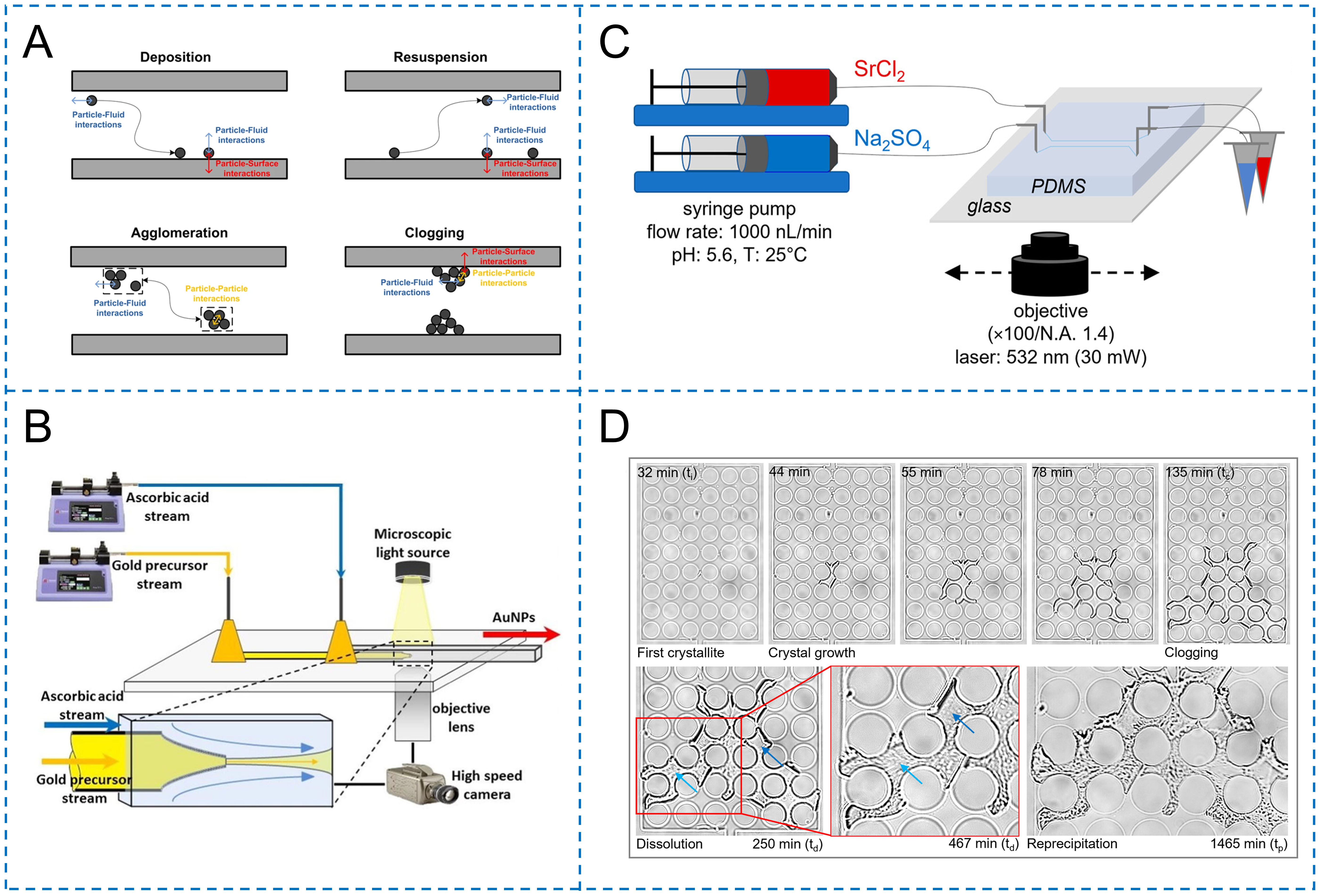
Figure 10. (A) Aggregation and clogging phenomena of microparticles in microfluidics. Adapted with permission from ref.[116]. Copyright 2018, Springer Nature; (B) Reactor fouling of the continuous synthesis of gold nanoparticles using a 3D glass capillary microfluidic device. Adapted with permission from ref.[118]. Copyright 2017, Elsevier; (C) Microfluidic experimental setup for precipitation-induced clogging experiments; (D) Time-lapse bright field images representative of precipitation-induced clogging experiments. (C and D) adapted from ref.[119]. Copyright 2023, American Geophysical Union. PDMS: Polydimethylsiloxane; NP: nanoparticle.
The importance of fouling and clogging extends well beyond the loss of uninterrupted operation. As solid material accumulates, the effective channel geometry changes, residence-time distributions broaden, and local heat and mass transfer conditions deviate from those originally used to define the synthesis window [Figure 10C and D][119]. In nanocatalyst synthesis, where the particle size, morphology, interfacial structure, and compositional uniformity are highly sensitive to the local reaction history, these changes can cause product drift even before complete blockage occurs. Reactor fouling therefore hinders not only operability but also structural reproducibility: after the flow environment is altered by deposition, particles no longer experience the same conditions compared with those generated earlier in the run. This difference makes fouling and clogging especially important because they directly erode reaction-history control, which determines continuous-flow structural precision.
These challenges are particularly acute in precipitation-driven syntheses, oxide-forming systems, and multicomponent reactions involving fast hydrolysis, reduction, or coupled phase formation[120,121]. In these systems, the timescale of particle birth can become comparable to or even shorter than the timescale of local mixing and removal, making uncontrolled deposition difficult to avoid. The challenge becomes more distinct as synthesis shifts to higher solid loading, extended continuous operation, or increased throughput because these conditions increase the burden on particle transport and reactor cleanliness. Therefore, reactor fouling and clogging is the first manufacturing challenge in continuous-flow nanocatalyst synthesis: before issues of long-term product consistency or scale-up can be addressed, the process must first remain physically operable under particle-forming conditions.
Mitigating these effects requires methods that intervene at both the reaction and reactor levels. One method is to reduce the probability of uncontrolled local particle formation through staged precursor introduction, better-defined mixing profiles, or dilution methods that decrease transient supersaturation peaks. Another method is to alter the flow environment itself, for example, by using a segmented-flow[122,123] operation to spatially isolate particle formation, reduce wall contact and improve particle transport through confined moving domains. Surface modification[124], anti-fouling channel design[125] and operating conditions that improve colloidal stabilization[126] can further reduce the shift to deposition and accumulation. Intensified transport or field-assisted dispersion may also mitigate local build-up, although these approaches increase complexity and do not eliminate the underlying trade-off between rapid particle formation and reactor stability.
Thus, reactor fouling and clogging should not be treated only as maintenance problems to be solved after a successful synthesis has been identified. They are integral to the engineering limits of continuous-flow nanocatalyst production because they define whether a structurally controlled synthesis can remain viable over extended operating periods. A process that produces well-defined nanocatalysts only until deposition alters the reactor environment has not achieved manufacturing relevance. The next challenge, even when operability is maintained, is whether the process can maintain structural consistency and catalytic reproducibility.
Process stability and reproducibility
Even when reactor fouling and clogging are sufficiently mitigated to permit extended operation, continuous-flow nanocatalyst synthesis still faces another more demanding requirement: the sustained preservation of product-defining structures over time. This issue is particularly important because a flow process may remain physically operable while gradually shifting from the reaction environment that originally produced the desired nanostructure. In nanocatalyst synthesis, this drift can be highly consequential[127]. Minor fluctuations in the flow rate, precursor supply, temperature, phase state, or external field coupling change the local reaction conditions. These changes cannot be observed directly during operation, but they affect the nucleation time, growth period, interfacial evolution, and multicomponent structure [Figure 11A][128]. Process stability is not only uninterrupted flow; it is the ability to maintain a sufficiently invariant operating window that ensures the structurally decisive characteristics of synthesis are reproducible [Figure 11B][129].
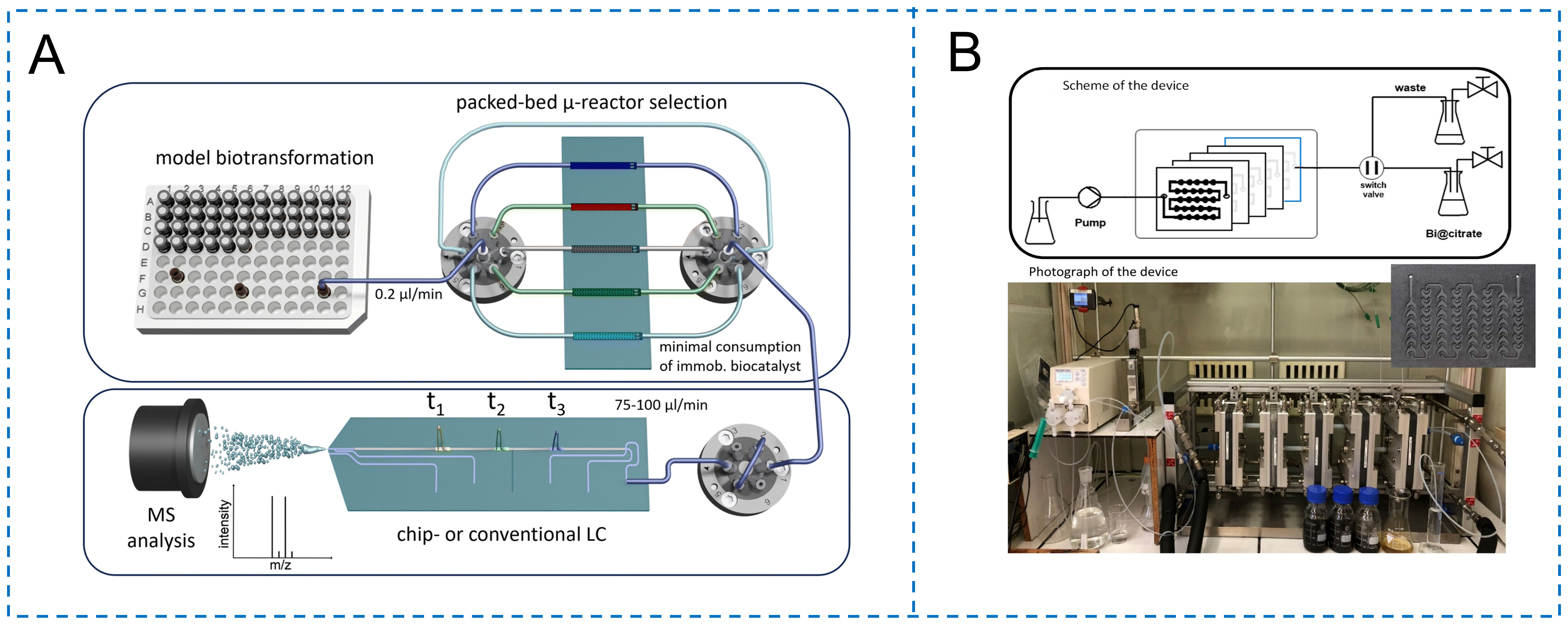
Figure 11. (A) Development of an automated platform for monitoring microfluidic reactors through multireactor integration and online detection. Adapted with permission from ref.[128]. Copyright 2024, The Royal Society of Chemistry; (B) Scheme and photograph of the pilot-scale Corning® AFR and the SiC plate. Adapted with permission from ref.[129]. Copyright 2025, American Chemical Society. LC: Liquid chromatography; MS: mass spectrometry.
This requirement is more stringent for nanocatalyst manufacturing than for many other continuous synthesis processes because reproducibility cannot be evaluated by a single average property. Nanocatalysts that appear broadly similar in terms of mean particle size may still differ significantly in terms of size distribution, exposed crystal facets, defect concentration, compositional homogeneity, interface quality, or catalyst-level accessibility, each of which can affect catalytic activity, selectivity, and durability[130,131]. The challenge is therefore multidimensional: reproducibility must be maintained simultaneously at the structural and functional levels. In practice, a stable nanocatalyst synthesis process should result not only in consistent particle formation but also in consistent structure-function relationships across repeated runs and extended operation. A process that continues to produce solids while gradually broadening structural distributions or shifting catalytic behavior has not yet achieved the level of control required for manufacturing translation.
Even without obvious reactor failure, several factors can affect this instability. Small fluctuations in the feed composition or precursor concentration can shift supersaturation profiles and alter the relative timing of nucleation and growth. Small thermal deviations can affect precursor decomposition, crystallization pathways, and defect incorporation, particularly in oxide or multicomponent systems. In multiphase or segmented-flow synthesis, instability may also arise from changes in droplet size, phase fraction or interfacial transport, which can affect the confinement conditions that define particle formation. Field-assisted flow systems[132-135] result in further sensitivities because the spatial uniformity of ultrasonic [Figure 12A], light [Figure 12B], microwave [Figure 12C] or other external inputs [Figure 12D] can also be maintained. Although individual perturbations are subtle, their cumulative effect can be substantial. Nanostructure formation often amplifies small differences in the local environment into larger structural differences in the final catalyst.
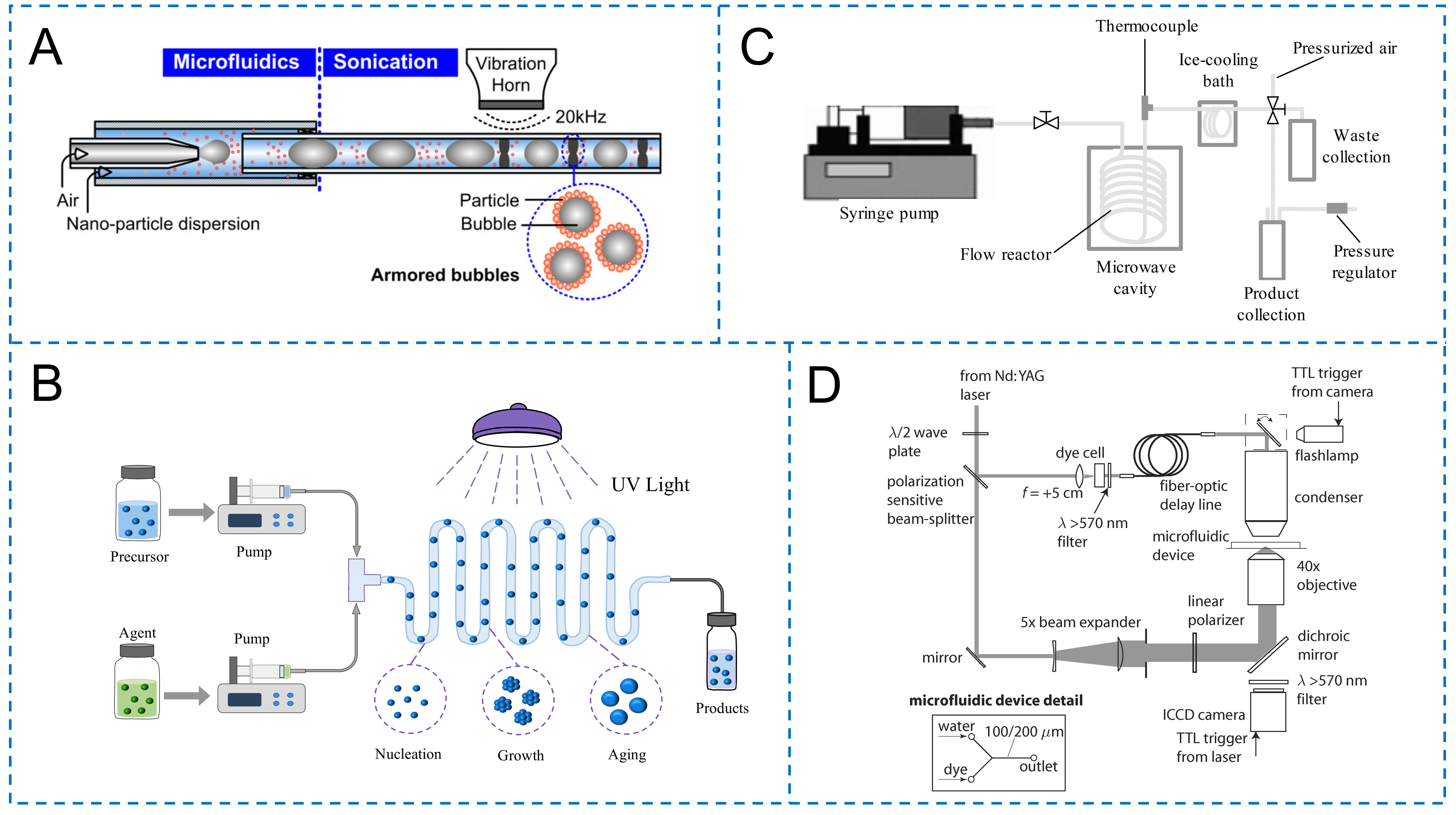
Figure 12. External field auxiliary flow system. (A) Ultrasonic fields. Adapted with permission from ref.[132]. Copyright 2014, American Chemical Society; (B) Light fields; (C) Microwave fields. Adapted with permission from ref.[134]. Copyright 2016, American Chemical Society; (D) Laser fields. Adapted with permission from ref.[135]. Copyright 2007, American Chemical Society. UV: Ultraviolet; TTL: transistor–transistor logic; YAG: yttrium aluminum garnet.
Therefore, process stability in continuous-flow nanocatalyst synthesis should be defined by the preservation of reaction history control rather than by the lack of operational interruption. What matters is not only whether the reactants continue to flow through the reactor but also whether the distributions of the mixing history, thermal exposure, residence time, and interfacial conditions remain acceptably narrow and temporally stable. This perspective also changes how reproducibility should be evaluated. Useful manufacturing metrics extend beyond short-term demonstrations of product formation and should include run-to-run consistency, duration of steady-state operation, temporal drift in key structural descriptors, variance in catalytic performance, and acceptable tolerance bounds for product quality. These criteria are necessary because the importance of continuous-flow synthesis is its ability to provide controlled repetition, not just controlled possibility.
Process stability and reproducibility link laboratory-scale control and manufacturing relevance. A synthesis approach that yields a desired nanostructure only transiently, or only under narrowly tuned conditions that are not reliable, remains a proof-of-concept rather than a production strategy. The issue at this stage is therefore not whether continuous flow can produce a target catalyst once but whether it can continue to do so while preserving the same structure-forming logic over extended timescales. This requirement becomes even more challenging during scale-up, where higher throughput and broader process integration place additional pressure on the retention of structural fidelity and catalytic consistency.
Scale-up and manufacturing translation
Scale-up is the most demanding test of whether continuous-flow nanocatalyst synthesis can shift from laboratory control to practical manufacturing. Theoretically, flow chemistry can increase production capacity without simply increasing the reactor volume, which makes it highly promising. In practical applications, the greatest challenge is not improving throughput but maintaining precise control over the reaction conditions that determine nanostructure formation [Figure 13A and B][136]. The structural fidelity of a synthesis method that performs well at a small scale is not intrinsically maintained when the flow rate, reactor number, channel geometry, or process integration are changed. This challenge is particularly critical for nanocatalysts, because the structural attributes that control catalytic behavior are often determined by narrow distributions of mixing, thermal exposure, residence time and, where relevant, interfacial confinement. When these distributions broaden during scale-up, the resulting catalyst may remain nominally similar in composition while losing the structural precision that originally justified continuous-flow synthesis[137].
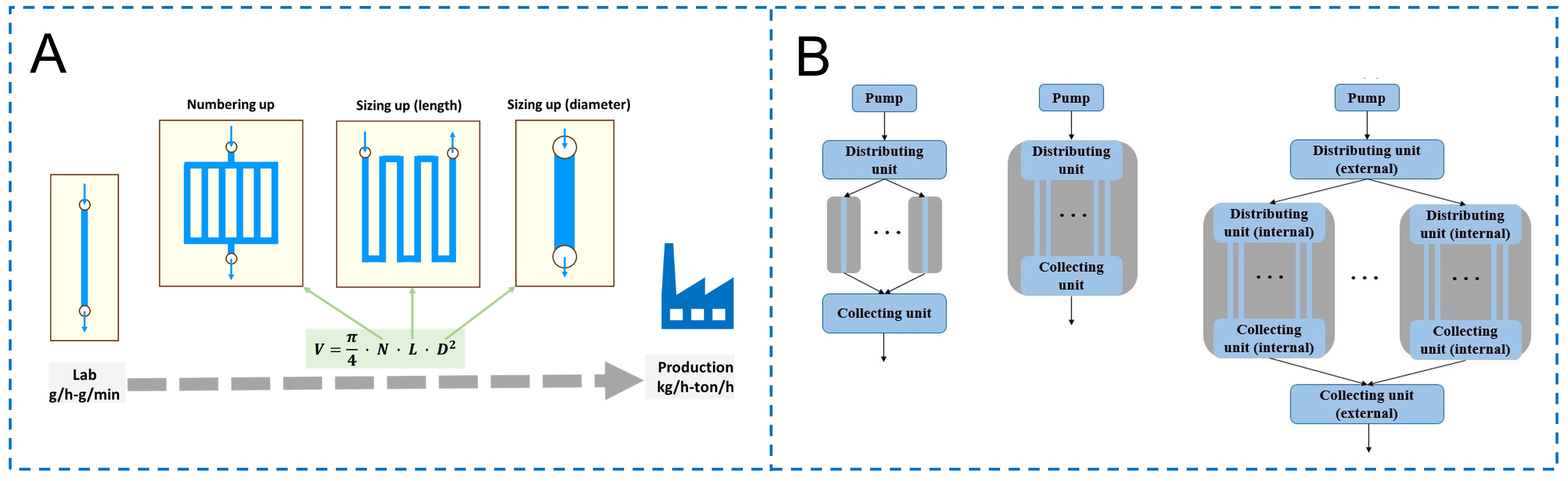
Figure 13. (A) Scale-up approaches of micro/milli-reactors from the laboratory scale (a single-channel reactor) to the production scale; (B) different types of flow distributors. (A and B) adapted from ref.[136]. Copyright 2021, Elsevier.
Scale-up should not be determined only by increasing grams per hour but by the ability to maintain structure-forming equivalence at higher production rates[138]. Meeting this requirement is difficult because the reactor characteristics that enable precise control at a small scale are often closely associated with confined geometries, short diffusion lengths and tightly defined local transport conditions. Increased throughput may compromise these characteristics by broadening residence-time distributions, weakening heat and mass transfer advantages or altering phase behavior in multiphase and segmented-flow systems. Even numbering up, which is often considered the most natural approach to scale up in flow chemistry, does not eliminate this problem. Parallel channels must still maintain sufficiently similar flow distributions, thermal conditions and residence times if each unit is to reproduce the same nanostructure[139,140]. The main issue is therefore not whether a flow process can be made larger but whether it can be made larger without changing the structure-forming logic, which determines catalyst performance.
Manufacturing translation also requires a broader view of the process than reactor operation does. After nanocatalyst synthesis shifts to production-relevant implementation, downstream handling becomes a component of the structural problem rather than a separate logistical step. Product collection, phase separation, washing, stabilization, deposition onto supports, catalyst shaping and other postsynthesis operations may alter the dispersion state, interfacial accessibility, compositional homogeneity or catalyst-level structure. A nanostructure that is well controlled at the reactor outlet may therefore lose practical importance if it cannot be recovered, formulated or integrated without structural deterioration. This is particularly important for supported and composite catalysts, where the final usable material is defined not only by the nanoparticle product itself but also by how that product is assembled into a stable and accessible catalytic structure. Manufacturing translation must therefore maintain not only nanoparticle identity but also catalyst usability.
Therefore, the criteria for manufacturing relevance are necessarily more stringent than those for controllable synthesis. A viable production approach should result in increased throughput while retaining structural fidelity, product consistency, and compatibility with downstream catalyst processing. This approach should also ensure the retention of catalytically critical properties under realistic operating and handling conditions rather than only at idealized synthesis endpoints. Successful manufacturing translation requires codesign across reactor configurations, operating windows, and downstream process integration. For continuous-flow nanocatalyst synthesis to reach its full potential, nanoscale precision must be maintained under broader processing conditions and remain functionally explicit in the final catalyst product. The remaining challenge, therefore, is not only to demonstrate that nanocatalysts can be synthesized continuously but also to establish process structures in which structural control, operational stability, and manufacturing viability are reinforced rather than compromised.
CONCLUSIONS AND OUTLOOK
Continuous-flow nanocatalyst synthesis is an important method for controlling nanostructure formation and combining reaction engineering with catalyst design. In addition to replacing batch operation, continuous-flow systems enable programmable reaction environments that regulate mixing, residence time, thermal history, interfacial confinement, and energy input, allowing precise control of primary particle features, interfaces, multicomponent structures, and catalyst-level integration. This precision is particularly important because the function of nanocatalysts is determined by the structural states created during synthesis rather than by the nominal composition. Nevertheless, translating excellent control effects in laboratories into stable catalytic performance in industrial production remains challenging. These challenges include reactor fouling, structural deviation, unstable operation, and the loss of controlled reaction conditions during scale-up and catalyst posttreatment.
Closed-loop validation methods that integrate continuous-flow synthesis with in-line or operando structural characterization (e.g., X-ray absorption spectroscopy, TEM, and particle tracking) and real-time catalytic evaluation are needed. These approaches would enable quantitative correlations among flow conditions, nanostructures, and catalytic performance and would facilitate iterative optimization of synthesis parameters for reactions of high interest, such as CO₂ hydrogenation, oxygen evolution (OER), and hydrogen evolution (HER). By combining structural precision, mechanistic understanding, and scalable operation, continuous-flow synthesis can evolve from a controllable nanoparticle preparation method into a robust framework for rational catalyst engineering and industrially relevant catalyst production.
DECLARATIONS
Authors’ contributions
Writing-original draft: Chen, J.; Tan, F.
Validation: Chen, J.; Tan, F.; Chen, X.; Shen, H.; Wang, H.; Zhang, S.
Software: Chen, J.; Tan, F.; Chen, X.; Shen, H.; Wang, H.; Lei, Y.
Project administration: Chen, J.; Tan, F.; Lei, Y.; Yu, Z.
Investigation: Chen, J.; Tan, F.; Chen, X.; Shen, H.; Wang, H.; Lei, Y.
Data curation: Chen, J.; Tan, F.; Yu, Z.
Conceptualization: Chen, J.; Tan, F.; Lei, Y.; Yu, Z.
Funding acquisition: Chen, J.; Tan, F.; Zhang, S.; Yu, Z.
Methodology: Chen, X.; Shen, H.; Wang, H.; Zhang, S.
Formal analysis: Zhang, S.; Yang, Z.
Visualization: Yang, Z.; Lei, Y.
Supervision: Lei, Y.
Resources: Lei, Y.; Yu, Z.
Writing- review & editing: Yu, Z.
Availability of data and materials
Not applicable.
AI and AI-assisted tools statement
During the preparation of this manuscript, the AI tool ChatGPT (GPT-5.4, OpenAI; version 5.4, released March 5, 2026) was used solely for language editing. The tool did not influence the study design, data collection, analysis, interpretation, or the scientific content of the work. All authors take full responsibility for the accuracy, integrity, and final content of the manuscript.
Financial support and sponsorship
This work was supported by the National Natural Science Foundation of China (22308146, T2322011, 22408156).
Conflicts of interest
Chen, J; Chen, X.; and Wang, H. are affiliated with Sinopec Carbon Industry Technology Co., Ltd. The other authors declare that there are no conflicts of interest.
Ethical approval and consent to participate
Not applicable.
Consent for publication
Not applicable.
Copyright
© The Authors 2026.
REFERENCES
1. Afewerki, S.; Córdova, A. Combinations of aminocatalysts and metal catalysts: a powerful cooperative approach in selective organic synthesis. Chem. Rev. 2016, 116, 13512-70.
2. Ullah, H.; Humayun, M.; Shah, S. A. Advances in catalysis for sustainable energy and environmental remediation. Catalysts 2026, 16, 100.
3. Din, M. A. U.; Shah, S. S. A.; Javed, M. S.; et al. Synthesis of MXene-based single-atom catalysts for energy conversion applications. Chem. Eng. J. 2023, 474, 145700.
4. Wohlgemuth, R. Enzyme catalysis for sustainable value creation using renewable biobased resources. Molecules 2024, 29, 5772.
5. Ahire, S. A.; Bachhav, A. A.; Pawar, T. B.; Jagdale, B. S.; Patil, A. V.; Koli, P. B. The Augmentation of nanotechnology era: a concise review on fundamental concepts of nanotechnology and applications in material science and technology. Results. Chem. 2022, 4, 100633.
6. Vollath, D.; Fischer, F. D.; Holec, D. Surface energy of nanoparticles - influence of particle size and structure. Beilstein. J. Nanotechnol. 2018, 9, 2265-76.
7. Joudeh, N.; Linke, D. Nanoparticle classification, physicochemical properties, characterization, and applications: a comprehensive review for biologists. J. Nanobiotechnol. 2022, 20, 262.
8. Mourdikoudis, S.; Pallares, R. M.; Thanh, N. T. K. Characterization techniques for nanoparticles: comparison and complementarity upon studying nanoparticle properties. Nanoscale 2018, 10, 12871-934.
9. Bhalothia, D.; Beniwal, A.; Kumar Saravanan, P.; Chen, P. C.; Chen, T. Y. Bridging the gap between single atoms, atomic clusters and nanoparticles in electrocatalysis: hierarchical structured heterogeneous catalysts. ChemElectroChem 2024, 11, e202400034.
10. Nyabadza, A. Mccarthy, É.; Makhesana, M.; et al. A review of physical, chemical and biological synthesis methods of bimetallic nanoparticles and applications in sensing, water treatment, biomedicine, catalysis and hydrogen storage. Adv. Colloid. Interface. Sci. 2023, 321, 103010.
11. Xu, R.; Wang, D.; Zhang, J.; Li, Y. Shape-dependent catalytic activity of silver nanoparticles for the oxidation of styrene. Chem. Asian. J. 2006, 1, 888-93.
12. Narayanan, R.; El-sayed, M. A. Catalysis with transition metal nanoparticles in colloidal solution: nanoparticle shape dependence and stability. J. Phys. Chem. B. 2005, 109, 12663-76.
13. Mishra, R. K.; Verma, K.; Singh, D. S. Defect engineering in nanomaterials: impact, challenges, and applications. Smart. Mater. Manuf. 2024, 2, 100052.
14. Gao, W.; Hood, Z. D.; Chi, M. Interfaces in heterogeneous catalysts: advancing mechanistic understanding through atomic-scale measurements. Acc. Chem. Res. 2017, 50, 787-95.
15. Gebauer, D.; Gale, J. D.; Cölfen, H. Crystal nucleation and growth of inorganic ionic materials from aqueous solution: selected recent developments, and implications. Small 2022, 18, 2107735.
16. Jun, Y.; Zhu, Y.; Wang, Y.; et al. Classical and nonclassical nucleation and growth mechanisms for nanoparticle formation. Annu. Rev. Phys. Chem. 2022, 73, 453-77.
17. Zhang, H.; Lin, H.; Zheng, Y.; Hu, Y.; Maclennan, A. Understanding of the effect of synthesis temperature on the crystallization and activity of nano-MoS2 catalyst. Appl. Catal. B. Environ. 2015, 165, 537-46.
18. Wu, K.; Tse, E. C.; Shang, C.; Guo, Z. Nucleation and growth in solution synthesis of nanostructures - from fundamentals to advanced applications. Prog. Mater. Sci. 2022, 123, 100821.
19. Sebastian, V.; Arruebo, M.; Santamaria, J. Reaction engineering strategies for the production of inorganic nanomaterials. Small 2014, 10, 835-53.
20. Ganachari, S. V., Banapurmath, N. R., Salimath, B., et al. Synthesis techniques for preparation of nanomaterials. In Handbook of Ecomaterials; Martínez, L. M. T., Kharissova, O. V., Kharisov, B. I., Eds.; Springer International Publishing, 2019; pp 83-103. DOI: 10.1007/978-3-319-68255-6_149.
21. Delannoy, L.; El Hassan, N.; Musi, A.; Le To, N. N.; Krafft, J.; Louis, C. Preparation of supported gold nanoparticles by a modified incipient wetness impregnation method. J. Phys. Chem. B. 2006, 110, 22471-8.
22. Park, J.; Joo, J.; Kwon, S.; Jang, Y.; Hyeon, T. Synthesis of monodisperse spherical nanocrystals. Angew. Chem. Int. Ed. 2007, 46, 4630-60.
23. Bokov, D.; Turki Jalil, A.; Chupradit, S.; et al. Nanomaterial by sol-gel method: synthesis and application. Adv. Mater. Sci. Eng. 2021, 2021, 5102014.
24. Mekuye, B.; Abera, B. Nanomaterials: An overview of synthesis, classification, characterization, and applications. Nano. Select. 2023, 4, 486-501.
25. Jahn, A.; Reiner, J. E.; Vreeland, W. N.; Devoe, D. L.; Locascio, L. E.; Gaitan, M. Preparation of nanoparticles by continuous-flow microfluidics. J. Nanopart. Res. 2008, 10, 925-34.
26. Makgwane, P. R.; Ray, S. S. Synthesis of nanomaterials by continuous-flow microfluidics: a review. J. Nanosci. Nanotechnol. 2014, 14, 1338-63.
27. Besenhard, M. O.; Storozhuk, L.; Lagrow, A. P.; et al. High temperature flow synthesis of iron oxide nanoparticles: size tuning via reactor engineering. Chem. Eng. J. 2023, 473, 144542.
28. Vinnacombe-willson, G. A.; Conti, Y.; Stefancu, A.; Weiss, P. S.; Cortés, E.; Scarabelli, L. Direct bottom-up in situ growth: a paradigm shift for studies in wet-chemical synthesis of gold nanoparticles. Chem. Rev. 2023, 123, 8488-529.
29. Nazir, S.; Zhang, J.; Junaid, M.; et al. Metal-based nanoparticles: basics, types, fabrications and their electronic applications. Z. Phys. Chem. 2024, 238, 965-95.
30. Shanmugaraj, K.; Mathivanan, M.; Gowri, V. M.; et al. Fabrication of platinum nanoparticles decorated on nitrogen enriched carbon spheres for nitroaromatics reduction under batch and continuous flow conditions. J. Water. Process. Eng. 2024, 67, 106153.
31. Harju, H.; Pipitone, G.; Lefferts, L. Influence of the catalyst particle size on the aqueous phase reforming of n-butanol over Rh/ZrO2. Front. Chem. 2020, 8, 17.
32. Xie, B.; Wang, Z.; Zhang, X.; et al. Morphology effect of cerium dioxide on the catalytic performance of Ru/CeO2 catalyst for the oxidation of different CVOCs. Sep. Purif. Technol. 2024, 345, 127428.
33. Linling, G.; Liao, Z.; Zhang, H.; Jiang, J.; Chen, Z. From defects to catalysis: mechanism and optimization of NO electroreduction synthesis of NH3. Front. Chem. 2024, 12, 1452689.
34. Jin, H.; Song, W.; Cao, C. An overview of metal density effects in single-atom catalysts for thermal catalysis. ACS. Catal. 2023, 13, 15126-42.
35. Fu, R.; Wang, L.; Yang, X.; et al. Defects-engineered metal-organic frameworks for supercapacitor platform. Sustain. Eng. Novit. 2025, 1, 2.
36. Yang H, Wu Y, Zhuang Z, et al. Factors affecting the catalytic performance of nano-catalysts. Chin. J. Chem. 2022, 40, 515-23.
37. Yin, M.; Yao, H.; Qiu, H.; Wu, C.; Zhang, M.; Hao, F. A revisit of crystallization in tin halide perovskite thin films: from nucleation, intermediate to crystal growth. Adv. Funct. Mater. 2024, 34, 2404792.
38. Baig, N.; Kammakakam, I.; Falath, W. Nanomaterials: a review of synthesis methods, properties, recent progress, and challenges. Mater. Adv. 2021, 2, 1821-71.
39. Altammar, K. A. A review on nanoparticles: characteristics, synthesis, applications, and challenges. Front. Microbiol. 2023, 14, 1155622.
40. Shao, M.; Ramírez-Márquez, N.; Liu, Z.; García-Martínez, J. Harnessing kinetic control in zeolite synthesis and interconversion to enhance catalytic performance. CCS. Chem. 2026, 8, 1762-79.
41. Cheng, Q.; Huang, M.; Xiao, L.; et al. Unraveling the influence of oxygen vacancy concentration on electrocatalytic CO2 reduction to formate over indium oxide catalysts. ACS. Catal. 2023, 13, 4021-9.
42. Tan, X.; Zhu, H.; He, C.; et al. Customizing catalyst surface/interface structures for electrochemical CO2 reduction. Chem. Sci. 2024, 15, 4292-312.
43. Chen, Y.; Fan, Z.; Zhang, Z.; et al. Two-dimensional metal nanomaterials: synthesis, properties, and applications. Chem. Rev. 2018, 118, 6409-55.
44. Saikia, A.; Newar, R.; Das, S.; Singh, A.; Deuri, D. J.; Baruah, A. Scopes and challenges of microfluidic technology for nanoparticle synthesis, photocatalysis and sensor applications: a comprehensive review. Chem. Eng. Res. Des. 2023, 193, 516-39.
45. Shin, Y.; Lim, Y.; Kwak, T.; et al. Microfluidic multi-scale homogeneous mixing with uniform residence time distribution for rapid production of various metal core-shell nanoparticles. Adv. Funct. Mater. 2021, 31, 2007856.
46. Zong, J.; Yue, J. Continuous solid particle flow in microreactors for efficient chemical conversion. Ind. Eng. Chem. Res. 2022, 61, 6269-91.
47. Sebastian, V. Toward continuous production of high-quality nanomaterials using microfluidics: nanoengineering the shape, structure and chemical composition. Nanoscale 2022, 14, 4411-47.
48. Ward, K.; Fan, Z. H. Mixing in microfluidic devices and enhancement methods. J. Micromech. Microeng. 2015, 25, 094001.
49. Saeed, M. M.; Carthy, E.; Dunne, N.; Kinahan, D. Advances in nanoparticle synthesis assisted by microfluidics. Lab. Chip. 2025, 25, 3060-93.
50. Li, Z.; Zhang, B.; Dang, D.; Yang, X.; Yang, W.; Liang, W. A review of microfluidic-based mixing methods. Sens. Actuators. A. Phys. 2022, 344, 113757.
51. Chen, X.; Lv, H. Intelligent control of nanoparticle synthesis on microfluidic chips with machine learning. NPG. Asia. Mater. 2022, 14, 69.
52. Owolabi, K. M.; Akgül, A.; Alisherov, F. Emergent spatiotemporal complexity from reaction-diffusion hybridization: a new model for multistable pattern dynamics. Nonlinear. Dyn. 2026, 114, 610.
53. Tang, W.; Lu, X.; Liu, F.; et al. Ceria-based nanoflake arrays integrated on 3D cordierite honeycombs for efficient low-temperature diesel oxidation catalyst. Appl. Catal. B:. Environ. 2019, 245, 623-34.
54. Jahanbakhsh, A.; Wlodarczyk, K. L.; Hand, D. P.; Maier, R. R. J.; Maroto-Valer, M. M. Review of microfluidic devices and imaging techniques for fluid flow study in porous geomaterials. Sensors 2020, 20, 4030.
55. Tang, H. Y.; Rigopoulos, S.; Papadakis, G. On the interaction of turbulence with nucleation and growth in reaction crystallisation. J. Fluid. Mech. 2022, 944, A48.
56. Bošković, D.; Loebbecke, S.; Gross, G. A.; Koehler, J. M. Residence time distribution studies in microfluidic mixing structures. Chem. Eng. Technol. 2011, 34, 361-70.
57. Ling, F. W. M.; Abdulbari, H. A.; Sim-Yee, C. Effect of residence time on the morphology of silica nanoparticles synthesized in a microfluidic reactor. J. Flow. Chem. 2022, 12, 17-30.
58. Yao, H.; Wang, Y.; Luo, G. A size-controllable precipitation method to prepare CeO2 nanoparticles in a membrane dispersion microreactor. Ind. Eng. Chem. Res. 2017, 56, 4993-9.
59. Miralles, V.; Huerre, A.; Malloggi, F.; Jullien, M. A review of heating and temperature control in microfluidic systems: techniques and applications. Diagnostics 2013, 3, 33-67.
60. Tang, H.; Wu, Z.; Zhang, J.; Su, R.; Zhu, X.; Dong, Z. Novel synthesis of nano-cerium oxide using ultrasonic microreactor: process optimization and AO7 degradation. Ceram. Int. 2025, 51, 3283-92.
61. Zhang, Y.; Zhou, Y.; Zhang, Z.; et al. Synthesis and characterization of a novel Au nanocatalyst with increased thermal stability. Dalton. Trans. 2014, 43, 1360-7.
62. Zhang, Z.; Shao, C.; Wang, S.; Luo, X.; Zheng, K.; Urbassek, H. M. Interaction of dislocations and interfaces in crystalline heterostructures: a review of atomistic studies. Crystals 2019, 9, 584.
63. Liu, H.; Wang, S.; Zhuo, R.; et al. Size-controlled synthesis of copper oxide nanoparticles with a supercritical hydrothermal synthesis method. Powder. Technol. 2024, 444, 119803.
64. Liu, H.; Wang, S.; Yang, J.; et al. The application of supercritical fluid technology in the synthesis of metal and metal oxide nanoparticles. CrystEngComm 2024, 26, 5675-93.
65. Mitchell, S.; Pérez-ramírez, J. Atomically precise control in the design of low-nuclearity supported metal catalysts. Nat. Rev. Mater. 2021, 6, 969-85.
66. Deng, B.; Schroën, K. Dynamic interfacial effects investigated by microfluidics: Formation and stability of droplets and bubbles. Curr. Opin. Colloid. Interface. Sci. 2024, 73, 101826.
67. Miyagawa, A.; Okada, T. Particle manipulation with external field; from recent advancement to perspectives. Anal. Sci. 2021, 37, 69-78.
68. Utikar, R. P.; Ranade, V. V. Intensifying multiphase reactions and reactors: strategies and examples. ACS. Sustainable. Chem. Eng. 2017, 5, 3607-22.
69. Liu, H.; Lan, X.; Yin, Y.; et al. Green synthesis and durable antibacterial AgNP-loaded alginate fibers enabled by microfluidic technology coupled with ultraviolet/thermal fields. ACS. Appl. Polym. Mater. 2025, 7, 5259-70.
70. Lignos, I.; Maceiczyk, R.; Demello, A. J. Microfluidic technology: uncovering the mechanisms of nanocrystal nucleation and growth. Acc. Chem. Res. 2017, 50, 1248-57.
71. Sebastian Cabeza, V.; Kuhn, S.; Kulkarni, A. A.; Jensen, K. F. Size-controlled flow synthesis of gold nanoparticles using a segmented flow microfluidic platform. Langmuir 2012, 28, 7007-13.
72. Roberts, E. J.; Karadaghi, L. R.; Wang, L.; Malmstadt, N.; Brutchey, R. L. Continuous flow methods of fabricating catalytically active metal nanoparticles. ACS. Appl. Mater. Interfaces. 2019, 11, 27479-502.
73. Dong, J.; Lau, J.; Svoronos, S. A.; Moudgil, B. M. Continuous synthesis of precision gold nanoparticles using a flow reactor. KONA 2022, 39, 262-9.
74. Sounart, T. L.; Safier, P. A.; Voigt, J. A.; et al. Spatially-resolved analysis of nanoparticle nucleation and growth in a microfluidic reactor. Lab. Chip. 2007, 7, 908.
75. Vitry, Y.; Teychené, S.; Charton, S.; Lamadie, F.; Biscans, B. Investigation of a microfluidic approach to study very high nucleation rates involved in precipitation processes. Chem. Eng. Sci. 2015, 133, 54-61.
76. Zou, H.; Dai, J.; Suo, J.; et al. Dual metal nanoparticles within multicompartmentalized mesoporous organosilicas for efficient sequential hydrogenation. Nat. Commun. 2021, 12, 4968.
77. Sebastian, V.; Smith, C. D.; Jensen, K. F. Shape-controlled continuous synthesis of metal nanostructures. Nanoscale 2016, 8, 7534-43.
78. Wang, Z.; Xiao, M.; You, J.; Liu, G.; Wang, L. Defect engineering in photocatalysts and photoelectrodes: from small to big. Acc. Mater. Res. 2022, 3, 1127-36.
79. Zardi, P.; Carofiglio, T.; Maggini, M. Mild microfluidic approaches to oxide nanoparticles synthesis. Chemistry. A. European. J. 2022, 28, e202103132.
80. Hao, N.; Xu, Z.; Nie, Y.; et al. Microfluidics-enabled rational design of ZnO micro-/nanoparticles with enhanced photocatalysis, cytotoxicity, and piezoelectric properties. Chem. Eng. J. 2019, 378, 122222.
81. Erfan, M.; Gnambodoe‐Capochichi, M.; Sabry, Y. M.; Khalil, D.; Leprince‐Wang, Y.; Bourouina, T. Dynamic microfluidic synthesis of zinc oxide nanowires: impact of channel architecture on growth homogeneity and uniformity. Adv. Materials. Inter. 2025, 12, 2400827.
82. Almeida, D. R. S.; Gil, J. F.; Guillot, A. J.; et al. Advances in microfluidic-based Core@shell nanoparticles fabrication for cancer applications. Adv. Healthc. Mater. 2024, 13, 2400946.
83. Hou, X.; Zhang, Y. S.; Santiago, G. T.; et al. Interplay between materials and microfluidics. Nat. Rev. Mater. 2017, 2, 17016.
84. Zhang, D.; Wang, Y.; Deng, J.; Wang, X.; Guo, G. Microfluidics revealing formation mechanism of intermetallic nanocrystals. Nano. Energy. 2020, 70, 104565.
85. Zhang, D.; Jia, S.; Jin, Z.; et al. Microfluidic technology: a new strategy for controllable synthesis of metal nanomaterials. ChemElectroChem 2025, 12, e202400666.
86. Shen, J.; Shafiq, M.; Ma, M.; Chen, H. Synthesis and surface engineering of inorganic nanomaterials based on microfluidic technology. Nanomaterials 2020, 10, 1177.
87. Zhang, Q.; Lee, I.; Joo, J. B.; Zaera, F.; Yin, Y. Core-shell nanostructured catalysts. Acc. Chem. Res. 2013, 46, 1816-24.
88. Wu, Z.; Shan, S.; Zang, S.; Zhong, C. Dynamic core-shell and alloy structures of multimetallic nanomaterials and their catalytic synergies. Acc. Chem. Res. 2020, 53, 2913-24.
89. Karatrantos, A. V.; Mugemana, C.; Bouhala, L.; Clarke, N.; Kröger, M. From ionic nanoparticle organic hybrids to ionic nanocomposites: structure, dynamics, and properties: a review. Nanomaterials 2022, 13, 2.
90. Roy, N.; Macintosh, K.; Eid, M.; Canning, G.; Rioux, R. M. Structural chemistry of intermetallic compounds for active site design in heterogeneous catalysis. Chem. Sci. 2025, 16, 8611-36.
91. Kim, Y. H.; Zhang, L.; Yu, T.; Jin, M.; Qin, D.; Xia, Y. Droplet-based microreactors for continuous production of palladium nanocrystals with controlled sizes and shapes. Small 2013, 9, 3462-7.
92. Niu, G.; Zhang, L.; Ruditskiy, A.; Wang, L.; Xia, Y. A droplet-reactor system capable of automation for the continuous and scalable production of noble-metal nanocrystals. Nano. Lett. 2018, 18, 3879-84.
93. Palanisamy, B.; Paul, B. Continuous flow synthesis of ceria nanoparticles using static T-mixers. Chem. Eng. Sci. 2012, 78, 46-52.
94. Shahbazali, E.; Hessel, V.; Noël, T.; Wang, Q. Metallic nanoparticles made in flow and their catalytic applications in micro-flow reactors for organic synthesis. Phys. Sci. Rev. 2016, 1, 20150016.
95. Bates, J. S. Progress and pitfalls in designing heterogeneous catalysts with molecular precision. Nature. Chem. 2025, 17, 318-24.
96. Tao, F.; Salmeron, M. Surface restructuring and predictive design of heterogeneous catalysts. Science 2024, 386, eadq0102.
97. Hamid, S. B. A., Schlögl, R. The impact of nanoscience in heterogeneous catalysis. In The Nano‐Micro Interface; Van De Voorde, M., Werner, M., Fecht, H. J., Eds.; Wiley, 2015; pp 405-30. DOI: 10.1002/9783527679195.ch20.
98. Xiao, Y.; Zhang, J.; Liu, T.; Xu, M.; Dong, Y.; Wang, C. Constructing morphologically stable supported noble metal catalysts in heterogeneous catalysis: mechanisms and strategies. Nano. Energy. 2024, 129, 109975.
99. Campbell, C. T. The energetics of supported metal nanoparticles: relationships to sintering rates and catalytic activity. Acc. Chem. Res. 2013, 46, 1712-9.
100. Rao, L.; Cai, B.; Bu, L.; et al. Microfluidic electroporation-facilitated synthesis of erythrocyte membrane-coated magnetic nanoparticles for enhanced imaging-guided cancer therapy. ACS. Nano. 2017, 11, 3496-505.
101. Zhu, H.; Wu, K.; He, C. Ultrasound-assisted synthesis of visible-light-driven Ag/g-C3N4 catalysts in a continuous flow reactor. Chem. Eng. J. 2022, 429, 132412.
102. Ullah, S.; Ahmed, S. M.; Huang, T.; et al. Tailoring Ni/CeO2 oxygen vacancies and metal dispersion via microfluidic synthesis techniques for enhanced low-temperature CO2 methanation. Chem. Eng. J. 2025, 515, 163859.
103. James, M.; Revia, R. A.; Stephen, Z.; Zhang, M. Microfluidic synthesis of iron oxide nanoparticles. Nanomaterials 2020, 10, 2113.
104. Yang, L.; Shan, S.; Loukrakpam, R.; et al. Role of support-nanoalloy interactions in the atomic-scale structural and chemical ordering for tuning catalytic sites. J. Am. Chem. Soc. 2012, 134, 15048-60.
105. Qin, R.; Liu, K.; Wu, Q.; Zheng, N. Surface coordination chemistry of atomically dispersed metal catalysts. Chem. Rev. 2020, 120, 11810-99.
106. Pei, C.; Chen, S.; Fu, D.; Zhao, Z.; Gong, J. Structured catalysts and catalytic processes: transport and reaction perspectives. Chem. Rev. 2024, 124, 2955-3012.
107. Tian, L.; Xu, F.; Sastre, G.; Primo, A.; Yu, J.; García, H. Engineering MXene surfaces and heterostructure interfaces for efficient heterogeneous catalysis. Chem. Soc. Rev. 2026, 55, 4244-302.
108. Munnik, P.; De Jongh, P. E.; De Jong, K. P. Recent developments in the synthesis of supported catalysts. Chem. Rev. 2015, 115, 6687-718.
109. Yu, X.; Andreo, J.; Walden, M.; et al. The importance of dean flow in microfluidic nanoparticle synthesis: a ZIF‐8 case study. Small. Methods. 2024, 8, 2300603.
110. L’Hospital, V.; Heyte, S.; Paul, S.; Parkhomenko, K.; Roger, A. Optimization of the continuous coprecipitation in a microfluidic reactor: Cu-based catalysts for CO2 hydrogenation into methanol. Fuel 2022, 319, 123689.
111. Tofighi, G.; Lichtenberg, H.; Gaur, A.; et al. Continuous synthesis of Cu/ZnO/Al2O3 nanoparticles in a co-precipitation reaction using a silicon based microfluidic reactor. React. Chem. Eng. 2022, 7, 730-40.
112. Khan, I. A.; Morgen, P.; Gyergyek, S.; Sharma, R.; Andersen, S. M. Microwave assisted flow synthesis of Ir-IrOx electrocatalysts for acidic oxygen evolution reaction: synthesis conditions and electrocatalytic performance correlation. J. Flow. Chem. 2025, 15, 171-84.
113. Feng, H.; Zhang, Y.; Liu, J.; Liu, D. Towards heterogeneous catalysis: a review on recent advances of depositing nanocatalysts in continuous-flow microreactors. Molecules 2022, 27, 8052.
114. Hakke, V.; Sonawane, S.; Anandan, S.; Sonawane, S.; Ashokkumar, M. Process intensification approach using microreactors for synthesizing nanomaterials - a critical review. Nanomaterials 2021, 11, 98.
115. Zhao, C.; He, L.; Qiao, S. Z.; Middelberg, A. P. Nanoparticle synthesis in microreactors. Chem. Eng. Sci. 2011, 66, 1463-79.
116. Shahzad, K.; Aeken, W. V.; Mottaghi, M.; Kamyab, V. K.; Kuhn, S. Aggregation and clogging phenomena of rigid microparticles in microfluidics: comparison of a discrete element method (DEM) and CFD–DEM coupling method. Microfluid. Nanofluid. 2018, 22, 104.
117. Abiev, R. S. High-efficiency continuous microreactors for controlled synthesis of nanosized particles of functional materials: review. Nanomaterials 2026, 16, 234.
118. Bandulasena, M. V.; Vladisavljević, G. T.; Odunmbaku, O. G.; Benyahia, B. Continuous synthesis of PVP stabilized biocompatible gold nanoparticles with a controlled size using a 3D glass capillary microfluidic device. Chem. Eng. Sci. 2017, 171, 233-43.
119. Lönartz, M. I.; Yang, Y.; Deissmann, G.; Bosbach, D.; Poonoosamy, J. Capturing the Dynamic Processes of Porosity Clogging. Water. Resour. Res. 2023, 59, e2023WR034722.
120. Hachem, K.; Ansari, M. J.; Saleh, R. O.; et al. Methods of chemical synthesis in the synthesis of nanomaterial and nanoparticles by the chemical deposition method: a review. BioNanoSci. 2022, 12, 1032-57.
121. Patil, S., Jagadale, S. Co-precipitation methods for the synthesis of metal oxide nanostructures. In Solution Methods for Metal Oxide Nanostructures; Elsevier, 2023; pp 39-60.
122. Stanley, C. E.; Wootton, R. C. R.; Demello, A. J. Continuous and segmented flow microfluidics: applications in high-throughput chemistry and biology. Chimia 2012, 66, 88.
123. Köhler, J. M.; Li, S.; Knauer, A. Why is micro segmented flow particularly promising for the synthesis of nanomaterials? Chem. Eng. Technol. 2013, 36, 887-99.
124. Zhou, J.; Ellis, A. V.; Voelcker, N. H. Recent developments in PDMS surface modification for microfluidic devices. Electrophoresis 2010, 31, 2-16.
125. Jung, S. Y.; Park, J. E.; Kang, T. G.; Ahn, K. H. Design optimization for a microfluidic crossflow filtration system incorporating a micromixer. Micromachines 2019, 10, 836.
126. Batista, C. C.; Jäger, A.; Albuquerque, B. L.; Pavlova, E.; Stepánek, P.; Giacomelli, F. C. Microfluidic-assisted synthesis of uniform polymer-stabilized silver colloids. Colloids. Surf. A:. Physicochem. Eng. Asp. 2021, 618, 126438.
127. Hessel, V.; Mukherjee, S.; Mitra, S.; et al. Sustainability of flow chemistry and microreaction technology. Green. Chem. 2024, 26, 9503-28.
128. Westphal, H.; Schmidt, S.; Lama, S.; et al. Development of an automated platform for monitoring microfluidic reactors through multi-reactor integration and online (chip-)LC/MS-detection. React. Chem. Eng. 2024, 9, 1739-50.
129. Hallot, G.; Chan, Y.; Ménard, F.; Port, M.; Gomez, C. Continuous flow synthesis of bismuth nanoparticles: a well-controlled nano-object size thanks to successful scaling-up. ACS. Sustain. Chem. Eng. 2025, 13, 1431-9.
130. Liu, L.; Corma, A. Metal Catalysts for Heterogeneous Catalysis: From Single Atoms to Nanoclusters and Nanoparticles. Chem. Rev. 2018, 118, 4981-5079.
131. Xie, S.; Choi, S.; Xia, X.; Xia, Y. Catalysis on faceted noble-metal nanocrystals: both shape and size matter. Curr. Opin. Chem. Eng. 2013, 2, 142-50.
132. Chen, H.; Li, J.; Zhou, W.; et al. Sonication-microfluidics for fabrication of nanoparticle-stabilized microbubbles. Langmuir 2014, 30, 4262-6.
133. Marelli, M.; Perez Schmidt, P.; Nguyen, X. T.; et al. Photo-induced microfluidic production of ultrasmall platinum nanoparticles. Nanoscale 2024, 16, 19669-74.
134. Bayazit, M. K.; Yue, J.; Cao, E.; Gavriilidis, A.; Tang, J. Controllable synthesis of gold nanoparticles in aqueous solution by microwave assisted flow chemistry. ACS. Sustainable. Chem. Eng. 2016, 4, 6435-42.
135. Hellman, A. N.; Rau, K. R.; Yoon, H. H.; et al. laser-induced mixing in microfluidic channels. Anal. Chem. 2007, 79, 4484-92.
136. Dong, Z.; Wen, Z.; Zhao, F.; Kuhn, S.; Noël, T. Scale-up of micro- and milli-reactors: An overview of strategies, design principles and applications. Chem. Eng. Sci.. X 2021, 10, 100097.
137. Panariello, L.; Mazzei, L.; Gavriilidis, A. Modelling the synthesis of nanoparticles in continuous microreactors: the role of diffusion and residence time distribution on nanoparticle characteristics. Chem. Eng. J. 2018, 350, 1144-54.
138. Cao, K.; Yuan, G.; Liu, M.; Lu, S.; Shin, B.; Yu, L. Organoselenium catalyzed reaction: sustainable chemistry from laboratory to industry. Sustain. Eng. Novit. 2025, 1, 1.
139. Ma, L.; Zhao, X.; Hou, J.; et al. Droplet microfluidic devices: working principles, fabrication methods, and scale-up applications. Small. Methods. 2024, 8, 2301406.
Cite This Article
 Open Access
How to Cite
Download Citation
Export Citation File:
Type of Import
Tips on Downloading Citation
Citation Manager File Format
Type of Import
Direct Import: When the Direct Import option is selected (the default state), a dialogue box will give you the option to Save or Open the downloaded citation data. Choosing Open will either launch your citation manager or give you a choice of applications with which to use the metadata. The Save option saves the file locally for later use.
Indirect Import: When the Indirect Import option is selected, the metadata is displayed and may be copied and pasted as needed.
About This Article
Copyright

Data & Comments
Data
0




Comments
Comments must be written in English. Spam, offensive content, impersonation, and private information will not be permitted. If any comment is reported and identified as inappropriate content by OAE staff, the comment will be removed without notice. If you have any queries or need any help, please contact us at support@oaepublish.com.