
AI Agent Expert Interview Series - Dr. Pengfei Ou
March 12, 2026, the Editorial Office of AI Agent had the pleasure of interviewing Prof. Ou from the National University of Singapore (NUS), whose research focuses on computational catalysis and artificial intelligence, with particular emphasis on machine learning–driven catalyst design, catalyst discovery, and mechanistic understanding.
In this conversation, Prof. Ou shared his perspectives on the evolving role of artificial intelligence and data-driven approaches in catalysis research. He discussed the key scientific challenges currently facing the field, as well as the complementary roles of first-principles calculations, such as density functional theory (DFT), and machine learning methods in accelerating catalyst discovery and design. He also highlighted the potential of AI in materials screening, reaction mechanism studies, and research decision-making, while discussing the challenges of accurately describing realistic catalytic environments involving solvents, applied potentials, and dynamic structural changes. Looking ahead, Prof. Ou emphasized the importance of interdisciplinary integration among chemistry, materials science, computational science, and artificial intelligence, and shared valuable advice for young researchers entering the fields of “AI + catalysis” and “AI + materials science.”
Watch the full interview with Prof. Pengfei Ou:
Interview Questions:
Q1. You have long been engaged in research on computational catalysis and machine learning–driven catalyst design. In your view, what are the most critical or challenging scientific questions currently facing catalysis research?
Q2. First-principles calculations, such as density functional theory (DFT), have played a vital role in catalysis research, yet they still face limitations in terms of scale and efficiency. How do you view the complementary roles of computational methods and data-driven approaches in advancing catalysis research?
Q3. In recent years, machine learning and artificial intelligence have been transforming the research paradigm in materials science and chemistry. Based on your experience, what do you see as the most promising applications of AI in catalyst discovery and reaction mechanism studies?
Q4. Catalytic systems often involve complex reaction environments, including solvents, applied potentials, and dynamic structural changes. What key challenges do current AI and computational approaches face in accurately describing catalytic processes under realistic reaction conditions?
Q5. Catalysis research is becoming increasingly interdisciplinary, requiring the integration of chemistry, materials science, computational science, and artificial intelligence. In your opinion, which interdisciplinary directions will be most important for the future development of catalysis research?
Q6. For young researchers who wish to enter the fields of “AI + catalysis” or “AI + materials science,” what core skills or capabilities do you believe are most important to develop?
About the Interviewee:
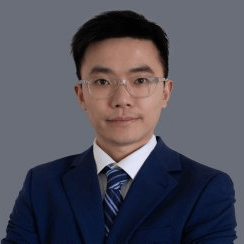
Pengfei Ou is an Assistant Professor in the Department of Chemistry at the National University of Singapore (NUS). He is also a member of the NUS Institute for Artificial Intelligence and the Centre for Hydrogen Innovations, and has been awarded the Presidential Young Professorship. He previously worked as a researcher at Northwestern University in the United States and conducted postdoctoral research at the University of Toronto in Canada. His research focuses on computational catalysis and artificial intelligence, aiming to accelerate catalyst discovery and mechanistic understanding. Since establishing his independent research group in 2024, he has published multiple high-impact papers as the corresponding author in journals such as Nature Synthesis, Nature Communications, and Advanced Energy Materials, among others. He also has extensive experience in industry collaboration, having worked closely on research projects with globally renowned companies and government agencies including TotalEnergies, Fujitsu, BP, and DSO Singapore. To date, he has published 110 peer-reviewed papers, with over 7,500 total citations and an h-index of 41. His honors include the NUS Presidential Young Professorship (2024), the Climate Positive Energy “Rising Stars in Sustainable Energy” Postdoctoral Fellowship (2022), and the Chinese Government Award for Outstanding Self-Financed Students Abroad (2021).
Editor: Wen Xue
Production Editor: Xingyue Luo
Respectfully Submitted by the Editorial Office of AI Agent