
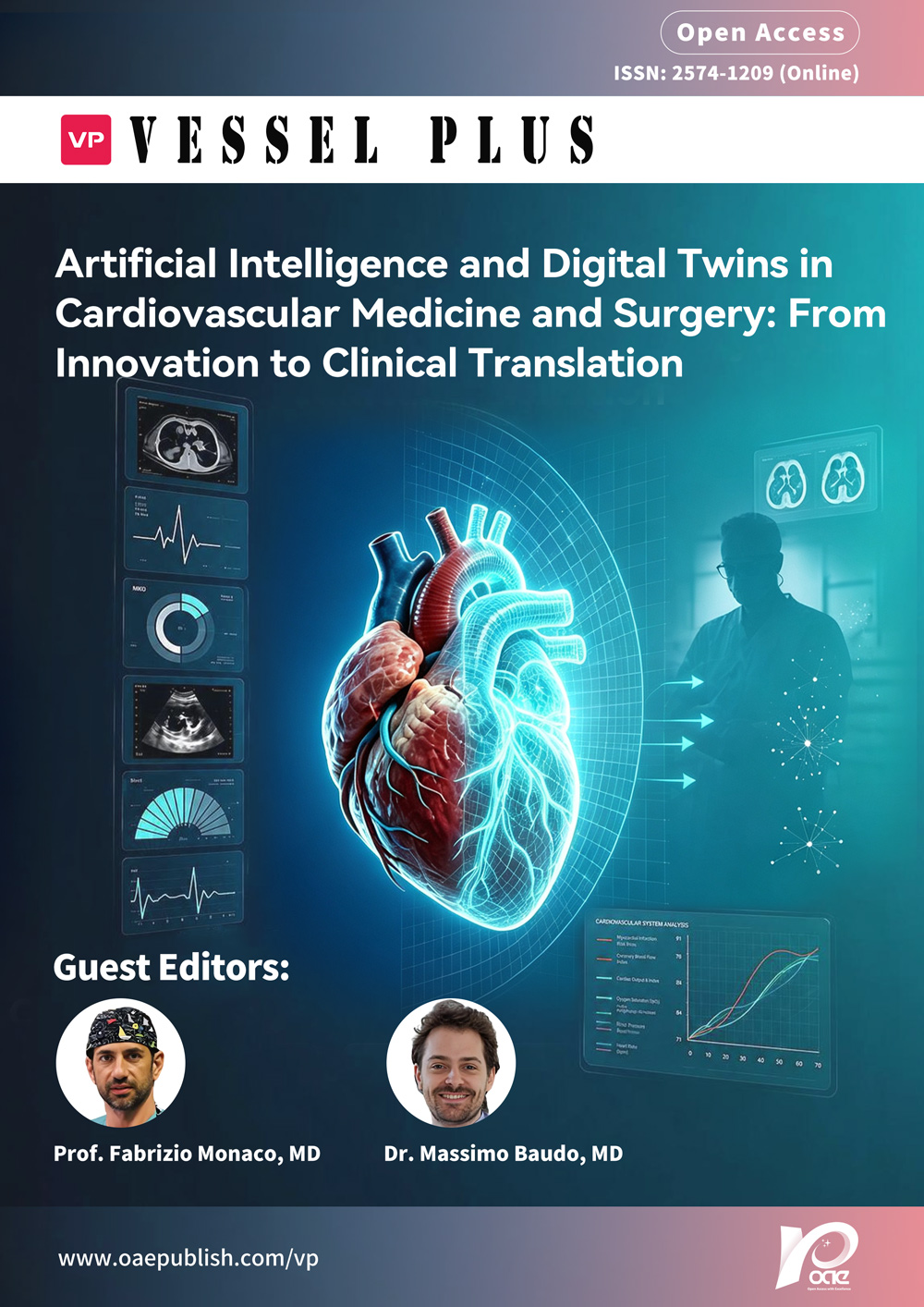
Topic: Artificial Intelligence and Digital Twins in Cardiovascular Medicine and Surgery: From Innovation to Clinical Translation
Guest Editor
Guest Editor Assistant
Special Topic Introduction
Artificial intelligence (AI) and digital twins are changing cardiovascular research. Their effect on clinical care is less certain. Machine-learning methods can process imaging, physiological signals, electronic health records, and molecular information at a level that is difficult to achieve through conventional analysis. Digital twins extend this approach by creating virtual representations that evolve as new patient data become available. These models may allow clinicians to explore disease trajectories, test alternative interventions, or anticipate the physiological response to treatment. Such possibilities are attractive. Most, however, remain incompletely tested in practice.
Cardiovascular medicine and surgery provide a demanding setting for clinical translation. Decisions are often time-sensitive, data are heterogeneous, and the consequences of error may be substantial. An algorithm that performs well in a retrospective dataset may fail when applied to another hospital, a different patient population, or a changing clinical workflow particularly where underlying data structures and coding practices differ across institutions. Technical accuracy alone is not enough. A useful system should alter decisions appropriately, integrate with existing care, and potentially improve outcomes without introducing burden or harm.
Translation consequently requires more than model development. Independent validation is needed, followed where appropriate by prospective assessment against current practice. The effects of clinician-algorithm interaction should also be examined. Bias, poor calibration, loss of performance over time, limited interoperability, and restricted interpretability may otherwise undermine apparently promising technologies. Economic and regulatory considerations cannot be deferred until after deployment.
This Special Issue will examine how AI and digital twins can move from computational innovation to credible cardiovascular practice. We welcome studies addressing development when linked to a clear clinical need, but particular attention will be given to external validation, real-world implementation, and evidence of clinical utility. The central question is simple: do these technologies improve cardiovascular decisions and care?
Topics of interest include, but are not limited to:
● Translating AI and digital-twin technologies into routine cardiovascular care;
● AI-supported diagnosis and phenotyping, including its potential role in clinical risk assessment;
● Cardiovascular imaging applications across echocardiography, computed tomography, magnetic resonance, and nuclear techniques;
● Patient-specific digital twins for physiological modelling, prediction of treatment response, and procedural simulation;
● AI-assisted planning and intraprocedural guidance for coronary, structural, and vascular interventions;
● Decision support during perioperative care and in the cardiovascular intensive care unit;
● Multimodal models combining clinical information with imaging, physiological signals, or molecular and wearable-device data;
● Federated learning, multi-center registries, and real-world data infrastructure supporting external validation;
● Generative AI and large language models: possible clinical applications, limitations, and effects on documentation;
● Independent validation, prospective evaluation, and pragmatic assessment under real-world conditions;
● Integration within clinical workflows and the evolving interaction between clinicians and AI;
● Effects on decisions, resource use, safety, and outcomes relevant to patients;
● Regulatory oversight, accountability, interoperability, post-deployment monitoring, explainability and interpretability methods relevant to clinical trust and accountability;
● Implementation science and the economic sustainability of AI-enabled cardiovascular care.
Keywords
Artificial intelligence, digital twins, cardiovascular medicine, cardiovascular surgery, clinical translation, implementation science, clinical decision support, precision cardiovascular care, external validation, explainable AI, precision cardiovascular care
Submission Deadline
Submission Information
For Author Instructions, please refer to https://www.oaepublish.com/vp/author_instructions
For Online Submission, please login at https://www.oaecenter.com/login?JournalId=vp&IssueId=vp26090810611
Submission Deadline: 31 Jan 2027
Contacts: Ada Chen, Science Editor, scienceeditor@vesselplus.net