




Volume 5, Issue 1 (2026) – 16 articles
Cover Picture: Food systems account for about 30% of anthropogenic emissions, of which agriculture contributes 12%-14%. Agro-ecosystems have large ecological footprints (EFP). Thus, the objective of the review is to examine land-use and management practices that can reduce EFP and sequester carbon (C) in soil. Decomposition of soil organic matter is accelerated by plow tillage and on-farm burning of crop residues. Livestock are also a source of CH4 through enteric fermentation and manure management. Approaches to reducing the global EFP of agroecosystems are discussed with the objective of adaptation and mitigation of anthropogenic climate change. Sequestration of atmospheric carbon dioxide (CO2) in soil, as soil organic carbon and soil inorganic carbon, can offset emissions. Examples of best management practices include conservation agriculture, judicious use of chemicals, drip fertigation, agroforestry, improved livestock grazing and manure management. The rate of C sequestration varies widely depending on soil, climate, and management. Soils of agroecosystems have the potential to sequester 4 to 10 Pg CO2 equivalents (CO2eq) per year (Pg = petagram = 1015g = 1 giga ton or Gt = 1 billion metric ton). However, the gross rate of C sequestration in soil varies among soils, eco-regions and management. The EFP of agro-ecosystems can be reduced by enhancing use efficiency of inputs, decreasing leakage of chemicals into the environment, conserving soil and water, and adopting regenerative agriculture. The importance of C farming and approaches to its adoption are discussed as payments for ecosystem services and the establishment of the Soil Health Act. Reducing EFP of agro-ecosystems is narrated in relation to Sustainable Development Goals of the United Nations.
view this paper 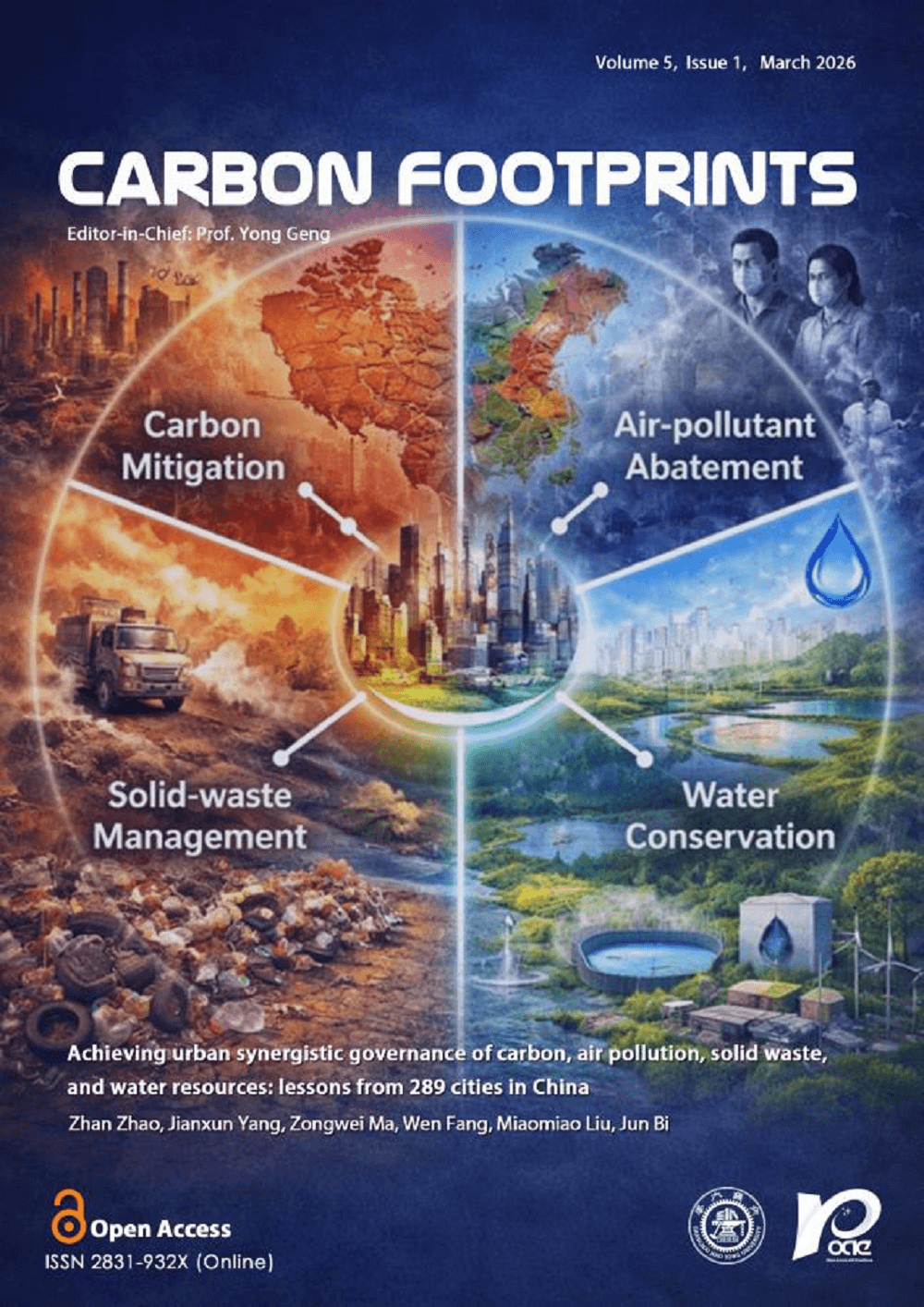
Back Cover Picture: Amid China’s “dual-carbon” goals and mounting environmental pressures, cross-sector synergy is essential for sustainable urban development. We develop an integrated assessment framework to evaluate synergistic governance across four subsystems - carbon mitigation, air-pollution abatement, solid-waste management, and water conservation - for 289 prefecture-level cities during 2011-2020. An obstacle degree model diagnoses which subsystems constrain overall synergy, while a machine-learning random forest model interpreted with Shapley Additive Explanations (SHAP) values quantifies the relative importance and nonlinear effects of twelve socioeconomic drivers. Results indicate broad improvements in synergistic level across most cities, with marked gains in air-pollution control and water conservation driving overall progress. In contrast, only moderate advances in carbon mitigation and high volatility in solid-waste management emerge as the principal barriers to further improvement. Spatial heterogeneity is pronounced: major urban agglomerations generally outperform other areas, with Pearl River Delta, Yangtze River Delta, and Chengdu-Chongqing (Chengyu) exhibiting strong cross-system improvement, whereas Central-Southern Liaoning and the Guanzhong Plain face persistent structural constraints. Machine-learning diagnostics further highlight energy intensity, energy structure, and the dominance of mining and electricity-supply sectors as top predictors of city-level synergistic performance, showing clear threshold effects. Based on these findings, we offer targeted and region-specific policy pathways to accelerate coordinated environmental governance across China’s leading urban agglomerations.
view this paper