
Volume 1, Issue 1 (2025) – 6 articles
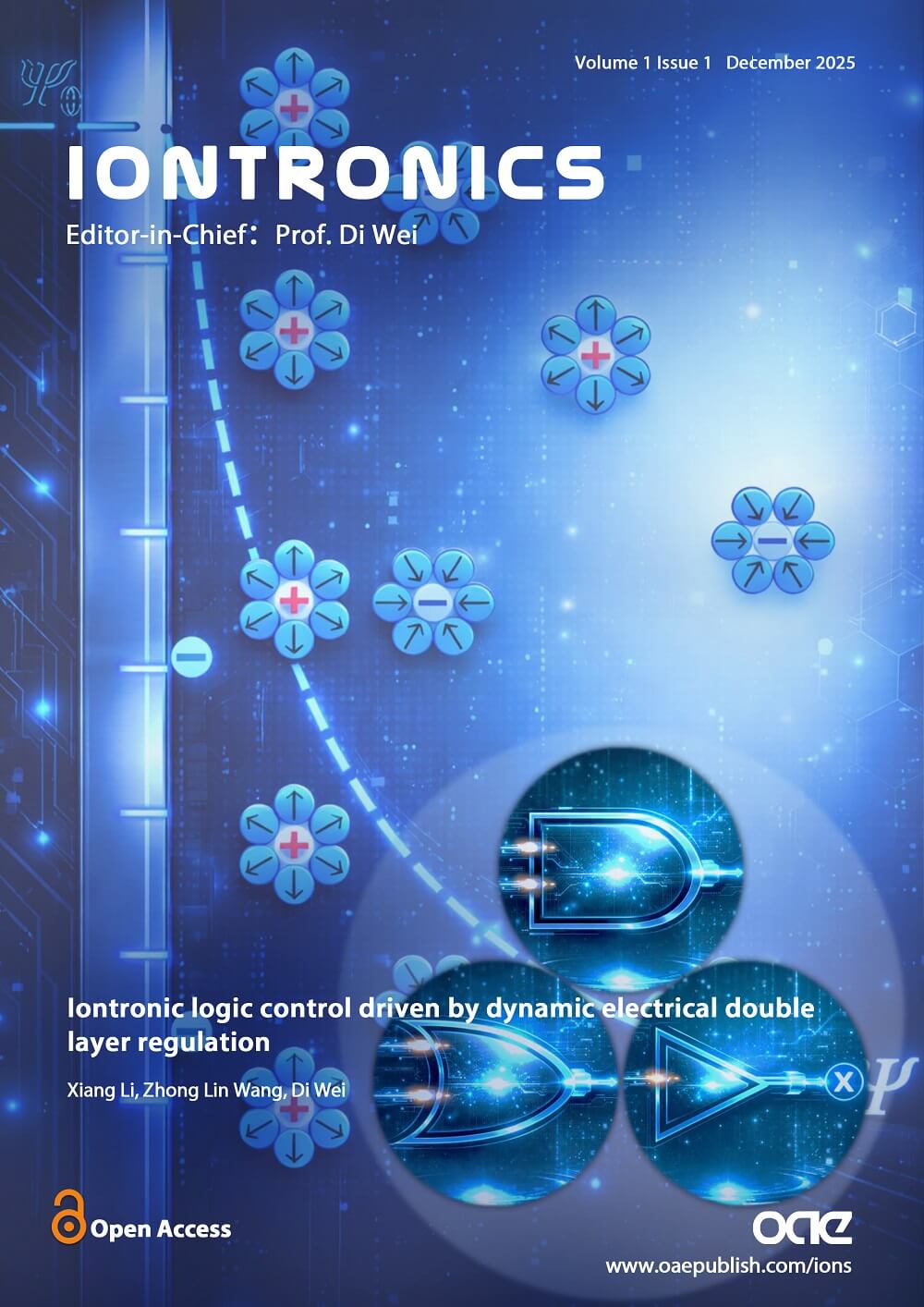
Cover Picture: Logic control underpins modern computation, sensing, and information processing, yet conventional semiconductor systems, despite their speed, integration density, and stability, remain limited by high energy demand, restricted memory plasticity, and poor biocompatibility. This Perspective introduces iontronic logic control as a next-generation paradigm in which ions act as information carriers for programmable signal processing. Logic control can be implemented through ion-concentration gradients, mechanically induced ionic migration, and dynamic regulation of electrical double layers (EDLs) at interfaces under applied fields. Critically, at dielectric interfaces where no external bias is imposed, localized triboelectric fields generated through contact electrification enable electrostatic regulation of EDLs, coupling mechanical-energy harvesting with real-time logic-state modulation. This mechanism facilitates robust ionic-electronic interactions without external power input. Within such an energy-information flow framework, iontronic logic achieves ultralow-power signal processing, intrinsic memory and plasticity, and reliable operation in aqueous and bio-relevant environments. Representative systems operate with millisecond-level or faster response times and energy consumption in the nanowatt range or even self-powered performance under triboelectric or concentration-gradient excitation. These capabilities open pathways to flexible, self-powered, and bio-integrated information systems that transcend the fundamental constraints of traditional semiconductor electronics.
view this paper 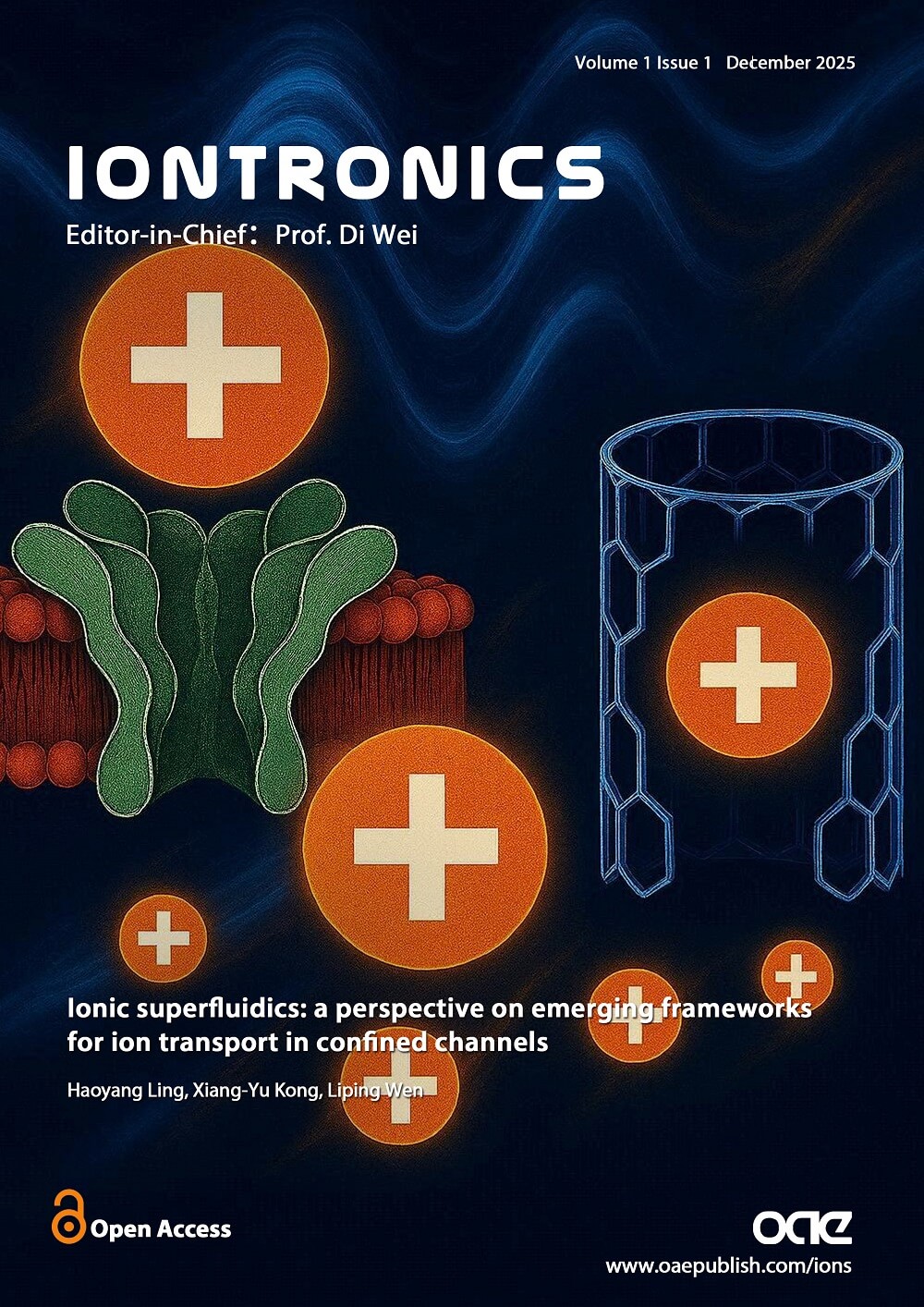
Back Cover Picture: Biological ion channels demonstrate exceptional capabilities for ultrafast ion transport, a process essential to numerous physiological functions. Inspired by these natural systems, significant efforts have been devoted to developing artificial ion channels, with transport performance in some synthetic systems now approaching that of their biological counterparts. Nevertheless, a theoretical framework that adequately explains the physical origin of such ultrafast ion transport remains lacking. The introduction of the concept of macroscopic quantum states was of great significance, as it paved the way for understanding the ultrafast ion transport in confined environments. Drawing from this theory, we further elaborate on the potential mechanism enabling ultrafast ion transport in sub-nanoscale confined environments and extend it to the design of the future nanofluidic materials. This perspective not only provides a fundamental explanation for the observed ultrafast ion transport phenomena in sub-nanoscale confined spaces but also opens a new route for the design of next-generation nanofluidic materials and iontronic systems applied in advanced energy and information technologies.
view this paper