

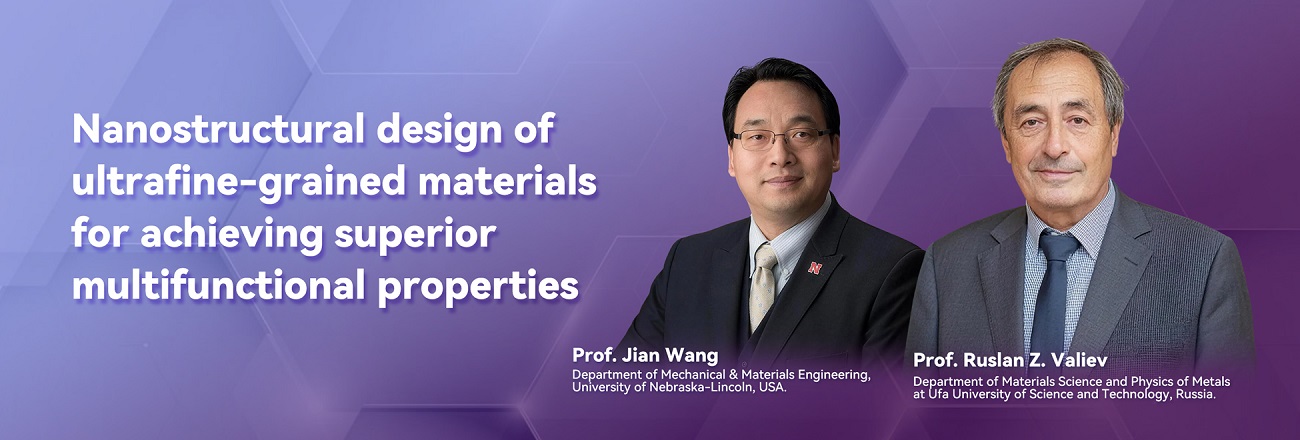
Nanostructural design of ultrafine-grained materials for achieving superior multifunctional properties
Contents
Host
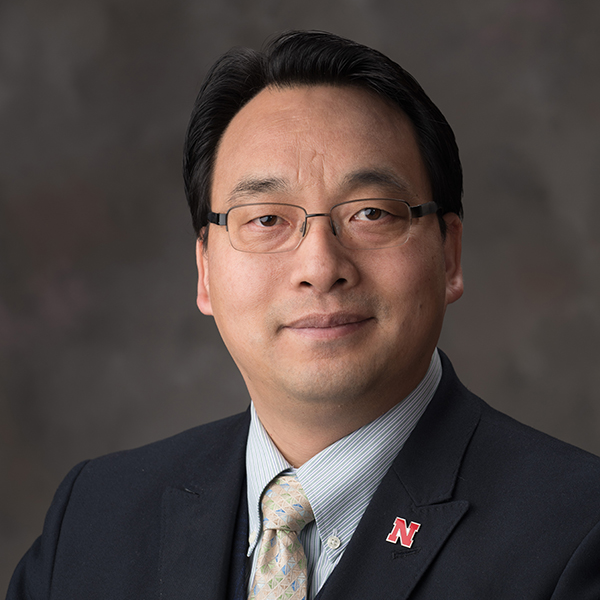
Prof. Jian Wang
Prof. Jian Wang is Wilmer J. and Sally L. Hergenrader Presidential Chair of Mechanical and Materials Engineering at the University of Nebraska-Lincoln since 2015. He received his PhD from Rensselaer Polytechnic Institute in 2006 and worked as technical staff member at Los Alamos National Laboratory (LANL) until 2015. His research focuses on quantitatively exploring the structure-properties relations of materials using multi-scale theory, modeling and experimental methods and techniques. He was awarded the LANL Distinguished Postdoctoral Performance Award (2009), the LDRD/Early Career Award (2011), TMS MPMD Young Leader Award (2013), International Plasticity Young Research Award (2015), Materials Today Rising Star Award in the category of Materials Genome Innovation (2018), TMS MPMD Distinguished Scientist Award (2022) and TMS BRIMACOMBE MEDALIST Award (2023). He is Fellow of ASME and Fellow of ASM International. He served as Editorial Board of International Journal of Plasticity (2015~), Materials Research Letters (2016~), and others. He has published more than ~400 peer-reviewed papers (> 28,000 citations and H-index = 94; 10 papers featured as Journal cover).
Speaker
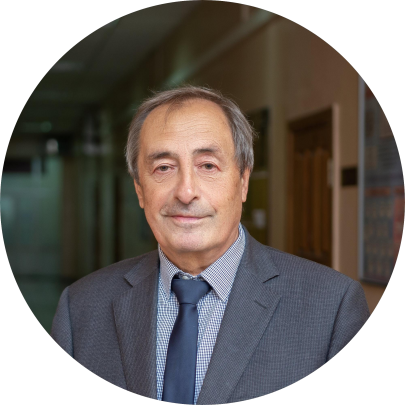
Prof. Ruslan Z. Valiev
Prof. Ruslan Z. Valiev is Director of the Institute of Physics of Advanced Materials and Professor in the Department of Materials Science and Physics of Metals at Ufa University of Science and Technology, Russia. He also served as Supervisor of the Laboratory for Mechanics of Advanced Nanomaterials at Saint Petersburg State University, a laboratory supported by the Government of the Russian Federation. In recognition of his outstanding scientific achievements, he was elected as a Member of the European Academy of Sciences (EAS) in 2009 and of other academic institutions. Presently, he is also a Principal Investigator with the Herbert Gleiter International Institute (Liaoning Academy of Materials, Shenyang, China).
Professor Valiev is internationally renowned as a pioneer in the field of severe plastic deformation (SPD). He was among the first scientists in the world to discover and establish the principles for producing bulk nanostructured metallic materials through SPD techniques. His research has fundamentally advanced the understanding of nanostructured metals and alloys, enabling remarkable improvements in their structural and functional properties and accelerating their applications in engineering, aerospace, energy, and biomedical fields. His studies are reflected in over 900 articles in archival scientific journals, over 13 well-known monographs, and special issues and reviews. He is among the most highly-cited scientists in the world in the area of nanomaterial science: the total number of citations exceeds 63,000 times (WoS), and his h-index = 113. He was ranked as top 2% leading scientists of the world based on the publicly available database by Stanford University and ranked #1 for Overall Highly Ranked Scholars in Russia by ScholarGPS.
Throughout his distinguished career, Professor Valiev has received numerous prestigious honors, including the European Academy of Sciences Blaise Pascal Medal in Materials Science (2011), the First Annual Materials Science and Engineering A (MSEA) Journal Prize (2010), Scopus Awards Russia (2011, 2014), the TMS Fellow Award and Somiya Award (2015), the Web of Science Highly Cited Researcher Russia Award (2017), the THERMEC Distinguished Award (2023) and the Academician G.V. Kurdyumov Medal of Honour for outstanding achievements in the field of physical metallurgy (2024). He is also the founding member and Chairman of the International NanoSPD Steering Committee, playing a leading role in shaping the global development of nanostructured materials research.
Professor Valiev is internationally renowned as a pioneer in the field of severe plastic deformation (SPD). He was among the first scientists in the world to discover and establish the principles for producing bulk nanostructured metallic materials through SPD techniques. His research has fundamentally advanced the understanding of nanostructured metals and alloys, enabling remarkable improvements in their structural and functional properties and accelerating their applications in engineering, aerospace, energy, and biomedical fields. His studies are reflected in over 900 articles in archival scientific journals, over 13 well-known monographs, and special issues and reviews. He is among the most highly-cited scientists in the world in the area of nanomaterial science: the total number of citations exceeds 63,000 times (WoS), and his h-index = 113. He was ranked as top 2% leading scientists of the world based on the publicly available database by Stanford University and ranked #1 for Overall Highly Ranked Scholars in Russia by ScholarGPS.
Throughout his distinguished career, Professor Valiev has received numerous prestigious honors, including the European Academy of Sciences Blaise Pascal Medal in Materials Science (2011), the First Annual Materials Science and Engineering A (MSEA) Journal Prize (2010), Scopus Awards Russia (2011, 2014), the TMS Fellow Award and Somiya Award (2015), the Web of Science Highly Cited Researcher Russia Award (2017), the THERMEC Distinguished Award (2023) and the Academician G.V. Kurdyumov Medal of Honour for outstanding achievements in the field of physical metallurgy (2024). He is also the founding member and Chairman of the International NanoSPD Steering Committee, playing a leading role in shaping the global development of nanostructured materials research.
Abstract
The concept of nanostructural design is presented and developed for enhancement of properties of metallic materials by tailoring ultrafine grains (UFG) and different grain boundaries (GB) (low angle and high angle, special and random, equilibrium and non-equilibrium ones with strain-induced segregations of alloying elements), using severe plastic deformation (SPD) techniques. In recent years SPD processing, which comprises the exposure of material to heavy straining under high pressure, has emerged as a promising method for materials’ nanostructuring [1, 2]. In this report, by varying regimes and routes of SPD processing for various metals and alloys, we demonstrate the ability to produce UFG materials with different grain boundaries, and study their effect on mechanical and functional properties of the processed materials, in particular, on their extraordinarily high strength and ductility, superplasticity, enhanced thermostability and electric conductivity. The origin of these phenomena is discussed on the basis of the results of computer simulation and experimental observations of deformation mechanisms in the UFG materials with different GBs [1, 3]. The examples of innovative applications of such materials in engineering and medicine are discussed. Presently, manufacturing of high-strength metallic materials for medicine is of great practical interest. Recent R&D of metallic biomaterials, such as commercially pure titanium and magnesium alloys, provide evidence that their nanostructuring by SPD techniques contributes to a significant increase in strength and fatigue properties, as well as maintains corrosion, which makes it possible to create medical implants of improved design and with enhanced biofunctional properties for dentistry and maxillofacial surgery [3].
Author acknowledges the support in part from Russian Science Foundation (Grant № 22-19-00445-П, https://rscf.ru/project/22-19-00445/).
Keywords: nanostructured metals, grain boundaries, severe plastic deformation, superior multifunctional properties, medical implants
Author acknowledges the support in part from Russian Science Foundation (Grant № 22-19-00445-П, https://rscf.ru/project/22-19-00445/).
Keywords: nanostructured metals, grain boundaries, severe plastic deformation, superior multifunctional properties, medical implants