


fig8
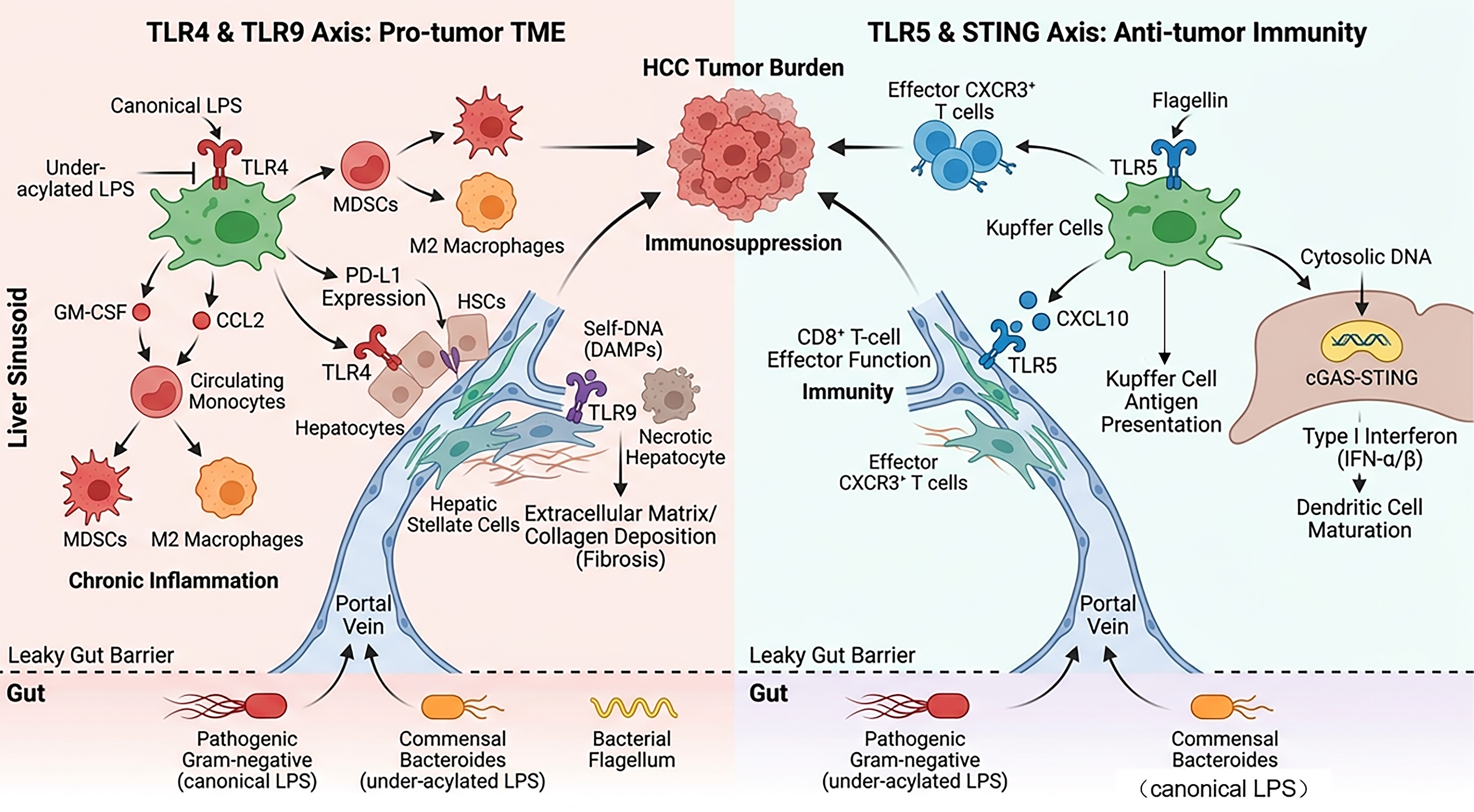
Figure 8. Direct immunomodulatory mechanisms of microbial pattern molecules via hepatic PRRs. The schematic contrasts the pro-tumorigenic TLR4/TLR9 axes (left) with the anti-tumorigenic TLR5/STING axes (right) within the liver microenvironment. Arrows indicate pathway activation, cellular recruitment, or immune cell maturation; T-bars denote receptor antagonism or inhibition (e.g., under-acylated LPS antagonizing TLR4). Detailed ligand-receptor interactions, including the distinct roles of canonical vs. under-acylated LPS, flagellin-mediated CXCR3+ T cell recruitment, and cGAS-STING signaling, are comprehensively discussed in the corresponding text. PRRs: Pattern recognition receptors; STING: stimulator of interferon genes; LPS: lipopolysaccharide; TLR4: Toll-like receptor 4; MDSCs: myeloid-derived suppressor cells; GM-CSF: granulocyte-macrophage colony-stimulating factor; DAMPs: damage-associated molecular patterns; TLR5: Toll-like receptor 5; CXCR3+: C-X-C motif chemokine receptor 3 positive; cGAS-STING: cyclic GMP-AMP synthase-stimulator of interferon genes; TLR9: Toll-like receptor 9; PD-L1: programmed death-ligand 1; CCL2: C-C motif chemokine ligand 2; HSCs: hepatic stellate cells; CD8+: cluster of differentiation 8 positive; CXCR3: C-X-C motif chemokine receptor 3; INF-α/β: interferon-α/β.