


fig1
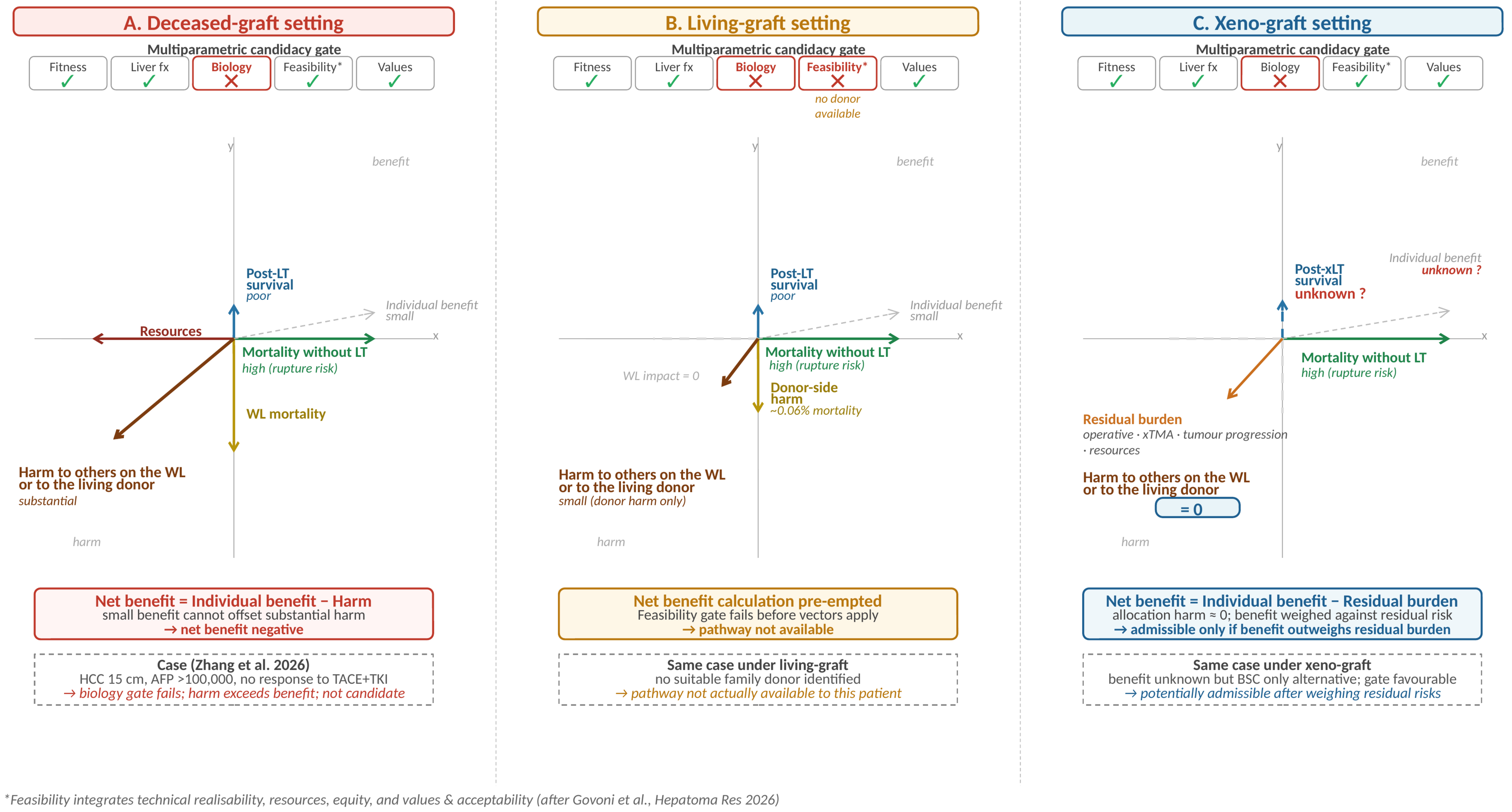
Figure 1. The net-benefit interpretation of transplant candidacy across three donor settings, inspired by the conceptual framework described by Cillo et al.[14]. Each panel depicts the Zhang case under a different donor source scenario[6]. The upper layer represents the multiparametric candidacy gate; the lower layer illustrates the net-benefit equation, where post-transplant survival and mortality without LT define the individual-benefit vector, and harm components are represented on the negative axes. (A) Deceased-donor setting. Scarce-resource use and waiting-list mortality generate a substantial harm vector. In the context of aggressive, treatment-unresponsive tumor biology, the individual-benefit vector is insufficient to offset harm to other candidates, resulting in negative net benefit; (B) Living-donor setting. Waiting-list harm is eliminated, but donor-related surgical harm persists; (C) Xenograft setting. Allocation-related harms are eliminated, but residual burdens remain. Tumor biology is unchanged, as it is patient-specific; uncertainty concerns post-xLT survival and therefore the magnitude of the individual-benefit vector (dashed). The decision shifts from balancing benefit against harm to others towards balancing an uncertain but plausible benefit against residual procedural risks and burdens, conditional on a favorable Feasibility gate. AFP: Alpha-fetoprotein; BSC: best supportive care; Fx: function; HCC: hepatocellular carcinoma; LT: liver transplant; TACE: transarterial chemoembolization; TKI: tyrosine kinase inhibitors; WL: waiting list; xLT: xeno-liver transplant; xTMA: Xenotransplantation-associated thrombotic microangiopathy.