


Confinement of Cu(I) single-atom site with asymmetric coordination modulation in defective metal-organic frameworks for photocatalysis
 0
0 
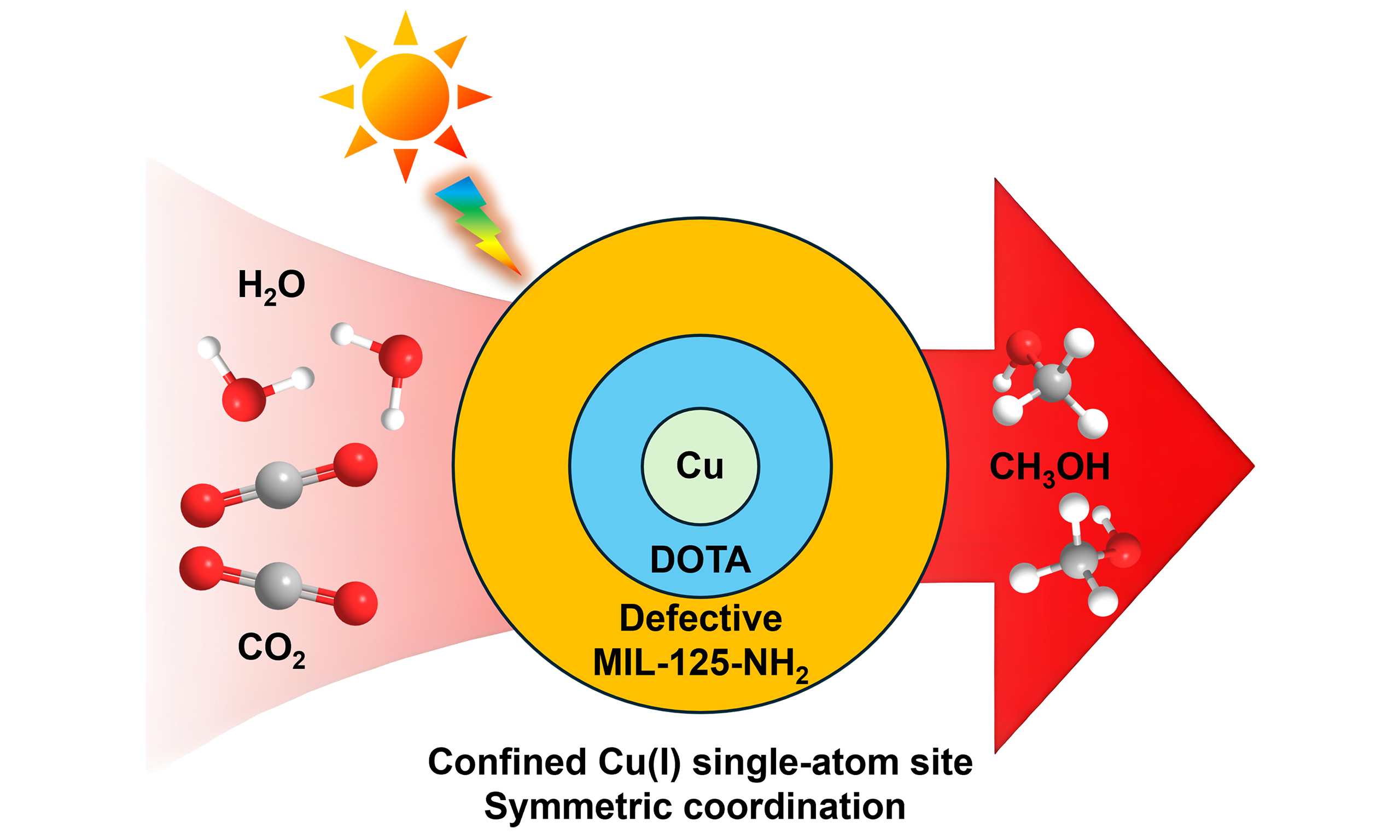
Photocatalytic CO2 reduction is a sustainable strategy that converts solar energy into chemical energy, addressing both global warming and the fossil fuel crisis[1-3]. However, the dissociation energy of the C=O bond in the CO2 molecule is as high as 805 kJ·mol-1[4], making CO2 highly stable and difficult to activate. In recent years, Metal-organic frameworks (MOFs) have attracted significant research interest in photocatalytic CO2 reduction due to their highly adjustable structures and versatile compositional characteristics. MOFs can not only efficiently capture CO2[5] but also optimize their band structures and facilitate the separation of photogenerated charge carriers through strategies such as linker engineering[6], metal node engineering[7], and defect engineering[8]. Compared with traditional inorganic semiconductors, MOFs offer unique advantages in photocatalytic CO2 reduction[9,10]. Currently, the main product of photocatalytic CO2 reduction with MOF systems is mostly CO[11] or CH4[12]. Limited research focuses on the CH3OH product[13], and the yield and selectivity still need to be improved. Moreover, the use of sacrificial agents and the lack of rigorous validation raise concerns about the true source of CH3OH product[14].
Recently, Dr. Yuanyuan Zhao, Prof. Guangshan Zhu, Prof. Hongzhu Xing, and coworkers reported a site-specific asymmetric coordination engineering strategy to construct a high-performance defective MIL-125-NH2 (D-MIL) photocatalyst with Cu single-atom (SA) sites for highly selective CO2 reduction to CH3OH[15]. First, the researchers prepared D-MIL with unsaturated Ti-oxo clusters via low-temperature pyrolysis. Then, the flexible N-heteromacrocyclic ligand tetraxetan (DOTA) was anchored at the defective sites to repair the missing-linker defects. Finally, Cu(II) ions were chelated with DOTA to form the target catalyst Cu-DOTA@D-MIL [Figure 1A]. X-ray absorption fine structure (XAFS) analysis and density functional theory (DFT) simulations confirm that Cu SA is coordinated with four N atoms of DOTA to form an asymmetric Cu-N4 configuration with a dihedral angle of 45° [Figure 1B], which effectively suppresses the aggregation of Cu species and stabilizes the active sites.
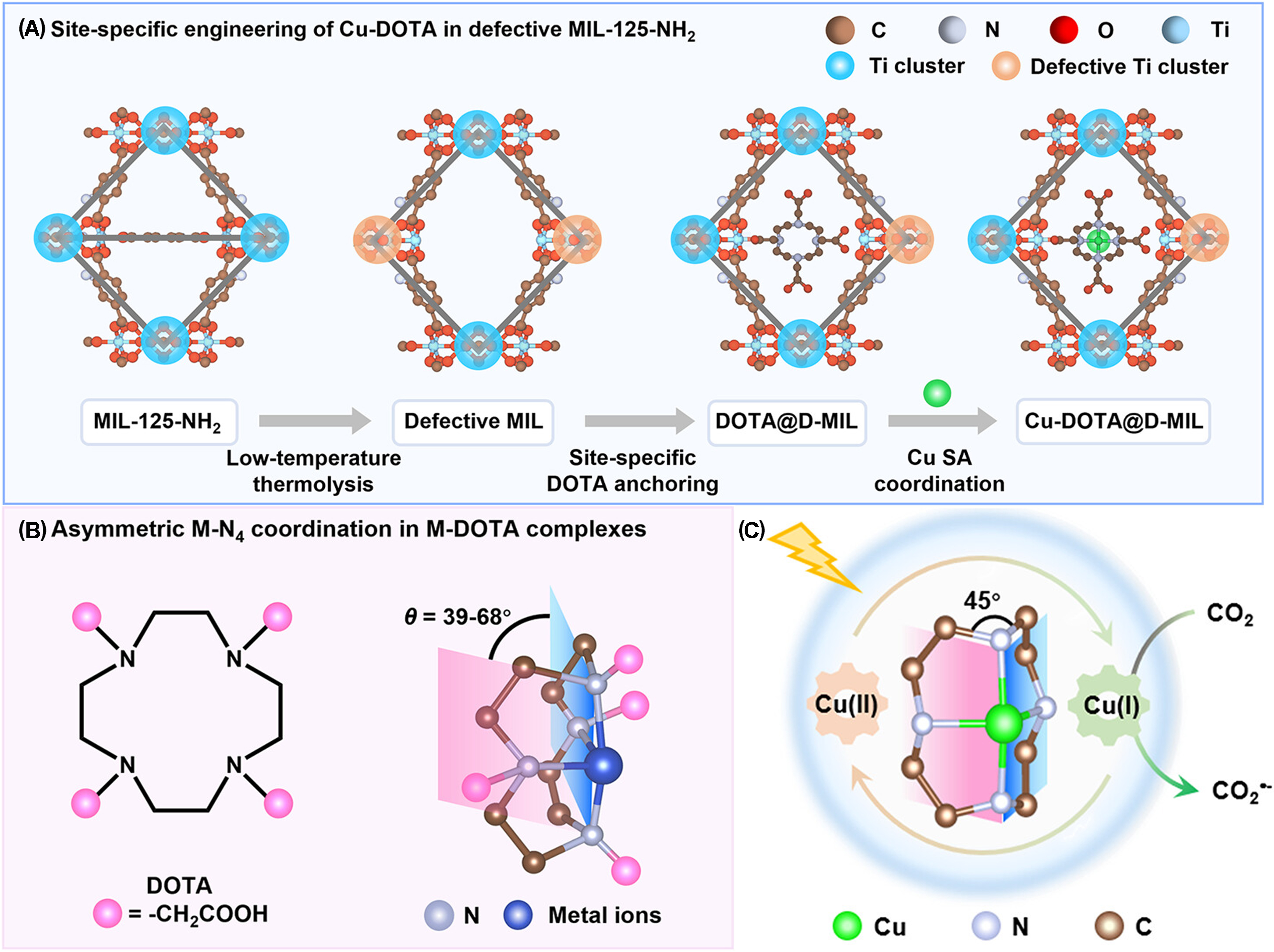
Figure 1. (A) Site-selective anchoring of Cu-DOTA within D-MIL; (B) Asymmetric M-N4 coordination in the complex; (C) Electron transfer pathway in CO2. This figure is adapted with permission from Ref.[15]. Copyright 2026 American Chemical Society. DOTA: N-heteromacrocyclic ligand tetraxetan; D-MIL: defective MIL-125-NH2; SA: single-atom.
Notably, the ultrahigh formation constant of Cu-DOTA (log βCu = 22.3) endows the catalyst with excellent structural stability. The D-MIL support not only provides suitable anchoring sites for the DOTA but also maintains the original crystallinity and disk-like morphology. Meanwhile, the incorporation of Cu-DOTA alters the conduction band position of the catalyst, making it closer to the reduction potential of CO2-to-CH3OH (-0.38 V vs. NHE) and more favorable for the conversion. In situ electron paramagnetic resonance results under light irradiation, along with cyclic voltammetry measurements, indicate that the catalyst follows a cascade electron transfer pathway. The photogenerated electrons reduce Cu(II) to stable Cu(I) active sites, which further mediate fast electron transfer to activate CO2 and are themselves oxidized back to Cu(II). The asymmetric Cu-N4 coordination microenvironment sustains the Cu(I)/Cu(II) redox cycle and avoids over-reduction to Cu(0), providing a steady electron supply for selective CO2 conversion [Figure 1C].
Under visible-light irradiation without any sacrificial agent, Cu-DOTA@D-MIL exhibits excellent photocatalytic CO2 reduction performance, achieving a CH3OH yield of 229.0 μmol·g-1·h-1 with a selectivity of up to 95.9% [Figure 2A]. Control experiments confirm the photocatalytic property of the conversion and the indispensability of CO2. Isotopic labeling experiments with 13CO2 further verify that the produced CH3OH is exclusively derived from CO2. The catalyst also shows excellent stability, maintaining about 93.8% of its initial CH3OH yield after 12 consecutive cyclic runs [Figure 2B]. Powder X-ray diffraction, transmission electron microscopy, X-ray photoelectron spectroscopy, and XAFS characterizations prove the robustness of Cu-DOTA@D-MIL. The Cu-DOTA complex alone shows no catalytic activity, while the combination of these components significantly boosts the CH3OH production rate, which is 70.5 times higher than that of pristine MIL-125-NH2 [Figure 2C][15].
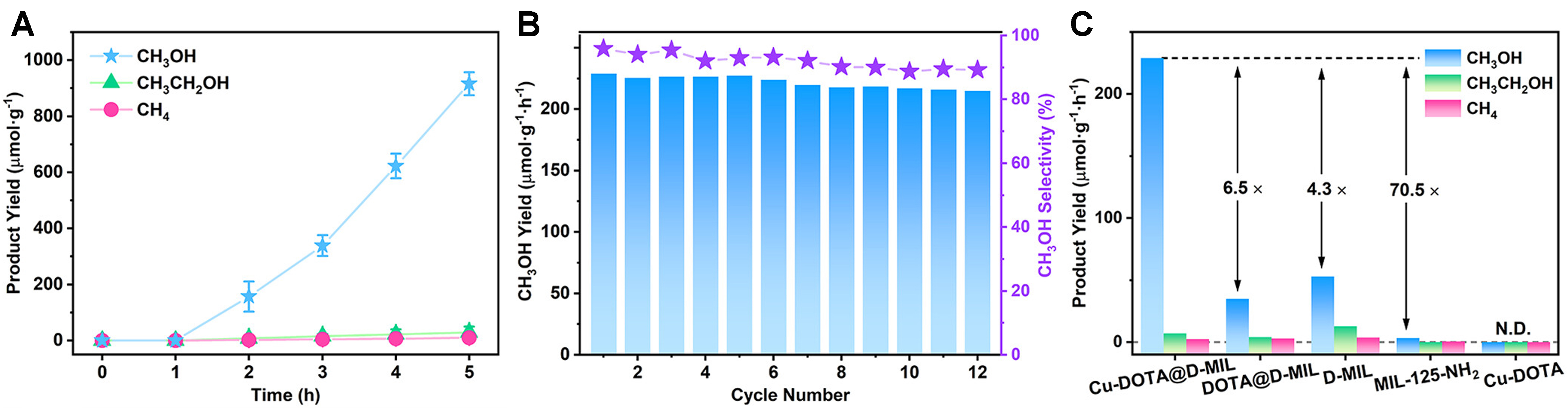
Figure 2. (A) Product yields of CH3OH, CH3CH2OH, and CH4 over Cu-DOTA@D-MIL during the photocatalytic CO2 reduction process; (B) Stability cycling tests over Cu-DOTA@D-MIL; (C) Product yields over Cu-DOTA@D-MIL, DOTA@D-MIL, D-MIL, MIL-125-NH2, and Cu-DOTA. This figure is adapted with permission from Ref.[15]. Copyright 2026 American Chemical Society. DOTA: N-heteromacrocyclic ligand tetraxetan; D-MIL: defective MIL-125-NH2.
Mechanistic investigations reveal that the superior catalytic results should be attributed to the asymmetric Cu-N4 coordination microenvironment, which modulates the electronic structure of Cu SA and facilitates the formation and stabilization of Cu(I) active sites. As a result, the Gibbs free energies to yield key reaction intermediates such as *CO and *CHO are significantly reduced by 0.07 and 0.50 eV, respectively, while the formation of byproducts including HCOOH and CO is suppressed [Figure 3]. In contrast, the Cu(II) site proceeds via a thermodynamically unfavorable pathway, as evidenced by the highly endothermic *OCH2-to-*CH2OH rate-determining step (ΔG = +1.53 eV) and the transition from Cu-O to Cu-C adsorption state.
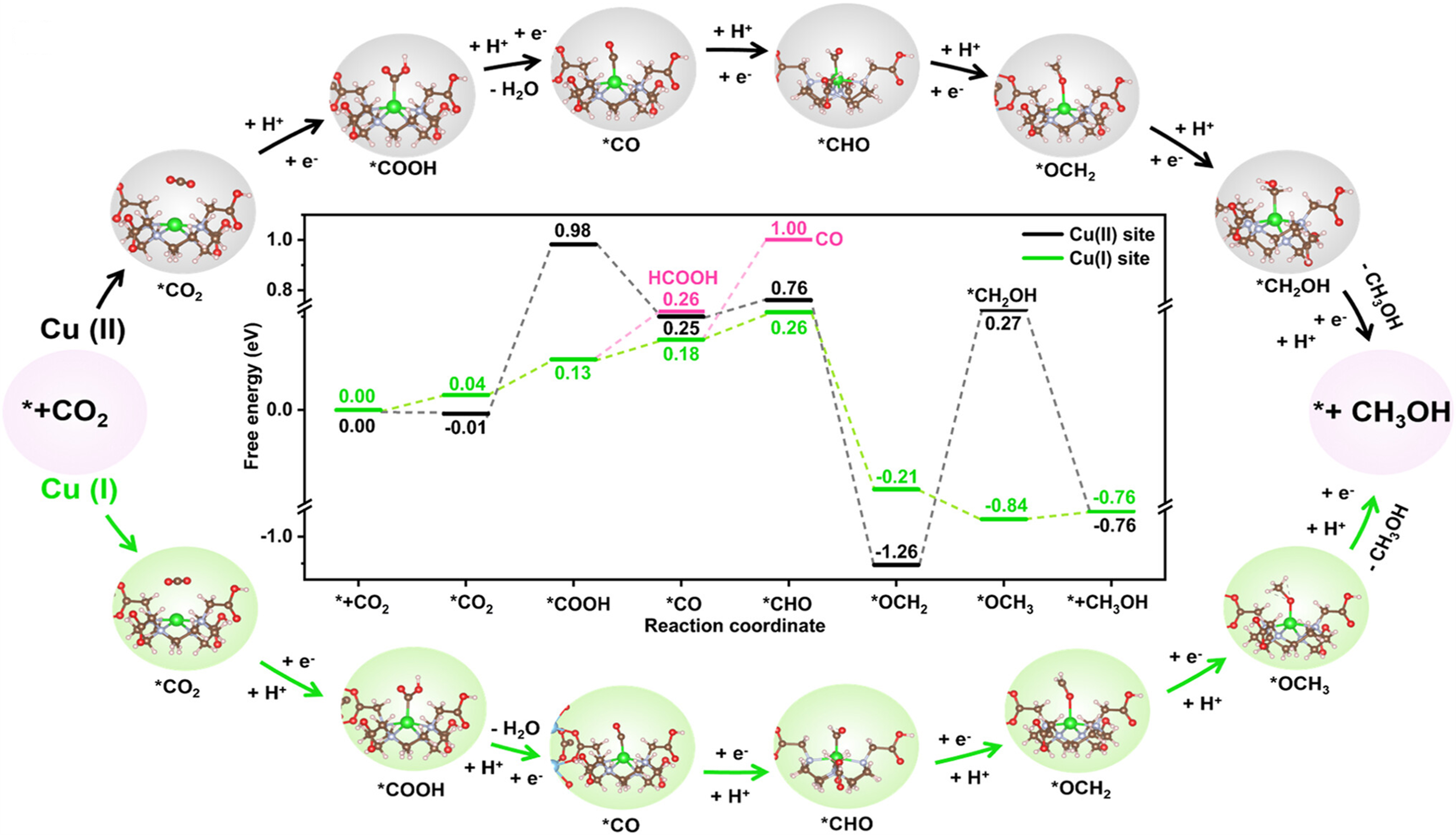
Figure 3. Proposed reaction routes and intermediate structures for CO2-to-CH3OH reduction over Cu(II) and Cu(I) active sites. This figure is adapted with permission from Ref.[15]. Copyright 2026 American Chemical Society.
In summary, MOF defect engineering and site-specific macrocyclic ligand functionalization are innovatively integrated to design a novel photocatalyst with an asymmetric coordination environment. The emerging and rare research strategy is deployed in photocatalytic CO2 to CH3OH reduction without a sacrificial agent. The high yield and selectivity of CH3OH highlight the importance of precise integration of each functional module in the catalyst design. This work not only addresses the critical issues of metal aggregation and active site oxidation in SA catalysts but also provides a new approach to regulate the catalytic reaction pathway by engineering the local coordination field of atomic sites. The asymmetric coordination engineering offers a new perspective on the development of high-selectivity, high-stability photocatalysts for CO2 conversion, and deepens the mechanistic understanding of solar-driven CO2 reduction catalysis.
DECLARATIONS
Authors’ contributions
Drafted the manuscript: Wang, L.
Revised and rewrote sections of the manuscript: Zhang, C.; Zhang, J.
Availability of data and materials
Not applicable.
AI and AI-assisted tools statement
Not applicable.
Financial support and sponsorship
This work was supported by the National Natural Science Foundation of China (21975183 and 22302147).
Conflicts of interest
All authors declared that there are no conflicts of interest.
Ethical approval and consent to participate
Not applicable.
Consent for publication
Not applicable.
Copyright
© The Author(s) 2026.
REFERENCES
1. Huang, N. Y.; Shen, J. Q.; Zhang, X. W.; Liao, P. Q.; Zhang, J. P.; Chen, X. M. Coupling ruthenium bipyridyl and cobalt imidazolate units in a metal–organic framework for an efficient photosynthetic overall reaction in diluted CO2. J. Am. Chem. Soc. 2022, 144, 8676-82.
2. Guo, S.; Zeng, F. G.; Li, X. D.; et al. Earth-abundant Zn–dipyrrin chromophores for efficient CO2 photoreduction. Natl. Sci. Rev. 2024, 11, nwae130.
3. Wang, Y.; Yu, W.; Wang, C.; Chen, F.; Ma, T.; Huang, H. Defects in photoreduction reactions: fundamentals, classification, and catalytic energy conversion. eScience 2024, 4, 100228.
4. Rhimi, B.; Liu, Z.; Liu, Z.; Zhou, M.; Shi, W.; Jiang, Z. Emerging trends in metal organic framework based materials for enhanced photocatalytic CO2 reduction. Coord. Chem. Rev. 2025, 537, 216706.
5. Chen, O. I. F.; Liu, C. H.; Wang, K.; et al. Water-enhanced direct air capture of carbon dioxide in metal–organic frameworks. J. Am. Chem. Soc. 2024, 146, 2835-44.
6. Wu, K.; Liu, X. Y.; Cheng, P. W.; et al. Linker engineering for reactive oxygen species generation efficiency in ultra-stable nickel-based metal–organic frameworks. J. Am. Chem. Soc. 2023, 145, 18931-8.
7. Zhang, H.; Shi, Y.; Chen, T.; et al. Rational integration of amino functionalization and catalytic site modulation in Zr-MOFs for synergistic enhanced photocatalysis. Angew. Chem. Int. Ed. 2026, 65, e23106.
8. Daliran, S.; Oveisi, A. R.; Kung, C. W.; et al. Defect-enabling zirconium-based metal–organic frameworks for energy and environmental remediation applications. Chem. Soc. Rev. 2024, 53, 6244-94.
9. Stanley, P. M.; Ramm, V.; Fischer, R. A.; Warnan, J. Analysis of metal–organic framework-based photosynthetic CO2 reduction. Nat. Synth. 2024, 3, 307-18.
10. Zhang, C.; Wu, Y.; Li, D.; Jiang, H. L. Recent advances in MOF composites for photocatalysis. Chem. Sci. 2025, 16, 13149-72.
11. Liu, X.; Ding, G.; Guo, X.; et al. Synergizing donor–acceptor Ni-MOF with lignin proton relay for efficient and selective CO2-to-CO photoreduction. Adv. Mater. 2026, 38, e20384.
12. Song, W.; Wu, Y.; Zhang, Y.; et al. Unveiling asymmetric dual-metal interfaces for solar-driven CO2-to-CH4 reduction coupled with C–H activation. J. Am. Chem. Soc. 2026, 148, 4568-78.
13. Zhao, Q.; Yang, S.; Zhang, S.; et al. Single MOF based on asymmetric intramolecular electron compartments enables highly efficient photocatalytic CO2 overall reaction to methanol. Angew. Chem. Int. Ed. 2026, 65, e20298.
14. Fernandes de Almeida, V.; Navalón, S.; Dhakshinamoorthy, A.; Garcia, H. Revisiting photocatalytic CO2 reduction to methanol: a perspective focusing on metal-organic frameworks. Angew. Chem. Int. Ed. 2025, 64, e202424537.
Cite This Article
 Open Access
How to Cite
Download Citation
Export Citation File:
Type of Import
Tips on Downloading Citation
Citation Manager File Format
Type of Import
Direct Import: When the Direct Import option is selected (the default state), a dialogue box will give you the option to Save or Open the downloaded citation data. Choosing Open will either launch your citation manager or give you a choice of applications with which to use the metadata. The Save option saves the file locally for later use.
Indirect Import: When the Indirect Import option is selected, the metadata is displayed and may be copied and pasted as needed.
About This Article
Copyright

Data & Comments
Data
0








Comments
Comments must be written in English. Spam, offensive content, impersonation, and private information will not be permitted. If any comment is reported and identified as inappropriate content by OAE staff, the comment will be removed without notice. If you have any queries or need any help, please contact us at support@oaepublish.com.