
fig2
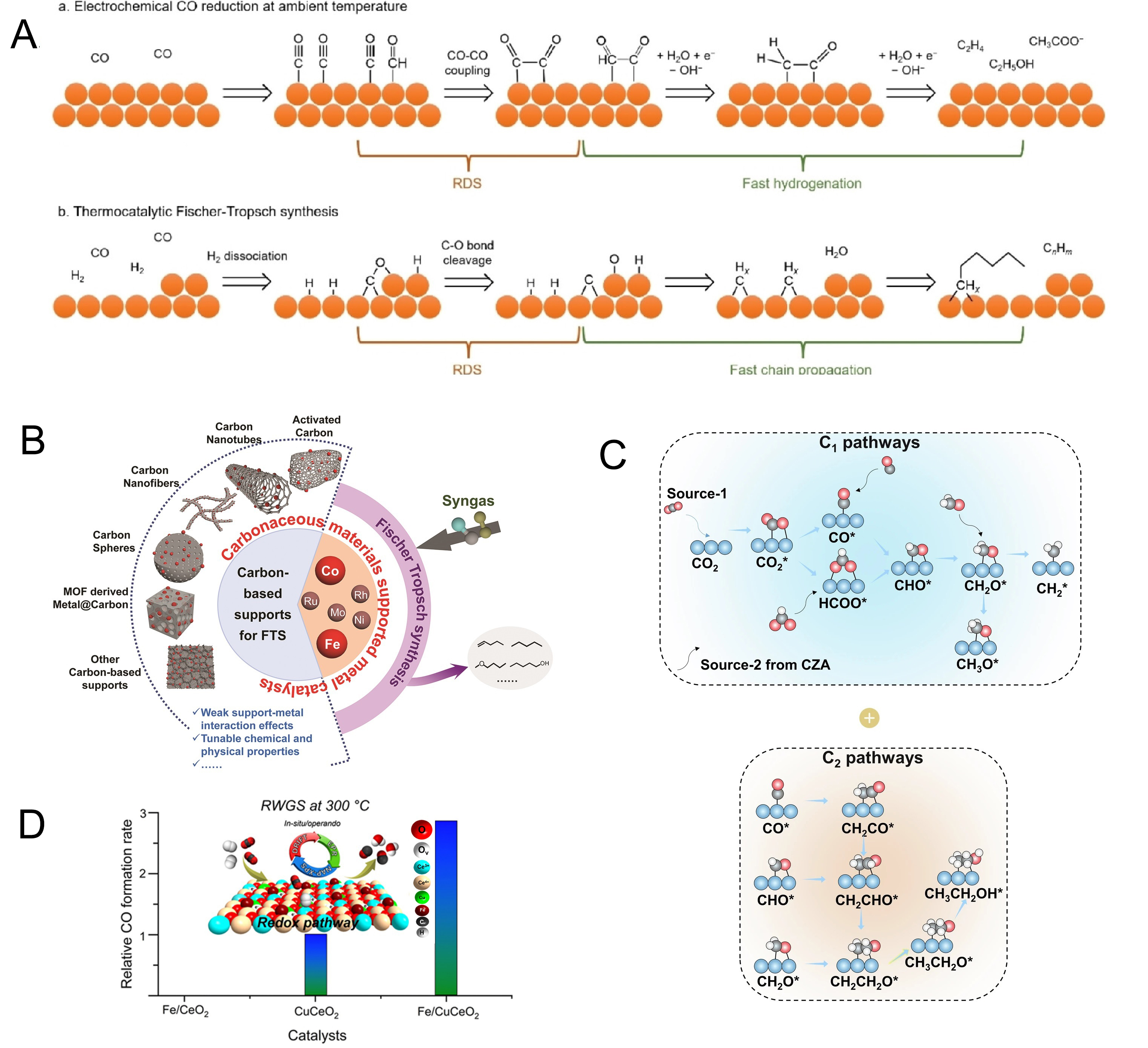
Figure 2. (A) Schematics of different COR pathways. (a) Electrochemical CO reduction at ambient temperature. (b) Thermocatalytic FTS. (A) is reprinted with permission from Ref.[44], Copyright © 2025 John Wiley and Sons; (B) Carbonaceous materials supported metal catalysts for FTS. (B) is reprinted with permission from Ref.[46], Copyright © 2021 Royal Society of Chemistry; (C) Reaction mechanism for C2+OH synthesis on the FeCo&CZA catalyst. The optimal reaction pathway for ethanol synthesis on (Fe3/4Co1/4)5C2(510) surface. Color: C: Gray, H: White, O: Red. (C) is reprinted with permission from Ref.[52], Copyright © 2025 Springer Nature; (D) Overview of the Redox Mechanism and Surface Structure Changes on the Fe/CuCeO2 Catalyst during the RWGS Reaction. (D) is reprinted with permission from Ref.[54], Copyright © 2024 American Chemical Society. RWGS: Reverse water-gas shift; FTS: Fischer-Tropsch synthesis; CZA: CuZnAl.