



fig2
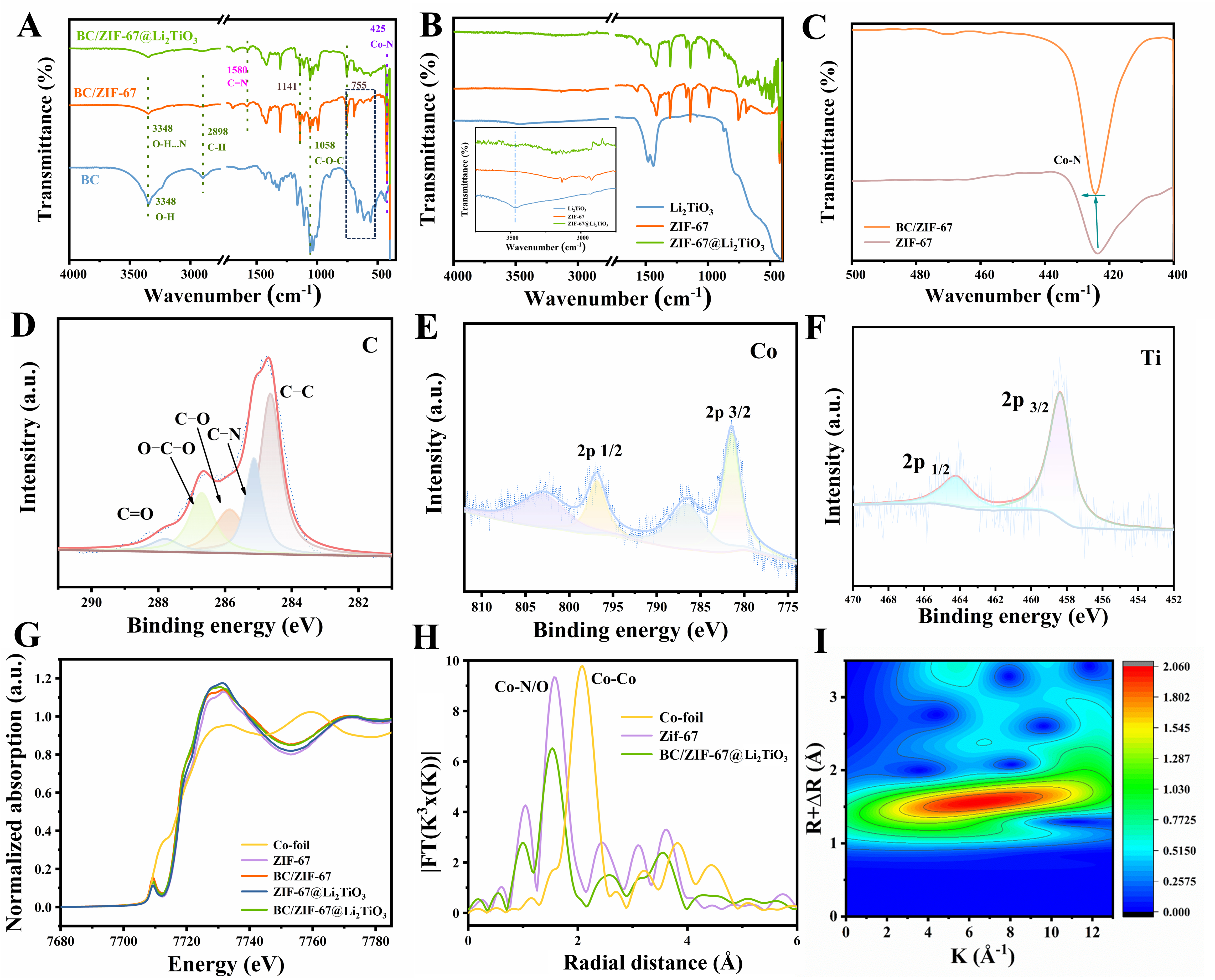
Figure 2. (A) FTIR analysis of BC, BC/ZIF-67, and BC/ZIF-67@Li2TiO3 membranes; (B) FTIR analysis of α-Li2TiO3, ZIF-67, and ZIF-67@Li2TiO3 powder; (C) FTIR analysis of BC/ZIF-67 membrane and ZIF-67 powder; The XPS spectra of (D) C, (E) Co, and (F) Ti in the BC/ZIF-67@Li2TiO3 membrane; (G) XANES for the Co-K edge of Co-foil, ZIF-67, BC/ZIF-67, ZIF-67@Li2TiO3, and the BC/ZIF-67@Li2TiO3 membrane; (H) The Fourier transform EXAFS for the Co K edge of Co foil, ZIF-67, and the BC/ZIF-67@Li2TiO3 membrane; (I) Wavelet transition of the BC/ZIF-67@Li2TiO3 membrane for the k3-weighted EXAFS signals. BC: Bacterial cellulose; ZIF-67: zeolitic imidazolate framework-67; QSSEs: quasi-solid-state electrolytes; XANES: X-ray absorption near-edge structure; FTIR: fourier transform infrared spectroscopy; XPS: X-ray photoelectron spectroscopy; EXAFS: extended X-ray absorption fine structure.