

fig5
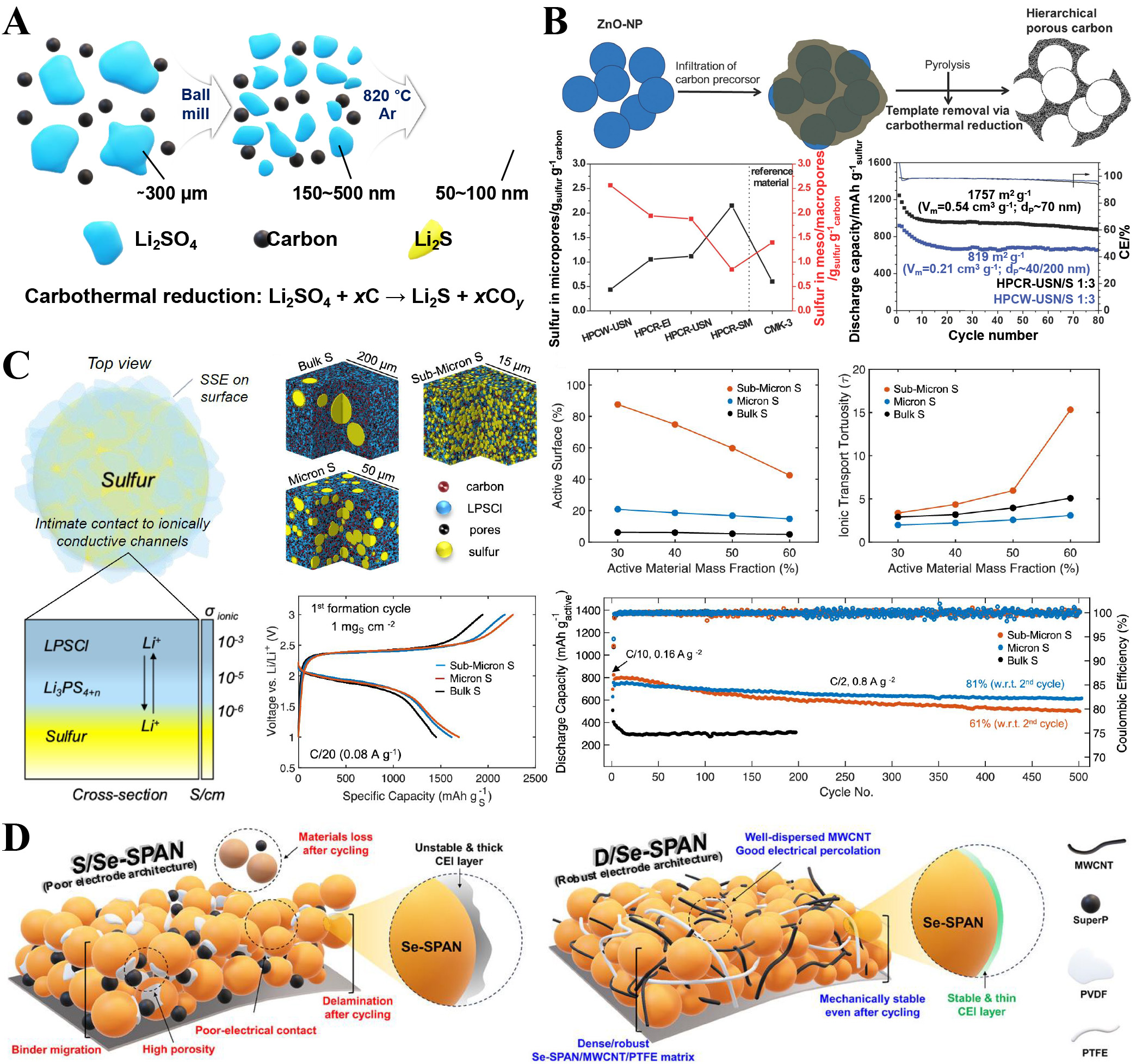
Figure 5. Representative studies of electronic and ionic transport engineering in dry electrodes fabricated by binder fibrillation. (A) Schematic illustration of Li2S/C composite formation via ball milling-assisted carbothermal reduction of Li2SO4 with carbon, based on the processing conditions and particle-size ranges reported in Ref.[60]; (B) Schematic illustration of the formation of hierarchical porous carbon via ZnO hard templating and comparison of sulfur distribution and electrochemical performance depending on pore structure. Adapted with permission from Ref.[61] Copyright © 2014 WILEY‐VCH Verlag GmbH & Co. KGaA, Weinheim; (C) Schematic illustration of ionically conductive interphase formation at the sulfur-LPSCl interface (left) and comparison of electrode structure and ionic transport tortuosity as a function of sulfur particle size (right). Reprinted from Ref.[62], under CC BY 4.0 license; (D) Schematic comparison of electrode structure and conductive network formation between wet-processed and dry-processed electrodes. Reprinted from Ref.[63], under CC BY 4.0 license. NP: Nanoparticle; SSE: solid-state electrolyte; LPSCI: lithium phosphorus sulfur chloride; SPAN: sulfurized polyacrylonitrile; MWCNT: multi-walled carbon nanotube; PVDF: poly(vinylidene fluoride); PTFE: polytetrafluoroethylene.