

fig1
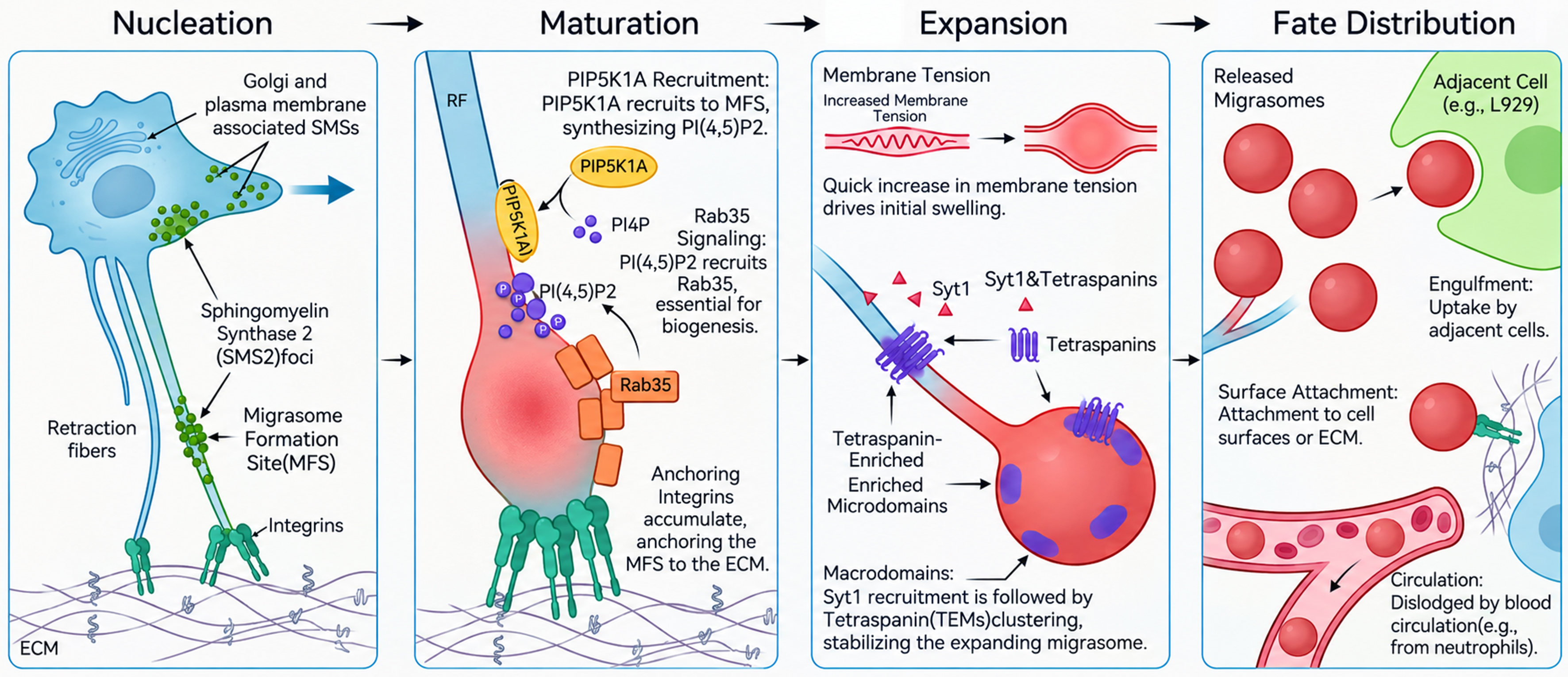
Figure 1. Biogenesis and fate of migrasomes. Migrasome formation is a multistage process comprising nucleation, maturation, and expansion stages. SMS2 initiates nucleation at migrasome formation sites by converting ceramide into SM, thereby promoting local membrane curvature. PIP5K1A and Rab35 subsequently facilitate the recruitment of integrins, establishing adhesion to the ECM. During maturation, tetraspanins and Syt1 regulate membrane expansion and stabilization, leading to the formation of TEMs that coalesce into mature migrasomes. As RFs disintegrate, migrasomes are released into the extracellular space, where they can be internalized by neighboring cells or persist as extracellular structures, thereby mediating intercellular communication. ECM: Extracellular matrix; MFSs: migrasome formation sites; PI(4,5)P2: phosphatidylinositol 4,5-bisphosphate; PI4P: phosphatidylinositol 4-phosphate; PIP5K1A: phosphatidylinositol 4-phosphate 5-kinase 1 alpha; Rab35: Ras-related GTP-binding protein 35; RFs: retraction fibers; SM: sphingomyelin; SMS2: sphingomyelin synthase 2; Syt1: synaptotagmin 1; TEMs: tetraspanin-enriched microdomains.