

Enhancing the transformation efficiency of “Forever Chemicals”
 0
0 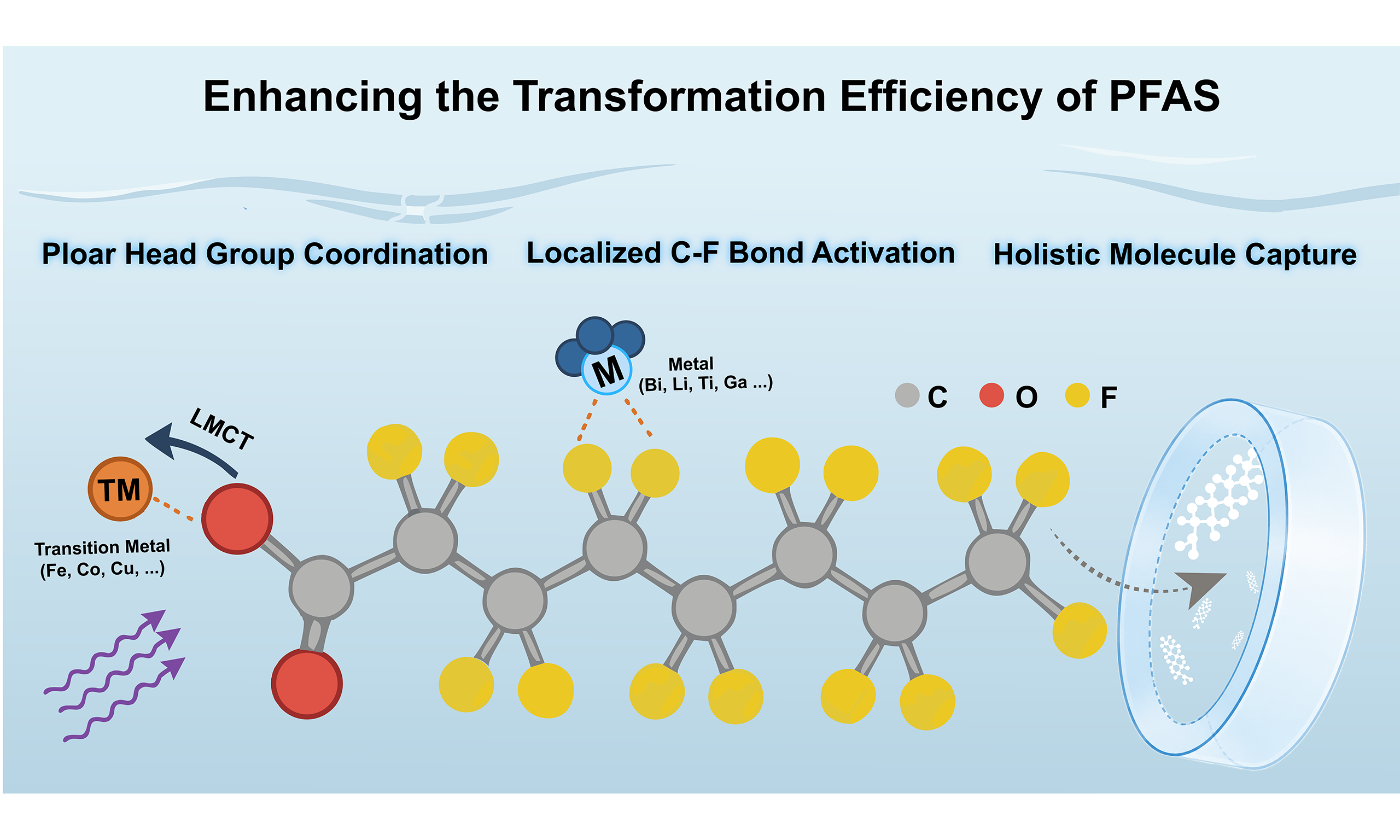


 Download PDF
INTRODUCTION
As a class of emerging contaminants of global concern, per- and polyfluoroalkyl substances (PFAS) are characterized by their exceptional persistence against environmental and biological degradation, leading to their designation as “forever chemicals”[1,2]. They have been widely utilized in extensive applications across various industries such as synthetic surfactants, flame retardants, and protective coatings[3-5]. In April 2024, the U.S. Environmental Protection Agency (EPA) issued new regulations establishing a maximum allowable level of 4 ng·L-1 for perfluorooctanoic acid (PFOA) and perfluorooctane sulfonate (PFOS) in drinking water[6].
PFAS comprise over 4,700 synthetic substances with carbon backbones in which hydrogen is partially or fully replaced by fluorine[7]. The C–F bond is the strongest covalent single bond in organic chemistry, with a bond dissociation energy (BDE), of up to ~485 kJ/mol, which significantly exceeds those of C–C (~ 330 kJ/mol) and C–H (~ 410 kJ/mol) bonds[8,9]. Physical adsorption is widely used for large-scale PFAS treatment but only transfers PFAS from water to an adsorption phase[10]. Eliminating their environmental risks requires chemical degradation and complete mineralization. Beyond hydrolysis and high-temperature thermocatalysis, oxidative and reductive defluorination are the most widely investigated approaches under milder conditions[11]. Many redox-based techniques such as advanced oxidation processes (AOPs)[12], electrochemical oxidation[13], semiconductor photocatalysis[14,15], and hydrated electron (eaq-)-mediated reduction have been employed for the degradation of PFAS. In the oxidation techniques, PFAS is degraded by losing electrons to sulfate radicals (SO4•-), the electrode or photocatalyst, or through electrophilic attack of the reactive oxygen species such as hydroxyl radicals (•OH)[16]. Due to fluorine’s strong electron-withdrawing nature, PFAS forms a robust “electron shield” that renders oxidative degradation ineffective. While its lowered lowest unoccupied molecular orbital (LUMO) energy makes it susceptible to reduction via high-energy electrons, these reduction methods suffer from high energy consumption, incomplete defluorination, and low efficiency for short-chain PFAS[17]. Furthermore, abundant co-existing interferents in real water matrices further severely inhibit PFAS degradation.
Cleavage of inert C–C and C–F bonds is fundamental to PFAS degradation. This Perspective highlights recent advances in enhancing PFAS degradation by tuning PFAS-catalyst interactions to activate these bonds. We show that the interaction modes of PFAS and the catalyst, such as the metal coordination of the polar head groups[18], F-site interactions[19] and holistic intercalation of PFAS[20], would markedly determine the cleavage of C–C and C–F bonds. Besides activating the bond cleavage, the interaction mode of PFAS with a catalyst would also largely influence enrichment and enhance the selective degradation of PFAS from the water matrices.
CRITICAL ROLE OF METAL COORDINATION OF PFAS POLAR HEAD GROUPS
PFAS polar head groups, especially carboxylates (-COO-), can coordinate with high-valent metal centers. Under suitable irradiation, the resulting complexes undergo ligand-to-metal charge transfer (LMCT) [Figure 1], generating a reduced metal center and an oxidized PFAS ligand. Subsequent Kolbe-type decarboxylation cleaves the C–C bond and initiates PFAS oxidative degradation.
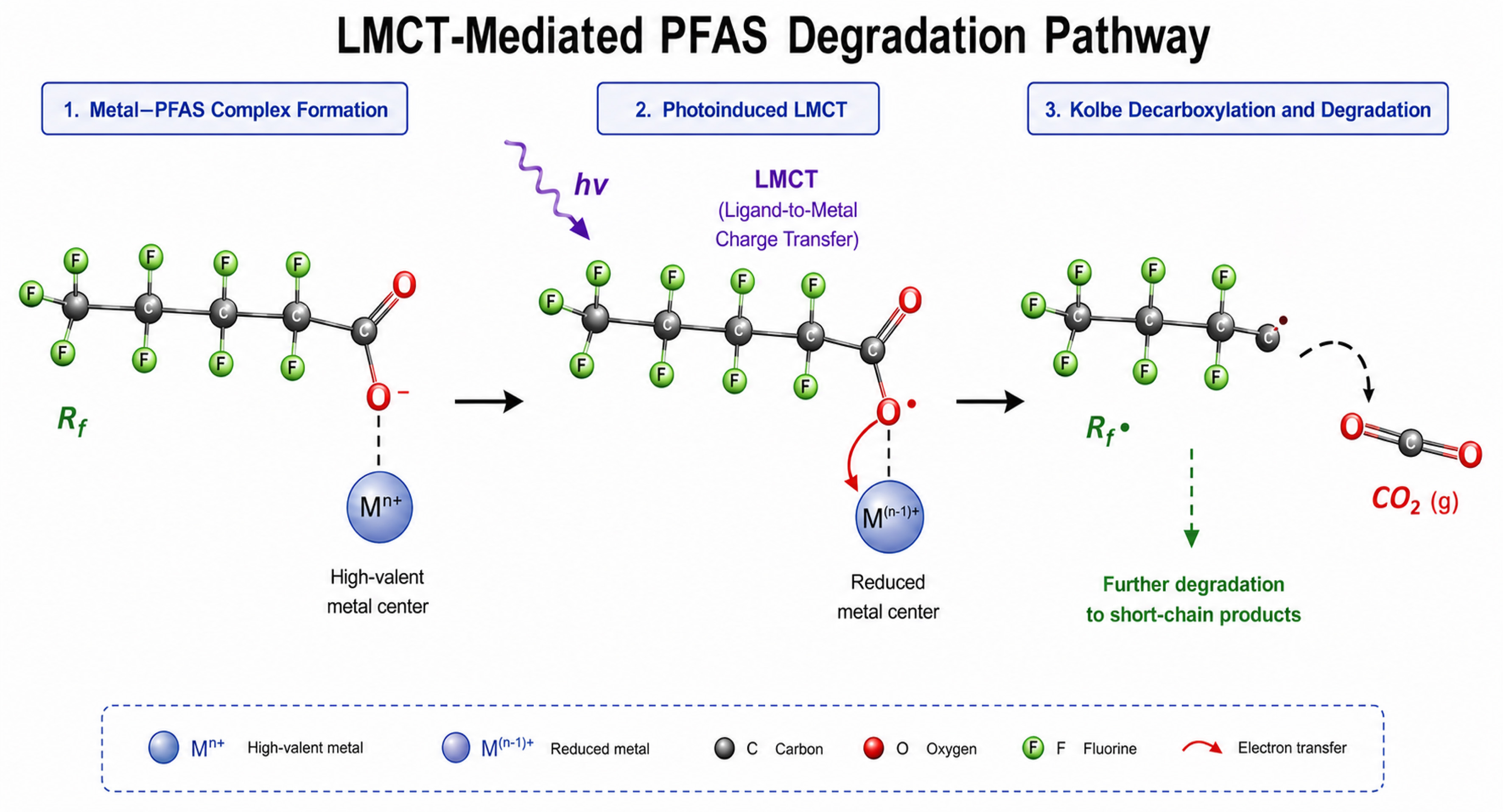
Figure 1. Schematic illustration of the LMCT-mediated degradation pathway of perfluoroalkyl carboxylates. LMCT: Ligand-to-metal charge transfer; PFAS: per- and polyfluoroalkyl substances.
For example, Guo et al. have successfully triggered a highly efficient degradation process under mild near-ultraviolet (UV) to visible light irradiation by specifically leveraging the complexation between Cu2+ and perfluoroalkyl anions[18] [Figure 2A]. In this system, near-complete mineralization was achieved, with intermediates of various perfluoroalkyl carboxylic acid (PFCA) chain lengths and ether carboxylic acids. The deep defluorination was attributed to the increasing degradation rates of perfluoroalkyl acids with decreasing chain length in the PFAS/Cu2+ system, together with the rapid degradation and defluorination of trifluoroacetic acid. This observation is remarkable because the intrinsic stability of perfluoroalkyl acids generally increases as their chain length decreases. Notably, this coordination-based strategy was also effective for GenX, an emerging ether-based alternative to legacy PFAS. Under the same LMCT-driven reaction conditions, GenX also underwent near-complete degradation and defluorination within 180 min, demonstrating the potential of terminal carboxylate coordination for activating alternative perfluoroalkyl ether carboxylic acids. While investigating the photochemical degradation of PFAS in the presence of Fe3+, Chen et al.[21] observed an “excessive defluorination” process, besides the LMCT reaction pathway. They attributed this process to hydrolysis occurring in parallel with the LMCT reaction, due to the formation of [PFOA-Fe]2+. By time-dependent density functional theory (TDDFT), they showed that the coordination induces remarkable electron density perturbation within the complex, fundamentally diminishing the robust electron shielding effect along the perfluorinated carbon chain. Consequently, the dissociation energy of internal C–C bonds can be dramatically reduced by up to 53%, rendering the fluorinated backbone highly susceptible to scission in the hydrolysis reaction.
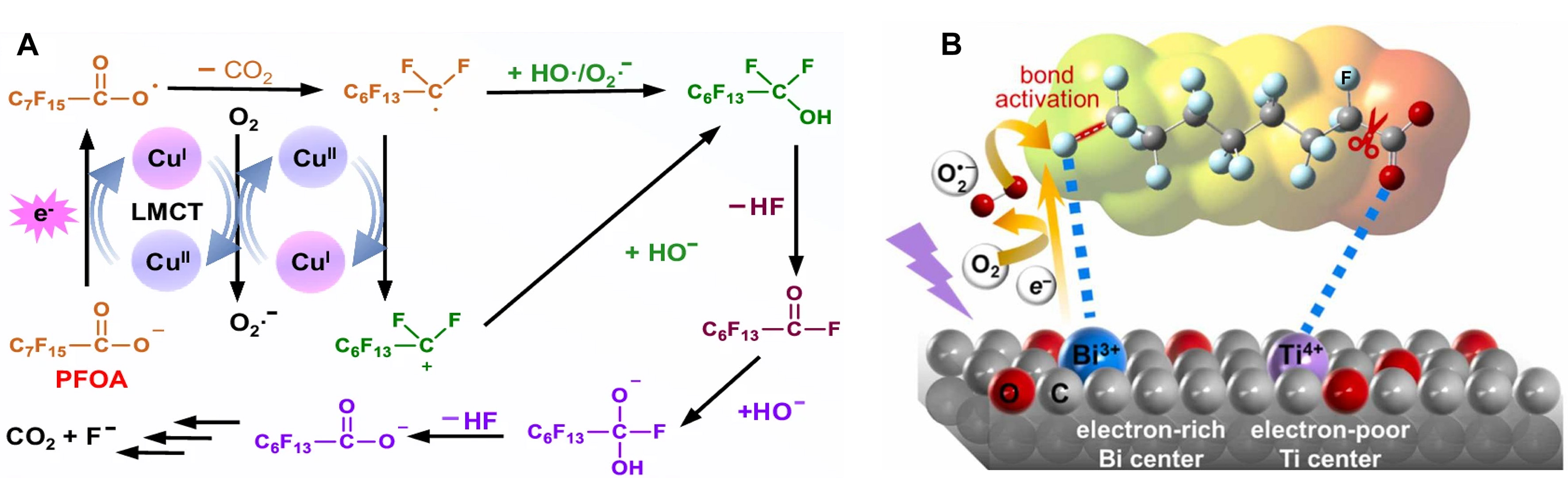
Figure 2. (A) Photoexcited LMCT decarboxylation pathway for radical generation via Cu2+ activation[18]. Figure 2A is reproduced under the CC BY-NC-ND license; (B) Proposed dual-site activation of PFOA through Ti–O and Bi–F interaction[22]. Figure 2B is reproduced under the CC BY4.0 license. LMCT: Ligand-to-metal charge transfer.
In addition to promoting direct C–C cleavage, coordination-mediated LMCT-like processes can facilitate PFAS activation through interfacial electron transfer. Bai et al. reported coordinatively unsaturated Ti sites bind the carboxylate group of PFOA through Ti-O coordination[22]. The resulting surface complex anchors PFOA and draws electron density from the carboxylate group toward the electron-deficient Ti center, making PFOA more susceptible to decarboxylation. This process contributes to efficient degradation at an ultralow catalyst loading [Figure 2B]. In addition to Cu, Fe, and Ti, the head-group coordination effect has also been applied to other metal-based systems for PFAS remediation (e.g., Co[23], Pd[24], and Ce[25,26]).
It should be pointed out that this coordination interaction usually occurs between the carboxylic acids and the metal centers. Therefore, it is mainly applicable to perfluorocarboxylic acids [e.g., PFOA[18], perfluorohexanoic acid (PFHxA)[27]]. For PFAS bearing sulfonic acid groups or lacking anionic groups, which coordinate weakly with metals, the applicability of the LMCT pathway remains relatively limited.
LOCALIZED C–F BOND ACTIVATION BY F-SITE INTERACTIONS
Beyond carboxylate groups, the abundant F atoms within PFAS molecules themselves can also serve as interaction sites and influence the defluorination reaction.
Metal-fluorine (M-F) coordination uses Lewis acid-base interactions to withdraw electron density from specific F atoms, elongating C–F bonds and reducing localized bond dissociation energies (BDEs)[28]. For instance, it is reported that, in Ti- and Bi-bearing bimetallic coordination polymers, coordinatively unsaturated Bi sites induce strong Bi–F bond complexation, which physically elongates the adjacent C–F bond from 1.330 to 1.362 Å, disrupting the stability of the perfluorinated backbone[22]. The Ga2O3/Bi single-atom catalyst reported by Huang et al. demonstrates that this activation originates from deep orbital hybridization between Bi 6p and F 2p orbitals[19]. This robust coordination selectively decreases the Mayer bond order of localized C–F bonds, substantially lowering the thermodynamic energy barrier for subsequent cleavage. This Bi–F coordination strategy achieved complete PFAS degradation within 8 min of irradiation, accompanied by a defluorination efficiency of 67.1%. Furthermore, this M-F affinity principle also governs macroscopic electrochemical reductive environments. Specifically, in lithium-mediated processes, the extreme electronegativity difference between Li metal and F atoms drives rapid electron injection into C–F antibonding orbitals, cleaving the bonds to form thermodynamically stable Li–F[29]. Consequently, M-F coordination acts as a critical thermodynamic and kinetic lever that transforms random, non-selective attacks into precision defluorination by penetrating the electron shield, inducing localized bond distortion. Despite its effectiveness, the lithium-mediated reduction system requires large volumes of organic solvents, creating secondary pollution risks and making it impractical for direct PFAS remediation in real-world waters.
ENHANCING PFAS SELECTIVITY THROUGH HOLISTIC MOLECULAR CAPTURE
Compared to targeted anchoring limited to the carboxyl terminal group or local activation of a single C–F bond, overall recognition of the entire molecular chain is gradually becoming the key to overcoming degradation bottlenecks[30,31]. Previous studies have confirmed that precise capture of the entire perfluorinated chain can be achieved by utilizing the inclusion complexation of macrocyclic host molecules such as cyclodextrins. This mechanism has already demonstrated extremely high specificity in environmental sensing and detection[32-34].
This fundamental recognition logic is currently being introduced into the field of catalytic degradation. Molecular imprinting technology constructs surface recognition cavities that match the three-dimensional structure of the target molecule, which enables the overall anchoring of the perfluorinated molecules[35]. Taking recent photoelectrocatalytic research as an example, functionalizing a titanium dioxide photoanode with highly exposed (201) facets via molecular imprinting successfully converted the adsorption configuration of PFOA on the catalyst surface[20]. It forced a shift from the traditional carboxylate monodentate adsorption to a preferential adsorption along the perfluoroalkyl backbone. This transformation in adsorption configuration directly causes an enhancement in efficiency. Specific backbone anchoring promotes mass transfer of target molecules on the catalyst surface and significantly lowers the energy barrier for the decarboxylation reaction, which is the rate-determining step. Consequently, the utilization efficiency of photogenerated holes increased substantially from 9.6% to 39.3%, accompanied by a significant reduction in the accumulation of short-chain intermediates.
Beyond M-F coordination, non-metal fluorine interactions, particularly F-F interactions, provide another route for PFAS recognition. Fluorinated metal-organic frameworks (MOFs) have been used for highly selective PFAS sensing[36,37]. These interactions arise from the “fluorous effect”: fluorine’s high electronegativity and low polarizability make perfluorinated chains both hydrophobic and lipophobic, driving “like-seeks-like” aggregation that lowers the system’s free energy[10]. This effect could guide the design of catalysts that combine selective PFAS recognition with deep mineralization.
Although highly selective for PFAS, molecularly imprinted polymers and fluorous-affinity materials face synthesis, cost, and environmental barriers. Future research should develop scalable, green synthetic routes and robust, reusable interfaces with less reliance on persistent fluorinated precursors, which is vital for translating these systems from lab concepts to practical remediation.
SUMMARY AND PERSPECTIVE
In summary, complete PFAS mineralization requires a shift from nonselective attack to precision degradation through coordination and recognition. Terminal-group complexation modulates local electron density and initiates charge transfer. Targeted fluorine interactions weaken selected C–F bonds by penetrating the electron shield of the perfluorinated backbone. Finally, molecular imprinting promotes whole-backbone recognition, overcoming mass-transfer limitations at trace concentrations by enriching PFAS within catalytic microenvironments. Together, these local-to-global strategies provide a framework for overcoming PFAS chemical inertness. Moreover, these three interaction-engineering strategies are not limited to legacy PFAS but also show potential for emerging PFAS, including GenX, PFHxA, and 6:2 fluorotelomer sulfonate (6:2 FTS).
Although these mechanisms show substantial potential at both the fundamental and laboratory scales, translating them into real-world aquatic remediation remains a formidable challenge. Future research on PFAS degradation should prioritize the following three critical dimensions:
Catalyst durability and practical applicability in real water matrices
The practical application of PFAS degradation catalysts requires improved stability, reusability, and performance in realistic water matrices. Most current studies remain limited to short-term tests, typically involving only a few reuse cycles or several hours of operation, which are insufficient to demonstrate long-term durability. Future work should evaluate continuous operation, catalyst structural evolution, and metal leaching in the presence of coexisting ions and natural organic matter. These efforts are essential to assess the environmental safety, scalability, and real-world feasibility of PFAS treatment technologies.
Tracking intermediates and fluorine mass balance
Comprehensive fluorine mass balance is essential for evaluating PFAS degradation, yet non-standardized protocols hinder reproducibility. Harmonized workflows should combine validated fluoride quantification [e.g., Ion chromatography (IC) with matrix-matched calibration, blanks, and recovery tests] targeted liquid chromatography-mass spectrometry (LC-MS) for known PFAS and short-chain perfluoroalkyl acids (PFAAs), and liquid chromatography-high-resolution mass spectrometry (LC-HRMS) for suspect/non-target screening of transformation products. Where concentrations permit, quantitative fluorine-19 nuclear magnetic resonance spectroscopy (19F NMR) can complement organofluorine and fluorine-recovery analyses. Reporting detection limits, recoveries, sampling procedures, and mass-balance calculations is crucial for comparable defluorination assessment.
AI-assisted design of integrated adsorption-degradation systems
AI-assisted screening can accelerate integrated adsorption-degradation system design for PFAS remediation. Machine learning and high-throughput calculations can identify materials that combine strong PFAS binding with favorable charge-transfer properties, C-F activation barriers, stability, and resistance to metal leaching. By enriching PFAS near active sites, these systems may overcome mass-transfer limitations at environmentally relevant concentrations and enable in situ degradation. AI-guided designs should be validated in realistic water matrices under long-term operation, with attention to regeneration, competing ions, desorption, and secondary release.
DECLARATIONS
Authors’ contributions
Made substantial contributions to conception: Tian, G.; Yang, J.; Chen, C.
Performed data acquisition: Tian, G.; Yang, J.
Provided financial support, supervised the research progress, and performed final review and editing of the manuscript: Chen, C.
Availability of data and materials
Not applicable.
AI and AI-assisted tools statement
During the preparation of this manuscript, the AI tool Gemini (version 3.1 Pro, released 2026-02-19) was used solely for Graphical Abstract and Figure 1. The tool did not influence the study design, data collection, analysis, interpretation, or the scientific content of the work. All authors take full responsibility for the accuracy, integrity, and final content of the manuscript.
Financial support and sponsorship
This work was supported by the National Key R&D Program of China (No. 2024YFA1211000), the National Natural Science Foundation of China (Nos. 22321004 and 22136005).
Conflicts of interest
Chen, C. is an Associate Editor of Greenverse Science and a Guest Editor of the Special Issue “Design of Porous Photocatalysts and Their Applications in Environmental Remediation” in Greenverse Science. He was not involved in any aspect of the editorial process for this manuscript, including reviewer selection, manuscript handling, or decision-making. The other authors declare that they have no conflicts of interest.
Ethical approval and consent to participate
Not applicable.
Consent for publication
Not applicable.
Copyright
© The Author(s) 2026.
REFERENCES
1. Trang, B.; Li, Y.; Xue, X. S.; Ateia, M.; Houk, K. N.; Dichtel, W. R. Low-temperature mineralization of perfluorocarboxylic acids. Science 2022, 377, 839-45.
2. Chen, Z.; Dong, R.; Wang, X.; et al. Efficient decomposition of perfluoroalkyl substances by low concentration indole: new insights into the molecular mechanisms. Environ. Sci. Technol. 2024, 58, 3530-9.
3. Song, D.; Qiao, B.; Feng, Q.; et al. Electrochemical degradation of perfluorooctanoic acid: fluorine mass balance and strategies to limit short-chain byproducts. Water. Res. 2026, 292, 125369.
4. Fernandes, R. J. C.; Silva, A. R.; Cardoso, B. D.; Coutinho, P. J. G.; Pereira, L. Potential of photocatalytic nanomaterials for PFOA and PFOS degradation: challenges and opportunities. J. Environ. Chem. Eng. 2025, 13, 115201.
5. Evich, M. G.; Davis, M. J. B.; Mccord, J. P.; et al. Per- and polyfluoroalkyl substances in the environment. Science 2022, 375, eabg9065.
6. US EPA. Per- and polyfluoroalkyl substances (PFAS). https://www.epa.gov/sdwa/and-polyfluoroalkyl-substances-pfas. (accessed 2026-09-02).
7. Lenka, S. P.; Kah, M.; Padhye, L. P. A review of the occurrence, transformation, and removal of poly- and perfluoroalkyl substances (PFAS) in wastewater treatment plants. Water. Res. 2021, 199, 117187.
8. Duinslaeger, N.; Radjenovic, J. Electrochemical degradation of per- and polyfluoroalkyl substances (PFAS) using low-cost graphene sponge electrodes. Water. Res. 2022, 213, 118148.
9. Biswas, S.; Yamijala, S. S. R. K. C.; Wong, B. M. Degradation of per- and polyfluoroalkyl substances with hydrated electrons: a new mechanism from first-principles calculations. Environ. Sci. Technol. 2022, 56, 8167-75.
10. Zhang, G.; Li, Y.; Wang, X. A.; et al. Covalent organic frameworks for adsorption of per- and polyfluoroalkyl substances (PFAS). ACS. Appl. Polym. Mater. 2026, 8, 1503-13.
11. Sun, R.; Alinezhad, A.; Altarawneh, M.; et al. New insights into thermal degradation products of long-chain per- and polyfluoroalkyl substances (PFAS) and their mineralization enhancement using additives. Environ. Sci. Technol. 2024, 58, 22417-30.
12. Yang, L.; He, L.; Xue, J.; et al. Persulfate-based degradation of perfluorooctanoic acid (PFOA) and perfluorooctane sulfonate (PFOS) in aqueous solution: review on influences, mechanisms and prospective. J. Hazard. Mater. 2020, 393, 122405.
13. Veciana, M.; Bräunig, J.; Farhat, A.; et al. Electrochemical oxidation processes for PFAS removal from contaminated water and wastewater: fundamentals, gaps and opportunities towards practical implementation. J. Hazard. Mater. 2022, 434, 128886.
14. Liu, X.; Duan, X.; Bao, T.; et al. High-performance photocatalytic decomposition of PFOA by BiOX/TiO2 heterojunctions: self-induced inner electric fields and band alignment. J. Hazard. Mater. 2022, 430, 128195.
15. Liu, F.; Li, H.; Gao, Z.; et al. Steering charge transfer in CuInS2/BiOCl composites to enable sunlight-driven C–F bond cleavage of PFAS in water. Nat. Water. 2026, 4, 334-47.
16. Zhang, C.; Tang, T.; Knappe, D. R. U. Oxidation of per- and polyfluoroalkyl ether acids and other per- and polyfluoroalkyl substances by sulfate and hydroxyl radicals: kinetic insights from experiments and models. Environ. Sci. Technol. 2023, 57, 18970-80.
17. Cui, J.; Gao, P.; Deng, Y. Destruction of per- and polyfluoroalkyl substances (PFAS) with advanced reduction processes (ARPs): a critical review. Environ. Sci. Technol. 2020, 54, 3752-66.
18. Guo, J.; Zhang, P.; Yu, H.; Fang, B.; Sun, H. Photoexcited LMCT of Cu2+ perfluorocarboxylate for initiating efficient defluorination. Nat. Commun. 2025, 16, 11628.
19. Huang, L.; Li, Y.; Zhang, C.; et al. Dual-functional Bi single atom sites enabling superior photocatalytic degradation of perfluorooctanoic acid. Appl. Catal. B:. Environ. Energy. 2026, 395, 126889.
20. An, Z.; Xie, Q.; Xu, S.; et al. Selective recognition and activation for accelerated decarboxylation and C–F bond cleavage of perfluorooctanoic acid. Appl. Catal. B:. Environ. Energy. 2025, 379, 125735.
21. Chen, Y.; Ma, H.; Zhu, J.; Gu, Y.; Liu, T. New insights into ferric iron-facilitated UV254 photolytic defluorination of perfluorooctanoic acid (PFOA): combined experimental and theoretical study. J. Hazard. Mater. 2022, 434, 128865.
22. Bai, L.; Onwumere, J.; Ezugwu, C. I.; et al. Activating PFAS for efficient photocatalytic defluorination using ultralow-dose Ti-doped bismuth coordination catalysts with unsaturated metal sites. Appl. Catal. B:. Environ. Energy. 2026, 384, 126230.
23. Yang, Y.; Liu, J.; Qin, F.; et al. Degradation of an emerging PFAS compound-sodium p-perfluorous nonenoxybenzenesulfonate via phosphate-enhanced activation of peroxymonosulfate by trace Co(II). ACS. EST. Water. 2026, 6, 2235-45.
24. Huang, D.; Wang, K.; Niu, J.; et al. Amorphous Pd-loaded Ti4O7 electrode for direct anodic destruction of perfluorooctanoic acid. Environ. Sci. Technol. 2020, 54, 10954-63.
25. Lin, H.; Xiao, R.; Xie, R.; et al. Defect engineering on a Ti4O7 electrode by Ce3+ doping for the efficient electrooxidation of perfluorooctanesulfonate. Environ. Sci. Technol. 2021, 55, 2597-607.
26. Liang, Y.; Wang, A.; Liang, S.; et al. Durable Ti4O7 heterojunction composite membrane encapsulating N-doped graphene nanosheets for efficient electro-oxidation of GenX and other PFAS in fluorochemical wastewater. Environ. Sci. Technol. 2025, 59, 4745-55.
27. Wang, R.; Huang, Y.; Fan, B.; et al. Fe(III)-mediated PFAS phototransformation under UV222 irradiation: LMCT initiation chemistry and performance in electroplating wastewater. Water. Res. 2026, 301, 126053.
28. Mohamed, M. S.; Chaplin, B. P.; Abokifa, A. A. Screening of transition metals for PFAS adsorption: a comparative DFT investigation. Chem. Eng. Sci. 2025, 307, 121363.
29. Sarkar, B.; Kumawat, R. L.; Ma, P.; et al. Lithium metal-mediated electrochemical reduction of per- and poly-fluoroalkyl substances. Nat. Chem. 2026, 18, 509-18.
30. Tasfaout, A.; Ibrahim, F.; Morrin, A.; et al. Molecularly imprinted polymers for per- and polyfluoroalkyl substances enrichment and detection. Talanta 2023, 258, 124434.
31. Román Santiago, A.; Yin, S.; Elbert, J.; Lee, J.; Shukla, D.; Su, X. Imparting selective fluorophilic interactions in redox copolymers for the electrochemically mediated capture of short-chain perfluoroalkyl substances. J. Am. Chem. Soc. 2023, 145, 9508-19.
32. Lin, Z. W.; Kim, S.; Dyakiv, Y.; et al. A Macroporous cyclodextrin monolith for continuous removal of per- and polyfluoroalkyl substances from water. J. Am. Chem. Soc. 2025, 147, 33761-9.
33. Tao, T.; Zhang, B. X.; Li, Z.; et al. Femtomolar congener-selective detection of perfluoroalkyl substances in water by a cyclodextrin-oriented molecularly imprinted transistor sensor. Environ. Sci. Technol. 2026, 60, 9895-906.
34. Wang, W.; Shao, H.; Zhou, S.; et al. Rapid removal of perfluoroalkanesulfonates from water by β-cyclodextrin covalent organic frameworks. ACS. Appl. Mater. Interfaces. 2021, 13, 48700-8.
35. Hu, L.; Li, Y.; Zhang, W. Characterization and application of surface-molecular-imprinted-polymer modified TiO2 nanotubes for removal of perfluorinated chemicals. Water. Sci. Technol. 2016, 74, 1417-25.
36. Liang, J.; Yang, N.; Chen, Y.; et al. Fluorine-driven polychromatic colorimetric screening of PFAS via iodide-mediated gold nanorod etching on a dual-ligand Cu-MOF: a “no aggregation, low inhibition” sensing paradigm. Anal. Chem. 2026, 98, 10015-30.
Cite This Article
 Open Access
How to Cite
Download Citation
If you have the appropriate software installed, you can download article citation data to the citation manager of your choice. Simply select your manager software from the list below and click on download.
Export Citation File
Type of Import
Tips on Downloading Citation
Citation Manager File Format
Type of Import
Direct Import: When the Direct Import option is selected (the default state), a dialogue box will give you the option to Save or Open the downloaded citation data. Choosing Open will either launch your citation manager or give you a choice of applications with which to use the metadata. The Save option saves the file locally for later use.
Indirect Import: When the Indirect Import option is selected, the metadata is displayed and may be copied and pasted as needed.
About This Article
Special Topic
Copyright

Data & Comments
Data
0








Comments
Comments must be written in English. Spam, offensive content, impersonation, and private information will not be permitted. If any comment is reported and identified as inappropriate content by OAE staff, the comment will be removed without notice. If you have any queries or need any help, please contact us at support@oaepublish.com.