

fig3
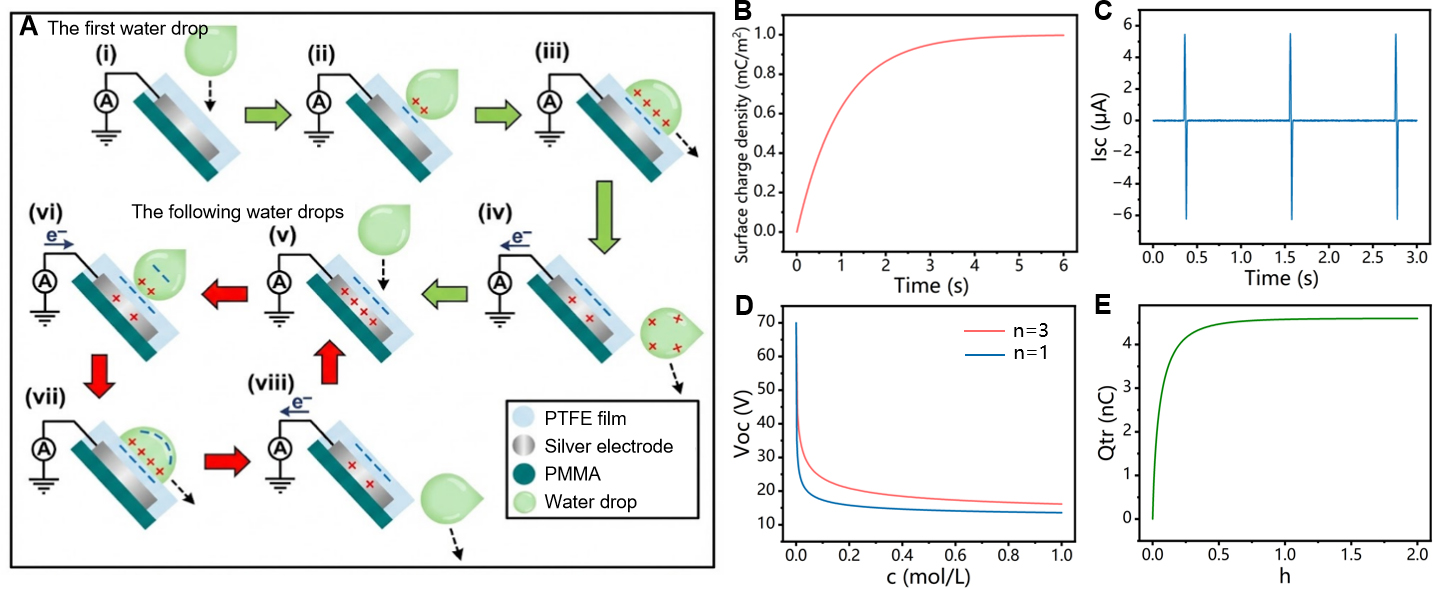
Figure 3. Theoretical model and output characteristics of SL-TENG. (A) Structure and working principle of a contact-mode SL-TENG. Adapted with permission[16], Copyright 2014 WILEY‐VCH Verlag GmbH & Co. KGaA, Weinheim; (B) Computed evolution of surface charge with charging time; (C) Computed bipolar current waveform; (D) Computed voltage response as a function of solution concentration, where n denotes the anion-to-cation charge ratio; larger n leads to a faster decay; (E) Computed induced charge as a function of falling height, showing an initial near-linear increase followed by saturation. PTFE: Polytetrafluoroethylene; PMMA: polymethyl methacrylate; Isc: short-circuit current; Voc: open-circuit voltage; Qtr: transferred charge; SL-TENG: solid-liquid triboelectric nanogenerator; n: electrolyte number concentration.