
fig3
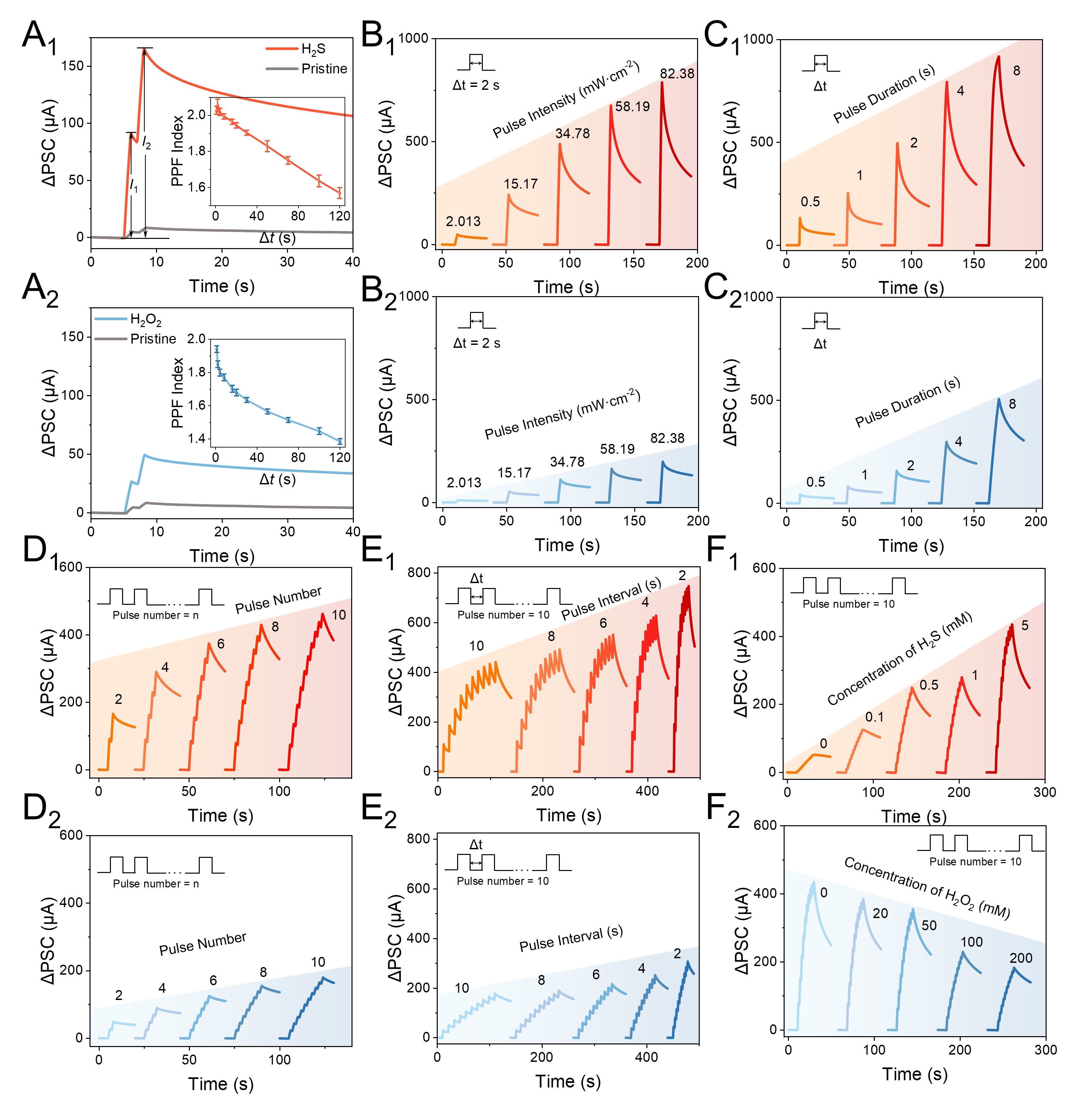
Figure 3. PPF behaviors of (A1) the pristine devices, and those after the treatment of H2S, and (A2) the pristine devices, and those after the treatment of H2O2; The inset shows the PPF indices for different pulse intervals (1 s, 15.17 mW·cm-2 light pulses). SIDP emulation of the device after the treatment of (B1) H2S and (B2) H2O2 with light intensities ranging from 2.013 mW·cm-2 to 82.38 mW·cm-2 (1 s light pulses); SDDP emulation of the device after treatment of (C1) H2S and (C2) H2O2 with pulse durations ranging from 0.5 s to 8 s (15.17 mW·cm-2 light pulses); SNDP emulation of the device after treatment of (D1) H2S and (D2) H2O2 with 2 to 10 pulses (15.17 mW·cm-2 light pulses); SRDP emulation of the device after treatment of (E1) H2S and (E2) H2O2 with light pulse intervals ranging from 10 s to 2 s (1 s, 15.17 mW·cm-2 light pulses); (F1) H2S-mediated synaptic plasticity; (F2) H2O2-mediated synaptic plasticity (1 s, 15.17 mW·cm-2 light pulses). ΔPSC: Postsynaptic current response; PPF: paired-pulse facilitation; H2S: hydrogen sulfide; H2O2: hydrogen peroxide; SIDP: spike-intensity-dependent plasticity; SDDP: spike-duration-dependent plasticity; SNDP: spike-number-dependent plasticity; SRDP: spike-rate-dependent plasticity.