



fig6
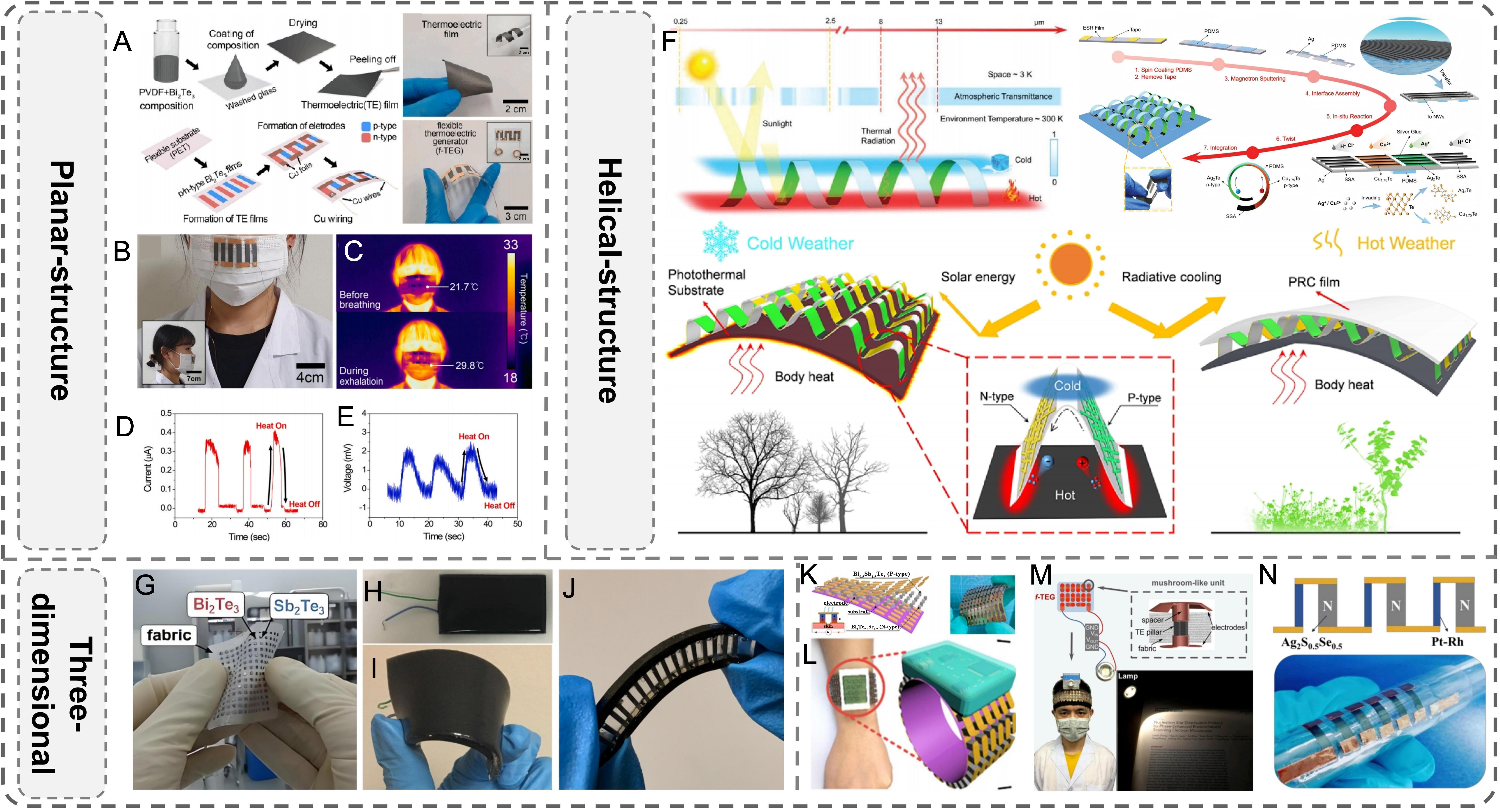
Figure 6. (A) Schematic illustrations of Bi2Te3/PVDF thermoelectric (TE) film fabrication and multicouple flexible thermoelectric generator (f-TEG) fabrication; (Insets) Photographs of the bent Bi2Te3/PVDF TE film (rolled on a plastic cylinder) and the bent/completed f-TEG; (B) Mask photos, (C) Infrared thermal imaging (D) Output current signals and (E) output voltage signals from the human body heat during breathing. (A-E) Reproduced with permission[100]. Copyright 2022, Elsevier; (F) Preparation process of helical TEGs; (F)Reproduced with permission[93]. Copyright 2022, WILEY‐VCH. And schematic diagram of the structure of a wave-shaped TEG with radiative cooling performance; (F) Reproduced with permission[114]. Copyright 2022, American Chemical Society. Flexible thermoelectric generators based on three-dimensional bulk material; (G) f-TEGs with bots of thermal legs on glass fabric. (G) Reproduced with permission[119]. Copyright 2014, Royal Society of Chemistry; (H-J) f-TEGs with bulk materials as legs and liquid metals as connections. (H-J) Reproduced with permission[120]. Copyright 2020, Elsevier; (K and L) f-TEGs with bulk materials and a polyimide substrate and Schematic view of the self-powered wearable bracelet integrating an f-TEG. (K and L) Reproduced with permission[121]. Copyright 2020, Elsevier; (M) f-TEG with mushroom-shaped modules powering a lamp. (M) Reproduced with permission[122]. Copyright 2022, Elsevier; (N) f-TEG with bulk and fiber materials; (N) Reproduced with permission[123]. Copyright 2019, Royal Society of Chemistry. PVDF: Polyvinylidene fluoride; TEG: thermoelectric generator; PDMS: polydimethylsiloxane; SSA: selective solar absorption; PRC: passive radiative cooling; PVDF: polyvinylidene fluoride.