



fig1
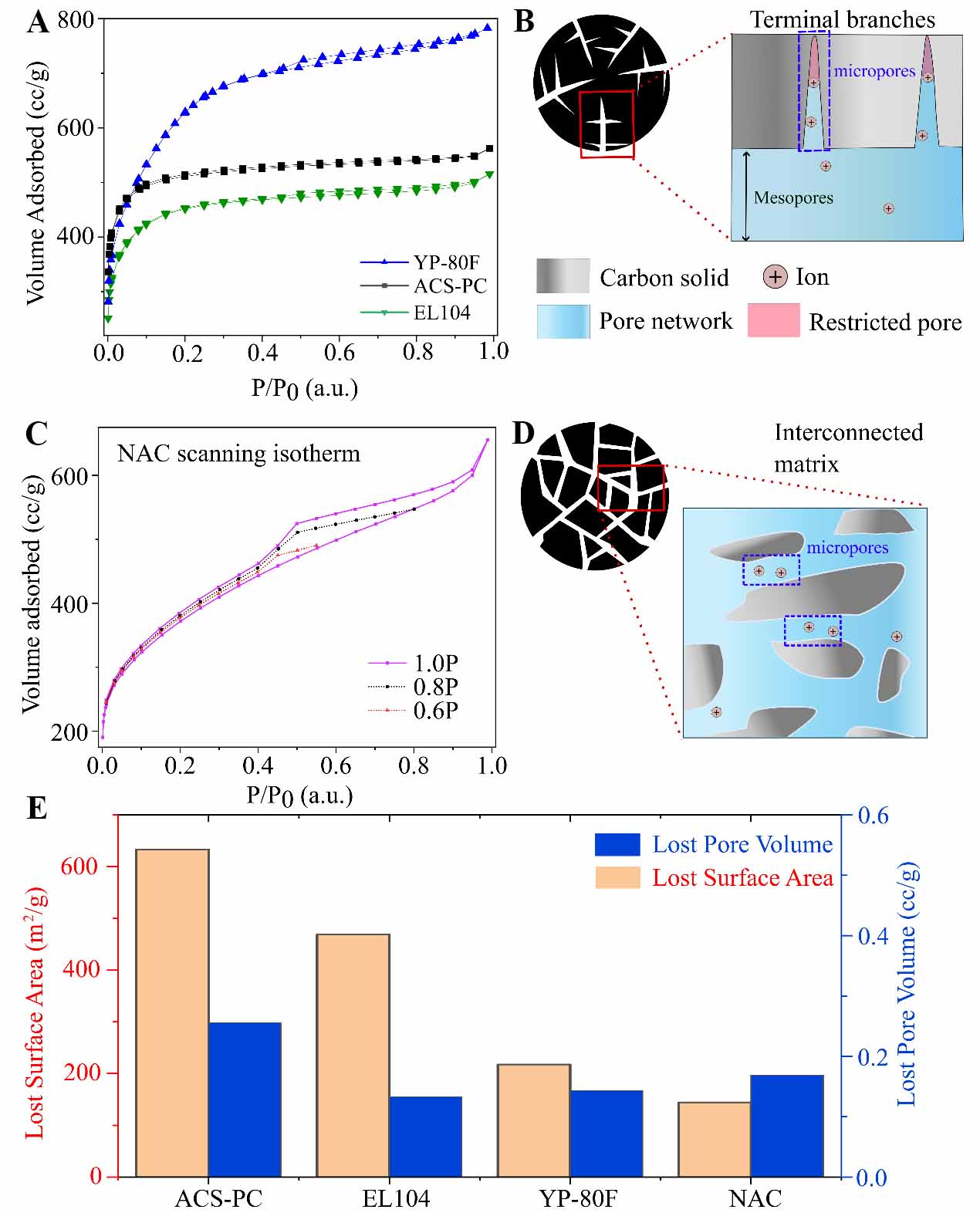
Figure 1. Gas physisorption analysis revealing distinct pore network architectures. (A) Standard nitrogen adsorption-desorption isotherms of EL104, YP-80F and ACS-PC, exhibiting Type I(b)-like behavior which is characteristic of micropore-rich carbons (MRCs); (B) Schematic interpretation of MRCs, highlighting micropore channels that extend from broader channels. Micropores and mesopores have been labelled to show their relative sizes; (C) Scanning isotherm array of NAC, due to its full-pressure range isotherm exhibiting a prominent hysteresis that sits between Type IV and Type H2 hysteresis; (D) Schematic interpretation of NAC’s pore structure based on its scanning hysteresis profile, suggesting a more interconnected network featuring micropores that can be accessed via multiple accessible pathways; (E) Quantifying lost surface area against lost pore volume incurred by each carbon after electrode fabrication through slurry processes. NAC: Nanoporous amorphous carbon.