




Functional materials for bioresorbable medical systems: recent advances and emerging biomedical applications
 0
0 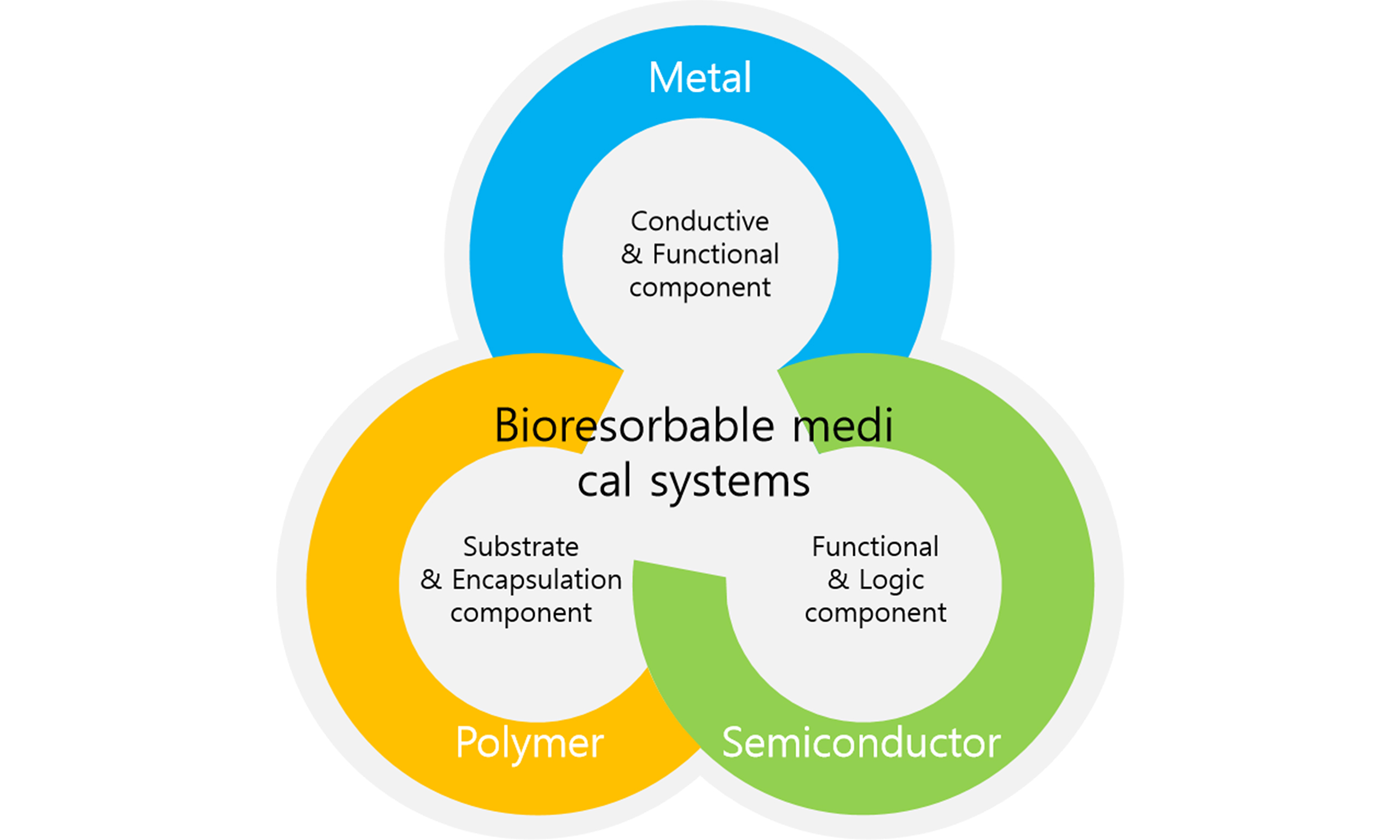
INTRODUCTION
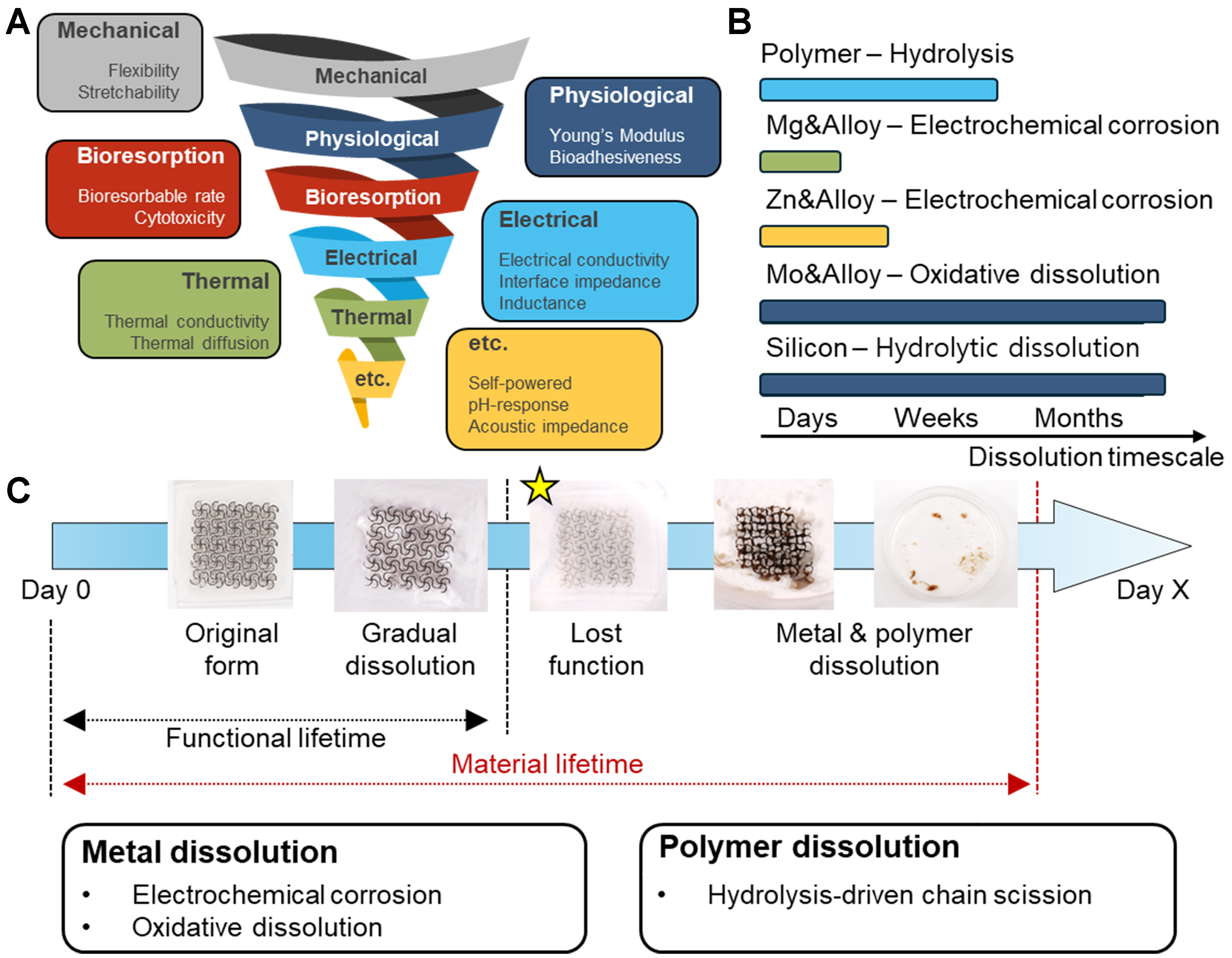
Bioresorbable biomedical systems enable retrieval-free surgery for temporary implantable devices, thereby reducing the burden on patients[1]. Key parameters for device optimization include bioadhesiveness, electrical conductivity, mechanical compliance, thermal conductivity, and bioresorption behavior [Figure 1A]. Functional materials with controlled hydrolysis and degradation characteristics support the development of multifunctional bioresorbable medical devices, ranging from sensors to actuators[2]. Encapsulation strategies that limit water penetration further regulate the functional lifetime of these devices to meet specific medical requirements[3-5]. Although in vivo studies demonstrate promising results[6-9], the physiological and biological mismatch between artificial materials and surrounding tissues remains a major challenge[10-13], and further research is required to develop functional materials with improved compatibility. This article highlights recent advances in bioresorbable materials and biomedical systems for next-generation bioresorbable electronics, emphasizing material chemistry, biomedical applications, and future challenges.
RECENT ADVANCES IN FUNCTIONAL MATERIALS FOR BIORESORBABLE SYSTEMS
Metals, silicon, and polymers each play distinct roles in bioresorbable systems owing to their unique properties [Figure 1B and C]. Polymers commonly serve as substrates and encapsulation layers due to their favorable mechanical properties and compatibility with convenient fabrication processes[14-16]. Water penetration into polymer matrices induces hydrolysis-driven chain scission, which gradually degrades the material and enables bioresorption over timescales ranging from days to months[17-31]. Metals form conductive layers that support applications ranging from simple electrodes to complex circuit architectures[1]. Biocompatible metals such as gold (Au) and titanium (Ti) exhibit electrical resistivities of 2.05 × 10⁻⁸ and 39 × 10-8 Ω·m, respectively, at 273 K, whereas bioresorbable metals such as magnesium (Mg), zinc (Zn), and molybdenum (Mo) show resistivities of 4.05 × 10⁻⁸, 5.46 × 10⁻⁸, 4.85 × 10⁻⁸ Ω·m, respectively[32]. Electrochemical corrosion ionizes Mg and Zn‑based metals, generating rapid chemical reactions that limit their functional lifetime in the body to days or weeks[1]. In contrast, Mo-based metals undergo slow oxidative dissolution and maintain stable surface impedance over timescales of weeks to months[1]. Metal powder–polymer composite structures provide conductive ink platforms that enable via formation and electrical interconnections between components[33]. Silicon (Si) and doped Si serve as key semiconductor materials in bioresorbable electronics. Hydrolytic dissolution of silicon occurs through the formation of orthosilicic acid [Si(OH)4], typically at rates ranging from a few to tens of nanometers per day[34]. Si nanomembrane (NM) devices overcome several limitations of bulk silicon, including limited flexibility, slow degradation, and mechanical fragility, thereby enabling their integration into implantable medical systems.
In 2012, the demonstration of physically transient Si electronics initiated the field of bioresorbable electronics[34]. Mg electrodes, MgO dielectric layers, and Si NMs form metal–oxide–semiconductor field-effect transistors that achieve on/off ratios exceeding 105 at a drain voltage of 0.1 V and a gate voltage of 5 V. Silicon-on-insulator (SOI) wafers allow repeatable fabrication through photolithography and support stable electronic operation. However, water penetration through the silk substrate and MgO encapsulation layer corrodes Mg electrodes, which rapidly degrades device performance within several days.
Laser ablation techniques extend SOI-based silicon electronics toward bioresorbable microelectromechanical systems (MEMS)[35]. Transfer printing to flexible substrates and integrated circuits further enables electrocapacitive sensors, electrostatic actuators, and electrothermal actuators. Process simplification reduces chemical waste and improves the fabrication yield of ecoresorbable and bioresorbable MEMS (eb-MEMS) with micrometer-scale resolution. Biocompatibility tests indicate no significant cytotoxicity associated with Si-based electronics[35]. Encapsulation strategies based on mixtures of candelilla wax and beeswax, polylactic acid (PLA), or semi-water-permeable hydrogel adhesive matrices regulate device lifetimes and isolate the electronics from the surrounding biological environment. The convergence of advanced semiconductor technology and bioresorbable packaging strategies enables highly precise implantable bioresorbable sensor systems for continuous health monitoring[36]. The resonance frequency of resistor–inductor–capacitor (RLC) circuits provides a convenient platform for passive wireless diagnosis[37].
Bioadhesive materials play a critical role in stabilizing implantable devices in biomedical applications because conventional surgical suturing can mechanically damage device structures and provoke local biological responses at the implantation site[38]. A mixture of polyethylene glycol–lactide acid diacrylate, a photoinitiator, sodium alginate, chitosan, 1-ethyl-3-(3-dimethylaminopropyl)carbodiimide, and sulfo-N-hydroxysuccinimide forms a photocurable bioadhesive hydrogel that functions as a bioelectronic–tissue interface material (BTIM). Carboxylic acid and amine groups present in biological tissues and device encapsulation layers form covalent bonds with functional groups in the BTIM. In vivo studies demonstrate that the BTIM maintains device fixation for up to two months and exhibits negligible cytotoxicity[38]. Histological analyses further show that the BTIM prevents suture-induced fibrotic tissue formation, which helps minimize foreign-body responses by reducing the mechanical mismatch between biological tissues and bioelectronic devices.
Bioresorbable heterogeneous material systems exhibit intrinsic differences from native tissues in their physical and acoustic properties, which enables circuit-free deep-tissue diagnostics[39]. The acoustic impedance mismatch between precisely aligned metal structures embedded in a pH-sensitive polymer matrix and surrounding soft tissue enables in vivo pH monitoring through ultrasound imaging. pH-responsive swelling or shrinkage of the polymer matrix modulates the spatial arrangement of Zn patterns, thereby enabling indirect visualization of gastrointestinal pH levels beyond the capabilities of conventional ultrasound imaging. The metastructured hydrogel sensor, incorporating an air-hydrogel heterostructure, broadens its potential applications to include intracranial pressure, temperature, pH, and flow rate sensing.
SUMMARY AND OUTLOOK
Advanced device-level functionalities, particularly for therapeutic modulation and wireless integration, represent promising directions for future applications[40-46]. Interactions between wearable and implantable systems further enable autonomous diagnosis and therapeutic intervention, including emergency cardiac pacing[40]. Electromagnetic induction provides an effective strategy for wireless power transfer; however, susceptibility to structural deformation, water penetration, and environmental variation necessitates robust encapsulation to preserve resonant behavior in vivo over extended durations[41]. Transitioning from electromagnetic induction to light-driven electrostimulation enables substantial miniaturization of bioresorbable devices by eliminating RLC circuitry[42]. Integration with optical filters further enables selective electrostimulation at multiple locations. Microchannel systems also enable temporary nerve-cooling implants that reversibly block peripheral nerve activity[43]. Alternating current generation through triboelectric effects under ultrasound stimulation further enables a metal-electrode–free nerve block system that minimizes mechanical mismatch with biological tissue[44]. Such simplified functional material systems provide structurally streamlined solutions for complex therapeutic interventions. Bioresorbable passive RFID systems also offer expanded opportunities for applications such as patient adherence monitoring[45].
Future research in bioresorbable medical systems requires the maturation of innovative technologies and the development of advanced functional materials that meet the physical and operational demands of next-generation devices. Key challenges include heterostructure interfacial instability, localized corrosion caused by water penetration, galvanic corrosion in heterogeneous metal systems, and polymer swelling induced by moisture uptake, which can alter mechanical and electrical performance. In addition, fibrotic capsule formation around implanted devices remains a significant concern. Soft hydrogel-like encapsulation materials offer a promising strategy to inhibit water ingress at edge heterointerfaces, which represent primary pathways for localized corrosion and sudden functional failure of bioresorbable devices by employing covalent or interpenetrating polymer networks that enhance interfacial adhesion and suppress delamination. However, challenges such as swelling-induced deformation and limited long-term stability remain. Improved adhesion to biological tissues combined with low mechanical stiffness can further reduce foreign-body responses. Embedding conductive bioresorbable microwires within compliant polymer matrices can improve mechanical flexibility and enable tunable degradation, thereby addressing the limitations of solid metal electrodes. However, ensuring electrical continuity during degradation remains a key challenge. Minimally invasive strategies based on in vivo shape transformation may further expand therapeutic possibilities by overcoming the constraints associated with preformed structural implantation. Continued advances in functional materials designed to meet these requirements will drive the development of the next generation of clinically translatable bioresorbable medical systems.
DECLARATIONS
Authors’ contributions
The author contributed solely to the article.
Availability of data and materials
Not applicable.
AI and AI-assisted tools statement
Not applicable.
Financial support and sponsorship
This work was supported by the Korean Fund for Regenerative Medicine (KFRM) grant funded by the Korea government (the Ministry of Science and ICT, the Ministry of Health & Welfare, KFRM 25A0105L1).
Conflicts of interest
The author declared that there are no conflicts of interest.
Ethical approval and consent to participate
Not applicable.
Consent for publication
Not applicable.
Copyright
© The Author(s) 2026.
REFERENCES
1. Ryu, H.; Seo, M. H.; Rogers, J. A. Bioresorbable metals for biomedical applications: from mechanical components to electronic devices. Adv. Healthc. Mater. 2021, 10, e2002236.
2. Park, D. Y.; Lee, H.; Kim, S.; et al. Recent advances in bioresorbable biomedical applications: from materials to devices. Adv. Elect. Materials. 2025, 11, 2400997.
3. Sun, H.; Xue, X.; Robilotto, G. L.; et al. Liquid-based encapsulation for implantable bioelectronics across broad pH environments. Nat. Commun. 2025, 16, 1019.
4. Han, W. B.; Hwang, S.; Yeo, W. Recent advances in encapsulation strategies for flexible transient electronics. Flex. Print. Electron. 2024, 9, 033001.
5. Hawker, M. J.; Pegalajar-Jurado, A.; Fisher, E. R. Conformal encapsulation of three-dimensional, bioresorbable polymeric scaffolds using plasma-enhanced chemical vapor deposition. Langmuir 2014, 30, 12328-36.
6. Zhu, Y.; Deng, K.; Zhou, J.; et al. Shape-recovery of implanted shape-memory devices remotely triggered via image-guided ultrasound heating. Nat. Commun. 2024, 15, 1123.
7. Hong, C.; Jung, D.; Lee, T.; Lee, J. Optical wireless data transfer through skin for implantable biomedical electronics. npj. Flex. Electron. 2025, 9, 500.
8. Wan, J.; Nie, Z.; Xu, J.; et al. Millimeter-scale magnetic implants paired with a fully integrated wearable device for wireless biophysical and biochemical sensing. Sci. Adv. 2024, 10, eadm9314.
9. Boys, A. J.; Güemes, A.; Ma, L.; et al. Implantable bioelectronics for gut electrophysiology. Nat. Commun. 2025, 16, 10240.
10. Yamagishi, K.; Lee, S.; Yokota, T.; Someya, T. Soft, flexible, and stretchable platforms for tissue-interfaced bioelectronics. Adv. Sci. 2026, 13, e21521.
11. Li, Y.; Li, N.; Liu, W.; et al. Achieving tissue-level softness on stretchable electronics through a generalizable soft interlayer design. Nat. Commun. 2023, 14, 4488.
12. Shin, Y.; Lee, H. S.; Hong, Y. J.; et al. Low-impedance tissue-device interface using homogeneously conductive hydrogels chemically bonded to stretchable bioelectronics. Sci. Adv. 2024, 10, eadi7724.
13. Sun, C.; Cheng, Z.; Abu-Halimah, J.; Tian, B. Perspectives on tissue-like bioelectronics for neural modulation. iScience 2023, 26, 106715.
14. Lee, G.; Ray, E.; Yoon, H. J.; et al. A bioresorbable peripheral nerve stimulator for electronic pain block. Sci. Adv. 2022, 8, eabp9169.
15. Jiang, Y.; Ji, S.; Sun, J.; et al. A universal interface for plug-and-play assembly of stretchable devices. Nature 2023, 614, 456-62.
16. Lee, H. S.; Jeong, E.; Choi, H.; et al. Facile and robust integration of functional hydrogels into micropillar-structured elastomer platforms for stable cardiac bioelectronics. Sci. Adv. 2026, 12, eaeb9059.
17. Dobrzyńska-Mizera, M.; Dodda, J. M.; Liu, X.; et al. Engineering of bioresorbable polymers for tissue engineering and drug delivery applications. Adv. Healthc. Mater. 2024, 13, e2401674.
18. Harpaz, D.; Axelrod, T.; Yitian, A. L.; Eltzov, E.; Marks, R. S.; Tok, A. I. Y. Dissolvable polyvinyl-alcohol film, a time-barrier to modulate sample flow in a 3D-printed holder for capillary flow paper diagnostics. Materials 2019, 12, 343.
19. Chaigneau, L.; Perrot, A.; Brezulier, D.; Coulon, J. F.; Chevire, F.; Lebullenger, R. Bioresorbable polylactic acid (PLA) and bioactive glasses (BG) composite: influence of gold coated of BG powder on mechanical properties and chemical reactivity. J. Mech. Behav. Biomed. Mater. 2023, 138, 105571.
20. Low, Y. J.; Andriyana, A.; Ang, B. C.; Zainal Abidin, N. I. Bioresorbable and degradable behaviors of PGA: current state and future prospects. Polym. Eng. Sci. 2020, 60, 2657-75.
21. Archer, E.; Torretti, M.; Madbouly, S. Biodegradable polycaprolactone (PCL) based polymer and composites. Phys. Sci. Rev. 2023, 8, 4391-414.
22. Basu, A.; Domb, A. J. Recent advances in polyanhydride based biomaterials. Adv. Mater. 2018, 30, e1706815.
23. Wan, L.; Lu, L.; Zhu, T.; et al. Bulk erosion degradation mechanism for poly(1,8-octanediol-co-citrate) elastomer: an in vivo and in vitro investigation. Biomacromolecules 2022, 23, 4268-81.
24. Tsuji, H.; Yamamura, Y.; Ono, T.; Saeki, T.; Daimon, H.; Fujie, K. Hydrolytic degradation and monomer recovery of poly(butylene succinate) and poly(butylene succinate/adipate) in the melt. Macro. React. Eng. 2008, 2, 522-8.
25. Wang, H.; Liu, X.; Christiansen, D. E.; et al. Thermoplastic polyurethane with controllable degradation and critical anti-fouling properties. Biomater. Sci. 2021, 9, 1381-96.
26. Abdalkarim, S. Y. H.; Yu, H. Y.; Song, M. L.; Zhou, Y.; Yao, J.; Ni, Q. Q. In vitro degradation and possible hydrolytic mechanism of PHBV nanocomposites by incorporating cellulose nanocrystal-ZnO nanohybrids. Carbohydr. Polym. 2017, 176, 38-49.
27. Salomez, M.; George, M.; Fabre, P.; et al. A comparative study of degradation mechanisms of PHBV and PBSA under laboratory-scale composting conditions. Polym. Degrad. Stab. 2019, 167, 102-13.
28. Browning, M. B.; Cereceres, S. N.; Luong, P. T.; Cosgriff-Hernandez, E. M. Determination of the in vivo degradation mechanism of PEGDA hydrogels. J. Biomed. Mater. Res. A. 2014, 102, 4244-51.
29. Wang, Y.; Ameer, G. A.; Sheppard, B. J.; Langer, R. A tough biodegradable elastomer. Nat. Biotechnol. 2002, 20, 602-6.
30. Polak-Kraśna, K.; Abaei, A. R.; Shirazi, R. N.; et al. Physical and mechanical degradation behaviour of semi-crystalline PLLA for bioresorbable stent applications. J. Mech. Behav. Biomed. Mater. 2021, 118, 104409.
31. Makadia, H. K.; Siegel, S. J. Poly lactic-co-glycolic acid (PLGA) as biodegradable controlled drug delivery carrier. Polymers 2011, 3, 1377-97.
32. Haynes, W. M. CRC Handbook of chemistry and physics, 97th ed.; CRC Press, 2016. https://books.google.com/books?id=VVezDAAAQBAJ. (accessed 2026-06-03).
33. Koo, J.; MacEwan, M. R.; Kang, S. K.; et al. Wireless bioresorbable electronic system enables sustained nonpharmacological neuroregenerative therapy. Nat. Med. 2018, 24, 1830-6.
34. Hwang, S. W.; Tao, H.; Kim, D. H.; et al. A physically transient form of silicon electronics. Science 2012, 337, 1640-4.
35. Yang, Q.; Liu, T.; Xue, Y.; et al. Ecoresorbable and bioresorbable microelectromechanical systems. Nat. Electron. 2022, 5, 526-38.
36. Kwon, K.; Kim, J. U.; Won, S. M.; et al. A battery-less wireless implant for the continuous monitoring of vascular pressure, flow rate and temperature. Nat. Biomed. Eng. 2023, 7, 1215-28.
37. Guo, Q.; Koo, J.; Xie, Z.; et al. A bioresorbable magnetically coupled system for low‐frequency wireless power transfer. Adv. Funct. Mater. 2019, 29, 1905451.
38. Yang, Q.; Wei, T.; Yin, R. T.; et al. Photocurable bioresorbable adhesives as functional interfaces between flexible bioelectronic devices and soft biological tissues. Nat. Mater. 2021, 20, 1559-70.
39. Liu, J.; Liu, N.; Xu, Y.; et al. Bioresorbable shape-adaptive structures for ultrasonic monitoring of deep-tissue homeostasis. Science 2024, 383, 1096-103.
40. Choi, Y. S.; Jeong, H.; Yin, R. T.; et al. A transient, closed-loop network of wireless, body-integrated devices for autonomous electrotherapy. Science 2022, 376, 1006-12.
41. Lee, G.; Does, M. D.; Avila, R.; et al. Implantable, bioresorbable radio frequency resonant circuits for magnetic resonance imaging. Adv. Sci. 2024, 11, e2301232.
42. Zhang, Y.; Rytkin, E.; Zeng, L.; et al. Millimetre-scale bioresorbable optoelectronic systems for electrotherapy. Nature 2025, 640, 77-86.
43. Reeder, J. T.; Xie, Z.; Yang, Q.; et al. Soft, bioresorbable coolers for reversible conduction block of peripheral nerves. Science 2022, 377, 109-15.
44. Lee, D. M.; Kang, M.; Hyun, I.; et al. An on-demand bioresorbable neurostimulator. Nat. Commun. 2023, 14, 7315.
45. Say, M. G.; You, S. S.; Cai, Y.; et al. Bioresorbable RFID capsule for assessing medication adherence. Nat. Commun. 2026, 17, 52.
46. Choi, Y. S.; Yin, R. T.; Pfenniger, A.; et al. Fully implantable and bioresorbable cardiac pacemakers without leads or batteries. Nat. Biotechnol. 2021, 39, 1228-38.
47. Hehrlein, C.; Schorch, B.; Kress, N.; et al. Zn-alloy provides a novel platform for mechanically stable bioresorbable vascular stents. PLoS. One. 2019, 14, e0209111.
Cite This Article
 Open Access
How to Cite
Download Citation
Export Citation File:
Type of Import
Tips on Downloading Citation
Citation Manager File Format
Type of Import
Direct Import: When the Direct Import option is selected (the default state), a dialogue box will give you the option to Save or Open the downloaded citation data. Choosing Open will either launch your citation manager or give you a choice of applications with which to use the metadata. The Save option saves the file locally for later use.
Indirect Import: When the Indirect Import option is selected, the metadata is displayed and may be copied and pasted as needed.
About This Article
Special Topic
Copyright

Data & Comments
Data
0








Comments
Comments must be written in English. Spam, offensive content, impersonation, and private information will not be permitted. If any comment is reported and identified as inappropriate content by OAE staff, the comment will be removed without notice. If you have any queries or need any help, please contact us at support@oaepublish.com.