



Volume 6, Issue 2 (2026) – 10 articles
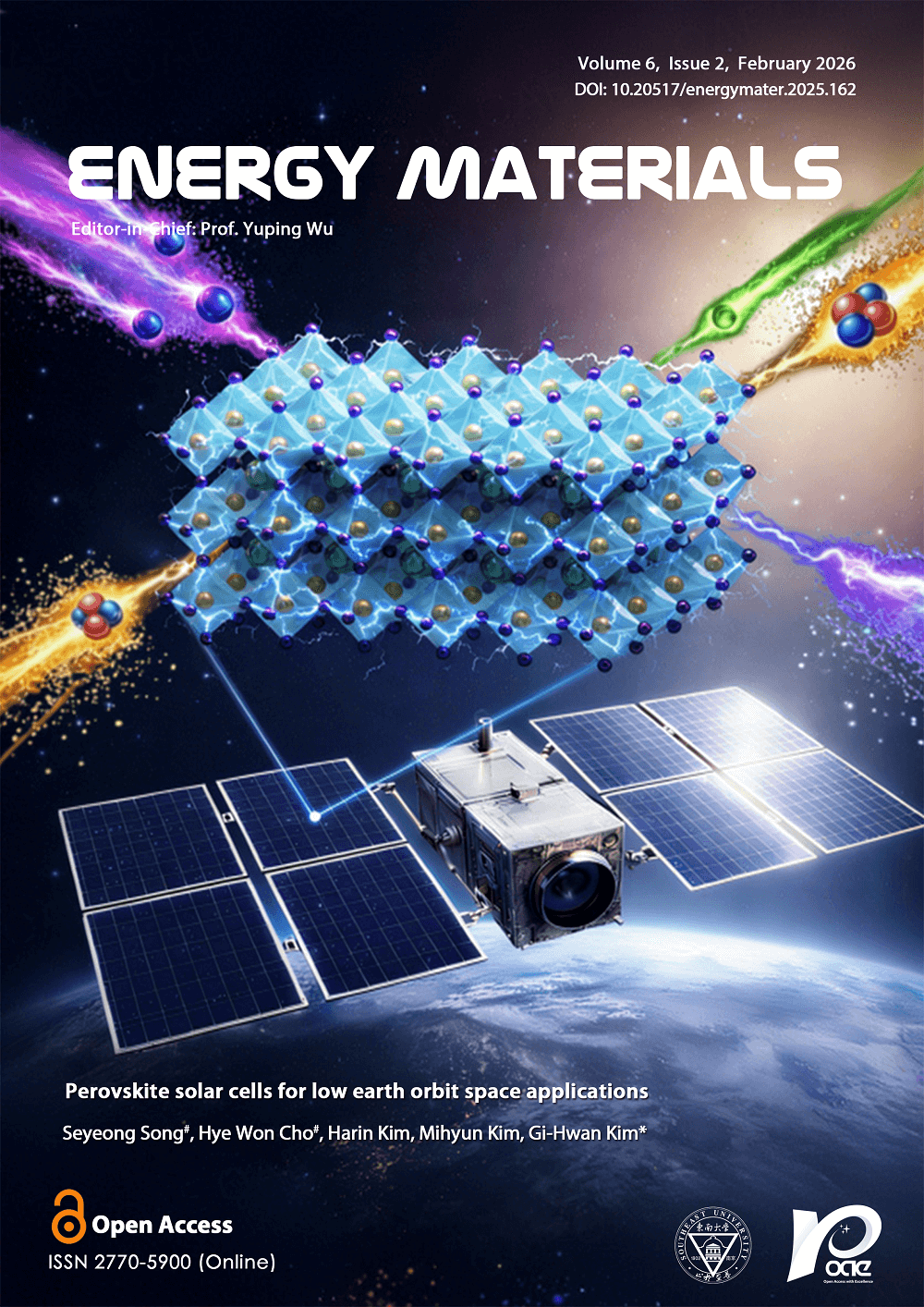
Cover Picture: Perovskite solar cells (PSCs) are a promising next-generation photovoltaic (PV) technology for space applications. Their high power-to-weight ratio, mechanical flexibility, and tunable optoelectronic properties make them particularly attractive for Low Earth Orbit (LEO) applications. PSCs demonstrate favorable behavior under low light and partial shading, as well as a unique self-healing response under certain space conditions. They also achieve specific power densities of 23-30 W g-1, representing a 10-15× improvement over conventional silicon arrays (0.5-2 W g-1) and 4-6× improvement over III-V multijunction cells (5.5 W g-1), while maintaining > 92% efficiency retention under 1 × 10¹⁶ e cm-2 electron irradiation. The key challenges and opportunities for PSCs in the LEO environment arise from intense ultraviolet radiation, vacuum exposure, thermal cycling, and proton irradiation. In this review, a comprehensive understanding of PSCs in the space environment is presented, including recent strategies to improve efficiency, as well as thermal and mechanical durability, while also addressing performance optimization and space PV analysis. This overview highlights the potential of perovskite photovoltaics for satellite power systems by enabling high-efficiency energy harvesting with minimal mass and processing constraints, positioning PSCs as a promising new PV paradigm for the coming decade.
view this paper 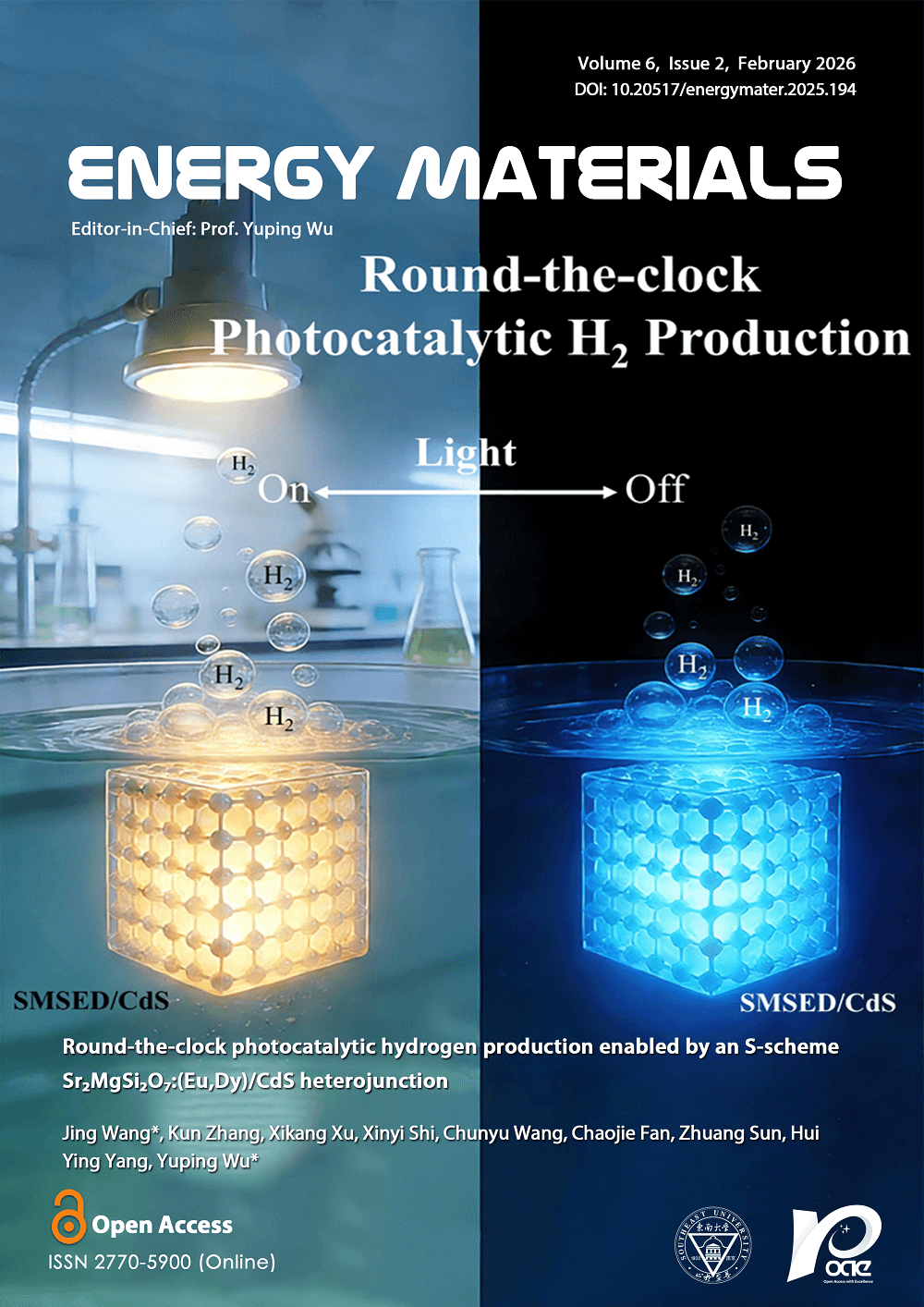
Back Cover Picture: Round-the-clock photocatalytic hydrogen production is essential for overcoming the intermittency of solar energy and achieving continuous solar-to-hydrogen conversion. However, the development of efficient round-the-clock photocatalysts remains a considerable challenge due to limited light availability and inefficient charge utilization in the dark. In this work, a long-afterglow-based S-scheme heterojunction photocatalyst, Sr2MgSi2O7:(Eu,Dy)/CdS (referred to as SMSED/CdS), is constructed via a ball-milling strategy. The luminescence from Sr2MgSi2O7:(Eu,Dy) (referred to as SMSED) is efficiently captured by CdS, thus serving as a built-in light source to drive dark catalytic reactions. Meanwhile, the unique electron transfer pathway in SMSED provides sufficiently long-lived electrons for the SMSED/CdS system. The S-scheme heterojunction formed between SMSED and CdS directs the photogenerated charge transfer, while maintaining the strong redox capability of SMSED/CdS. Consequently, the SMSED/CdS exhibits hydrogen production of 45.20 mmol g-1 under ultraviolet-visible light within 1 h and a dark activity of 4.37 mmol g-1 sustained over 3 h. The corresponding mechanism was comprehensively studied via analysis of physicochemical properties, band structure, ex-situ and in-situ X-ray photoelectron spectroscopy, and density functional theory calculations. This study provides a significant breakthrough in developing round-the-clock photocatalysts.
view this paper