

Volume 6, Issue 8 ( 2026) – 20 articles
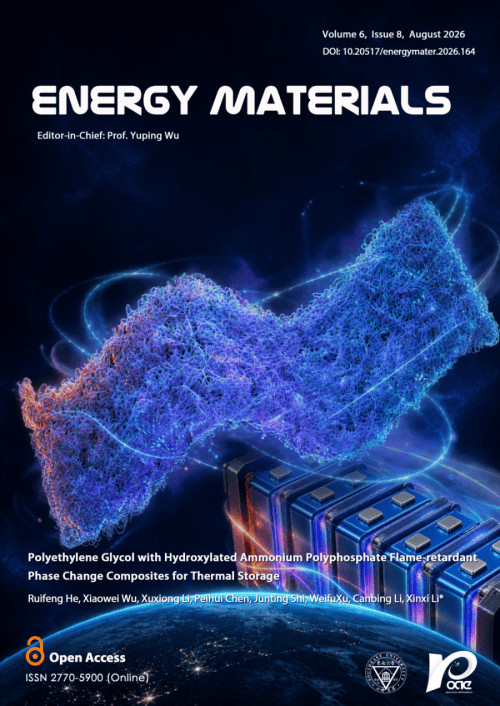
Cover Picture: Efficient thermal management remains a key challenge in lithium-ion battery systems, as temperature fluctuations can compromise performance and safety. Composite phase change materials (CPCMs) offer high latent heat and passive temperature regulation but are often hindered by leakage and flammability. In this study, a passive battery thermal management system incorporating an intrinsically flame-retardant CPCM was developed. Hydroxylated ammonium polyphosphate (HAPP) was synthesized through a cation-exchange reaction and integrated into a hexamethylene diisocyanate (HDI)-crosslinked polyethylene glycol (PEG) network, providing structural support and flame-retardant functionality. A Polyethylene glycol (PEG)/Hexamethylene diisocyanate (HDI)/HAPP/expanded graphite (EG) composite, denoted as PHHE, was prepared through chemical crosslinking. The resulting three-dimensional HAPP-PEG-HDI network effectively restricted the macroscopic leakage of PEG. PHHE exhibits an initial latent heat of 111.35 J/g and a mass retention of 99.88% after aging at 80 °C for 5 h. During battery-module testing at a discharge rate of 2 C, the PHHE-based battery module reached a maximum temperature of 52.08 °C, indicating its passive temperature-regulation capability. These results demonstrate that PHHE integrates thermal-energy storage, shape stability, flame-retardant functionality, and battery temperature regulation, providing a potential material approach for the thermal management of battery packs and related energy-storage systems.
view this paper 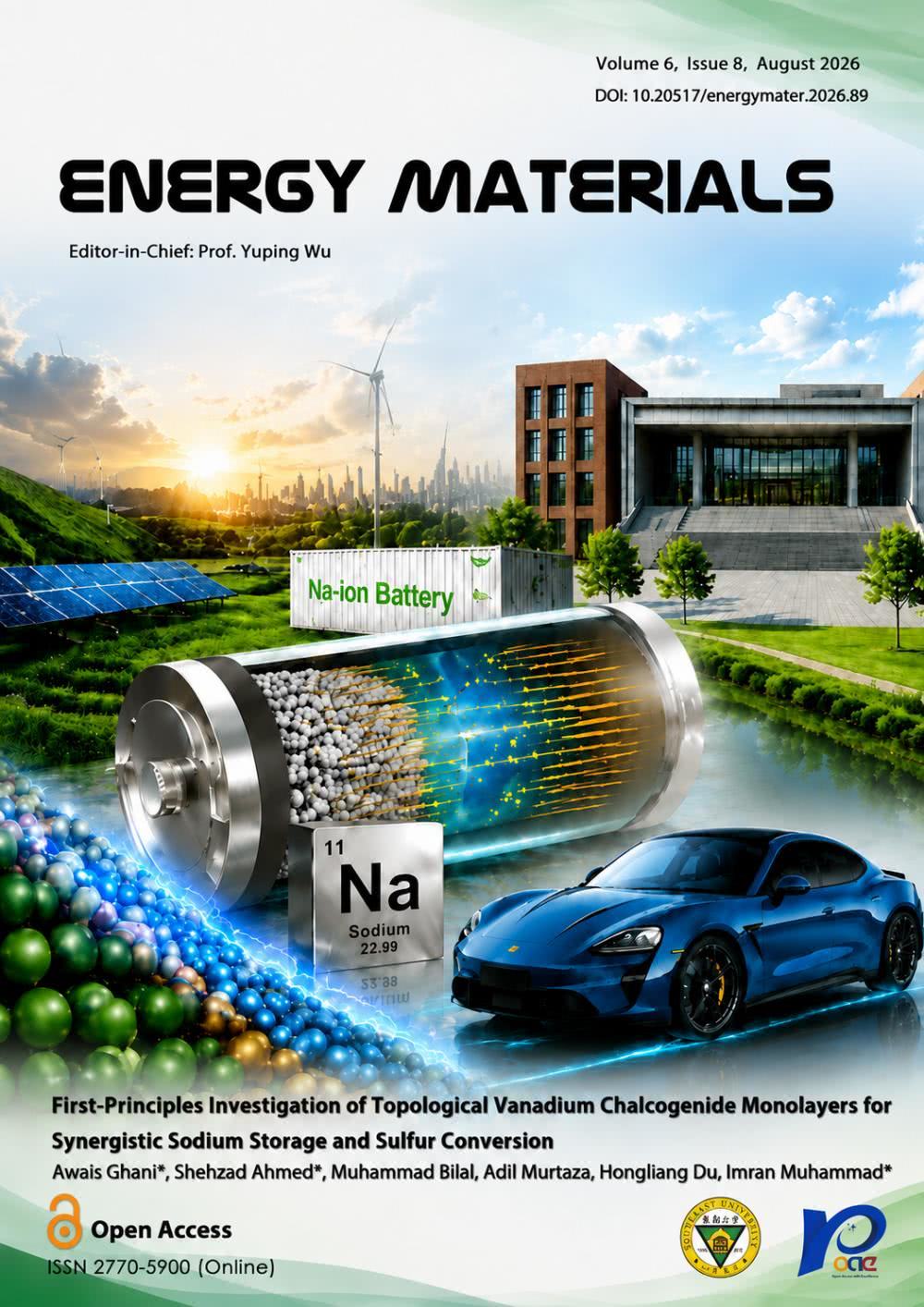
Back Cover Picture: An atomic-level understanding of anion and cation intercalation is essential for advancing alkali-metal-ion electrodes and anchoring metal polysulfides. Sodium batteries present a more sustainable alternative to lithium-based systems. Developing electrode materials that support both sodium-ion storage and sodium-polysulfide conversion, each in its own cell configuration, is therefore of growing interest. In this study, two-dimensional quaternary vanadium-based chalcogenides (V2WS4, V2WSe4, V2MoS4, and V2MoSe4) are computationally investigated. They exhibit indistinguishable bonding environments, topological band gaps, and versatility across two distinct cell configurations: sodium-ion storage and polysulfide anchoring. The distinctive topological electronic properties of these monolayers enhance Na+/K+ adsorption and facilitate high charge flux, indicating strong chemisorption while maintaining conductivity. These materials exhibit rapid ion transport, as evidenced by low diffusion barriers of 0.22 eV and 0.16 eV for Na+ and K+ ions, respectively, and deliver higher capacities of up to 1,151 mAh g-1 for Na+ and 821.9 mAh g-1 for K+ compared to conventional graphitic electrodes, along with a low open-circuit voltage of approximately 0.21 V. Additionally, these materials suppress polysulfide shuttling via energetic anchoring and accelerate the reduction reactions, particularly for long-chain sodium polysulfides. Sulfur reduction reactions and kinetic calculations for sodium-sulfur clusters indicate that V2MoSe4 exhibits the lowest rate-limiting free-energy change, while V2MoS4, V2WS4, and V2WSe4 demonstrate moderate kinetics and redox stability. These vanadium-based topological chalcogenides are thus promising anode materials for sodium-ion storage and as anchoring platforms for sodium-sulfur battery cathodes.
view this paper