



A review of advanced Ni-based cathode materials with layered structures for sodium batteries
 0
0 
Abstract
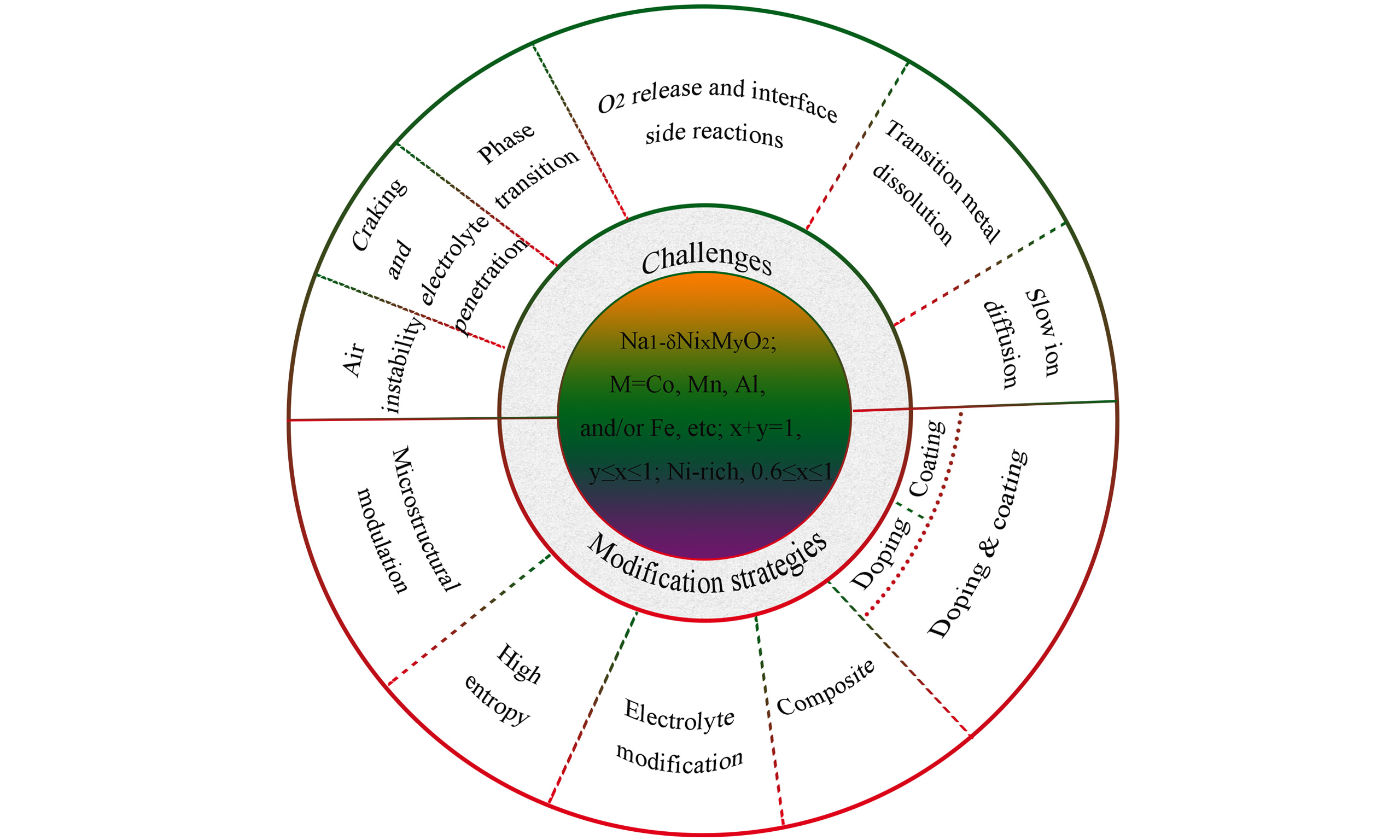
Sodium-ion batteries (SIBs), benefiting from abundant sodium resources, cost-effectiveness, high safety, and environmental friendliness, are emerging as vital supplements to lithium-ion batteries (LIBs) in various fields, including electric vehicles, portable power sources, and stationary energy storage stations. The performance of SIBs largely hinges on cathode materials. Among them, Ni-based layered oxide cathode materials (Na1-δNixMyO2; M=Co, Mn, Al, Fe, and/or other elements; x + y = 1, y ≤ x ≤ 1; Ni-rich, 0.6 ≤ x ≤ 1) have exhibited distinctive advantages and enhancement potential due to the unique arrangement of Na and Ni ions within their layered structures. Na1-δNixMyO2 can significantly increase the specific discharge capacity by increasing the Ni content, which is of great significance for improving the energy density of SIBs. However, increasing the Ni content of Na1-δNixMyO2 also brings challenges, namely a decrease in structural stability, cycle durability, and thermal safety. In this paper, a comprehensive review is provided to understand the relationship between material structure and electrochemical performance. The degradation mechanism and modification strategies to further improve the performance and mitigate the degradation of SIB cathode materials of Ni-based cathodes such as Na1-δNixMyO2 are emphasized. This paper also analyzes the technical challenges and proposes future research directions to overcome them toward practical SIB applications.
Keywords
INTRODUCTION
Driven by the high energy demand to meet rapid industrialization and improvement of human living conditions, the accelerated depletion of fossil fuels and the resulting negative environmental impact have become serious concerns for the sustainability of human society[1,2]. In this context, investigating clean, renewable energy sources - including solar, wind, and hydropower - and advancing technologies for electricity generation, storage, and conversion has been recognized as essential[3-6]. Specifically, in the realm of electrical energy storage and conversion, electrochemical systems - such as lithium-ion batteries (LIBs), sodium-ion batteries (SIBs), and supercapacitors - alongside processes like water electrolysis for hydrogen generation and CO2 reduction for low-carbon fuel synthesis, have been validated as reliable, efficient, and viable solutions[7-16]. In particular, lithium-based battery packs, serving as energy storage/conversion and power units, have stimulated the rapid development of new energy electric vehicles, which have significantly penetrated the automotive sector[17]. For example, by 2024, the global penetration rate of new energy electric vehicles has soared from 0.2% in 2012 to around 19.11%, while China’s penetration rate has surpassed 45.5% (far higher than the UK’s 22.7%, France’s 21.0%, the US’s 9.5%, and Canada’s 6.8%), with the sales penetration rate even exceeding 50%[18]. Currently, the new energy vehicles on the market are basically equipped with battery units using lithium-ion as the energy carrier. The availability of lithium is constrained by its low geological reserves, which amount to just ~20 ppm in the continental crust[19,20] [Figure 1A], and a significant portion of it is concentrated in South America and Australia, which may pose substantial challenges to the supply of lithium resources [Figure 1B and C]. According to statistics, 87% of global lithium consumption comes from lithium batteries [Figure 1D][21]. Hence, the development of cost-efficient, safe, and durable batteries with high energy density is essential, provided they can also circumvent the limitations imposed by scarce raw materials[22,23]. In this regard, sodium is considered an alternative due to its electrochemical properties being similar to lithium when used as an electrode material in SIBs[24,25]. From a resource standpoint, the crustal abundance of sodium (~23,000 ppm) exceeds that of lithium by a factor of 1,000, ranking it as the sixth most abundant element. It is widely distributed globally and inexpensive [Figure 1E-H][26,27]. Meanwhile, SIBs are secondary batteries that use Na+ as charge carriers. Their working principles and structures are similar to those of LIBs, and 95% of LIB production systems can be adapted for SIBs, facilitating rapid capacity conversion[28]. Given their ample resources, low cost, and adequate performance, SIBs have become a focal point of research in energy storage[29,30] [Figure 1I]. Although their energy density is slightly lower, it is sufficient for applications with moderate energy density requirements, such as grid storage stations and low-speed electric vehicles (EVs) [Figure 1J][31]. Owing to their superior cost-effectiveness, performance, and resource availability, SIBs are expected to enter this technology domain[32].
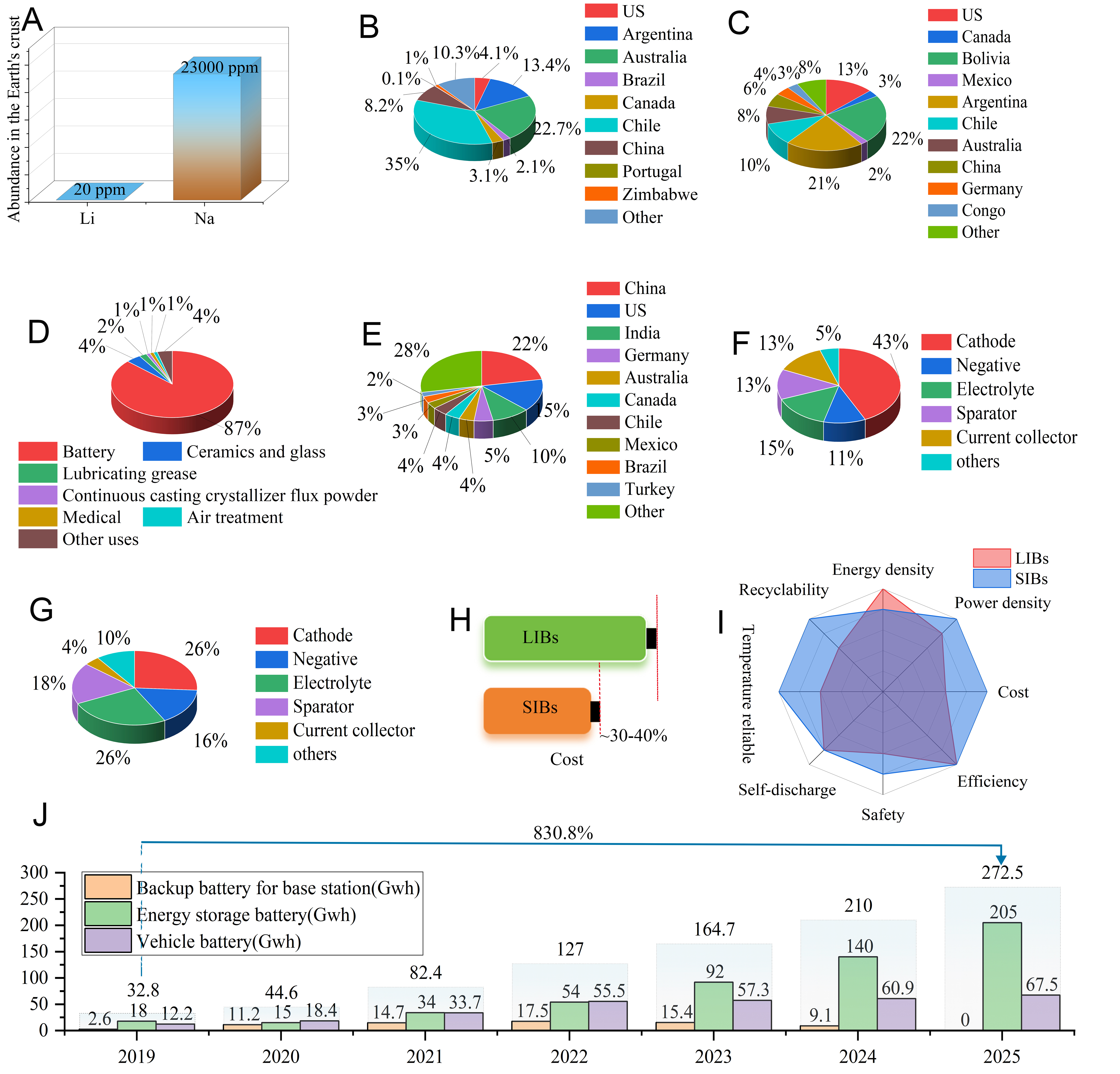
Figure 1. Comparison of LIBs and SIBs in terms of resources, costs, and performance. (A) Lithium and sodium content in the Earth’s crust. (B) Lithium resources in 2023. (C) Lithium reserves in 2023. (D) Proportion of global lithium resource consumption structure in 2023. (B-D) Drawing based on the data from Ref.[21]; (E) Sodium resources in 2020. (E) Drawing based on the data from Ref.[26]; (F-H) Cost analysis of LIBs and SIBs. (F-H) Drawing based on the data from Ref.[27]; (I) Comparison of comprehensive performance between LIBs and SIBs. (J) Sodium electricity market and various application scales. (J) Drawing based on the data from Ref.[31]. LIBs: Lithium-ion batteries; SIBs: sodium-ion batteries.
Currently, the industrial scale-up of SIBs is still in its infancy, and the progress in this field primarily hinges on advancements in electrode materials development. Among the anode-related technology routes, the prospects for the industrialization of hard carbon materials are quite clear. In contrast, the cathodes present three potential development pathways, as shown in Figure 2: Polyanionic compounds[33-37], Prussian Blue Analogue (PBAs)[38-44], and layered NaxTMO2[45-51]. Among them, polyanion-type cathodes exhibit excellent cycle life and robust structural stability. However, they have relatively low energy density. Moreover, the widespread use of vanadium and fluorine in polyanion materials has raised concerns due to their toxicity and high cost, seriously hindering their development and application[52,53]. The Prussian blue cathode demonstrates superior specific capacity and rate performance. However, it exhibits limitations in terms of cycle life, tap density, and electrical conductivity[54]. Furthermore, the presence of the O-C≡N functional group raises concerns regarding the potential toxicity of this material[42]. The structural taxonomy of layered NaxTMO2 comprises O3, O2, P3, and P2 phases, which are determined by how Na+ are coordinated and how O2- stacks inside the TMO6 polyhedra[55]. The electrochemical properties of different P2 and O3 types of NaxTMO2 are shown in Tables 1 and 2. O3-type cathodes, characterized by their high Na content, typically exhibit high charge and discharge capacities. However, they are hindered by slow Na+ transport and poor air stability[56,57], yet they overcome these limitations by delivering high capacities over a wide voltage range.
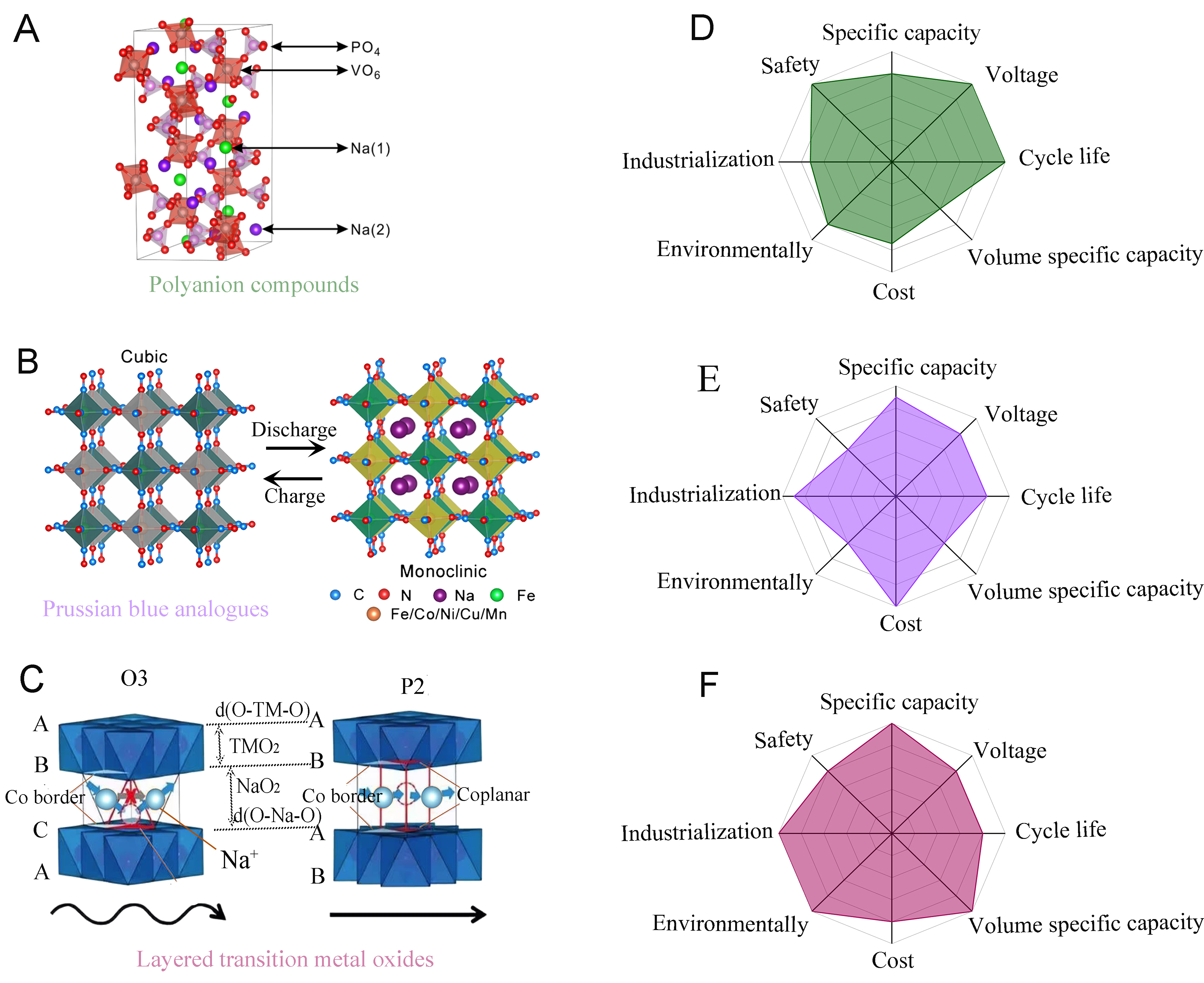
Figure 2. (A) Typical crystal structures of polyanionic compounds. Reproduced with permission[37]. Copyright 2018, American Chemical Society; (B) Typical crystal structures of Prussian blue analogs. Reproduced with permission[44]. Copyright 2025, American Chemical Society; (C) Typical crystal structures of layered transition metal oxides. Reproduced with permission[51]. Copyright 2014, American Chemical Society; (D) Key performance comparison chart of polyanionic compounds; (E) Key performance comparison chart of Prussian blue analogs (PBAs). No additional copyright attribution; (F) Key performance comparison chart of layered transition metal oxides (LTMO).
Summary of the doping strategies for Ni-based cathodes of SIBs
| Materials | Voltage range (V) | Electrolyte | Initial capacity (mAh g-1) | Capacity retention (%) | Rate performance (mAh g-1) | Mass loading (mg cm-2) | Full-cell cycle performance (%) | Ref. |
| NaNi1/3Fe1/3Mn1/3-0.02Zr0.02O2 | 2-4 | 1 M NaPF6 in propylene carbonate (PC) and ethyl methyl carbonate (EMC) [1:1 in volume, 5% fluoroethylene carbonate (FEC)] | 125.6 (1 C) | 77.1% (300 cycles at | ~86 (10 C) | - | - | [132] |
| Na[Ti0.03(Ni0.6Co0.2Mn0.2)0.97]O2 | 1.5-4.1 (half cell) 1.0-4.1 (full cell) | 0.5 M NaPF6 in PC and FEC (98:2 by volume) | 154 (0.1 C) | 87% (100 cycles at | ~108 (10 C) | 6 | 77% (400 cycles at | [133] |
| Na0.94Mg0.03(Ni1/3Fe1/3Mn1/3)O2 | 2-4.1 (half cell) 1.0-4.0 (full cell) | 1 M NaPF6 in propylene carbonate (PC, 100%) with fluoroethylene carbonate (FEC, 5% in volume) | 148.9 (0.1 C) | 81.6% (200 cycles at | 103.8 (10 C) | 2.0 | 85.6% (100 cycles at | [134] |
| Na0.52Ca0.04Ni1/3Co1/3Mn1/3O2 | 2.5-4.2 | 1 M NaPF6 in EC and diethyl carbonate (DEC) with fluoroethylene carbonate (FEC, 3 wt%) | 173 (10 mA g-1) | 75% (105 cycles at | 133 (2 C) | - | - | [135] |
| NaNi1/3Fe1/3Mn1/3O1.99F0.01 | 2-4 | 1M NaClO4 dissolved in PC | 129.4 (150 mA g-1) | 85% (70 cycles at | - | - | - | [136] |
| Na0.95Ni0.40Fe0.15Mn0.3Ti0.15O2 | 2-4.2 (half cell) 1.5-4.1 (full cell) | 1 M NaClO4 in propylene carbonate (PC, 95 vol %) and fluoroethylene carbonate (FEC, | 161.6 (0.1 C) | 81.8% (200 cycles at | 108.3 (10 C) | - | 83.4% (100 cycles at | [137] |
| Na0.98Ca0.01Ni0.35Cu0.05Fe0.2Mn0.4O2 | 2-4 (half cell) 1.9-3.9 (full cell) | 1 M NaClO4 in polycarbonate (PC, 100%) with 5 wt.% FEC | 128.18 (0.1 C) | 80.65% (300 cycles at | 86.02 (10 C) | 2-3 | 73.4 % (350 cycles at 0.5 C) | [138] |
| Na0.99K0.01Ni0.5Mn0.4Ti0.1O2 | 2-4 | 1 M NaClO4 dissolved in ethylene carbonate (EC) and PC [1:1 in volume, 5% FEC] | 128 (0.1 C) | 81% (400 cycles at | 97.1 (5 C) | 2.2 | 73% (500 cycles at 1 C) | [139] |
| Na(Ni1/3Fe1/3Mn1/3)0.98Al0.02B0.02O2 | 2-4.3 | 1 M NaClO4 in PC + 5% FEC | 175.9 (0.1 C) | 63.1% (200 cycles at | 87.6 (10 C) | 3.8 | - | [140] |
| Na(Ni1/3Fe1/3Mn1/3)0.99Mo0.01O1.99F0.01 | 2-4 | 1 M NaClO4 dissolved in EC and DEC (volume ratio = 1:1) and 5% FEC | 149.4 (0.1 C) | 91.97% (100 cycles at | 137 (1 C) | 5.0 | - | [141] |
| NaNi0.40Mn0.40Ti0.13Fe0.06Al0.01O2 | 2-4 | 1.0 M NaClO4 in PC with 5% FEC | 125.1 (0.1 C) | 82.2% (200 cycles at | 47.3 (10 C) | - | 88.9% (100 cycles at | [142] |
| Na0.8Ni0.3Fe0.2Mn0.3Li0.1Mg0.02Ca0.05Sb0.03O2 | 2-4.2 (half cell) 1.0-4.2 (full cell) | 1 M NaClO4 in EC and PC and 5% FEC | 130 (0.2 C) | 85% (250 cycles at | 92 (5 C) | 3-4 | 74.2% (100 cycles at 0.5 C) | [143] |
Summaries on the coating strategies for Ni-based cathodes of SIBs
| Materials | Voltage range (V) | Electrolyte | Initial capacity (mAh g-1) | Capacity retention (%) | Rate performance (mAh g-1) | Mass loading (mg cm-2) | Full-cell status (%) | Ref. |
| 1 wt% Al2O3 -NaNi0.6Co0.2Mn0.2O2 | 1.5-4.1 | 0.5 M NaPF6 solution in propylene carbonate (PC) and uoroethylene carbonate (98: 2 by volume) | 152.8 (0.1 C) | 91% (50 cycles at 0.5 C) | 115 (10 C) | 6 | 75% (300 C cycles at 0.5 C) | [146] |
| 1 wt% AlF3-Na[Ni0.65Co0.08Mn0.27]O2 | 1.5-4.1 | 0.5 M NaPF6 in PC + fluoroethylene carbonate (FEC) 2 vol % | 168 (0.5 C) | 90% (50 cycles at 0.5 C | 145 (5 C) | 5.5-6 | 90% (200 cycles at 0.5 C) | [152] |
| 1 mol% Na3-3xAlxPO4-NaNi0.4Fe0.2Mn0.4O2 | 2-4 (half cell) 0.5-4 (full cell) | 1 M NaClO4 in propylene carbonate/ethylene carbonate/dimethyl carbonate (PC/EC/DMC = 1:1:1 in volume) with fluorinated ethylene carbonate (2% in volume) | 181 (0.1 C) | 80% (200 cycles at 1 C) | 128.7 (5 C) | 5 | 70% (500 cycles at 1 C) | [153] |
| Bulk Ti doping and surface Al2O3 coating -NaNi0.6Co0.2Mn0.2O2 | 1.5-4.1(half cell) 1-4.1 (full cell) | 1 M NaClO4 in a mixed solvent of EC and DMC (1:1 in volume) with an addition of 5 wt% FEC | 163.5 (0.1 C) | 85.4% (200 cycles at 0.5 C) | 118.5 (10 C) | 7.5 ± 0.15 | ~70% (500 cycles at 0.5 C) | [154] |
| B3+ doping and B2O3 coating-NaNi1/3Fe1/3Mn1/3O2 | 2-4 | 1 M NaPF6 dissolved in PC and ethyl methyl carbonate (EMC) containing 2% FEC (volume ratio 1:1) | 124.9 (0.2 C) | 87% (200 cycles at | 99 (10 C) | - | - | [155] |
This enhanced performance is largely attributed to their unique structural geometry, which facilitates faster Na+ migration compared to O3-type structures, despite having a relatively lower Na content[58,59]. While O3-type cathodes necessitate Na+ migration via tetrahedral interstices to reach neighboring octahedral sites, P2-type cathodes allow ions to bypass these interstitial positions and hop directly between prismatic sites, thereby enabling accelerated ion transport[20].
P2/O3 layered oxides have become the core candidate system for high-energy-density cathodes in SIBs owing to their high capacity, excellent low-temperature performance, low cost, environmental friendliness, and safety[60]. However, their commercialization remains constrained by two bottlenecks: insufficient energy density and poor cycling stability under extreme temperatures. Among the transition metal oxide (TMO) cathodes, Ni-based and Ni-rich layered oxides have long been considered promising candidates due to the high capacity and energy density afforded by the Ni2+/Ni4+ redox couple[61-64]. Increasing Ni content in
Notably, studies have shown that high Ni content is neither a necessary condition nor the optimal choice for achieving superior performance. Ni-free and low-Ni layered oxides have already matched or even surpassed Ni-rich systems in key metrics such as rate capability, cycling stability, and safety[82,83]. Nevertheless, Ni-based cathodes still hold significant value in high-energy-density applications where cost and safety constraints are relatively relaxed. Through rational modification strategies, the shortcomings in rate capability, cycling stability, and safety can be effectively addressed, maintaining strong practical competitiveness.
Concurrently, other reviews have emphasized recent progress, challenges, and mitigation strategies for the practical implementation of NaxTMO2[84]. Notably, Li et al.[85] provided a systematic overview of advancements in NaTMO2 cathodes, focusing predominantly on Mn-based layered materials. Despite the progress in Mn-based layered materials, a complete survey detailing the substantial promise of Ni-rich cathodes, particularly with a systematic mapping of the research landscape, has not been previously presented. To fill this lacuna, this review provides a detailed investigation into recent breakthroughs regarding Ni-based cathodes for SIBs. The paper consolidates effective methods for the intelligent design of these materials, prioritizing their singular properties and the underlying mechanisms that enhance performance. Notably, this work highlights distinct peculiarities specific to Ni-rich cathodes in SIB applications, offering critical insights into their structural stability, electrochemical behavior, and scalability challenges. Additionally, by critically weighing the pros and cons of this emerging material category, this study provides actionable insights to direct future efforts in creating high-performance Ni-rich cathodes for forthcoming SIB technologies.
CRYSTAL STRUCTURE OF Na1-δNixMyO2 LAYERED CATHODES
Drawing inspiration from the successful application of layered oxides in LIBs, such as commercially available layered cathode materials including LiCoO2[86], LiNixCoyMnzO2[87], and LiNixCoyAlzO2[88]. Researchers have focused on Na+ layered oxide cathodes, which have emerged as the most commercially viable candidates. These cathodes have attracted extensive research interest due to their crystal structures, which bear a striking resemblance to those of Li+ layered oxides. The typical structural formula for Na-based layered cathodes is denoted as NaxMO2, where the variable x denotes the Na content. TM represents one or more transition metal (TM) ions (e.g., Fe, Mn, Ni, Al, Co, etc.). Based on variations in Na+ occupancy and oxygen stacking sequences, layered oxide structures are categorized into O3, O2, P2, and P3[53]. As illustrated in Figure 3A-D, the letters P and O are used to denote the coordination environment of Na+, with “O” representing octahedral sites and “P” representing prismatic sites[89]. Within a unit cell, the count of oxide layers and the distinct stacking configurations are represented by numerical values; specifically, a value of 2 indicates an ABBA sequence, whereas 3 indicates an ABCABC sequence. When in-plane distortion occurs within the crystal structure, leading to a reduction in symmetry, the symbol “′” is appended after the letter to denote monoclinic or orthorhombic phases. From the perspectives of thermodynamic stability and preparation feasibility, P2- and O3-type layered oxides stand out as the predominant focus of current research among cathode materials.
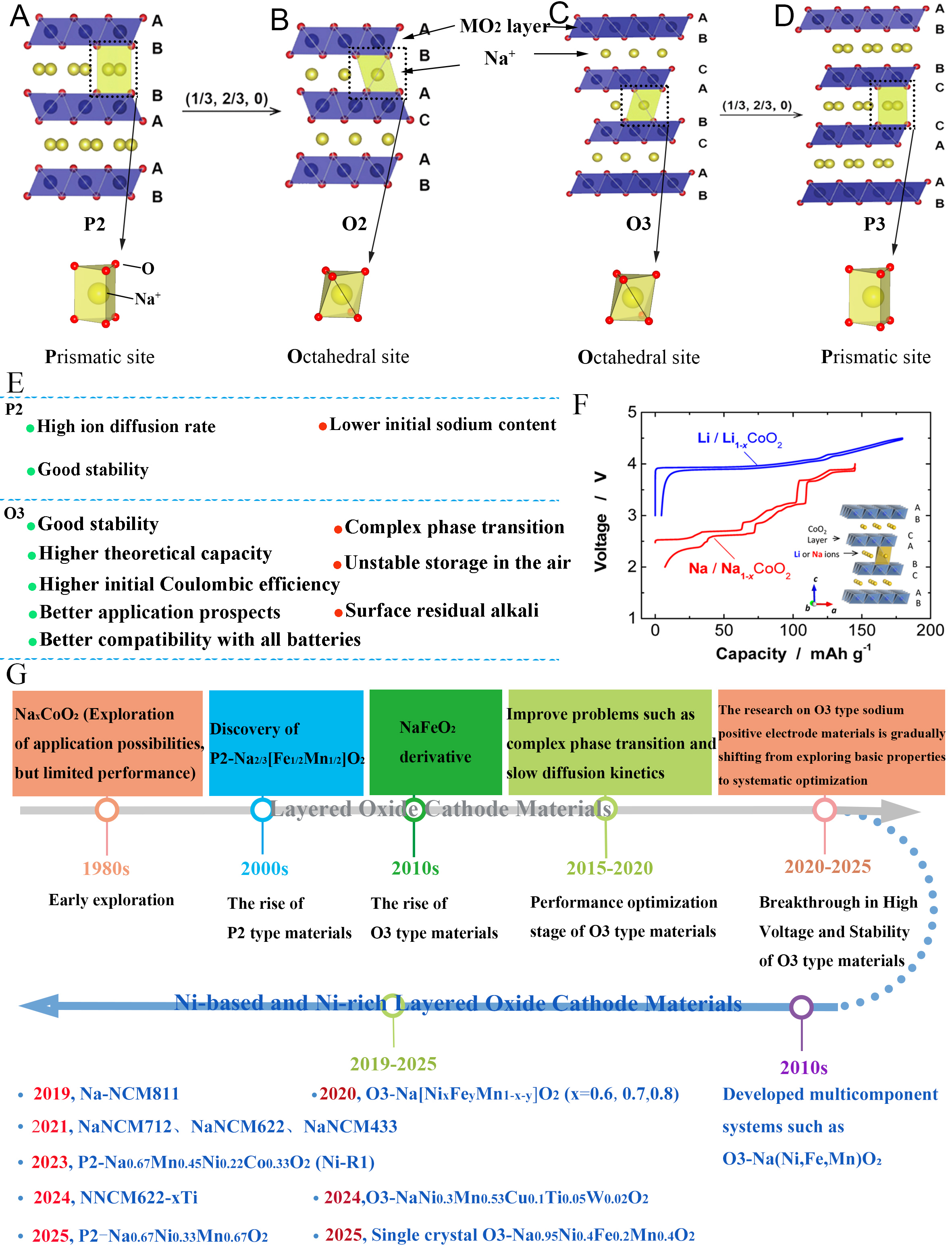
Figure 3. (A-D) Types of layered oxide cathode (LOC) and their crystal structures. (A-D) Reproduced with permission[89]. Copyright 2017, Wiley-VCH GmbH; (E) Advantages and disadvantages of P2 and O3 LOC; (F) Comparative analysis of charge-discharge profiles for
The formation of various types of layered oxides is tied to synthesis conditions, encompassing factors such as Na content, constituent elements, and the type and stoichiometric ratio relative to the calcination temperature. Typically, when the Na content falls within the range of 0.6 to 0.7, P2-NaxTMO2 is predominantly formed[90]. Conversely, higher Na concentrations (0.7 ≤ x ≤ 1) promote the emergence of the O3 phase. Unlike the O3 structure observed in lithium layered oxides, the P phase represents a distinctive crystal configuration unique to Na+ layered oxides[91,92]. This disparity stems from the larger radius of Na+, which facilitates its stable accommodation within prismatic sites within the alkali metal (AM) layers. Generally, the layered structure is composed of edge-sharing TMO6 octahedra interspersed with interlayer Na+. Prior studies have underscored that layered oxide materials with different structural configurations exhibit distinct advantages and disadvantages concerning their electrochemical performance[93]. In P-type structures, Na+ occupies two distinct prismatic sites: the Naf sites, which are coplanar with oxide octahedra, and the Nae sites, which share edges with adjacent oxide octahedra. Within the P2 phase structure, Na+ can undergo direct transfer between adjacent prismatic sites, thereby facilitating superior rate capability. In contrast, O3-type materials, although offering higher theoretical capacity owing to their inherently high initial Na content, suffer from inferior Na+ transport kinetics. This limitation arises because Na+ migration in O3-type materials necessitates traversing a pathway from octahedral sites through tetrahedral transition sites, which requires overcoming substantial diffusion energy barriers (as depicted in Figure 3E).
The extraction of Na+ from the interlayers during C&D prompts adjacent transition metal layers to glide, a movement intended to stabilize the system’s energy and consequently induce phase transitions. This reversible ion movement drives a cascade of structural changes in both P2 and O3 phases. Specifically, within the P2 structure, the sliding of TM layers upon Na+ removal allows for the creation of octahedral sites, which triggers the emergence of an O2 phase with an “ABAC” oxygen stacking pattern. Conversely, for the O3 phase, to maintain structural energy stability, layer sliding leads to a stacking sequence of “ABBCCA”, corresponding to the P3 phase. The occurrence of such phase transitions in layered oxides can result in crystal structure distortion and damage [Figure 3E]. While P2-type oxides offer lower Na+ migration barriers via direct prismatic-prismatic hops and are thus preferred for high-rate applications, O3-type oxides deliver higher volumetric capacity and better structural coherence at moderate rates. The choice is further modulated by dopants: Mg2+/Ti4+ stabilize P2 against high-voltage phase transitions, whereas Jahn-Teller-active Cu2+ favors O3 ordering; Li+/Mg2+ Na-site substitution narrows prismatic channels and can tilt the balance toward O3. P3 and O1 structures occupy intermediate positions - P3 balancing rate and stability, O1 maximizing stability at the expense of kinetics[92]. Notably, interlayer engineering with oversized alkali ions provides a powerful lever: a K-substituted layered oxide cathode demonstrates that K+ pillars expand the
Consequently, it is of paramount importance to implement modification strategies aimed at mitigating or suppressing detrimental phase transitions. In fact, the initial exploration of Na-based layered cathodes commenced in the 1980s, when Yabuuchi et al.’s research on materials such as NaxCoO2 unveiled their potential as Na+ battery cathodes, albeit with limited performance [Figure 3F][51]. Over the subsequent two to three decades, the rapid advancement of LIBs overshadowed SIBs research, causing it to stagnate. By the early 21st century, materials like P2-Na2/3[Fe1/2Mn1/2]O2 demonstrated remarkable electrochemical performance, rekindling interest in P2-type cathodes. The study of Na2/3[Ni1/3Mn2/3]O2 (~3.7 V, capacity: ~173 mAh g-1) marked a significant milestone in the development of high-performance P2-type materials. In the 2010s, O3-type materials, such as derivatives of NaFeO2[60], emerged as prominent candidates, boasting higher initial sodium content and capacity compared to their P2-type materials. However, a trade-off emerged between their structural stability, particularly during deep sodium extraction, and their kinetic performance. Over the following decade, research pivoted towards co-doping or substitution with various transition metals (including Ni, Mn, Fe, Cu, Ti, Mg, Zn, etc.), resulting in the creation of multicomponent systems like O3-Na[NiFeMn]O2, O3-Na[CuFeMn]O2, and O3-Na[NiCoMn]O2 [Figure 3G]. These advancements significantly enhanced reversible capacity, operating voltage, and cycling stability, and reduced costs[57]. Notably, in lithium-based layered Ni-rich oxides, an open layered framework can facilitate Li+ deintercalation. Due to the multi-electron reaction of Ni-rich ions, these materials can exhibit
CHALLENGES OF Na1-δNixMyO2 FOR SIBS
Although Na1-δNixMyO2 materials exhibit remarkable potential for practical applications, they face multiple key issues, including phase transitions, microcracks, oxygen release, interface side reactions, transition metal leaching, low sodium ion diffusion efficiency, and poor air stability. These factors are intricately intertwined and mutually influential, forming a vicious cycle through the conduction chain of “Na extraction → layer gliding/phase transition → strain/microcracking → electrolyte penetration → oxygen release/TM dissolution → cathode electrolyte interphase (CEI) thickening → impedance growth/capacity fading”. This cycle severely restricts their electrochemical performance and practical utility, thereby posing significant obstacles to the research and development of these materials.
Structural stability degradation
Under high-voltage operation, the continuous extraction of Na+ from the cathode lattice can trigger detrimental phase transitions, such as P2-O2 or O3-P3 transformations[58]. In P2-type layered oxides, Na+ ions occupy trigonal prismatic sites, while functioning as a pillar to reduce electrostatic repulsion across adjacent oxygen layers[52]. Upon Na+ extraction, this shielding effect weakens, resulting in an increase in O-O repulsion. This forces the TM layers to slide along specific crystallographic directions [e.g., (1/3, 2/3, 0)], altering the stacking sequence from “AB-BA-AB” (P2) to “AB-AC-AB” (O2)[98]. Similarly, in O3-type structures where Na+ are located in octahedral sites, their extraction modifies the interlayer spacing. When the Na+ extraction reaches a certain level (typically ~25%), the sliding energy barrier for the TMO2 layers decreases[99]. This causes the TMO2 layers to glide and transform the stacking order from O3 to P3[100]. Critically, these phase transitions are accompanied by significant volume changes. The resulting structural inhomogeneity generates localized stress concentrations, which in turn can induce further phase transitions. This creates a vicious cycle of “phase transition → stress concentration → accelerated phase transition”, continuously degrading the material’s structural integrity. After numerous electrochemical cycles, this leads to lattice distortion and micro-cracking. The long-term cycling stability is severely compromised by capacity/voltage degradation, inferior rate performance, and growing voltage hysteresis. To address this, Xie et al.[101] recently focused on the interplay between phase transitions in O3-Na1-δNi1/3Fe1/3Mn1/3O2 and the cut-off voltage. Specifically, their findings indicated that limiting the voltage to 4.0 V induces an O3-to-P3 phase transition upon charging, and the material reverts to the O3 phase during the subsequent discharge. However, as the voltage window is extended to 4.3 V, monoclinic phases O3’ and P3’ emerge, and the discharge process involves a reverse phase transition sequence of O3’-P3’-O3, ultimately reverting to the O3 phase. Additionally, Yuan et al.[102] documented how iron doping modifies the phase transition mechanism in NaNi0.4Fe0.2Mn0.4O2. Specifically, the pathway evolved from O3-P3-O’3 in the Fe-free NaNi0.5Mn0.5O2 to O3-P3-OP2 upon Fe incorporation. Such intricate structural rearrangements during phase transitions cause pronounced volume changes and intense internal stress. These mechanical failures drive TM cation migration and dissolution, foster micro-crack formation, and ultimately degrade the long-term cycling performance.
Micro-cracking and electrolyte penetration
The primary factors inducing microcrack formation are volume changes stemming from phase transitions and anisotropic lattice strain. Furthermore, interfacial reactions with ambient air, oxygen evolution, parasitic side reactions, and the diffusion of transition metal cations collectively compromise the structural integrity of the material during prolonged electrochemical cycling. This degradation accelerates the extension of microcracks from the surface into the bulk crystal[103]. Microcracks damage the internal structure of materials, resulting in poor contact between some active substances and electrolytes, preventing them from participating in electrochemical reactions and directly causing reversible capacity decay. In addition, microcracks provide more permeation channels for the electrolyte, thereby enlarging the interfacial zone between the cathode material and the electrolyte, which readily triggers parasitic reactions[104]. This not only consumes active substances but also generates harmful products such as gases or insulation layers, hindering ion transport and reducing safety. Cracks can also damage the crystal structure and sodium ion transport channels, leading to tortuous and obstructed ion diffusion paths, decreased charge and discharge rates, and degraded rate performance, making it difficult to meet high-power application requirements. Finally, the presence of microcracks weakens the mechanical strength of the material, making the cathode more prone to pulverization due to external forces during assembly or use. This not only damages the structural integrity but may also lead to poor contact between the electrode and the current collector, further exacerbating performance degradation. According to Ding et al.[105], O3-NaNi0.4Fe0.2Mn0.4O2 undergoes distinct microstructural evolution during cycling. While the inner structure remains layered, the surface suffers from severe lattice changes, leading to microcracks and Na+/TM cation mixing after 200 cycles. This surface degradation is linked to TM dissolution and results in the reconstruction of the surface into a rock-salt phase. The resulting particle pulverization increases the electrode-electrolyte contact area, triggering detrimental side reactions and capacity fading [Figure 4A-H]. In contrast, Gao et al.[106] demonstrated that a high-entropy design in NaxTMO2 cathodes can mitigate these problems. The strategy utilizes multicomponent TMO2 slabs to widen the interlayer distance, which stabilizes the crystal structure against Jahn-Teller effects and lattice variations. This stabilized skeleton not only improves Na+ diffusion and prevents intragranular cracking but also inhibits TM dissolution. Furthermore, the high-entropy configuration increases TM-O bond strength, preventing oxygen evolution and improving the material’s resistance to thermal runaway [Figure 4I-Q].
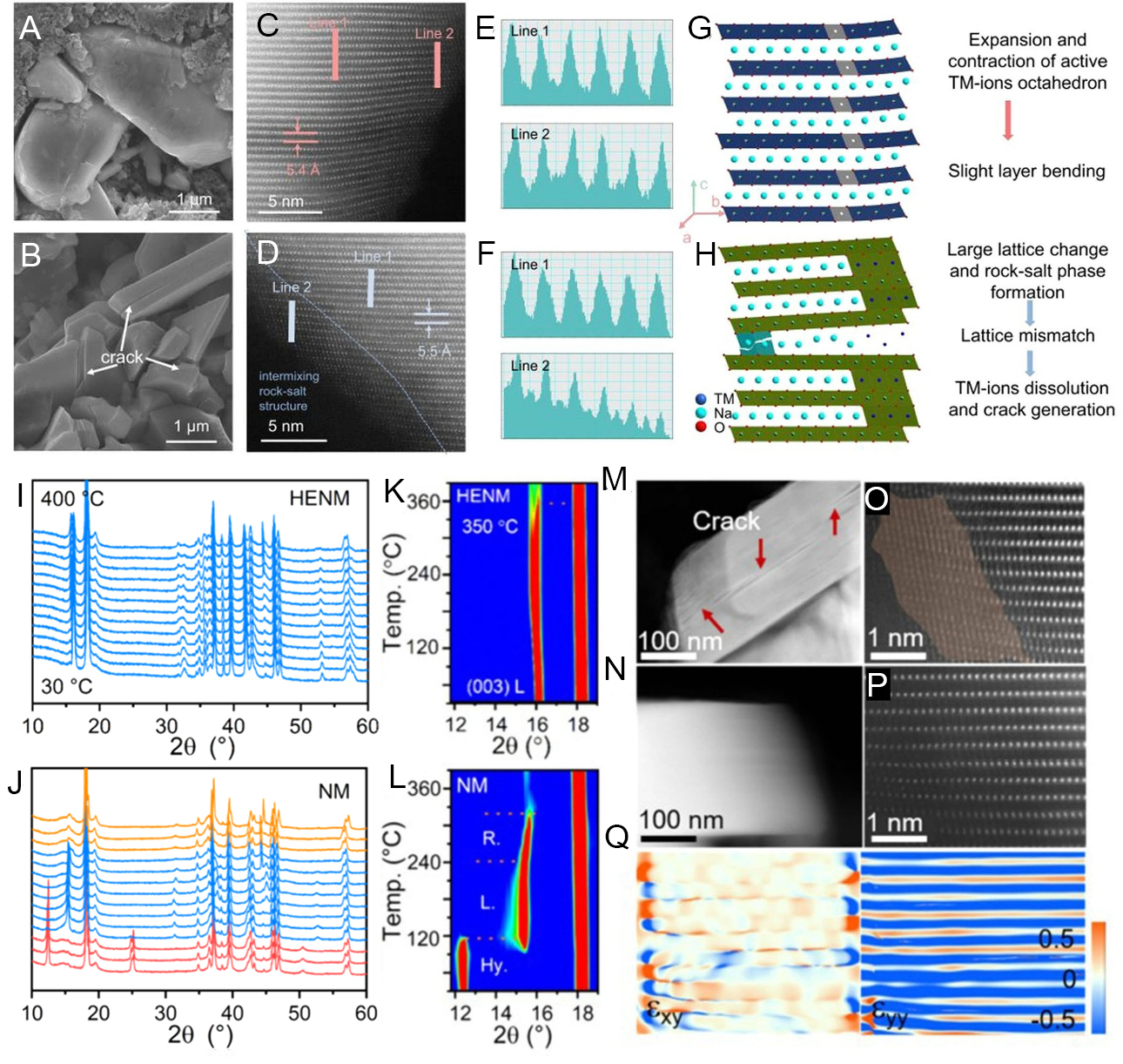
Figure 4. Morphological evolution and Na+ storage kinetics of HEO424 and NFM424 cathodes after 200 cycles. (A-D) SEM and HAADF-STEM images of the cycled electrodes. (E and F) Intensity profiles along the designated lines in (C) and (D). (G and H) Schematic diagrams illustrating the structural changes in HEO424 and NFM424. (A-H) Reproduced with permission[105]. Copyright 2022, American Chemical Society. HT-XRD patterns (30 °C to 400 °C) and contour maps of (I and K) charged HENM and (J and L) charged NM electrodes. Hy. = hydrated phase, L. = layered structure, and R. = rock salt phase. HAADF-STEM images of (M and O) NM and (N and P) HENM after 50 cycles at different magnifications. (Q) GPA analysis of the HENM cathode. (I-Q) Reproduced with permission[106]. Copyright 2025, American Chemical Society. SEM: Scanning electron microscope; HAADF-STEM: high-angle annular dark-field scanning transmission electron microscopy; HT-XRD: high-temperature X-ray diffraction; HENM: high-entropy NaxTMO2; NM: NaxTMO2; GPA: geometric phase analysis.
O2 release and interfacial side reactions
Under high voltage conditions, the oxygen element in the material is prone to being released in the form of O2, which is essentially related to the oxygen binding energy of the crystal structure, the oxygen activity of the electronic structure, and surface defects[107]. The detrimental effects of oxygen release are twofold. Firstly, it results in the loss of reactive oxygen species, which directly reduces the material’s capacity. Secondly, it triggers a chain reaction at the interface. The released O2 reacts with organic solvents and sodium salts within the electrolyte, resulting in electrolyte degradation and the evolution of gaseous byproducts and detrimental species. These byproducts deposit to create a compact and thick passivation layer on the electrode surface. Such a film not only elevates the internal resistance of the cell but also induces corrosion of the electrode’s surface structure. Notably, structural instability accelerates O2 release[108]. Phase transitions and crack formation expose more internal oxygen-active sites, facilitating further O2 release. Conversely, O2 release damages the structure. The passivation film hinders ion transport, resulting in uneven local stress distribution. This uneven stress, in turn, induces more phase transitions and cracks. As a result, a vicious cycle is formed: “structural damage → oxygen release → interface deterioration → exacerbating structural damage”. The long-term stability and performance of the battery are detrimentally affected by this cycle. In a systematic study by Liu et al.[109], gas evolution in layered oxide cathodes was examined across various compositions, voltage limits, dopants, and morphologies. Notably, NaNiO2 demonstrates superior gas emission compared to LiNiO2 (LNO), even at low states of charge. This behavior stems from the inductive effect of the ionic Na-O bond, which enhances Ni-O covalency. Screening of dopants (Co, Mn, Al, Mg) revealed that Mn and Mg are superior in curbing gas release via enhanced metal-oxygen bonding. While NaNi1/3Fe1/3Mn1/3O2 (NFM) cathodes synthesized by co-precipitation (CP-NFM) evolve more gas than those made by solid-state routes, the hierarchical secondary structure of CP-NFM mitigates this through varied reactivity of primary particles. Among Li, Ti, Mg, and Cu dopants for NFM, Li is the most potent, achieving gas levels on par with LNO. Advanced characterization shows that solvent decomposition mainly forms an organic-rich CEI instead of soluble species, while NaPF6 salt worsens interfacial reactions by forming Na2O. Collectively, these findings provide a roadmap for designing safer SIBs.
Transition metal dissolution
TM dissolution is primarily driven by the formation of soluble low-valence ions. The high solubility of low-valence oxides/fluorides in the electrolyte triggers the release of TM ions from the positive electrode. This process is further aggravated by the Jahn-Teller effect in ions like Mn3+, whose unique electronic structure (strong electron delocalization, weak ionicity, and strong Lewis basicity) promotes reactions with acidic electrolytes. The consequences of this dissolution are twofold: first, it causes a depletion of cathode active material, directly lowering battery capacity[110]. Second, dissolved ions migrate to the anode, forming harmful precipitates (NiO, MnCO3) that damage the solid electrolyte interphase (SEI) film and increase internal resistance[111]. Ultimately, excessive TM leaching poses severe safety risks, potentially causing internal shorts and thermal runaway.
Slow ion diffusion
Because of the considerable radius of Na+ (~1.02 Å), its diffusion in layered lattices is hindered by structural and electrostatic factors, yielding a diffusion coefficient inferior to that of Li+ in lithium-ion systems[112-114]. For instance, in standard layered oxide cathodes, the Na+ diffusion coefficient usually lies between 10-12 and 10-10 cm2 s-1, which restricts the battery’s rate performance[115]. Transport limitations are closely linked to other challenges: structural instability (phase transitions, cracks) can disrupt the “continuous transport channel” of ions and electrons; the interface passivation film caused by O2 release will directly block the surface transport path. Restricted transport can also lead to local overcharging/overdischarging inside the material (such as incomplete sodium ion deintercalation inside the particles and surface side reactions), causing more severe stress heterogeneity and phase transition, forming a vicious cycle of “poor transport → structural damage → worse transport”. Therefore, employing a simple yet effective strategy to regulate the transport channels of Na+ is of great significance for accelerating the transport rate of Na+ and improving its kinetic characteristics. Liu et al.[116] constructed a high-rate O3-type cathode by modulating the migration pathways of Na+. By introducing highly electronegative fluoride ions into the oxygen sites, they altered the local chemical environment of the transition metal layers, thereby strengthening the bonding between transition metals and oxygen. This, in turn, expanded the transport channels for Na+, ensuring rapid reaction kinetics during the transport process. The authors verified via DFT computations that F- doping effectively decreases the energy barrier associated with Na+ migration. As a result, the presence of F- promotes faster Na+ diffusion, which significantly boosts the battery’s ability to handle high currents. However, a single doping or coating strategy struggles to simultaneously enhance kinetic performance and structural stability. To address this challenge, Li et al.[117] fabricated a copper-rich spinel@O3-type composite oxide cathode with a surface-modified structure (Na0.9Mn0.5Ni0.5Cu0.1O2+x). The surface-bound copper-rich spinel phase acts as a protective barrier for the active material: it reduces side reactions and prevents the accumulation of by-products at the electrolyte/transition metal interface, consequently boosting the material’s chemical stability. Meanwhile, its exceptional ionic and electronic conductivity significantly enhances the cathode’s capacitive energy storage capacity, enabling rapid Na+ intercalation/deintercalation within the framework and demonstrating outstanding rate discharge performance and high-rate capacity retention. Even under extreme conditions, the surface spinel structure effectively functions as a protective layer: it blocks the interlayer insertion of water molecules, decelerates the de-sodiation process at the cathode surface, and suppresses the emergence of Na-deficient phases such as O1 and P3. Beyond surface protection, the spinel phase is crucial for managing bulk structural changes; it buffers the significant volume expansion during the O-P phase transition, mitigating internal cracking and preserving the continuity of Na+ transport channels. These synergistic effects collectively guarantee the material’s structural integrity and performance durability.
Poor air stability
Layered oxides with high nickel content are highly susceptible to chemical degradation upon exposure to atmospheric moisture and CO2 (such as surface hydroxylation and carbonate formation), leading to crystal structure damage (such as increased interlayer spacing) and electrochemical performance degradation (such as decreased capacity and increased polarization)[63]. The impact of poor air stability permeates the entire process of preparation, storage, and use: the additional protective measures required for poor air stability (such as encapsulation and inert atmosphere) will also increase production costs, forming a dual burden with the “cost and resource” issue. Even brief contact with moist air initiates a degradation cascade in layered oxide cathodes. Surface-migrated Na+ reacts with atmospheric H2O/CO2, producing alkaline salts (e.g., NaOH, NaHCO3, Na2CO3)[63]. The resulting active Na loss, combined with TM ion oxidation, destabilizes the lattice, causing irreversible TMO2 layer slippage and severe capacity decay. This instability is particularly acute in Ni-rich NaNi0.7Mn0.15Co0.15O2, which undergoes drastic morphological alterations in air[118]. Spectroscopic evidence confirms the formation of surface species like NaOH, Na2CO3, and Na2CO3·H2O on these materials. Surface reaction products act as insulating barriers, severely degrading the performance of NaNi0.7Mn0.15Co0.15O2. Ji et al.[119] reported that Na+/H+ exchange causes severe lattice expansion along the
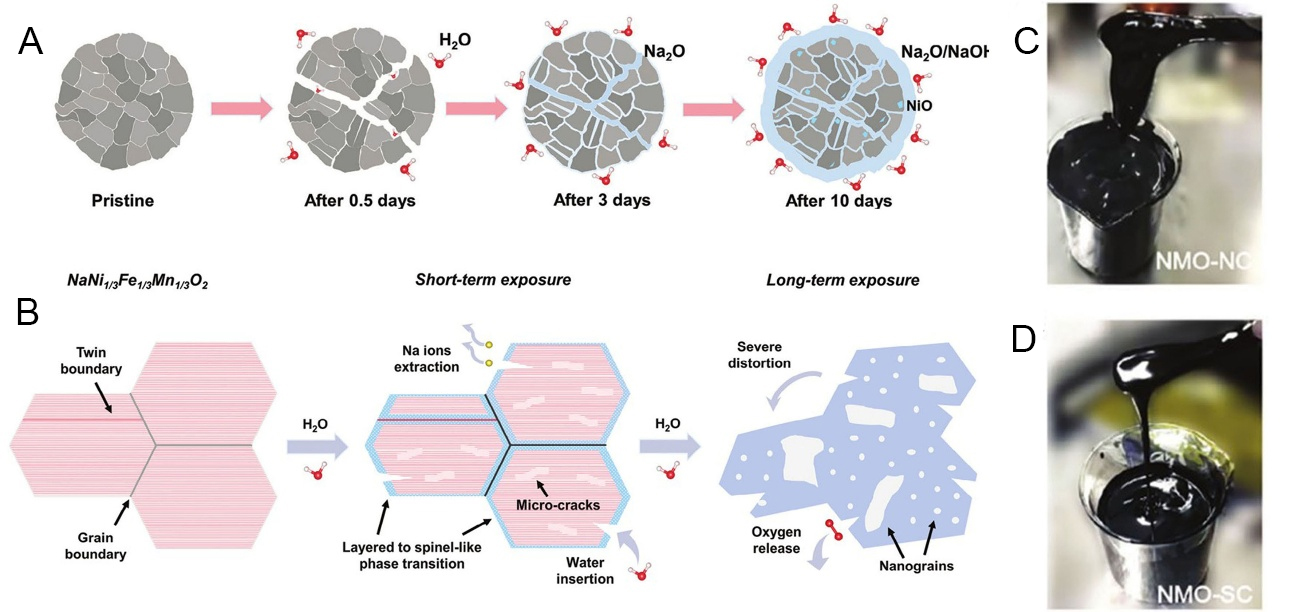
Figure 5. (A) Visualization of water vapor corrosion on NFM cathodes. (B) Kinetic evolution of short-/long-term reactions between layered oxide cathodes and water vapor. (A and B) Reproduced with permission[119]. Copyright 2024, Wiley-VCH GmbH; Visuals of the slurry obtained through the stirring of Super P carbon, PVDF binder, and NMP solvent, incorporating (C) NMO-NC or (D) NMO-SC. Reproduced with permission[122]. Copyright 2024, Wiley-VCH GmbH. NFM: NaNi1/3Fe1/3Mn1/3O2; PVDF: polyvinylidene fluoride; NMP: N-methyl-2-pyrrolidone; NMO-NC: naturally cooled slowly cooled O-type Na0.9Ni0.25Mn0.4Fe0.2Mg0.1Ti0.05O2; NMO-SC: slowly cooled O3-type Na0.9Ni0.25Mn0.4Fe0.2Mg0.1Ti0.05O2.
From a manufacturability perspective, these degradation mechanisms directly dictate dry-room requirements, electrode slurry stability, storage, transport, and cost. First, the high alkalinity (pH > 12) of the electrode slurry decomposes the Polyvinylidene fluoride (PVDF) binder during mixing, causing gelation in N-Methyl-2-pyrrolidone (NMP) and irreversible performance loss [Figure 5C and D], necessitating strict dry-room control throughout slurry preparation and subsequent processing[122]. Second, material exposure to moisture and CO2 during ambient storage and transport accelerates Na+ loss and Na2CO3 fiber growth, requiring inert-atmosphere encapsulation or specialized moisture-proof packaging, which directly increases logistics and warehousing costs. Furthermore, the synthesis stage likewise demands a controlled dry environment to prevent precursor degradation. All these additional protective measures - from raw material storage, dry-room operations, to finished product encapsulation - significantly increase both capital and operational costs, creating a compounding effect with the inherent “cost and resource” challenges of sodium-ion batteries, and becoming a critical manufacturability bottleneck that limits the scalable production of Ni-rich layered oxide cathodes.
MODIFICATION STRATEGIES
Considerable research endeavors have been directed towards enhancing the performance of Na1-δNixMyO2 cathodes. The modification strategies employed can be systematically classified into the following categories: (1) Lattice doping with alien ions for structural stabilization; (2) Surface passivation using a barrier layer to inhibit electrolyte erosion; (3) Strain-relief structural design to enhance mechanical and chemical stability; (4) High-entropy doping enhances the configurational entropy of the material, thereby stabilizing its crystal structure, effectively suppressing phase transitions, and broadening the pathways for ion transport; (5) The enhanced performance of P2/O3 biphasic layered oxides stems from the synergy of their distinct phases; (6) Electrolyte modification increases interface stability and kinetic transfer efficiency; (7) By strengthening M-O bonds through element doping, isolating the electrolyte via surface coating, and reducing defect-active sites through structural regulation, lattice oxygen release under high voltage can be simultaneously suppressed from both bulk bond energy and surface interface dimensions, thereby improving cycling stability and safety. This section offers a comprehensive summary of the modification strategies applied to Na1-δNixMyO2 cathodes over recent years. It provides an in-depth discussion of their corresponding mechanisms of action, as well as the advantages, disadvantages, and existing issues associated with enhancing the cycling stability and safety of these cathodes.
Heteroatom doping
Given that most phase transitions occur within the high-voltage range, constraining the upper cut-off voltage can effectively suppress these phase transitions. However, this approach sacrifices the capacity of the cathode material, thereby reducing overall performance. Another effective strategy is element doping, which can modulate complex phase transitions in the cathodes and eliminate Na+/vacancy ordered structures, thereby improving electrochemical performance, such as cycle stability and rate capability.
To improve performance, aliovalent dopants are introduced in trace amounts into the original Na1-δNixMyO2 cathodes[123,124]. Once embedded in the cathode lattice, these elements modify the material’s physical and chemical nature, thereby boosting its electrochemical behavior[125]. The host structure possesses three distinct substitution sites: TM, AM, and oxygen (O). To combat layered structural degradation, cationic and anionic substitutions are widely adopted. This broad spectrum of dopants and sites offers substantial versatility for material engineering. The review initiates with single-site doping within the bulk phase and progresses to multi-element co-doping. Analysis underscores the benefits of these strategies, such as lowering energy barriers, strengthening M-F bonds, and exploiting pillar/pinning effects. For systematic presentation, ion doping approaches are categorized into three primary groups: cationic, anionic, and multi-ion doping.
Cation doping
The classification of cation doping encompasses TM ions, AM ions, alkaline earth metal ions, and other cationic doping modalities, which typically function by substituting ions at TM or Na lattice sites[126-131]. Among them, metal cation doping can be classified into two categories based on the electrochemical activity of the doping elements: electrochemically active elements and electrochemically inactive elements. TM cation doping stands out as the most extensively investigated system, primarily due to its relative ease of incorporation into TM sites within Na1-δNixMyO2 cathodes and its potential to enhance performance in certain scenarios. It is crucial to emphasize that, despite the extensive body of research documenting advancements in LIBs, the comprehensive investigation of doping additional metals into Na1-δNixMyO2 cathodes for SIBs remains significantly underexplored. Incorporating inactive elements into Na1-δNixMyO2 cathodes is an effective approach to enhance capacity and cycling stability by suppressing phase transitions. While further investigation is needed, Zr4+, Ti4+, and Mg2+ have been identified as highly promising dopants[132-134]. These inactive elements not only inhibit Na/vacancy ordering and harmful phase transitions but also significantly improve Na+ diffusion kinetics. For example, a Zr-doped O3-type cathode material, namely NaNi1/3Fe1/3Mn1/3O2, was successfully fabricated by Jiang et al.[132]. Their research demonstrated that the incorporation of Zr4+ could induce microscopic adjustments to the crystal structure. The robust Zr-O bond effectively contracted the octahedral configuration within the transition metal layer (TMO6) to inhibit TM layer slipping and preserve the lattice framework, thereby preventing TM layer slippage and stabilizing the overall crystal structure, which finally boosted cyclic stability [Figure 6A-E]. Furthermore, the introduction of Zr4+ also expanded the interlayer spacing of Na+ diffusion, facilitating smoother Na+ insertion and extraction during charge and discharge, and consequently improving the material’s rate
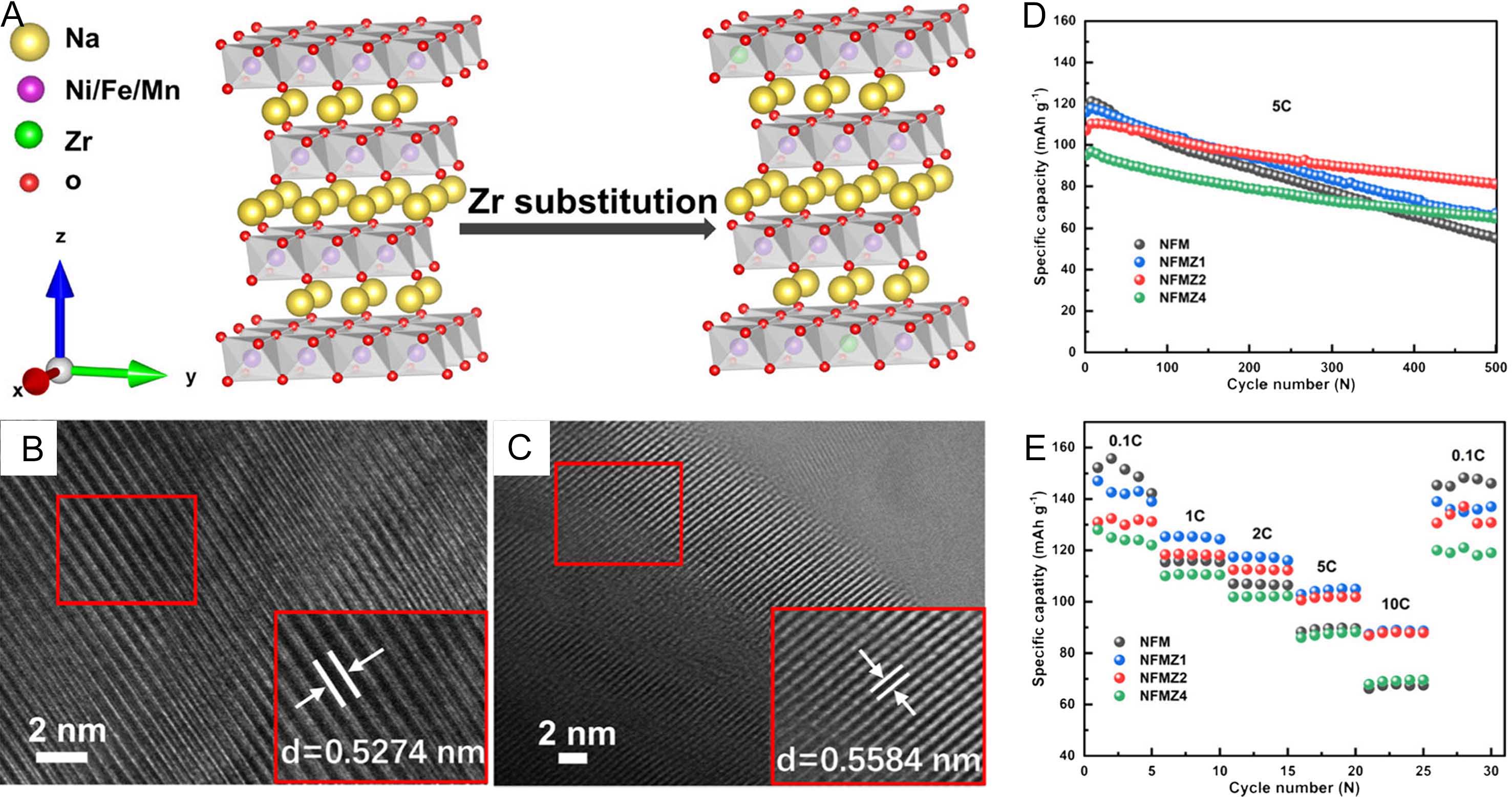
Figure 6. (A) The crystal structure types of NaNi1/3Fe1/3Mn1/3O2 and NaNi1/3Fe1/3Mn1/3-xZrxO2 (x = 0, 0.01, 0.02, 0.04). High-resolution transmission electron microscopy images of (B) NFM and (C) NFMZ2. (D) Cycling performance of all electrodes at 5 C. (E) The rate capability of all electrodes. (A-E) Reproduced with permission[132]. Copyright 2024, Wiley. NFM: NaNi1/3Fe1/3Mn1/3O2.
Anionic doping
In contrast to extensive studies on cation doping, anionic doping in Na1-δNixMyO2 cathodes remains relatively underexplored, despite its potential to significantly enhance structural integrity and electrochemical metrics[10]. Anionic doping represents a promising strategy for stabilizing the structure of Na1-δNixMyO2 cathodes by substituting O2- with heteroanionic dopants, consequently leading to intensified bonding interactions with TM cations. F- doping has been widely studied for its beneficial effects. Zhang et al.[136] showed that NaNi1/3Fe1/3Mn1/3O1.99F0.01 maintains a high reversible capacity of 110.0 mAh g-1 over 70 cycles at 150.0 mA g-1. This enhancement stems from F-’s ability to modulate oxygen binding energy and reduce Mn3+ content, effectively suppressing Jahn-Teller distortion and stabilizing the O3 phase. Concurrently, F- doping accelerates Na+ diffusion, leading to improved rate capability.
Multi-ion doping
While single-ion doping demonstrates partial efficacy in suppressing phase transitions and enhancing performance, its application remains constrained by significant limitations. Specifically, doping with electrochemically inert ions often leads to diminished reversible capacity, whereas incorporating active ions may induce a decline in the voltage plateau. Moreover, single doping strategies provide only marginal improvements in structural stability. In contrast, multi-ion doping approaches enable the integration of diverse ionic advantages, facilitating comprehensive material optimization through synergistic interactions. For example, Yu et al.[137] synthesized the Fe3+/Ti4+ co-doping O3-Na0.95Ni0.40Fe0.15Mn0.3Ti0.15O2 (NFMT) cathode via a high-temperature solid-state method. Anchored by electrochemically inactive Ti4+, which underpins structural integrity and cycling retention, the cathode design further utilizes high-redox-potential Fe3+ to boost oxidation resistance and capacity through charge compensation mechanisms. The synergistic interaction between Fe/Ti co-doping effectively elevates the redox potential, thereby optimizing both electrochemical kinetics and structural robustness. Additionally, Fe/Ti co-doping significantly stabilizes the cathode by suppressing complex phase changes. The reversible O3 → P3 → OP2 transition occurs with negligible volume change, guaranteeing structural integrity over prolonged cycles [Figure 7A-F]. However, current multi-cation doping strategies predominantly focus on substituting TM sites to suppress irreversible phase transitions. Emerging studies indicate that rational substitution at Na sites plays a critical role in optimizing structural integrity and Na+ diffusion kinetics. Therefore, developing a synergistic dual-site (Na/TM) substitution strategy represents a promising approach to advancing the performance
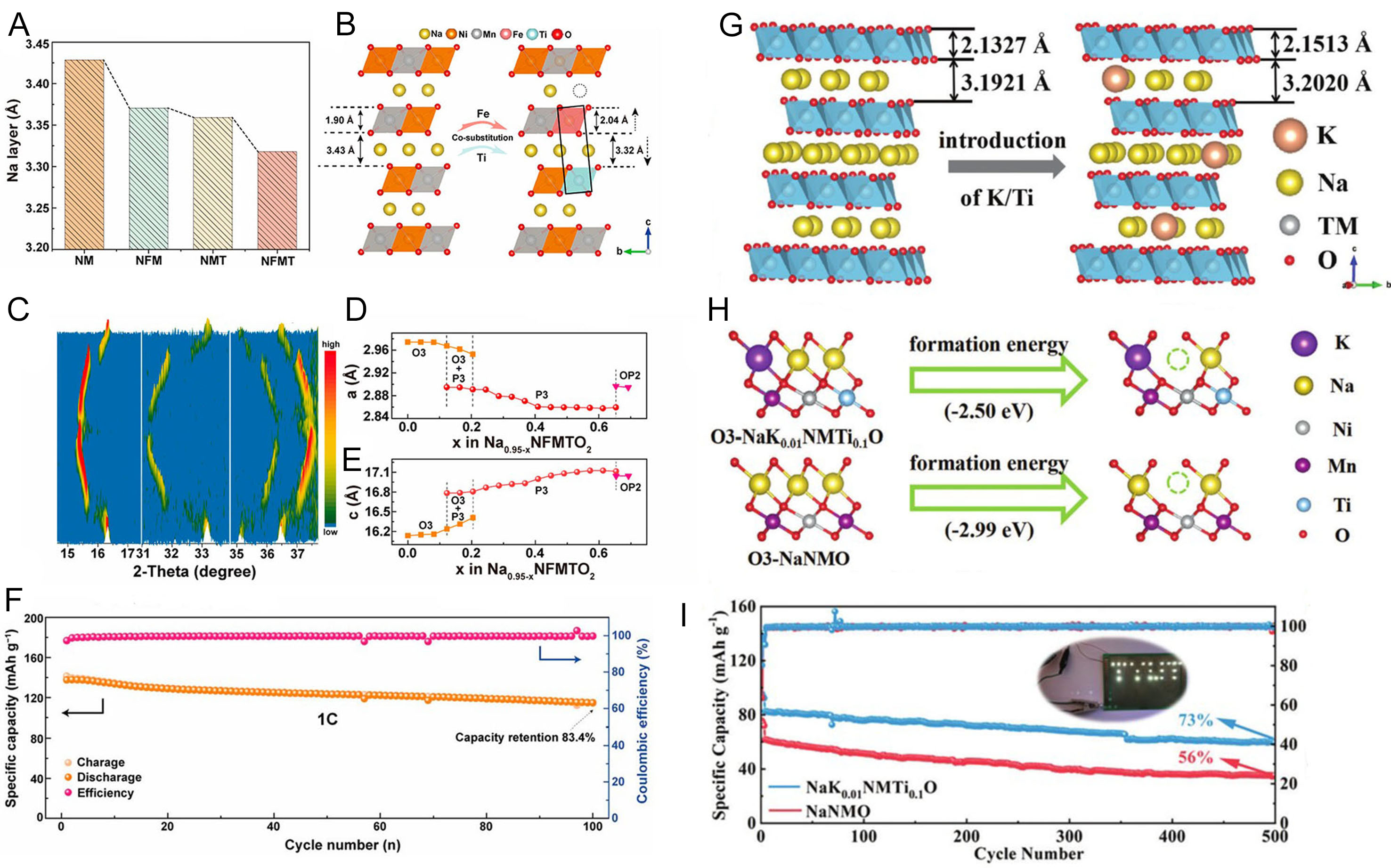
Figure 7. (A) Na-layer interplanar spacing evolution in substituted samples. (B) Structural modification of NM host via Fe/Ti co-doping. (C) Contour plots of principal diffraction peaks. (D and E) Lattice parameter variation during charging. (F) Cycling stability of NFMT/HC full cell. (A-F) Reproduced with permission[137]. Copyright 2023, American Chemical Society. (G) Crystal structures of NaNMO and NaK0.01NMTi0.1O. (H) Na+ vacancy formation energies and 500-cycle performance of full cells at 1 C within 1.5-4.0 V. (I) The full cell assembled with a hard carbon anode showcases robust long-term cycling and high-capacity characteristics. (G-I) Reproduced with permission[139]. Copyright 2023, Wiley-VCH GmbH. NM: NaxTMO2; NFMT: O3-Na0.95Ni0.40Fe0.15Mn0.3Ti0.15O2; HC: hard carbon.
In contemporary research endeavors, numerous attempts have been made to optimize the outcomes of co-doping, exemplified by the co-doped system[141], etc. These exploratory efforts have, to a certain degree, enhanced the performance of relevant materials. However, the underlying mechanisms responsible for these performance improvements remain largely uncharted territory and warrant in-depth investigation. In addition to the aforementioned double-doping approach, doping strategies involving an even broader spectrum of elements have also garnered extensive research attention. Li et al.[142] adopted a synergistic multi-element doping strategy to fabricate the O3-NaNi0.40Mn0.40Ti0.13Fe0.06Al0.01O2, systematically investigating the mechanism by which multi-metal substitution suppresses complex phase transitions. The disordered doping of Ti4+, Fe3+, and Al3+ modulates the electronic structure. By activating Ni/Fe redox above 2.5 V and suppressing Mn Jahn-Teller distortion below 2.5 V, structural integrity is significantly enhanced. Ex-situ XRD reveals that the P3 phase prevents P3” phase formation, alleviating structural collapse, while DFT calculations show a lowered Na+ diffusion barrier via optimized electronic configuration and strengthened TM-O bonds. Additionally, Zhang et al.[143] demonstrated that co-doping with Li+, Mg2+, Ca2+, and Sb5+ in O3-Na0.8Ni0.4Fe0.2Mn0.4O2 effectively suppresses detrimental phase transitions and anisotropic strain at 4.1 V. Sb5+ doping combined with Li-O/Mg-O vacancies stabilized oxygen redox, allowing the material to retain
Surface coating
Surface coating has established itself as a critical technique to boost the performance of sodium-ion layered cathodes. By establishing physical isolation, ensuring structural stability, bolstering air stability, and optimizing ion transport pathways, it synergistically resolves a range of issues, including side reactions, structural degradation, and sluggish ion transport that cathode materials encounter during cycling. This, in turn, lays a solid foundation for achieving high energy density, extended cycle life, and outstanding rate performance in sodium-ion batteries[144]. An optimal coating should uniformly and thoroughly encapsulate cathode particles, effectively minimizing electrolyte decomposition, gas evolution, and transition metal dissolution, thereby significantly enhancing the cycle life of the battery. A critical observation is that the optimal coating thickness is generally below 10 nm[145]. Excessively thick coatings can hinder Na+ diffusion and elevate interfacial resistance, leading to a deterioration in rate capability. Conversely, coatings that are too thin may not provide adequate protection to the cathode surface, resulting in electrolyte degradation and accelerated capacity loss due to transition metal dissolution. Recent advancements have explored diverse coating materials to optimize the performance of Na1-δNixMyO2 cathodes, including metal oxides, polyanionic composites, and organic polymers. This section summarizes the effects of these coating types on the electrochemical properties of Na1-δNixMyO2 cathodes. The surface coating type can be selected or combined according to specific needs to address the issues of sodium ion layered positive electrode materials, thereby improving the overall performance and cycle life of sodium ion batteries.
Metal oxides and fluorides coatings
Metal oxides are widely employed to modify Na1-δNixMyO2 cathodes due to their superior conductivity and structural stability[86]. For instance, Hwang et al.[146] utilized dry ball-milling to coat O3-type NaNi0.6Co0.2Mn0.2O2 with ≈15 nm Al2O3 nanoparticles. This uniform encapsulation suppressed interfacial side reactions and facilitated Na+ transport, delivering a high capacity of 151 mAh g-1 and enhanced cycling stability. High Resolution Transmission Electron Microscope (HRTEM)/Selected Area Electron Diffraction (SAED) analysis confirms that the ~20 nm Al2O3 coating remains intact after cycling, preserving the [100] zone structure with only minor (003) fringe discontinuities. No severe material loss is observed, verifying the coating’s effectiveness against HF attack. Similar improvements have been reported with coatings like NaPO3, MgO, and TiO2[146-151]. However, surface engineering for SIBs lags behind LIBs; many LIB protocols relying on organic solvents or high-temperature calcination are incompatible with SIBs due to moisture sensitivity and thermal instability. To address this, Sun et al.[152] developed an AlF3-coated, composition-gradient NaNi0.65Co0.08Mn0.27O2 cathode via dry ball-milling. This design achieved 168 mAh g-1 (90% retention over 50 cycles in half-cells) and 132 mAh g-1 (90% retention over 200 cycles in full-cells) at
Polyanionic composite coatings
Conventional multi-step heat treatments are typically required to ensure strong adhesion between the coating layer and matrix, while the limited functionality of single-component coatings may restrict further optimization of Na+ transport kinetics. Given the inherent air instability of the Na1-δNixMyO2 cathode, conventional secondary heat treatment coating methods often induce irreversible capacity loss, compromising the efficacy of surface modification. Achieving effective material modification, particularly via coating strategies, while preserving electrochemical performance remains critical.
To address this, in-situ one-step coating methods are imperative to minimize degradation pathways. Furthermore, the judicious selection of coating materials is instrumental in alleviating the performance degradation inherent to conventional two-step synthesis routes. To circumvent the air-sensitivity of NFM424, Wang et al.[153] introduced a one-step approach to in-situ form a plastic crystal Na3-3xAlxPO4 layer. High-temperature synthesis enabled the simultaneous bulk doping of Al [Figure 8A]. The 1 mol %NAP@NFM424 cathode delivers superior rate capability (~88% retention at 5 C vs. 76.2% for bare NFM424) and improved cycling stability (80% vs. 65% retention over 200 cycles) in half-cell tests (2.0-4.0 V) [Figure 8B and C]. High-resolution Scanning Transmission Electron Microscopy (STEM) images clearly reveal the fine interlayer interface structure between the sample matrix and the surface. Through local lattice fringe analysis, the bulk retains the original layered structure, corresponding to the (003) crystal plane of NFM424 with an interplanar spacing of 5.325 Å. A Na3-3xAlxPO4 phase structure with a thickness of about
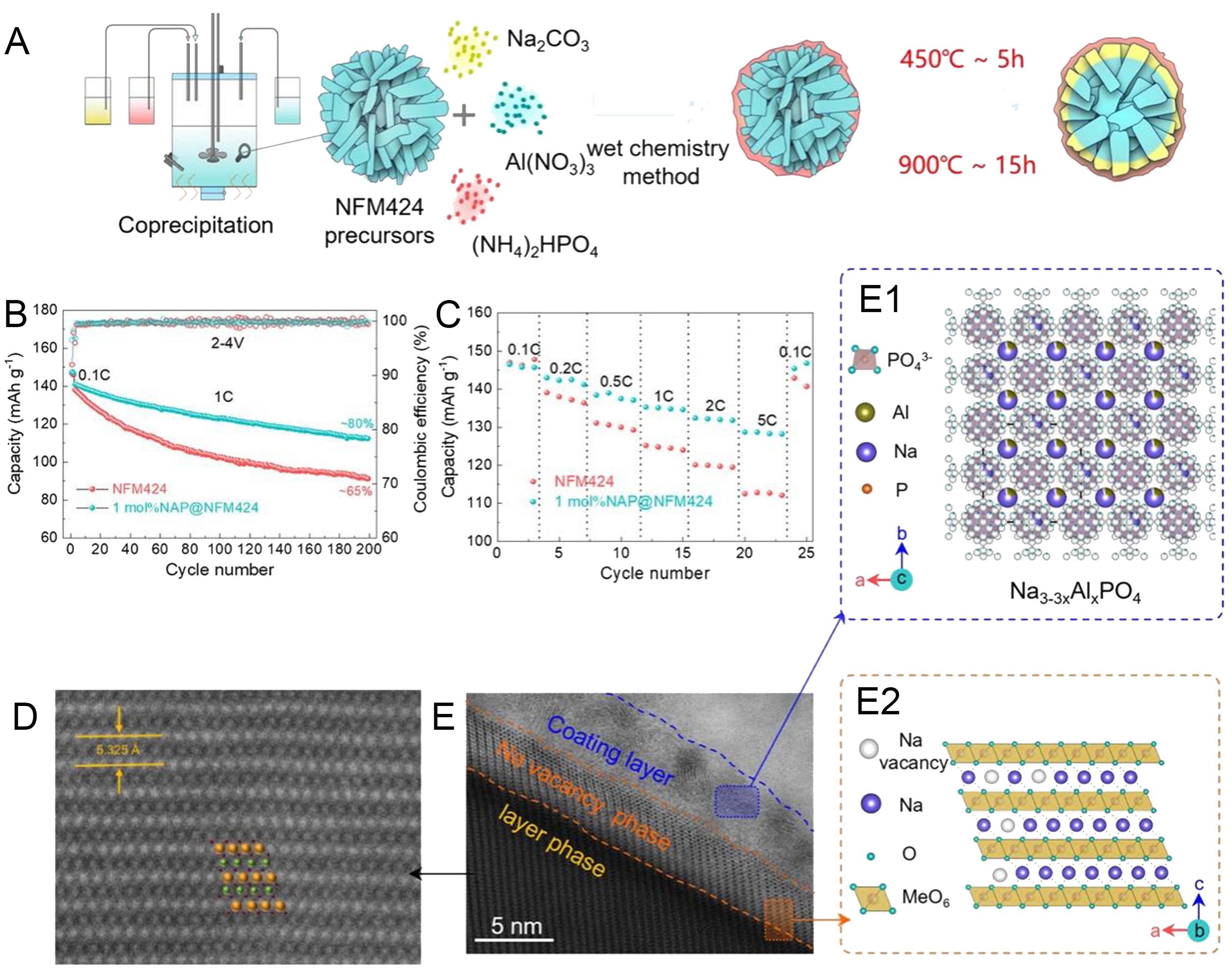
Figure 8. (A) Schematic of the coating/doping modification on NFM424. (B and C) Cycling and rate performance of NFM424 and 1 mol% NAP@NFM424 (2.0-4.0 V). (D) HAADF-STEM micrograph of the layered phase. (E) STEM image showing the cross-section of a modified Na3-3xAlxPO4 particle. (E1) Schematic of the Na3-3xAlxPO4 crystal structure. (E2) Interfacial structure diagram. (A-E) Reproduced with permission[153]. Copyright 2023, American Chemical Society. HAADF-STEM: High-angle annular dark-field scanning transmission electron microscopy; STEM: scanning transmission electron microscopy; NAP: Na3-3xAlxPO4.
Co-modification through doping and coating
Simple element doping can delay phase transition and enhance structural stability, but there are limitations in the modification effect and an inability to balance bulk and interfacial stability. To bolster the robustness of layered oxide cathodes, it is imperative to establish a unified modification framework
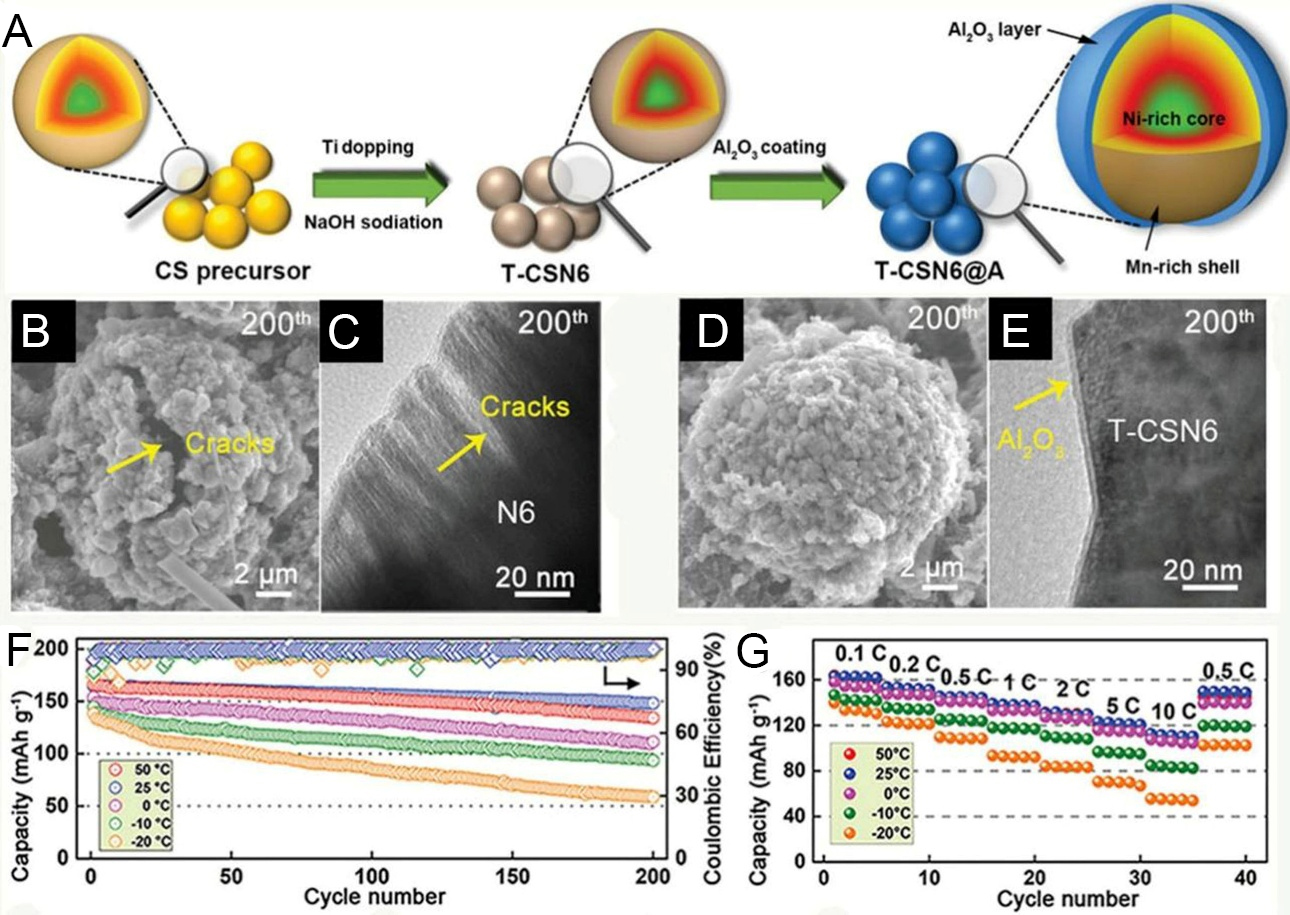
Figure 9. (A) Schematic illustration for the synthetic procedure. Typical FESEM images, TEM images, and corresponding XRD patterns of N6 (B and C), and T-CSN6@A (D and E) harvested from matching post-cycled electrodes after 200th cycles, respectively. (F) Cycling performance (0.5 C) of T-CSN6@A. (G) rate behaviors at different temperatures of T-CSN6@A. This figure is reproduced with permission from Ref.[154]. Copyright 2023, Wiley-VCH GmbH. FESEM: Field emission scanning electron microscope; TEM: transmission electron microscope; XRD: X-ray diffraction.
High entropy and nickel-based layered oxide cathodes
In 2015, Rost et al. introduced high-entropy oxides (HEOs), a class of materials defined by unique compositions that revolutionized research directions in materials science[156]. Since then, it has attracted widespread attention and in-depth research from academia and industry on this type of material. This type of material typically involves mixing five or more elements in equal or nearly equal proportions to form a material system with higher configurational entropy. The significant increase in configurational entropy endows high-entropy oxides with unique physical and chemical properties, making them highly applicable in the field of layered cathodes. Leveraging the synergy of multiple elements, the material harnesses both entropy structures and doping effects to concurrently enhance electrochemical activity, structural stability, and average voltage. Notably, the optimized anion redox mechanism elevates both capacity and voltage, while the air tolerance of sodium-ion layered cathodes is markedly improved [Figure 10][157-160]. For example, a rational high-entropy strategy was adopted by Liu et al.[161] to engineer a cobalt-free layered oxide cathode with the composition Na0.9Ni0.3Fe0.2Mn0.3Ti0.1Cu0.05Sn0.05O2. By introducing multiple metal ions, they achieved a significant increase in entropy (∆S = 1.57 R), thermodynamically favoring single solid-solution phase formation. The results revealed that the Na-O bond length in the HEO (2.31 Å) was shorter than that in NFM (2.38 Å), indicating stronger bond strength, which contributes to enhanced air stability. Additionally, the oxygen charge density distribution in the HEO was uneven and notably reduced, suggesting that high-entropy doping suppressed the covalency of TM-O bonds and stabilized the interlayer oxygen charge. This high-entropy state resulted in a highly disordered arrangement of cations within the TM layers, triggering a series of synergistic effects, known as the “cocktail effect”, which significantly improved the performance of the cathode material.
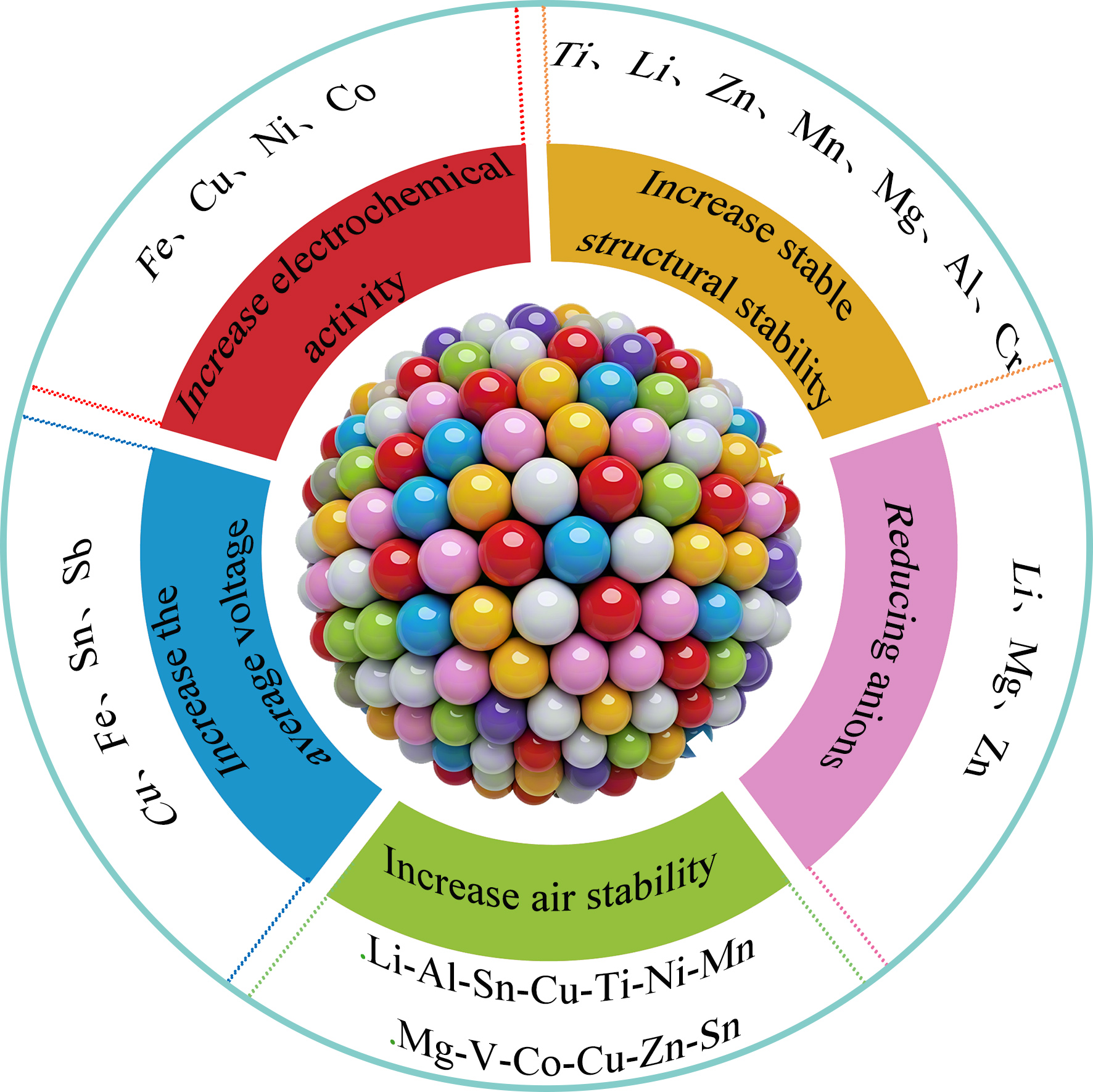
Figure 10. Classification of the functions of high-entropy modified Ni-based cathode for SIBs. SIBs: Sodium-ion batteries.
Qiu et al.[158] substantially enhanced the high-voltage performance and air stability of the O3-NaxTMO2 cathode by modulating the interlayer oxygen charge. They also successfully fabricated an O3-Na0.85Li0.1Al0.02Sn0.08Cu0.1Ti0.1Ni0.3Mn0.3O2 type HEO, enabling the stable operation of high-loading SIBs [Figure 11A]. In addition, ion-doping with larger radii can also effectively increase interlayer spacing and improve ion diffusion efficiency. For example, Shi et al.[125] proposed a Ca/Sn dual site doping strategy and prepared Na0.98Ca0.01Ni0.33Fe0.33Mn0.315Sn0.015O2 (CS-NFM) to improve the electrochemical performance of O3-type layered oxide cathode materials. The synergistic effect of Ca/Sn dual-site doping can regulate the coordination environment and chemical bonds of TM ions, leading to rapid charge transfer kinetics and highly reversible phase transitions with minimal volume changes. The improved structural stability effectively suppressed the dissolution of TM and inhibited the formation of salt rock phases and microcracks during long-term cycling, maintaining the integrity of the particles [Figure 11B-J]. Despite the superior rate capability and cycling stability of CS-NFM - attributed to its suppression of metal dissolution and cracking - research on high-entropy oxides is still nascent. Key challenges regarding inhomogeneous mixing, transition metal interactions, and optimal stoichiometric ratios remain unresolved, even as basic design rules begin to emerge.
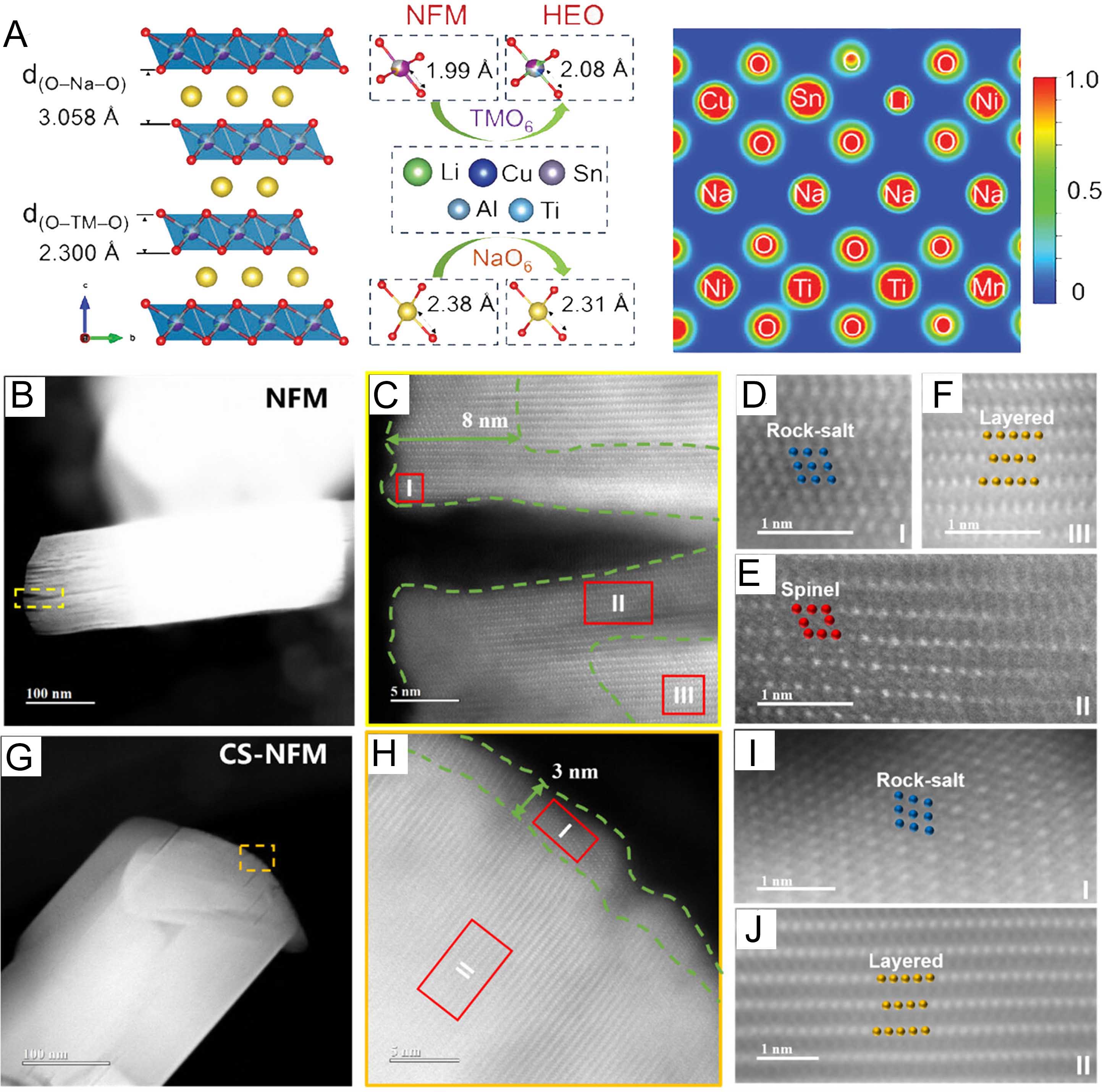
Figure 11. (A) Interlayer spacing & Na-O/TM-O bonds (HEO vs. NFM). Reproduced with permission[158]. Copyright 2025, Wiley-VCH GmbH. AC-TEM images of (B-F) NFM and (G-J) CS-NFM after 500 cycles at 1 C. (B-J) Reproduced with permission[125]. Copyright 2025. American Chemical Society. NFM: NaNi1/3Fe1/3Mn1/3O2; HEO: high-entropy oxides; CS-NFM: Ca/Sn dual site doping strategy and prepared Na0.98Ca0.01Ni0.33Fe0.33Mn0.315Sn0.015O2; AC-TEM: spherical aberration-corrected transmission electron microscopy.
Composite
While P2 and O3 single-phase oxides present distinct trade-offs, the design of P2/O3 biphasic materials has emerged as a key strategy for advanced sodium-ion cathodes [Figure 12A]. This composite architecture integrates the high capacity of the O3 phase with the structural stability of the P2 phase, enabling synergistic multi-channel Na+ migration that effectively overcomes kinetic and structural limitations.
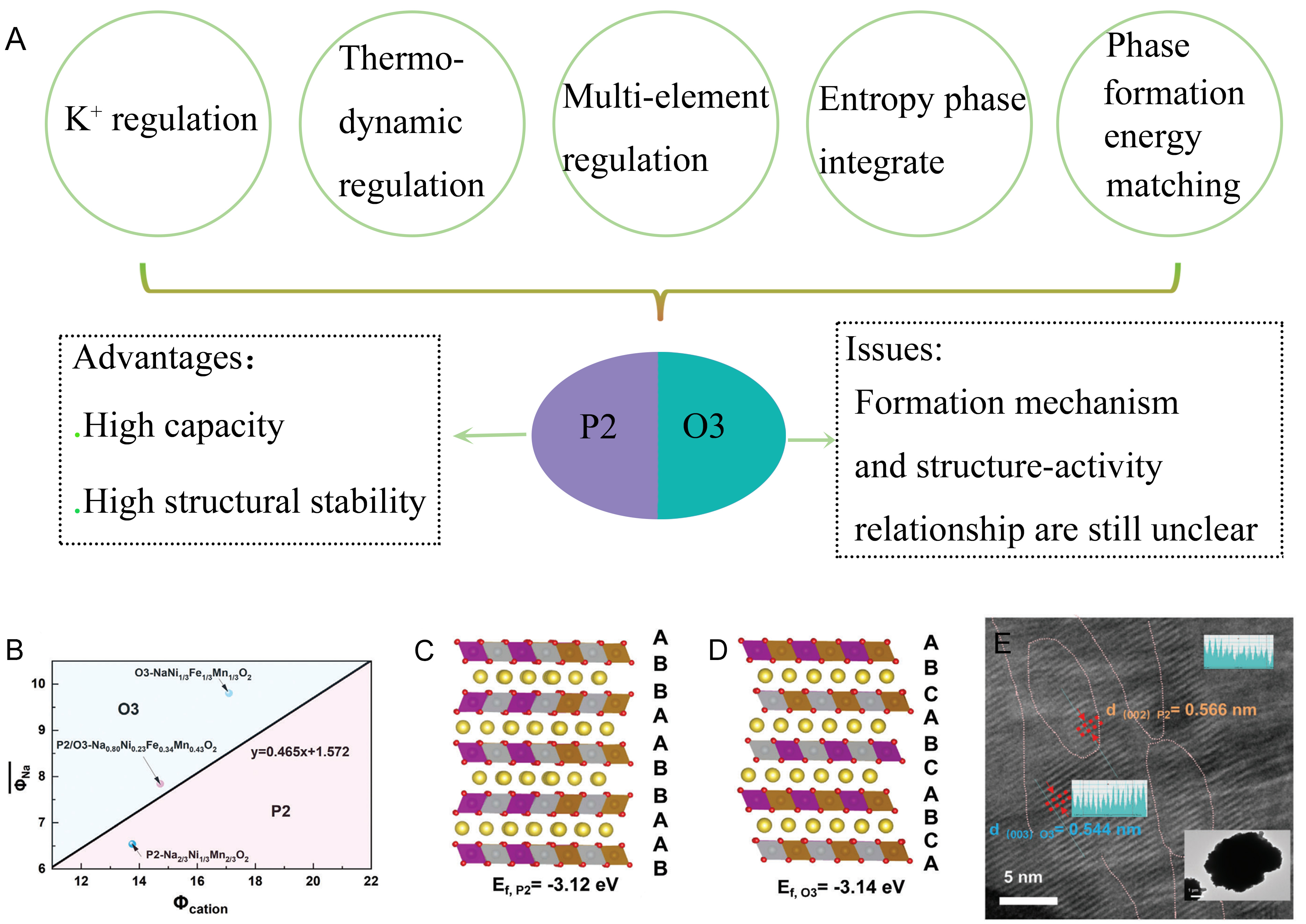
Figure 12. (A) Preparation strategy, advantages and existing problems of P2/O3 composite phase. (B) Pre-evaluation of cation potential for the custom-developed materials and widely reported counterparts; (C) and (D) the corresponding structural sketches and phase formation energy characteristics of P2-type and O3-type Na0.8Ni0.23Fe0.32Mn0.45O2. (E) TEM images of P2/O3 Na0.8Ni0.23Fe0.32Mn0.45O2. (B-E) Reproduced with permission[163]. Copyright 2025, Wiley-VCH GmbH. TEM: Transmission electron microscope.
For example, Duan et al.[162] synthesized a thermodynamically and kinetically stable P2/O3 biphasic K0.05Na0.8Ni0.5Mn0.5O2 via a high-temperature solid-phase method using potassium element regulation. Fe doping suppresses Mn3+-induced Jahn-Teller effects, yielding a P2/O3 biphasic material with high reversible capacity and excellent 200-cycle stability. Crucially, P2/O3 composites form preferentially when the constituent phases possess similar thermodynamic energies[163]. This study reveals that owing to the comparable formation energies of P2-type and O3-type phases [Figure 12B-D], no long-range ordered structure is generated, and a P2/O3-type Na0.8Ni0.23Fe0.32Mn0.45O2 (abbreviated as P2/O3) composite cathode material dominated by the O3 phase is constructed [Figure 12E]. Leveraging mechanisms including reversible Mn redox activated by weak hybridization, confined Jahn-Teller effect, and reduced Na+ migration energy barrier, the material achieves high specific capacity and ultra-long cycling stability, and meanwhile exhibits excellent air stability and processing adaptability. Chang et al.[164] co-doped with Li+ and Ti4+ to equalize the thermodynamic formation energies of the P2 and O3 phases. From a thermodynamic perspective, by changing the calcination time, they prepared Na2/3Li1/18Ni5/18Mn5/18Ti5/18Fe2/18O2 materials with adjustable P2/O3 phase ratios. The high-entropy strategy can enhance lattice and interlayer stability through configurational entropy, and in conjunction with composite phase structures, can further improve electrode material performance. Nevertheless, exploring high-capacity single-phase cathodes remains crucial, and in-depth research on the structure performance relationship of composite phases is of great significance for the design of advanced SIB cathodes.
Microstructural modulation
The control of Ni-based sodium layered positive electrode microstructure is a key technology for improving the diffusion rate of Na+ and structural stability, mainly including morphology structure control (particle
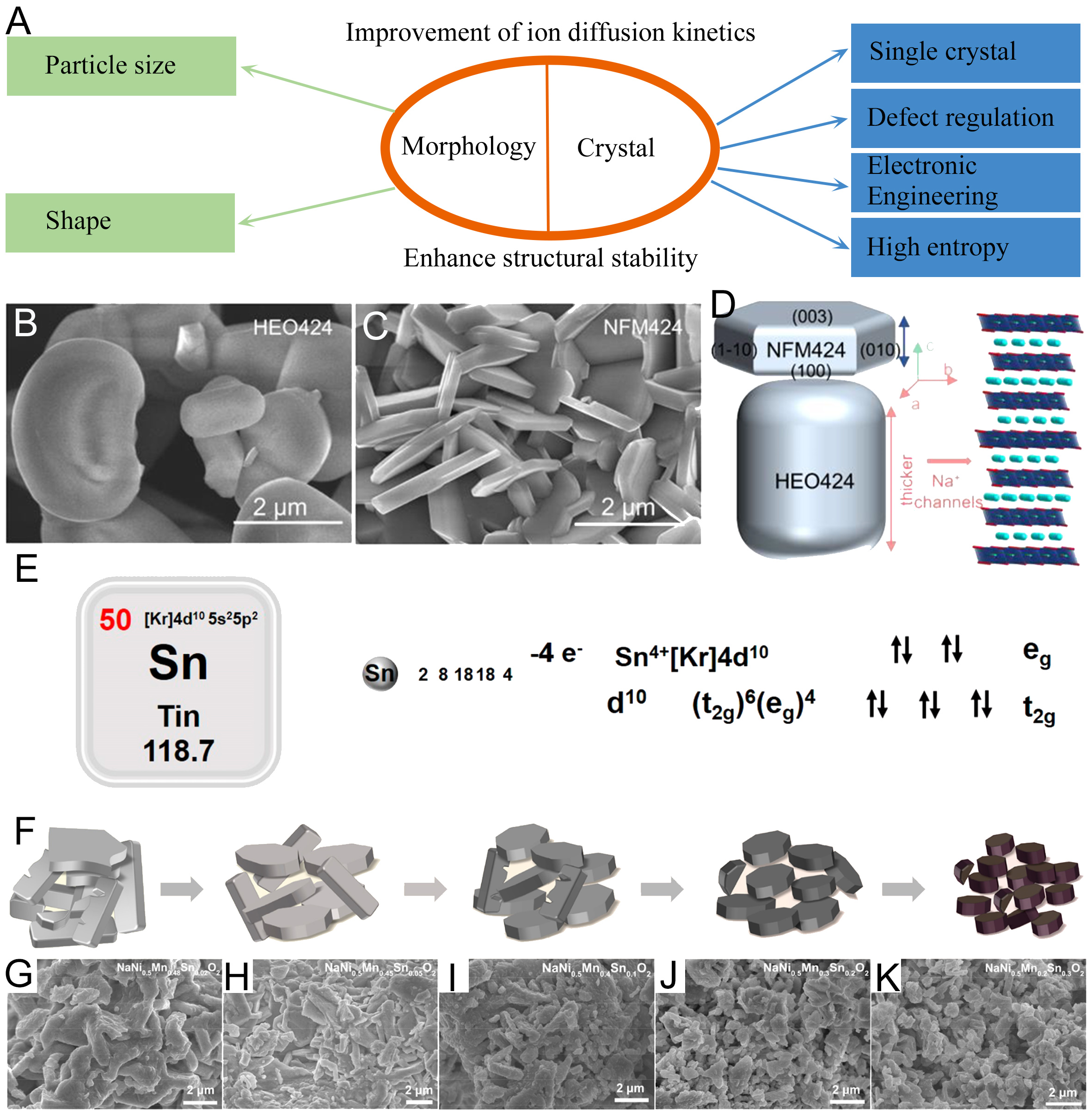
Figure 13. (A) Types and functions of microstructural modules schematic diagram. (B and C) SEM images of HEO424 and NFM424. (D) Schematic illustrations showing the morphological structure of HEO424 and NFM424. (B-D) Reproduced with permission[105]. Copyright 2022. American Chemical Society; (E) Schematic showing the arrangement of the outermost electron of Sn4+. (F) Schematic of morphological evolution. (G-K) SEM images of NaNi0.5Mn0.5-xSnxO2 cathode materials. (E-K) Reproduced with permission[168]. Copyright 2023. American Chemical Society. SEM: Scanning electron microscope.
Electrolyte modification
The electrolyte is vital for Na+ transport during battery operation, serving as the primary medium for charge carrier mobility. Its properties, including conductivity and ion diffusion rate, significantly impact the battery’s overall performance[169]. From the perspective of electrolyte formulation, the choice of sodium salt significantly impacts various crucial parameters of the electrolyte, such as sodium ion transport, sodium ion solvation structure, SEI, CEI compositions, electrochemical window, among others, which are the primary determinants of the electrolyte performance. Generally, crystals with lower lattice energies demonstrate superior conductivity (NaPF6 > NaClO4 > NaTFSI > NaOTf > NaBF4), while the HOMO (Highest Occupied Molecular Orbital) level dictates their redox resistance (NaOTf > NaClO4 > NaTFSI > NaBF4 > NaPF6)[170]. NaClO4 exhibits favorable conductivity but lacks resistance to high voltage, whereas NaPF6 and NaTFSI offer both excellent conductivity and high voltage characteristics. Nevertheless, NaTFSI is relatively costly, while NaPF6 salt suffers from poor chemical stability (being highly sensitive to moisture at levels below 20 ppm) and inadequate thermal stability[169]. Therefore, a reasonable combination of concentration, solvent, and additives is imperative to strike a balance between cost and performance. Among solvents, organic solvent systems, typified by carbonate esters, carboxylate esters, and ethers, are characterized by an appropriate voltage range and a wide temperature range. Among these, ethylene carbonate (EC), featuring a cyclic structure, is the most extensively utilized. Blending this compound with linear carbonates Diethyl carbonate/dimethyl carbonate (DEC/DMC) reduces electrolyte viscosity and boosts ionic conductivity. While ester-based electrolytes offer a wide operating voltage range for layered oxide cathodes, their decomposition instability generates resistive organic species (such as ROCO2Na). These byproducts promote a thick and brittle CEI layer, ultimately inducing structural degradation and transition metal dissolution. Wang et al.[171] reported enhanced Na+ coordination at the NFM/electrolyte interface in various EC-based solvents [with 5% fluoroethylene carbonate (FEC)], attributed to the cathode’s strong nucleophilicity and high electron density. Among them, the EC/DMC electrolyte, with the smallest molecular chain and the most tightly dissolved structure, exhibits stable electrochemical performance, resulting in a uniform and stable CEI, thereby displaying superior interface compatibility and cycling stability [Figure 14A-D].
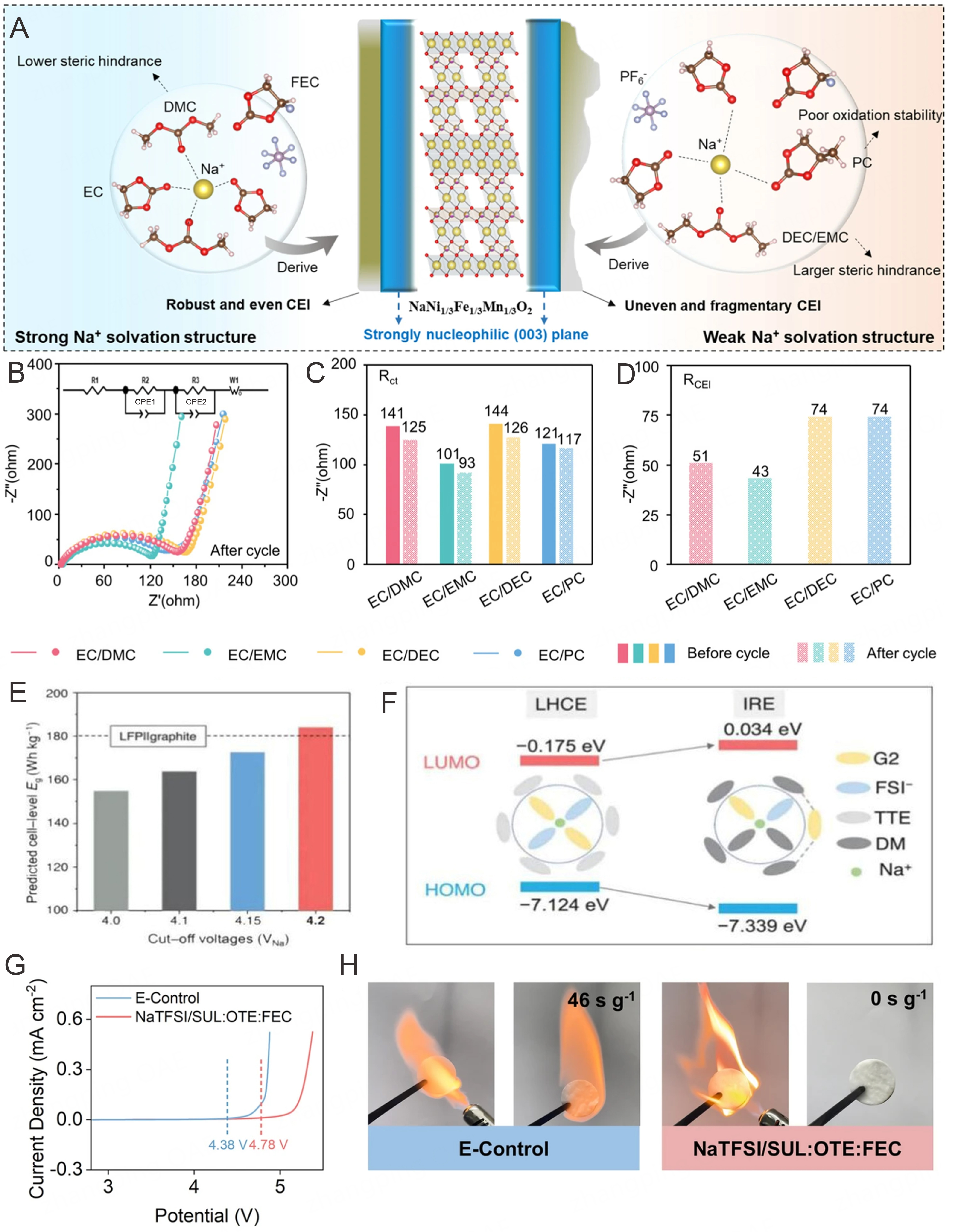
Figure 14. (A) Na+ solvation and (003) plane interface chemistry of cathodes. (B) EIS plots and (C and D) Rct and RCEI fitted models. (A-D) Reproduced with permission[171]. Copyright 2023. Springer; (E) Calculated battery-level energy density (Eg) as a function of cut-off voltage in the NFM||HC cell. (F) Solvation sheath structures of LHCE (NaFSI-G2-TE) and IRE (NaFSI-G2-DM), and their corresponding HOMO/LUMO. (E and F) Reproduced with permission[173]. Copyright 2025. Wiley-VCH GmbH; (G) LSV of Na||stainless steel half cells. (H) Combustion testing of E-Control and NaTFSI/SUL:OTE:FEC. (G and H) Reproduced with permission[176]. Copyright 2024. Springer. EIS: Electrochemical impedance spectroscopy; NFM: NaNi1/3Mn1/3Fe1/3O2; HC: hard carbon; LHCE: localized high-concentration electrolyte; IRE: intermolecular-reinforced ether; HOMO: highest occupied molecular orbital; LUMO: lowest unoccupied molecular orbital; SUL: sulfone; OTE: 1H, 1H, 5H-octafluoropentyl-1, 1, 2, 2-tetrafluoroethyl ether; FEC: fluoroethylene carbonate; CEI: cathode electrolyte interphase; DEC: diethyl carbonate; EMC: ethyl methyl carbonate; PC: propylene carbonate; DMC: dimethyl carbonate.
Ether-based electrolytes can effectively stabilize SIBs’ negative electrodes and play a key role in improving the low-temperature and rate performance of SIBs due to their unique weak solvation ability and lower reduction potential. Ether-based electrolytes promote a unique CEI formation mechanism, yielding a thin yet robust interphase rich in inorganic components. This optimized chemical composition significantly enhances their compatibility with layered oxide cathodes[172]. However, although traditional ether electrolytes are suitable for sodium negative electrodes, their antioxidant capacity is poor, and they are prone to decomposition at high voltages, resulting in unstable interfaces and capacity degradation. Although high concentration or localized high concentration electrolyte strategies can improve interface stability, they are accompanied by a series of problems such as high cost, high viscosity, and gas production. Although traditional ether electrolytes are compatible with sodium anodes, they have poor antioxidant properties and are prone to decomposition under high pressure, leading to interface instability and capacity decay. Although high concentration or localized high concentration strategies can improve interface stability, they come with problems such as high cost, high viscosity, and gas production. For example, increasing the cut-off voltage of the sodium layered positive electrode from 4.0 V to 4.2 V can achieve an energy density of
In a separate study, He et al.[176] designed a localized high-concentration electrolyte using sulfolane and a fluorinated ether diluent, which formed a robust, thin CEI with excellent oxidation resistance. This enabled O3-NaNMF cathodes to deliver outstanding high-voltage (4.2 V) performance, with capacity retentions of 79.48% (300 cycles at 1 C) and 81.15% (400 cycles at 2 C). Moreover, the electrolyte’s non-flammability improves SIB safety [Figure 14G-H]. Beyond solvents, additives play a pivotal role by leveraging differential lowest unoccupied molecular orbital/highest occupied molecular orbital (LUMO/HOMO) energy levels to preferentially decompose and tailor interfacial chemistry. Additionally, solid-state batteries have emerged as a research focus due to their remarkable energy density and cycling stability, but still face challenges such as poor solid-solid contact, unstable solid-state electrolyte/cathode interface, and thermal instability that need to be addressed. Building continuous charge transfer channels, designing “zero strain” layered oxides, and using surface coatings are classic strategies to solve the above problems, but their commercialization still faces greater challenges compared to liquid electrolytes[20].
Synergy and conflict among modification strategies
First, we systematically evaluated six strategies - doping, surface coating, strain-relief gradient design, high-entropy doping, P2/O3 biphasic design, and electrolyte modification - across six dimensions: mechanism, advantages, drawbacks, cost, scalability, and applicability to Ni-rich cathodes [Table 3]. Beyond individual evaluation, the various modification strategies for ternary sodium-ion nickel-based cathodes exhibit complex synergistic and conflicting relationships in practical applications. Doping and coating represent the most fundamental complementary combination: doping enhances TM-O bond strength and reduces Na+ diffusion barriers from the bulk perspective, while coating suppresses electrolyte erosion and side reactions at the surface; their integration simultaneously improves bulk and surface stability, yet an excessively thick or poorly conductive coating layer may offset the ionic diffusion rate enhancement achieved by doping, creating a performance trade-off. High-entropy modification introduces multi-component active elements to increase Na+ storage sites and broaden the voltage window, and its synergy with P2/O3 biphasic design is particularly pronounced - the lattice distortion induced by high-entropy doping can be buffered at the P2/O3 interface within the biphasic structure, which itself combines the high-rate capability of the P2 phase with the high capacity of the O3 phase; their superposition effectively suppresses phase transition degradation during cycling. Nevertheless, high-entropy design significantly increases synthesis complexity and cost, and the compositional inhomogeneity inherent to multi-element distribution may compromise the uniformity of subsequent coating, leading to processing conflicts. Crystal microstructure regulation and electrolyte modification also exhibit bidirectional interactions: the distinct chemical reactivities of P2 and O3 phases at the surface of biphasic materials demand precise electrolyte matching - fluorinated salts or ionic liquid additives can reduce interfacial impedance and suppress decomposition, but if they undergo redox reactions with specific dopants or coating layers, they may instead damage interfacial integrity. Research has shown that phase coexistence and local structural regulation at the P2/O3 interface can effectively balance energy density, dynamic performance, and cycling stability, and this biphasic design paradigm is not limited to Ni-rich systems but can also be extended to sustainable low-Ni or Ni-free chemistries[177]. In summary, these strategies are not simply additive but require systematic balancing across three dimensions - bulk, surface, and interface: matching coating thickness and conductivity with doping-enhanced diffusion, ensuring compatibility between high-entropy composition and biphasic structure, and maintaining chemical stability between electrolyte and modified surfaces. A mismatch at any stage can convert synergistic effects into performance penalties; therefore, the optimal solution must be systematically tailored to the specific material system and application scenario.
Comparative evaluation of modification strategies for Ni-based layered cathodes
| Strategy | Mechanism | Key benefits | Main drawbacks | Cost | Scalability | Applicability |
| Doping (bulk) | Substitutional/interstitial cation stabilization of O3 lattice | Suppresses phase transitions (H2 → H3), improves thermal stability | Excessive doping degrades Na+ diffusion kinetics | Low-Moderate | High (conventional co-precipitation) | ★★★★☆ |
| Surface coating | Physical barrier against HF attack, suppresses CEI growth | Excellent cycling stability, minimal bulk impact | Additional processing steps, coating uniformity issues | Moderate | Moderate-High (ALD/wet-chemistry scalable) | ★★★★★ |
| Strain-relief design (concentration gradient) | Smooths Na-concentration gradient → reduces intragranular strain | Simultaneously improves energy density and cycle life | Complex synthesis control (multi-step co-precipitation) | High | Low-Moderate | ★★★★☆ |
| High-entropy doping | Configurational entropy stabilization of single-phase structure | Exceptional structural/thermal stability, suppresses oxygen release | Difficult composition optimization, limited understanding | High | Low (research stage) | ★★★☆☆ |
| P2/O3 biphasic design | Phase coexistence enables complementary kinetics + stability | Balances energy density, rate capability, and cycling | Requires precise phase-ratio control | Moderate | Moderate | ★★★★☆ (also extensible to low-Ni/Ni-free) |
| Electrolyte modification | Tailored CEI/electrolyte interface reduces parasitic reactions | Improves high-voltage stability | Compatibility with full-cell design needed | Moderate | High (drop-in replacement) | ★★★★★ |
SUMMARY AND FUTURE PERSPECTIVES
Summary
While the exploration of modification methods is still in its infancy and faces specific challenges, strong momentum is driving the development of related technologies to address these limitations. Through comparative analysis and the synergistic integration of diverse approaches, the future enhancement of these techniques appears highly promising. This review is expected to provide critical insights for the rational design of advanced electrode materials for SIBs, thereby accelerating their industrial implementation.
Technical challenge analysis
Despite the promise of Na1-δNixMyO2 layered oxides as SIB cathodes, several persistent problems limit their industrial use, notably structural collapse, parasitic interface reactions, slow Na+ diffusion, and sensitivity to air. In response to these bottlenecks, recent research endeavors have centered on the systematic optimization of multidimensional modification strategies, which can be summarized into seven distinct directions. Below is an analysis of the advantages, drawbacks, costs, and industrial application prospects associated with each strategy:
(1) Ion doping regulation: Ion doping into the Na1-δNixMyO2 cathode has been shown to bolster structural stability, optimize Na+ diffusion pathways, regulate electrochemical activity, and improve air stability. Nevertheless, this approach is not without its limitations: using a single ion often falls short in comprehensively addressing multiple issues, while multi-ion doping processes introduce complexity. Excessive doping or the inappropriate selection of dopant elements can lead to adverse effects such as lattice expansion, diminished conductivity, and exacerbated oxygen evolution. Furthermore, the heightened synthesis complexity associated with ion doping drives up production costs. The cost increase of common elements such as Mg, Al, and Zn is small, while the cost of rare elements such as Ti, Mo, and W increases significantly.
(2) Surface coating engineering: The surface coating strategy applied to the Na1-δNixMyO2 cathode offers a multifaceted approach to enhancing performance by suppressing interface side reactions, buffering volume changes, accelerating ion transport kinetics, improving air stability, and prolonging material cycle life. However, this strategy is not without its drawbacks, including the potential for increased interface resistance, high process complexity, rising costs, and impurity introduction. The cost of materials depends on the type and purity of coating materials (such as aluminum oxide, phosphate, carbon materials, etc.), and the cost of processes (such as atomic layer deposition, sol-gel method, spraying method, etc.) is affected by equipment investment and energy consumption. Despite these challenges, the encapsulation strategy holds significant promise for widespread application in energy storage and power delivery systems. Through meticulous process optimization and cost management, it is anticipated to facilitate the large-scale deployment of SIBs, proving to be an economically feasible approach for energy storage.
(3) Doping and coating: Combining doping and coating creates a powerful synergistic effect, but this hybrid method still struggles with common technical issues.
(4) High-entropy: Increasing the configuration entropy of materials can enhance their structural stability, ion diffusion kinetics, and optimize air stability. At the same time, multiple elements work together, combining electronic conductivity, ion storage capacity, and structural support, resulting in better overall performance than traditional single- or dual-element materials. However, introducing some inactive or low-active elements may dilute the proportion of active substances, resulting in a slightly lower specific volume than the ideal value, which requires precise design to balance capacity and stability. High-entropy material synthesis necessitates precise stoichiometric and parameter control, yet faces scalability and efficiency bottlenecks with conventional routes. The mixing of multiple metal elements complicates the recycling process, and existing recycling technologies are difficult to efficiently separate and reuse each element, increasing environmental pressure and costs. In addition, the specific mechanism of the high-entropy effect is not fully understood, which limits the rational design and performance optimization of materials.
(5) Composite phase: P2/O3 biphasic oxides synergistically optimize kinetics and thermodynamics at the phase interface, markedly enhancing structural stability and cycle life. However, preparing multiphase structures is complex, and stability needs to be verified; furthermore, the synthetic route for such materials is highly intricate, and although it has excellent laboratory performance, large-scale production requires solving the problem of process amplification.
(6) Microstructure control: The control of the microstructure of nickel-based cathodes is a key technology for improving the diffusion rate of sodium ions and enhancing structural stability, mainly including morphology control and crystal structure control, which plays an important role in promoting the development of sodium ion batteries. Partial microstructure control, such as nanostructure design and precise doping, requires high synthesis processes and precise control of reaction conditions, which increases production difficulty and cost.
(7) Electrolyte modification: Electrolytes play a crucial role in facilitating the transport of Na+ during charge/discharge processes. Their performance metrics, encompassing conductivity and ion diffusion kinetics, exert a profound influence on the overall performance of the battery. To enhance interfacial stability and ion transport efficiency, strategies such as incorporating functional additives or modulating the solvation structure are often employed. However, the development of high-performance modified electrolytes typically necessitates the use of costly additives, specialized solvents, or sophisticated synthesis protocols, which collectively contribute to escalated production expenses. Moreover, these modified electrolytes may encounter compatibility challenges with other battery components, including separators and negative electrodes, thereby necessitating re-optimization of the battery design and assembly processes to ensure seamless integration and optimal performance.
In summary, the factors that affect the degradation of Na1-δNixMyO2 cathode structure are often not singular and have complex correlations. Some of these factors can form a vicious cycle through the conduction chain of “structural damage performance degradation further structural damage”, severely restricting its electrochemical performance and practical application process. Therefore, a single modification strategy is difficult to comprehensively solve, and multiple modification strategies need to work together to optimize material properties from multiple dimensions such as bulk structure, electronic structure, and interface characteristics, in order to achieve the application of high-performance SIBs.
Possible research directions
For future development of Ni-rich cathode in SIBs, the focus can be directed toward the following directions while strengthening mechanistic investigations: (1) By integrating Density Functional Theory (DFT) with Machine Learning force fields (ML) force fields [Deep Potential/Gaussian Approximation Potential (DeepMD/GAP)], nanosecond-scale multiscale simulations reveal Na+ diffusion kinetics, P2/O3 phase transitions, and oxygen redox evolution to clarify degradation origins under high Ni content, while Graph Neural Networks (GNNs) enable high-throughput screening of optimal multi-element doping strategies - both refined iteratively via active learning; (2) Employing in-situ synchrotron X-ray Diffraction/X-ray Absorption Spectroscopy (XRD/XAS), cryo-electron microscopy, and Raman spectroscopy to dynamically track layered structure distortion, surface reconstruction, and transition metal dissolution during charge/discharge cycling, combined with electrochemical impedance spectroscopy to analyze the dynamic correlation between interfacial side reactions and battery performance; (3) developing a high-throughput screening platform based on graph neural networks that integrates crystal structure databases and experimental data to predict the mechanisms of multi-element doping in enhancing air stability, and optimizing doping element combinations and concentration gradients through active learning; and (4) Digital Twin Implementation: Multimodal data from in-situ characterization and EIS are fused to construct a three-tier twin (“atom → particle → cell”), upon which reinforcement learning performs inverse design of gradient-structured cathodes, enabling bidirectional closed-loop optimization - predicting performance from structure and deriving optimal structure from target performance; (5) Standardized testing and full-cell validation: Establish unified air-stability testing standards for Ni-rich layered oxides, including dry-air tolerance tests (with clearly defined temperature/humidity conditions and exposure duration) and accelerated aging protocols (high-temperature/high-humidity cycling, high-rate cycling), to ensure comparability of results across studies. Concurrently, conduct full-cell validation with hard carbon anodes to evaluate the effectiveness of cathode modifications under practical full-cell conditions; (6) Engineering validation: Promote the preparation and testing of high-loading electrodes and obtain pouch-cell data to assess capacity retention, rate performance, and cycle life under realistic operating conditions, thereby bridging the data gap between laboratory-scale small electrodes and industrial-scale production; (7) Gas-evolution analysis: Systematically conduct gas-evolution analysis during charge/discharge (O2, CO2, H2), and use mass spectrometry or gas chromatography to quantitatively assess the extent of parasitic reactions, providing direct evidence for the suppression strategies of interfacial side reactions; (8) Techno-economic comparison: Perform techno-economic comparisons between Ni-based layered oxides and Ni-free layered oxides, comprehensively evaluating dimensions such as raw material costs, process complexity, energy density, and cycle life, to provide data support for industrialization route selection.
In summary, the research on sodium-ion high-nickel layered oxides is still in its early stages of development, and commercialization faces multiple challenges from basic material research to industrial implementation. Therefore, interdisciplinary collaboration is needed to accelerate the practical application of high-performance sodium-ion batteries.
DECLARATIONS
Authors’ contributions
Made substantial contributions to conception and design of the study and performed data analysis and interpretation: Lv, Y.; Huang, S.; Ge, S.; Zhang, J.
Performed data acquisition, as well as provided administrative, technical, and material support: Gao, T.;
Availability of data and materials
Not applicable.
AI and AI-assisted tools statement
Not applicable.
Financial support and sponsorship
This work was funded by the National Natural Science Foundation of China (22508365, 22302172), Zhejiang Provincial Natural Science Foundation of China (LQN26B030012), China Postdoctoral Science Foundation (2025M780920), and Nanxun Scholars Program for Young Scholars of ZJWEU (RC2023021320).
Conflicts of interest
Lv, Y.; Huang, S.; and Cui, J. are affiliated with Jiangsu OptimumNano Energy Co., Ltd., Yangzhou, China. The other authors declare that they have no conflicts of interest.
Ethical approval and consent to participate
Not applicable.
Consent for publication
Not applicable.
Copyright
© The Author(s) 2026.
REFERENCES
1. Saher, S.; Johnston, S.; Esther-kelvin, R.; Pringle, J. M.; Macfarlane, D. R.; Matuszek, K. Trimodal thermal energy storage material for renewable energy applications. Nature. 2024, 636, 622-6.
2. Peng, M.; Ge, Y.; Gao, R.; et al. Thermal catalytic reforming for hydrogen production with zero CO2 emission. Science 2025, 387, 769-75.
3. Heenan, T. M. M.; Mombrini, I.; Llewellyn, A.; et al. Mapping internal temperatures during high-rate battery applications. Nature 2023, 617, 507-12.
4. Wang, L.; Liu, T.; Wu, T.; Lu, J. Strain-retardant coherent perovskite phase stabilized Ni-rich cathode. Nature 2022, 611, 61-7.
5. Bin Abu Sofian, A. D. A.; Lim, H. R.; Siti Halimatul Munawaroh, H.; Ma, Z.; Chew, K. W.; Show, P. L. Machine learning and the renewable energy revolution: exploring solar and wind energy solutions for a sustainable future including innovations in energy storage. Sustain. Dev. 2024, 32, 3953-78.
6. Kumar, A.; Pal, D. B. Renewable energy development sources and technology: overview. In Renewable energy development: technology, material and sustainability; Kumar, S.; Singh, V. K.; Eds.; Clean Energy Production Technologies, Springer, Singapore, 2025; pp 1-23.
7. Su, X.; Xu, X.; Ji, Z.; Wu, J.; Ma, F.; Fan, L. Polyethylene oxide-based composite solid electrolytes for lithium batteries: current progress, low-temperature and high-voltage limitations, and prospects. Electrochem. Energy. Rev. 2024, 7, 2.
8. Qi, N.; Yan, K.; Yu, Y.; et al. Machine learning and neural network supported state of health simulation and forecasting model for lithium-ion battery. Front. Energy. 2024, 18, 223-40.
9. Wu, Y.; Shuang, W.; Wang, Y.; et al. Recent progress in sodium-ion batteries: advanced materials, reaction mechanisms and energy applications. Electrochem. Energy. Rev. 2024, 7, 17.
10. Zhang, Z.; Zhang, H.; Wu, Y.; et al. Advances in doping strategies for sodium transition metal oxides cathodes: a review. Front. Energy. 2024, 18, 141-59.
11. Liu, S.; Yang, J.; Chen, P.; et al. Flexible electrodes for aqueous hybrid supercapacitors: recent advances and future prospects. Electrochem. Energy. Rev. 2024, 7, 25.
12. Xiong, S.; Ke, H.; Cao, L.; et al. CC@BCN@PANI core-shell nanoarrays as ultra-high cycle stability cathode for Zn-ion hybrid supercapacitors. Front. Energy. 2023, 17, 555-66.
13. Wu, Y.; Xiao, B.; Liu, K.; et al. Electrochemical synthesis of high-efficiency water electrolysis catalysts. Electrochem. Energy. Rev. 2025, 8, 2.
14. Hossain, M. N.; Zhang, L.; Neagu, R.; Rassachack, E. Free-standing single-atom catalyst-based electrodes for CO2 reduction. Electrochem. Energy. Rev. 2024, 7, 5.
15. Xu, P.; Liu, Y.; Qin, M.; Huang, F.; Liang, S.; Fang, G. Electronic structure regulation inducing robust solid electrolyte interphase for stable anode-free sodium metal batteries. Adv. Powder. Mater. 2025, 4, 100303.
16. Cai, J.; Zhu, Y.; Zhang, Z.; et al. Electronic modification of NaCrO2 via Ni2+ substitution as efficient cathode for sodium-ion batteries. Energy. Mater. 2024, 4, 400073.
17. Njema, G. G.; Ouma, R. B. O.; Kibet, J. K. A Review on the recent advances in battery development and energy storage technologies. J. Renew. Energy. 2024, 2024, 1-35.
18. Sohu. Global penetration rate of new energy vehicles in 2024: Japan 2.9%, United States 9.5%, India lagging behind. https://www.sohu.com/a/825254728_100032338 (accessed 2026-08-18).
19. Liu, X.; Dong, X.; Adenusi, H.; Wu, Y.; Passerini, S. Co-solvent strategy for rechargeable post-lithium metal batteries. Nat. Rev. Chem. 2025, 9, 415-26.
20. Guo, Y.; Jin, R.; Fan, M.; et al. Sodium layered oxide cathodes: properties, practicality and prospects. Chem. Soc. Rev. 2024, 53, 7828-74.
21. U.S. Department of the Interior, U.S. Geological Survey. Mineral commodity summaries 2024. https://pubs.usgs.gov/periodicals/mcs2024/mcs2024.pdf (accessed 2026-08-18).
22. Mauger, A.; Julien, C. M.; Armand, M.; et al. Recent advances on water-splitting electrocatalysis mediated by noble-metal-based nanostructured materials. Adv. Energy. Mater. 2021, 11, 2000773.
23. Yang, S. Y.; Park, J.; Kim, J. H.; et al. Spray-assisted synthesis of ant-cave-structured Ni-rich cathode microspheres with Li-reactive coating layer for high-performance Li-ion batteries. Mater. Today. Chem. 2024, 35, 101889.
24. Yao, A.; Benson, S. M.; Chueh, W. C. Critically assessing sodium-ion technology roadmaps and scenarios for techno-economic competitiveness against lithium-ion batteries. Nat. Energy. 2025, 10, 404-16.
25. Satrughna, J. A. K.; Kanwade, A.; Srivastava, A.; et al. Experimental and computational advancement of cathode materials for futuristic sodium ion batteries. Mater. Today. 2025, 91, 375-408.
26. U.S. Geological Survey. Mineral commodity summaries 2020. https://pubs.usgs.gov/publication/mcs2020 (accessed 2026-08-18).
27. https://mp.weixin.qq.com/s/eVFfGPnxXBp55V4G8UeeVw (accessed 2026-08-18).
28. Peng, B.; Wan, G.; Ahmad, N.; Yu, L.; Ma, X.; Zhang, G. Recent progress in the emerging modification strategies for layered oxide cathodes toward practicable sodium ion batteries. Adv. Energy. Mater. 2023, 13, 2300334.
29. Ruan, J.; Hu, J.; Li, Q.; et al. Current collector interphase design for high-energy and stable anode-less sodium batteries. Nat. Sustain. 2025, 8, 530-41.
30. Li, X.; Zhang, T.; Zhao, Y.; et al. Enhancing robustness and charge transfer kinetics of sodium-ion batteries through introduction of anionic anchoring separators. J. Am. Chem. Soc. 2025, 147, 8488-99.
31. https://www.globalmarketmonitor.com.cn (accessed 2026-08-18).
32. Zhang, H.; Gao, Y.; Liu, X.; et al. Long-cycle-life cathode materials for sodium-ion batteries toward large-scale energy storage systems. Adv. Energy. Mater. 2023, 13, 2300149.
33. Jiang, S.; Wang, H.; Wang, T.; et al. Electrochemical activity of 3d transition metal ions in polyanionic compounds for sodium-ion batteries. Battery. Energy. 2024, 3, 20230071.
34. Niu, Y.; Zhao, Y.; Xu, M. Manganese-based polyanionic cathodes for sodium-ion batteries. Carbon. Neutraliz. 2023, 2, 150-68.
35. Joy, A.; Kumari, K.; Parween, F.; Sultana, M. S.; Nayak, G. C. A comprehensive review on strategies for enhancing the performance of polyanionic-based sodium-ion battery cathodes. ACS. Omega. 2024, 9, 22509-31.
36. Lu, X.; Li, S.; Li, Y.; Wu, F.; Wu, C.; Bai, Y. From lab to application: challenges and opportunities in achieving fast charging with polyanionic cathodes for sodium-ion batteries. Adv. Mater. 2024, 36, 2407359.
37. Wang, Q.; Zhang, M.; Zhou, C.; Chen, Y. Concerted ion-exchange mechanism for sodium diffusion and its promotion in Na3V2(PO4)3 framework. J. Phys. Chem. C. 2018, 122, 16649-54.
38. Wang, W.; Gang, Y.; Hu, Z.; et al. Reversible structural evolution of sodium-rich rhombohedral Prussian blue for sodium-ion batteries. Nat. Commun. 2020, 11, 980.
39. Jing, Z.; Kong, L.; Mamoor, M.; et al. Rational design of prussian blue analogues for ultralong and wide-temperature-range sodium-ion batteries. J. Am. Chem. Soc. 2025, 147, 3702-13.
40. Ran, B.; Cheng, R.; Zhong, Y.; et al. High entropy activated and stabilized nickel-based prussian blue analogue for high-performance aqueous sodium-ion batteries. Energy. Storage. Mater. 2024, 71, 103583.
41. Wei, C.; Li, C.; Qu, D.; et al. High-entropy selenides derived from Prussian blue analogues as electrode materials for sodium-ion batteries. J. Colloid. Interface. Sci. 2024, 675, 139-49.
42. Liu, X.; Cao, Y.; Sun, J. Defect Engineering in prussian blue analogs for high-performance sodium-ion batteries. Adv. Energy. Mater. 2022, 12, 2202532.
43. Huang, J.; Du, R.; Zhang, H.; et al. Low-cost Prussian blue analogues for sodium-ion batteries and other metal-ion batteries. Chem. Commun. 2023, 59, 9320-35.
44. Ji, M.; Jin, T.; Xu, Q.; et al. High-entropy layer grown on Mn-based prussian blue analog for Na-ion storage. ACS. Energy. Lett. 2025, 10, 5165-73.
45. Zou, P.; Yao, L.; Wang, C.; Lee, S. J.; Li, T.; Xin, H. L. Regulating cation interactions for zero-strain and high-voltage P2-type Na2/3Li1/6Co1/6Mn2/3O2 layered oxide cathodes of sodium-ion batteries. Angew. Chem. Int. Ed. 2023, 62, e202304628.
46. Wang, L.; Wang, L.; Wang, H.; et al. Progress and perspective of high-entropy strategy applied in layered transition metal oxide cathode materials for high-energy and long cycle life sodium-ion batteries. Adv. Funct. Mater. 2025, 35, 2417258.
47. Zhou, X.; Yang, C.; Liu, X.; et al. Inhibiting inter-layer gliding in transition metal layered oxides through interphase engineering for sodium-ion batteries. Nat. Commun. 2025, 16, 6691.
48. Zhou, Q.; Li, Y.; Ren, H.; et al. Phase transition and targeted modulation mechanisms of layered cathodes for sodium-ion batteries. Mater. Today. 2025, 89, 374-87.
49. Dai, J.; Li, J.; Yao, Y.; et al. Strengthening transition metal-oxygen interaction in layered oxide cathodes for stable sodium-ion batteries. ACS. Nano. 2025, 19, 11197-209.
50. Jeong, S. H.; Kim, I.; Eom, S.; Hwang, H.; Jung, Y. H.; Kim, J. Engineering the local chemistry through Fe substitution in layered P2-Na0.7Ni0.2Co0.2Mn0.6O2 for high-performance sodium-ion batteries. Energy. Storage. Mater. 2025, 75, 104041.
51. Yabuuchi, N.; Kubota, K.; Dahbi, M.; Komaba, S. Research development on sodium-ion batteries. Chem. Rev. 2014, 114, 11636-82.
52. Huang, Y.; Dong, Y.; Yang, Y.; et al. Integrated rocksalt-polyanion cathodes with excess lithium and stabilized cycling. Nat. Energy. 2024, 9, 1497-505.
53. Chen, X.; Chen, K.; Ji, F.; et al. Achieving fast ion/electron transportation and smooth phase transition in polyanion cathode by the high entropy strategy. Adv. Energy. Mater. 2025, 15, 2500502.
54. Song, X.; Song, S.; Wang, D.; Zhang, H. Prussian blue analogs and their derived nanomaterials for electrochemical energy storage and electrocatalysis. Small. Methods. 2021, 5, 2001000.
55. Liu, X. Y.; Li, S.; Zhu, Y. F.; et al. Promoting layered oxide cathodes based on structural reconstruction for sodium-ion batteries: reversible phase transition, stable interface regulation, and multifunctional intergrowth structure. Adv. Funct. Mater. 2024, 35, 2414130.
56. Ma, X.; Yang, C.; Xu, Z.; et al. Structural and electrochemical progress of O3-type layered oxide cathodes for Na-ion batteries. Nanoscale. 2023, 15, 14737-53.
57. Yuan, X. G.; Guo, Y. J.; Gan, L.; et al. A universal strategy toward air-stable and high-rate O3 layered oxide cathodes for Na-ion batteries. Adv. Funct. Mater. 2022, 32, 2111466.
58. Chen, Z.; Deng, Y.; Kong, J.; et al. Toward the high-voltage stability of layered oxide cathodes for sodium-ion batteries: challenges, progress, and perspectives. Adv. Mater. 2024, 36, 2402008.
59. Li, Y.; Zhang, T.; Song, Z.; et al. Challenges and modification strategies on high-voltage layered oxide cathode for sodium-ion batteries. ChemSusChem. 2024, 18, e202401666.
60. Liang, X.; Hwang, J. Y.; Sun, Y. K. Practical cathodes for sodium-ion batteries: who will take the crown? Adv. Energy. Mater. 2023, 13, 2301975.
61. Ding, F.; Zhao, C.; Zhou, D.; et al. A novel Ni-rich O3-Na[Ni0.60Fe0.25Mn0.15]O2 cathode for Na-ion batteries. Energy. Storage. Mater. 2020, 30, 420-30.
62. Lv, Y.; Shi, L.; Yu, J.; Huang, S. Design of cobalt-free ni-rich cathodes for high-performance sodium-ion batteries using electrochemical Li+/Na+ exchange. Energies 2025, 18, 3205.
63. Wang, L.; Wang, J.; Lu, Y.; et al. A review of Ni-based layered oxide cathode materials for alkali-ion batteries. Chem. Soc. Rev. 2025, 54, 4419-67.
64. Chu, S.; Guo, S.; Zhou, H. Advanced cobalt-free cathode materials for sodium-ion batteries. Chem. Soc. Rev. 2021, 50, 13189-235.
65. Li, M.; Qiu, X.; Yin, Y.; Wei, T.; Dai, Z. O3-type Ni-rich NaNi2/3Mn1/6Fe1/6O2: a high-performance cathode material for sodium-ion batteries. J. Alloys. Compd. 2023, 969, 172406.
66. Venkatachalam, P.; Karra, C.; Duru, K. K.; Maram, P. S.; Madhavan, A. A.; Kalluri, S. Perspective-challenges and benchmarking in scale-up of Ni-rich cathodes for sodium-ion batteries. J. Electrochem. Soc. 2022, 169, 070536.
67. Magotra, A.; Sharma, S.; Ahmed, A.; Singh, A.; Sundramoorthy, A. K.; Arya, S. Sol-gel synthesized NaNiO2 nanorods as high-performance battery-type electrodes for energy storage. Mater. Sci. Eng. B. 2026, 325, 119080.
68. Chang, L.; Yang, R.; Bi, X.; et al. Research progress of layered P2-Na2/3Ni1/3Mn2/3O2 cathode material for sodium ion batteries. J. Energy. Storage. 2023, 73, 109025.
69. Huang, Y.; Yan, Z.; Luo, W.; et al. Vitalization of P2-Na2/3Ni1/3Mn2/3O2 at high-voltage cyclability via combined structural modulation for sodium-ion batteries. Energy. Storage. Mater. 2020, 29, 182-9.
70. Jiang, Y.; Zhu, L.; Tian, J.; et al. A high rate and stability O3-type cathode material based on a Y-doped NaNi1/3Fe1/3Mn1/3O2 matrix. Mater. Today. Commun. 2025, 46, 112523.
71. Fang, K.; Yin, J.; Zeng, G.; et al. Elucidating the structural evolution of O3-type NaNi1/3Fe1/3Mn1/3O2: a prototype cathode for Na-ion battery. J. Am. Chem. Soc. 2024, 146, 31860-72.
72. Yang, M.; Fan, Z.; Liu, J.; et al. Insights into the facet and morphological domination on the electrochemical performance of layered NaNi1/3Fe1/3Mn1/3O2 for sodium-ion batteries. Energy. Fuels. 2024, 38, 2453-62.
73. Liang, Y.; Liu, W.; Tang, Z.; Qin, M.; Wu, H.; Zeng, J. Enhancing electrochemical properties of O3-type NaNi1/3Fe1/3Mn1/3O2 cathode material for sodium-ion batteries via regulation of precursor’s growth environment. Chem. Eng. J. 2025, 516, 164118.
74. Gan, Y.; Cui, H.; Zhang, K.; Song, Y.; Gao, W. Exploring the degradation characteristics and thermal stability of NaNi1/3Fe1/3Mn1/3O2 cathode for sodium-ion battery cycling with high potential. J. Energy. Storage. 2025, 114, 115776.
75. Qiu, Z.; Li, S.; Zhou, W.; et al. Near-surface structure reconstruction for long-life single-crystal NaNi1/3Fe1/3Mn1/3O2 by washing treatment. Appl. Surf. Sci. 2026, 715, 164437.
76. Stulasti, K. N. R.; Setyawati, R. B.; Azinuddin, Y. R.; Suci, W. G.; Aliwarga, H. K. K.; Purwanto, A. Production of NaNi0.5Co0.3Mn0.2O2 (Na-NCM 532) for sodium-ion battery via combination method. Mater. Sci. Forum. 2023, 1111, 33-43.
77. Wang, B.; Kong, X.; Obrezkov, F.; et al. Understanding of a Ni-rich O3-layered cathode for sodium-ion batteries: synthesis mechanism and Al-gradient doping. Small 2024, 21, 2408072.
78. Yao, H.; Zheng, L.; Xin, S.; Guo, Y. Air-stability of sodium-based layered-oxide cathode materials. Sci. China. Chem. 2022, 65, 1076-87.
79. Su, J.; Pei, Y.; Yang, Z.; Wang, X. First-principles investigation on crystal, electronic structures and diffusion barriers of NaNi1/3Co1/3Mn1/3O2 for advanced rechargeable Na-ion batteries. Comput. Mater. Sci. 2015, 98, 304-10.
80. Wang, Y.; Gu, H.; Liu, W.; et al. Mechanism evaluation of intercalatus-capacitive cooperated cathode candidates for advanced sodium ion batteries. J. Phys. Chem. C. 2019, 123, 21874-7.
81. Tahir, S.; Murtaza, G.; Alhummiany, H.; et al. Experimental and computational study of binary transition metal oxides NaNi1/2X1/2O2 (X=Cr, Fe, Co and Cu) for energy storage applications. Mater. Chem. Phys. 2023, 306, 128093.
82. Peng, J.; Sarapulova, A.; Fu, Q.; et al. Understanding the electrochemical reaction mechanism of the Co/Ni Free layered cathode material P2-Na2/3Mn7/12Fe1/3Ti1/12O2 for sodium-ion batteries. Chem. Mater. 2024, 36, 4107-20.
83. Lavela, P.; Leyva, J.; Tirado, J. L. High-performance Ni-free sustainable cathode Na0.67Mg0.05Fe0.1Mn0.85O2 for sodium-ion batteries. ChemSusChem 2024, 17, e202301327.
84. Jayamkondan, Y.; Penki, T. R.; Nayak, P. K. Recent advances and challenges in the development of advanced positive electrode materials for sustainable Na-ion batteries. Mater. Today. Energy. 2023, 36, 101360.
85. Li, Y.; Liu, G.; Che, J.; et al. Review on layered oxide cathodes for sodium-ion batteries: degradation mechanisms, modification strategies, and applications. Interd. Mater. 2024, 4, 24-51.
86. Guo, H.; Hou, Y.; Wang, X.; et al. Ultra-soluble 1-azaphenothiazine additive stabilizes high-voltage LiCoO2 for 500 Wh Kg-1 lithium metal pouch cells. Adv. Mater. 2025, 37, 2503618.
87. Zhang, H.; Zeng, A.; Zhang, Z.; et al. A dispersed buffer phase enables mitigated stress toward stable 4.6 V Graphite||NCM811 batteries. Mater. Today. 2025, 88, 382-92.
88. Park, N.; Lee, H.; Yu, T.; et al. High-energy, long-life Ni-rich cathode materials with columnar structures for all-solid-state batteries. Nat. Energy. 2025, 10, 479-89.
89. Wang, P. F.; You, Y.; Yin, Y. X.; Guo, Y. G. Layered oxide cathodes for sodium-ion batteries: phase transition, air stability, and performance. Adv. Energy. Mater. 2018, 8, 1701912.
90. Quispe-garrido, L. V.; Baena-moncada, A. M.; Garcia, G.; et al. From low- to high-entropy layered transition metal oxide cathodes: recent progress on spray-drying technologies in materials design for sodium-ion batteries. J. Mater. Chem. A. 2026, 14, 19848-92.
91. Lee, D. H.; Xu, J.; Meng, Y. S. An advanced cathode for Na-ion batteries with high rate and excellent structural stability. Phys. Chem. Chem. Phys. 2013, 15, 3304.
92. Zhao, C.; Wang, Q.; Yao, Z.; et al. Rational design of layered oxide materials for sodium-ion batteries. Science 2020, 370, 708-11.
93. Wang, Q.; Zhao, C.; Wagemaker, M. Rational design of layered oxide materials for batteries. Acc. Chem. Res. 2025, 58, 1742-53.
94. Aranda, M.; Lavela, P.; Tirado, J. L. A novel potassium-containing layered oxide for the cathode of sodium-ion batteries. Battery. Energy. 2024, 3, 20230057.
95. Chen, Y.; Wang, S.; Jie, Y.; Lei, Z.; Cao, R.; Jiao, S. Synthesis and electrochemical investigation of O3-type high-nickel NCM cathodes for sodium-ion batteries. Chem. Res. Chin. Univ. 2021, 37, 280-5.
96. Liu, Y.; Zhou, X.; He, D.; et al. NaTiOx‐modified high-nickel layered oxide cathode for stable sodium-ion batteries. Carbon. Energy. 2024, 7, e627.
97. Yang, J.; Tang, M.; Liu, H.; et al. O3-type layered Ni-rich oxide: a high-capacity and superior-rate cathode for sodium-ion batteries. Small 2019, 15, 1905311.
98. Hasa, I.; Passerini, S.; Hassoun, J. Toward high energy density cathode materials for sodium-ion batteries: investigating the beneficial effect of aluminum doping on the P2-type structure. J. Mater. Chem. A. 2017, 5, 4467-77.
99. Shi, Y.; Hu, E.; Sumboja, A.; Anggraningrum, I. T.; Syahrial, A. Z.; Yan, Q. Layered 3d transition metal-based oxides for sodium-ion and lithium-ion batteries: differences, links and beyond. Adv. Funct. Mater. 2024, 35, 2413078.
100. Kaufman, J. L.; Van Der Ven, A. NaxCoO2 phase stability and hierarchical orderings in the O3/P3 structure family. Phys. Rev. Mater. 2019, 3, 015402.
101. Xie, Y.; Wang, H.; Xu, G.; et al. In operando XRD and TXM study on the metastable structure change of NaNi1/3Fe1/3Mn1/3O2 under electrochemical sodium-ion intercalation. Adv. Energy. Mater. 2016, 6, 1601306.
102. Yuan, D. D.; Wang, Y. X.; Cao, Y. L.; Ai, X. P.; Yang, H. X. Improved electrochemical performance of Fe-Substituted NaNi0.5Mn0.5O2 cathode materials for sodium-ion batteries. ACS. Appl. Mater. Interfaces. 2015, 7, 8585-91.
103. Cheng, L.; Luo, X.; Ge, B. Understanding and mitigating lattice collapse degradation in layered oxide materials for sodium-ion battery anode. ACS. Appl. Mater. Interfaces. 2024, 16, 35006-12.
104. Liang, X.; Song, X.; Sun, H. H.; Kim, H.; Kim, M.; Sun, Y. High-energy and long-life O3-type layered cathode material for sodium-ion batteries. Nat. Commun. 2025, 16, 3505.
105. Ding, F.; Zhao, C.; Xiao, D.; et al. Using High-entropy configuration strategy to design na-ion layered oxide cathodes with superior electrochemical performance and thermal stability. J. Am. Chem. Soc. 2022, 144, 8286-95.
106. Gao, S.; Huang, Y.; Geng, J.; et al. Reversible phase transition of an oxide cathode in high-voltage sodium-ion batteries. ACS. Energy. Lett. 2025, 10, 4140-7.
107. Sun, Y.; Weng, J.; Zhou, P.; et al. Improving oxygen-redox-active layered oxide cathodes for sodium-ion batteries through crystal facet modulation and fluorinated interfacial engineering. Adv. Mater. 2024, 36, 2410575.
108. Huang, J.; Xue, Z.; Lee, S.; Chen, H.; Ji, X.; Du, K. Spatial Heterogenous redox couples degradation in sodium-ion battery cathode materials and the mitigation of voltage fade by blocking oxygen release. J. Am. Chem. Soc. 2025, 147, 22444-52.
109. Liu, C.; Cui, Z.; Manthiram, A. Decoding gas evolution pathways and interfacial chemistry in layered oxide cathodes for safer sodium-ion batteries. Adv. Energy. Mater. , 2025, e04756.
110. Liu, Y. F.; Han, K.; Peng, D. N.; et al. Layered oxide cathodes for sodium-ion batteries: from air stability, interface chemistry to phase transition. InfoMat. 2023, 5, e12422.
111. Yang, X.; Li, Y.; Li, X.; et al. Binary eutectic fluoride salts modification enhancing structural stability of layered oxide cathodes for Na-ion batteries. Energy. Storage. Mater. 2025, 76, 104158.
112. Hwang, J.; Myung, S.; Sun, Y. Sodium-ion batteries: present and future. Chem. Soc. Rev. 2017, 46, 3529-614.
113. Wang, J.; Zhu, Y.; Su, Y.; et al. Routes to high-performance layered oxide cathodes for sodium-ion batteries. Chem. Soc. Rev. 2024, 53, 4230-301.
114. Song, T.; Wang, C.; Lee, C. S. Structural degradation mechanisms and modulation technologies of layered oxide cathodes for sodium-ion batteries. Carbon. Neutraliz. 2022, 1, 68-92.
115. He, J.; Li, M.; Ma, Z.; et al. Optimization of electrochemical performance in P2-type sodium-ion battery cathode materials via sodium stoichiometry adjustment and MgO coating. Ionics 2025, 32, 1907-21.
116. Liu, G.; Xu, W.; Wu, J.; et al. Unlocking high-rate O3 layered oxide cathode for Na-ion batteries via ion migration path modulation. J. Energy. Chem. 2023, 83, 53-61.
117. Li, M.; Zhuo, H.; Song, M.; et al. Tailoring Cu-rich surface spinel phase for high-performance O3-type layered cathode materials for sodium-ion batteries. Nano. Energy. 2024, 123, 109375.
118. You, Y.; Dolocan, A.; Li, W.; Manthiram, A. Understanding the air-exposure degradation chemistry at a nanoscale of layered oxide cathodes for sodium-ion batteries. Nano. Lett. 2018, 19, 182-8.
119. Ji, P.; Lei, X.; Wang, J.; et al. Unveiling the structural and chemical evolution of layered oxide cathode for Na-ion batteries induced by water vapor. Adv. Funct. Mater. 2024, 34, 2410485.
120. Sun, Y.; Wang, H.; Meng, D.; et al. Degradation mechanism of O3-type NaNi1/3Fe1/3Mn1/3O2 cathode materials during ambient storage and their in situ regeneration. ACS. Appl. Energy. Mater. 2021, 4, 2061-7.
121. Yang, Y.; Wang, Z.; Du, C.; et al. Decoupling the air sensitivity of Na-layered oxides. Science 2024, 385, 744-52.
122. Feng, L.; Guo, J.; Sun, C.; et al. An active strategy to reduce residual alkali for high-performance layered oxide cathode materials of sodium-ion batteries. Small 2024, 20, 2403084.
123. Yu, X.; Shi, Q.; Qiu, Y.; Zhao, S.; Feng, W.; Zhao, Y. Stabilizing O3-type Na(NiFeMn)1/3O2 cathode for high-rate sodium storage through strategic copper-magnesium co-doping. Nano. Res. 2025, 18, 94907597.
124. Xie, C.; Zhou, J.; Chen, C.; et al. Promoting synthesis of single crystalline O3-NaNi1/3Fe1/3Mn1/3O2 with Cu/Ti doping for sodium-ion batteries. Adv. Energy. Mater. , 2025, e04771.
125. Shi, S.; Yang, Q.; Sui, S.; et al. Boosting the sodium storage performance of O3-type layered oxide cathode by dual-site doping. Nano. Lett. 2025, 25, 10034-43.
126. Li, Z.; Li, Y.; Ye, Y.; Zheng, J.; Xu, X. Unraveling the effect of Cu2+ on the environmental stability of sodium-ion layered cathode materials. ACS. Energy. Lett. 2025, 10, 5605-12.
127. Liu, R.; Yang, S.; Zhou, S.; et al. Regulating reversible phase transition at high voltage window on O3-Type layered cathodes by doping zn for sodium-ion batteries. Small. 2025, 21, e05197.
128. Cai, Y.; Luo, Z.; Liao, K.; et al. Dual-site Zn doping boosts longevity and air stability of O3-type NaNi1/3Fe1/3Mn1/3O2 cathode for high-performance sodium-ion batteries. J. Power. Sources. 2025, 631, 236272.
129. Jakhar, R.; Ghosh, S.; Mishra, A. R.; et al. Engineering Na-rich P2-type layered oxides through Li/Ti dual doping for oxygen redox activation and superior structural stability. Adv. Energy. Mater. , 2026, e06119.
130. Hu, H. Y.; Yang, M.; Chen, D.; et al. Spatially selective substitution for structural stabilization of sodium layered oxide cathodes. Angew. Chem. Int. Ed. 2025, 138, e19108.
131. Bass, S. B.; Oguzie, K. L.; Azambou, C. I.; et al. Combined DFT-experimental, structural and microstructural analysis of Mo-doped NaNiFeMnO2 Layered Oxides. Hybrid. Adv. 2026, 13, 100640.
132. Jiang, C.; Wang, Y.; Xin, Y.; et al. Toward high stability of O3-type NaNi1/3Fe1/3Mn1/3O2 cathode material with zirconium substitution for advanced sodium-ion batteries. Carbon. Neutraliz. 2024, 3, 233-44.
133. Yu, T.; Hwang, J.; Bae, I. T.; Jung, H.; Sun, Y. High-performance Ti-doped O3-type Na[Tix(Ni0.6Co0.2Mn0.2)1-x]O2 cathodes for practical sodium-ion batteries. J. Power. Sources. 2019, 422, 1-8.
134. Wu, Y.; Dang, Y.; Xiao, Z.; et al. Mg anti-site occupation suppresses Fe migration in O3-type NaNi1/3Fe1/3Mn1/3O2 cathodes toward high-performance sodium-ion batteries. Energy. Storage. Mater. 2025, 83, 104736.
135. Matsui, M.; Mizukoshi, F.; Hasegawa, H.; Imanishi, N. Ca-substituted P3-type NaxNi1/3Mn1/3Co1/3O2 as a potential high voltage cathode active material for sodium-ion batteries. J. Power. Sources. 2021, 485, 229346.
136. Zhang, Q.; Huang, Y.; Liu, Y.; et al. F-doped O3-NaNi1/3Fe1/3Mn1/3O2 as high-performance cathode materials for sodium-ion batteries. Sci. China. Mater. 2017, 60, 629-36.
137. Yu, L.; Chang, Y.; Liu, M.; et al. O3-Type Na0.95Ni0.40Fe0.15Mn0.3Ti0.15O2 cathode materials with enhanced storage stability for high-energy Na-ion batteries. ACS. Appl. Mater. Interfaces. 2023, 15, 23236-45.
138. Wu, J.; Zhou, W.; Zhang, S.; et al. A Synergistic Cu/Ca dual-doping strategy for high-stability and fast-charging O3-type cathode in sodium-ion batteries. Angew. Chem. Int. Ed. 2025, 64, e202519551.
139. Wu, L. R.; Zhang, Y. H.; Wu, Z.; et al. Stabilized O3-type layered sodium oxides with enhanced rate performance and cycling stability by Dual-Site Ti4+/K+ substitution. Adv. Sci. 2023, 10, 2304067.
140. Mao, Y.; Gong, H.; Wang, X.; et al. Stabilization of phase transition process and lattice oxygen of O3-layered oxide cathode for sodium-ion battery via dual-doping strategy. Adv. Energy. Mater. 2025, 15, 2502592.
141. Li, W.; Chen, Q.; Zhang, D.; et al. High stability of Mo-F dual-doped O3-type NaNi1/3Fe1/3Mn1/3O2 cathode material for sodium-ion battery. Mater. Today. Commun. 2022, 32, 103839.
142. Li, Z.; Xi, W.; Jiang, Z.; et al. Multi-Element doping regulation of the disordered phase transition and multi-step phase transition suppression effect in O3-type sodium-ion batteries. Small. 2025, 21, e06854.
143. Zhang, K.; Xu, Z.; Li, G.; et al. Regulating phase transition and oxygen redox to achieve stable high-voltage O3-type cathode materials for sodium-ion batteries. Adv. Energy. Mater. 2023, 13, 2302793.
144. Nisar, U.; Muralidharan, N.; Essehli, R.; Amin, R.; Belharouak, I. Valuation of surface coatings in high-energy density lithium-ion battery cathode materials. Energy. Storage. Mater. 2021, 38, 309-28.
145. Dai, L.; Guo, Z.; Wang, Z.; et al. Defensive and ion conductive surface layer enables high rate and durable O3-type NaNi1/3Fe1/3Mn1/3O2 sodium-ion battery cathode. Small. 2023, 20, 2305019.
146. Hwang, J. Y.; Myung, S. T.; Choi, J. U.; et al. Resolving the degradation pathways of the O3-type layered oxide cathode surface through the nano-scale aluminum oxide coating for high-energy density sodium-ion batteries. J. Mater. Chem. A. 2017, 5, 23671-80.
147. Jo, J. H.; Choi, J. U.; Konarov, A.; et al. Sodium-ion batteries: building effective layered cathode materials with long-term cycling by modifying the surface via sodium phosphate. Adv. Funct. Mater. 2018, 28, 1705968.
148. Hwang, J. Y.; Yu, T. Y.; Sun, Y. K. Simultaneous MgO coating and Mg doping of Na[Ni0.5Mn0.5]O2 cathode: facile and customizable approach to high-voltage sodium-ion batteries. J. Mater. Chem. A. 2018, 6, 16854-62.
149. Kaliyappan, K.; Liu, J.; Xiao, B.; et al. Enhanced performance of P2-Na0.66(Mn0.54Co0.13Ni0.13)O2 cathode for sodium-ion batteries by ultrathin metal oxide coatings via atomic layer deposition. Adv. Funct. Mater. 2017, 27, 1701870.
150. Kaliyappan, K.; Liu, J.; Lushington, A.; Li, R.; Sun, X. Highly Stable Na2/3(Mn0.54Ni0.13Co0.13)O2 cathode modified by atomic layer deposition for sodium-ion batteries. ChemSusChem 2015, 8, 2537-43.
151. Liu, Y.; Fang, X.; Zhang, A.; et al. Layered P2-Na2/3[Ni1/3Mn2/3]O2 as high-voltage cathode for sodium-ion batteries: the capacity decay mechanism and Al2O3 surface modification. Nano. Energy. 2016, 27, 27-34.
152. Sun, H.; Hwang, J.; Yoon, C. S.; Heller, A.; Mullins, C. B. Capacity degradation mechanism and cycling stability enhancement of AlF3-coated nanorod gradient Na[Ni0.65Co0.08Mn0.27]O2 cathode for sodium-ion batteries. ACS. Nano. 2018, 12, 12912-22.
153. Wang, H.; Ding, F.; Wang, Y.; et al. In situ plastic-crystal-coated cathode toward high-performance Na-ion batteries. ACS. Energy. Lett. 2023, 8, 1434-44.
154. Li, X.; Liang, L.; Su, M.; et al. Multi-level modifications enabling chemomechanically stable Ni-rich O3-layered cathode toward wide-temperature-tolerance quasi-solid-state Na-ion batteries. Adv. Energy. Mater. 2023, 13, 2203701.
155. Guo, K.; Che, H.; Zhang, H.; et al. Preparation and characterization of B2O3-coated NaNi1/3Fe1/3Mn1/3O2 cathode materials for sodium-ion batteries. Energy. Storage. Sci. Technol. 2022, 11, 2980-8.
156. Rost, C. M.; Sachet, E.; Borman, T.; et al. Entropy-stabilized oxides. Nat. Commun. 2015, 6, 8485.
157. Gao, H.; Li, J.; Zhang, F.; et al. Revealing the potential and challenges of high-entropy layered cathodes for sodium-based energy storage. Adv. Energy. Mater. 2024, 14, 2304529.
158. Qiu, J.; Qin, M.; Huang, F.; et al. High-entropy configuration regulating interlayer oxygen charge toward high-voltage and air-stability layered cathode in high-loading sodium ion full batteries. Adv. Funct. Mater. 2025, 35, 2500158.
159. Dong, Y.; Zhou, Z.; Ma, Y.; et al. Layered-structured sodium-ion cathode materials: advancements through high-entropy approaches. ACS. Energy. Lett. 2024, 9, 5096-119.
160. Wu, F.; Wu, S.; Ye, X.; Ren, Y.; Wei, P. Research progress of high-entropy cathode materials for sodium-ion batteries. Chin. Chem. Lett. 2025, 36, 109851.
161. Liu, M.; Guan, Z.; Wang, X.; et al. High-voltage phase stabilization and air-stability enhancement in O3-type entropy-reinforced sodium layered cathodes. Nano. Energy. 2025, 142, 111216.
162. Duan, Y.; Ma, Z.; Huang, Y.; Bao, S.; Lu, J. Synergistic effect of P2, O3 phase on biphasic layered oxide with enhanced electrochemical performance for sodium storage. J. Colloid. Interface. Sci. 2025, 682, 715-24.
163. Li, S.; Zhou, W.; Liu, F.; et al. Mitigating long range jahn-teller ordering to stabilize mn redox reaction in biphasic layered sodium oxide. Adv. Energy. Mater. 2024, 15, 2403955.
164. Chang, Y.; Liu, X.; Xie, Z.; et al. Manipulating thermodynamics and crystal structure modulates P2/O3 biphasic layered oxide cathodes for sodium-ion batteries. Energy. Storage. Mater. 2025, 74, 103972.
165. Zhang, F.; Yang, Z.; He, B.; et al. Tailoring local chemistry of O3-type Ni/Fe/Mn-based layered oxide cathodes for high-performance sodium-ion batteries. ACS. Nano. 2025, 19, 23011-27.
166. Yang, X.; Zhang, L.; Liu, G.; et al. Phase transition modulated by grain size and lattice distortion in layered transition metal oxide for sodium-ion batteries. ACS. Appl. Mater. Interfaces. 2024, 16, 40805-13.
167. Zhang, X.; Hu, H.; Liu, X.; et al. Expediting layered oxide cathodes based on electronic structure engineering for sodium-ion batteries: reversible phase transformation, abnormal structural regulation, and stable anionic redox. Nano. Energy. 2024, 128, 109905.
168. Hu, H.; Wang, H.; Zhu, Y.; et al. A Universal strategy based on bridging microstructure engineering and local electronic structure manipulation for high-performance sodium layered oxide cathodes. ACS. Nano. 2023, 17, 15871-82.
169. Li, C.; Xu, H.; Ni, L.; et al. Nonaqueous liquid electrolytes for sodium-ion batteries: fundamentals, progress and perspectives. Adv. Energy. Mater. 2023, 13, 2301758.
170. Tian, Z.; Zou, Y.; Liu, G.; et al. Electrolyte solvation structure design for sodium ion batteries. Adv. Sci. 2022, 9, 2201207.
171. Wang, S.; Zhang, J.; Hua, W.; et al. Solvation-enhanced electrolyte on layered oxide cathode tailoring even and stable CEI for durable sodium storage. Carbon. Neutral. 2023, 2, 20.
172. Zeng, A.; He, Y.; Qin, M.; et al. Robust interface for O3-type layered cathode towards stable ether-based sodium-ion full batteries. Energy. Storage. Mater. 2025, 74, 103894.
173. Cui, X.; Ding, S.; Niu, Y.; et al. 4.2 V O3-layered cathodes in sodium-ion pouch cells enabled by an intermolecular-reinforced ether electrolyte. Adv. Mater. 2025, 37, 2415611.
174. Li, A.; Pollard, T. P.; Wang, Z.; et al. Non-fluorinated electrolyte for high-voltage anode-free sodium metal battery. Nat. Sustain. 2025, 9, 306-16.
175. He, X.; Deng, J.; Feng, N.; et al. Engineering anionic aggregation in dilute electrolyte for high performance layered oxide cathodes for sodium-ion batteries. Angew. Chem. Int. Ed. 2025, 65, e22923.
176. He, X.; Peng, J.; Lin, Q.; et al. Sulfolane-based flame-retardant electrolyte for high-voltage sodium-ion batteries. Nano. Micro. Lett. 2024, 17, 45.
Cite This Article
 Open Access
How to Cite
Download Citation
Export Citation File:
Type of Import
Tips on Downloading Citation
Citation Manager File Format
Type of Import
Direct Import: When the Direct Import option is selected (the default state), a dialogue box will give you the option to Save or Open the downloaded citation data. Choosing Open will either launch your citation manager or give you a choice of applications with which to use the metadata. The Save option saves the file locally for later use.
Indirect Import: When the Indirect Import option is selected, the metadata is displayed and may be copied and pasted as needed.
About This Article
Copyright

Data & Comments
Data
0








Comments
Comments must be written in English. Spam, offensive content, impersonation, and private information will not be permitted. If any comment is reported and identified as inappropriate content by OAE staff, the comment will be removed without notice. If you have any queries or need any help, please contact us at support@oaepublish.com.