
Volume 2, Issue 1 (2026) – 10 articles
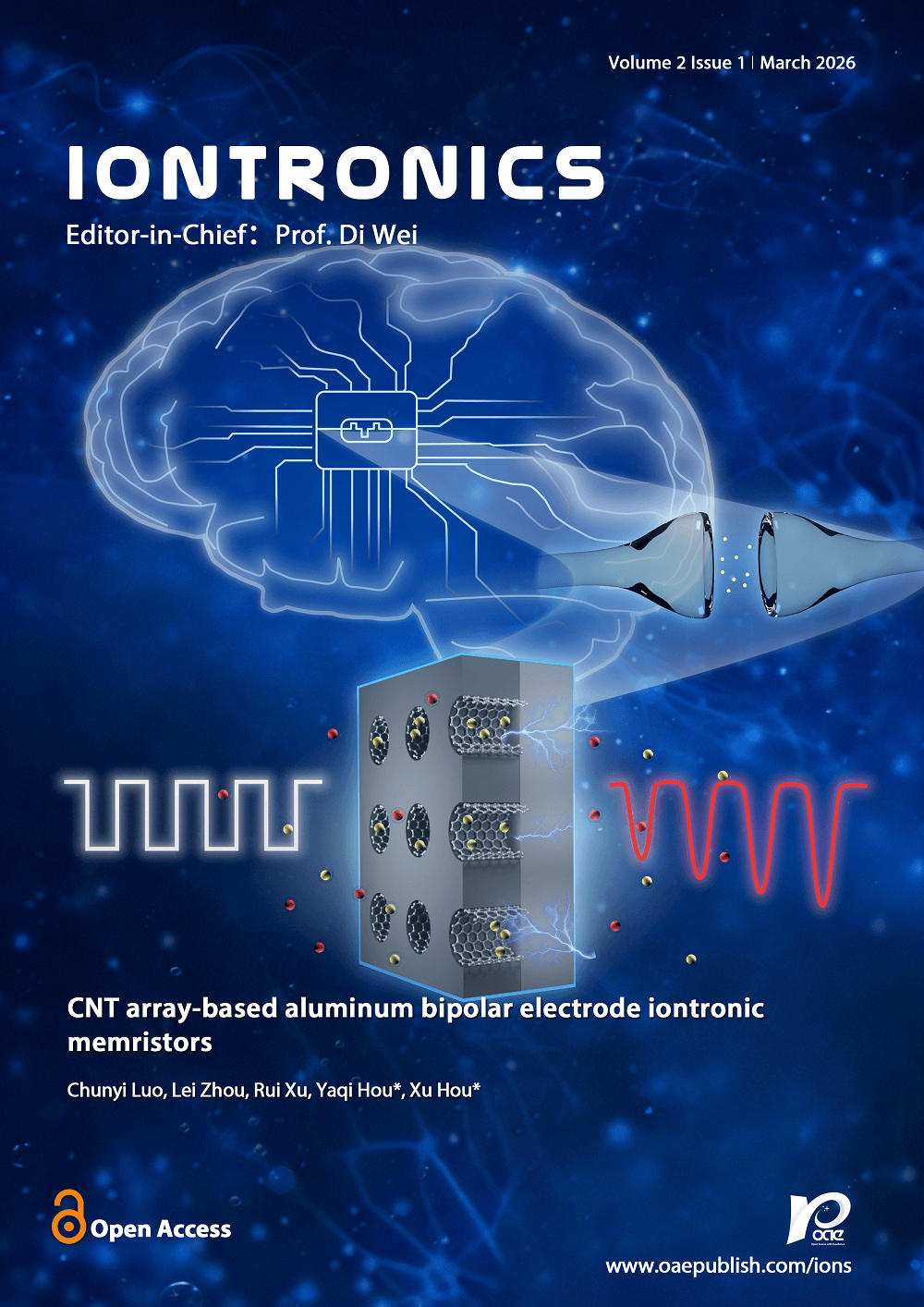
Cover Picture: Iontronics has emerged as a compelling platform for neuromorphic computing, where ions serve as functional charge carriers for information processing. Iontronic memristors hold particular promise due to their ability to emulate synaptic signal transmission through history-dependent ion transport. However, most existing devices rely on delicate control of nanochannel geometry and surface chemistry to induce ionic hysteresis, posing challenges for tunability and scalable materials design. Here, we introduce an alternative route to ionic memristive behavior based on asymmetric electrochemical reactions occurring at the poles of a bipolar electrode (BPE). In this system, a carbon nanotube array (ACNT) membrane selectively regulates cation transport on one side of an aluminum BPE, dynamically modifying local reaction environments and producing voltage-dependent enhancement or suppression of the redox current. This coupling between ion-selective nanochannels and reaction kinetics yields pronounced rectification and hysteretic current-voltage responses without requiring precise adjustment of nanoscale confinement. The ACNT-based-aluminum device further mimics short-term synaptic plasticity, demonstrating its capability for neuromorphic emulation. This electrochemically driven strategy establishes a versatile materials framework in which diverse redox chemistries and ion-regulating layers can be combined to construct tunable, solution-operable iontronic memristors.
view this paper 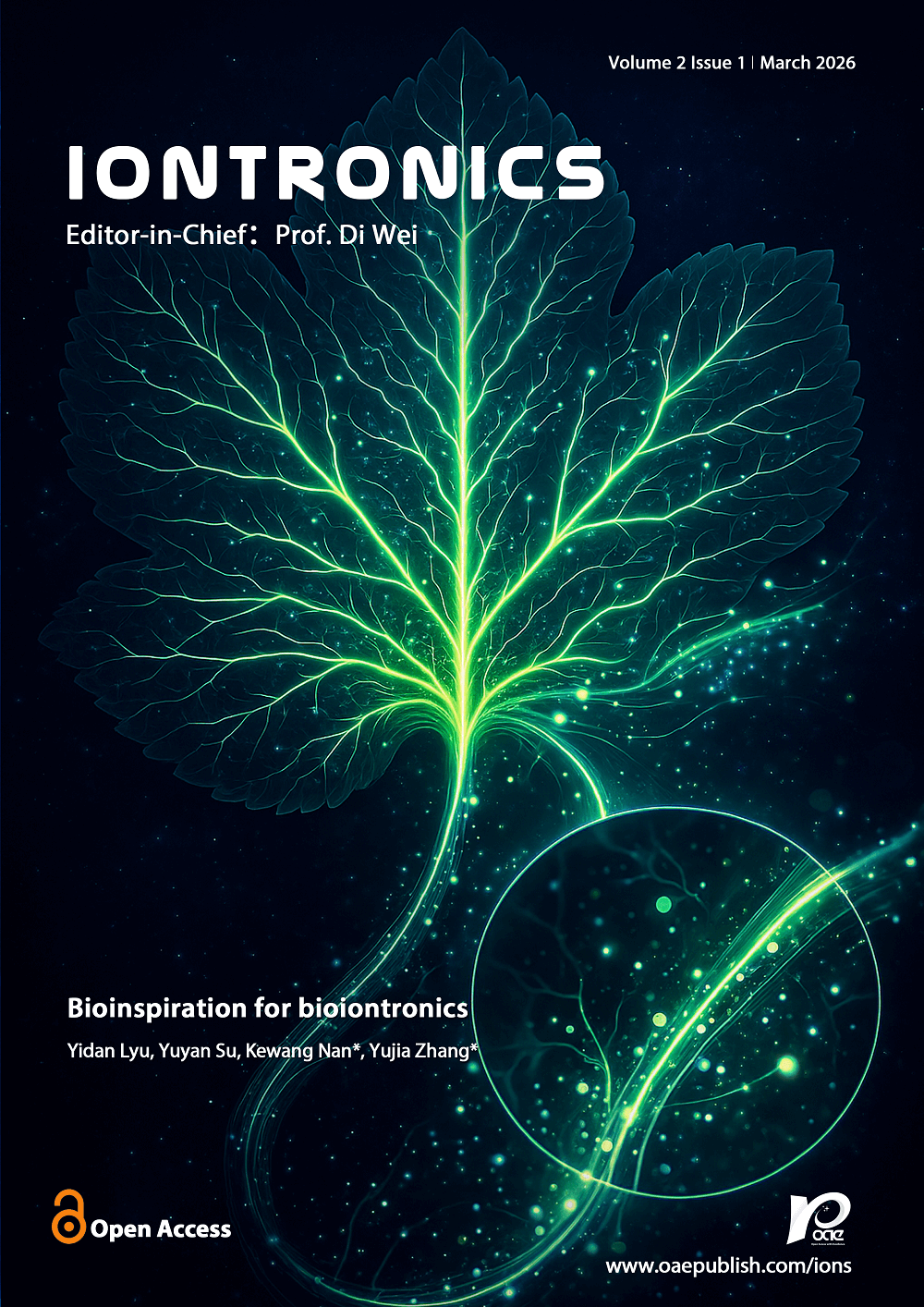
Back Cover Picture: Ions and small molecules form the basic language of biology, enabling numerous biological signaling activities. Biology has used the language of ions since the beginning of life, and scientists are only now beginning to catch up. The field of bioiontronics is emerging, aiming to communicate with living matter through ions and molecules for the detection and modulation of biological activities. Bioiontronics is an interdisciplinary field that originates from iontronics, the active control of ion transport. Specifically, bioiontronics refers to iontronic devices that interface with biological systems, incorporate biological components, or employ biomimetic designs. Therefore, understanding the ionic nature of biological systems is essential to bioiontronics and may inspire future breakthroughs. Here, we summarize ionic phenomena across different biological scales and examine their ionic mechanisms. We further summarize the bioinspired endeavors of bioiontronics, including energy harvesting and storage, sensing, signal processing, and biointerfaces. Finally, we outline the potential applications and challenges of mimicking natural ionic processes. The Review serves both as a source of information and as a benchmark and encouragement for further bioiontronic developments.
view this paper