



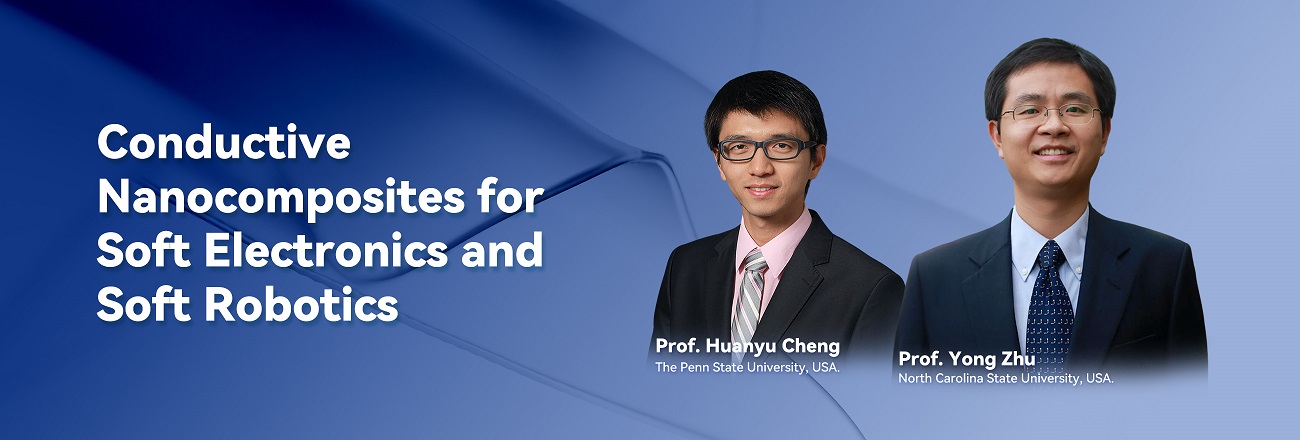
Conductive Nanocomposites for Soft Electronics and Soft Robotics
Time
8:00 PM (Beijing Time, UTC+8)
8:00 AM (Eastern Daylight Time, UTC−4)
8:00 AM (Eastern Daylight Time, UTC−4)
Join the Webinar

Zoom Meeting ID: 871 5155 9388
Passcode: 242737
Join Zoom Meeting:
https://us06web.zoom.us/j/87151559388?pwd=Na916AB7PGafGKLIQk3w7awRfVRytS.1
Share
Contents
Guest

Prof. Yong Zhu
Department of Mechanical and Aerospace Engineering, North Carolina State University, Raleigh, USA
Biosketch:
Yong Zhu received his BS degree from the University of Science and Technology of China and MS and PhD degrees from Northwestern University. After completing his postdoctoral training at the University of Texas at Austin, he joined the faculty of North Carolina State University in 2007, where he is currently the Andrew Adams Distinguished Professor in the Department of Mechanical and Aerospace Engineering. His group conducts research at the intersection of mechanics of materials and micro/nano-engineering, including nanomechanics and nanomaterial-enabled stretchable electronics. His work has been recognized with a number of prestigious awards including James R. Rice Medal from the Society of Engineering Science, ASME Zdeněk P. Bažant Medal, Gustus L. Larson Memorial Award, and Sia Nemat-Nasser Early Career Award, Bessel Research Award from the Alexander von Humboldt Foundation, and Best Wearable Material/Component Development Award at IDTechEx Wearable USA.
Yong Zhu received his BS degree from the University of Science and Technology of China and MS and PhD degrees from Northwestern University. After completing his postdoctoral training at the University of Texas at Austin, he joined the faculty of North Carolina State University in 2007, where he is currently the Andrew Adams Distinguished Professor in the Department of Mechanical and Aerospace Engineering. His group conducts research at the intersection of mechanics of materials and micro/nano-engineering, including nanomechanics and nanomaterial-enabled stretchable electronics. His work has been recognized with a number of prestigious awards including James R. Rice Medal from the Society of Engineering Science, ASME Zdeněk P. Bažant Medal, Gustus L. Larson Memorial Award, and Sia Nemat-Nasser Early Career Award, Bessel Research Award from the Alexander von Humboldt Foundation, and Best Wearable Material/Component Development Award at IDTechEx Wearable USA.
Moderator

Prof. Huanyu Cheng
Department of Engineering Science and Mechanics, The Pennsylvania State University, Pennsylvania, USA
Biosketch:
Huanyu Cheng is the James L. Henderson, Jr. Memorial Associate Professor of Engineering Science and Mechanics at The Pennsylvania State University. He holds affiliations with the departments of Engineering Science and Mechanics, Mechanical Engineering, Biomedical Engineering, Architectural Engineering, and Industrial and Manufacturing Engineering. His research focuses on advanced materials and devices, applied mechanics and biomechanics, nanoscience and bionanoscience engineering, as well as structural and human health monitoring. His work integrates interdisciplinary approaches to develop innovative materials and systems for applications spanning engineering and healthcare. He has been recognized as a Highly Cited Researcher in the Cross-Field category by Clarivate for multiple years.
Huanyu Cheng is the James L. Henderson, Jr. Memorial Associate Professor of Engineering Science and Mechanics at The Pennsylvania State University. He holds affiliations with the departments of Engineering Science and Mechanics, Mechanical Engineering, Biomedical Engineering, Architectural Engineering, and Industrial and Manufacturing Engineering. His research focuses on advanced materials and devices, applied mechanics and biomechanics, nanoscience and bionanoscience engineering, as well as structural and human health monitoring. His work integrates interdisciplinary approaches to develop innovative materials and systems for applications spanning engineering and healthcare. He has been recognized as a Highly Cited Researcher in the Cross-Field category by Clarivate for multiple years.
Abstract
Soft electronics represent an advancement beyond silicon-based rigid electronics, much like soft robotics extend the capabilities of conventional robots composed of rigid links. Both fields have gained significant momentum in recent years, driven largely by progress in soft electronic materials. Among these, conductive nanocomposites incorporating nanofillers have emerged as a particularly promising class of materials. In this talk, I will focus on silver nanowire (AgNW)–based nanocomposites for applications in soft electronics and soft robotics. I will begin by presenting highly conductive and stretchable nanocomposites formed through AgNW percolation networks, followed by a range of wearable sensors designed for monitoring human physiology and motion with applications in personalized healthcare. Next, I will introduce AgNW-based soft heaters and bimorph actuators and highlight their roles in soft robotic systems. I will discuss bioinspired soft crawling robots that use distributed, programmable thermal actuation in combination with origami-inspired designs. By leveraging mechanical instability, we are able to substantially enhance the speed of these thermally actuated soft robots. I will conclude with our recent progress toward scalable and sustainable nanomanufacturing approaches for these soft electronic and robotic systems.