



fig6
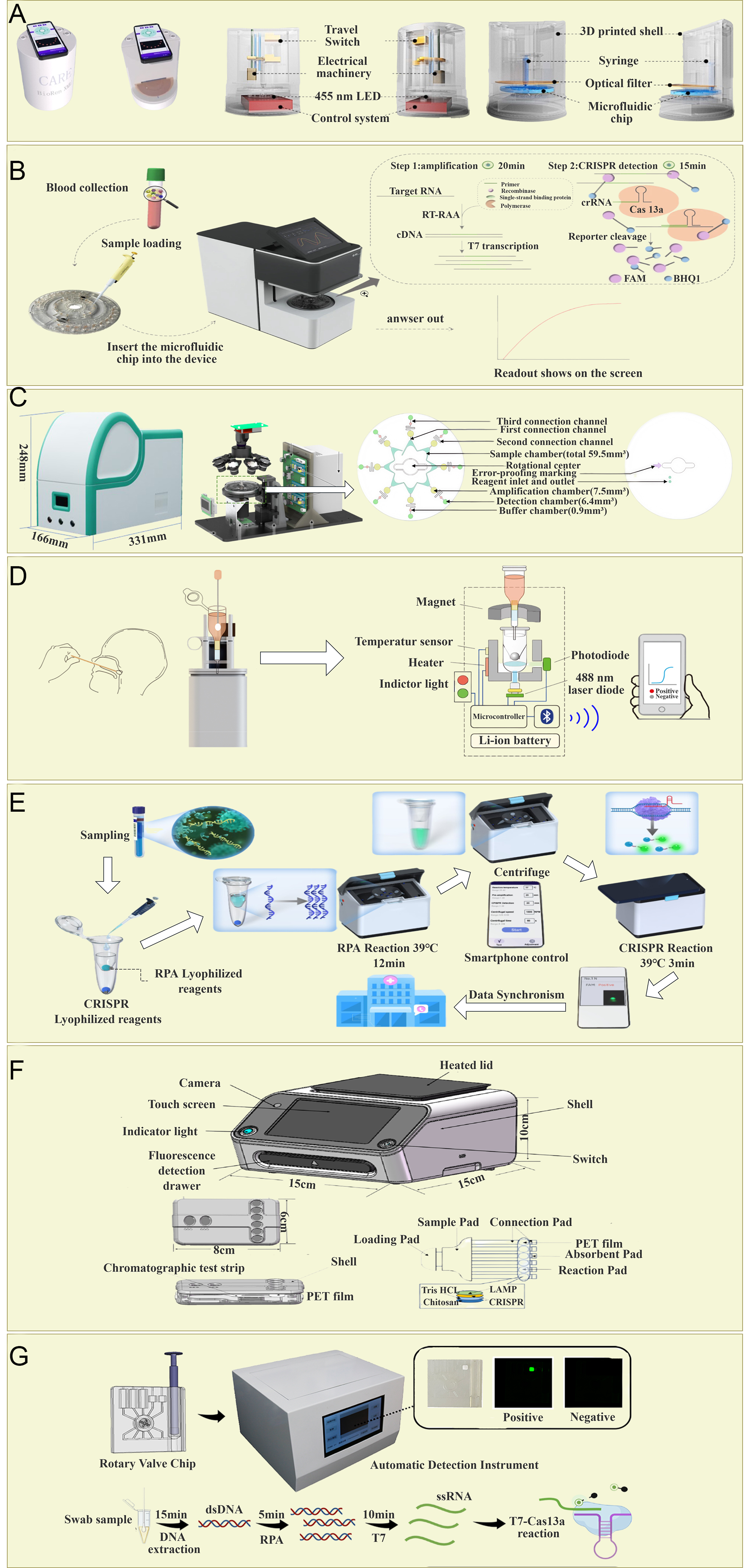
Figure 6. Representative CRISPR-Cas integrated detection platforms. Schematics and/or photographs illustrate the key working principles and designs of the various integrated systems discussed. (A) CARE device[94]: A fully sealed, pressure-driven Microfluidic Chip integrating RPA and CRISPR-Cas12a Detection for multiplex pathogen detection. (B) Portable integrated centrifugal system[99]: A CD-sized disk that automates Nucleic Acid Extraction, RAA, and CRISPR-Cas13a Detection. (C) Lift-CM Platform[101]: A centrifugal microfluidics system employing a spatially encoded disk and ascending heating to transfer amplicons to the CRISPR Detection chamber, compatible with various Isothermal Amplification methods. (D) CRAFT Platform[102]: A palm-sized device utilizing a mobile magnetic head valve within a single tube to compartmentalize RPA and CRISPR reactions. (E) Smartphone-controlled portable device[103]: A handheld device integrating heating, centrifugation, and Fluorescence Detection for extraction-free detection. (F) Integrated paper-based platform[107]: A Test Strip integrating bacterial Lysis, Chitosan Nucleic Acid purification, LAMP, and CRISPR-Cas12a Detection, driven by Capillary Action. (G) Automated microfluidics platform[109]: A Rotary Valve and plunger-assisted chip for fully automated sample pretreatment, Nucleic Acid Extraction, and one-pot RPA-T7-Cas13a reaction.