




fig4
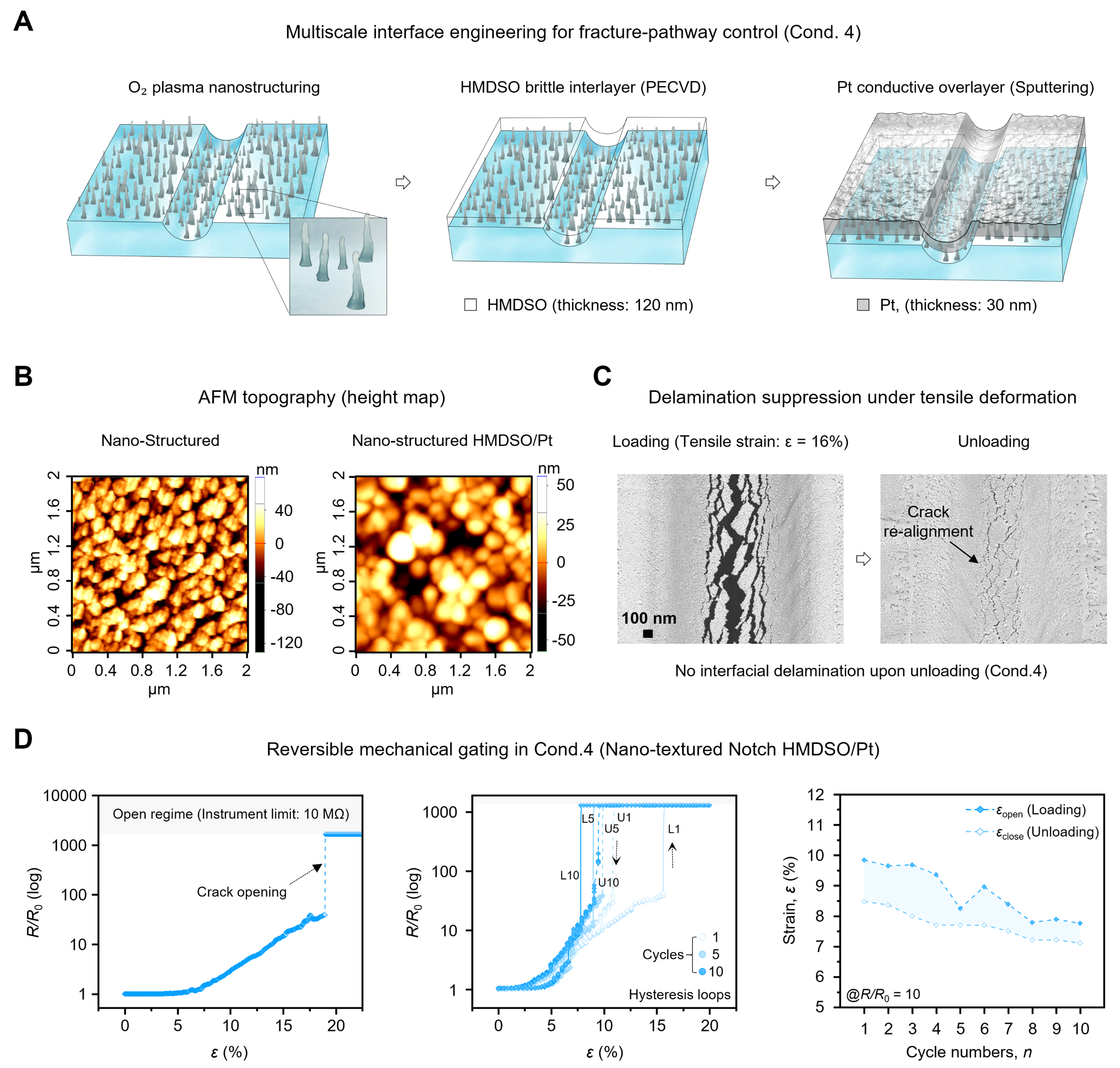
Figure 4. Fracture-pathway control through multiscale interface engineering. (A) Schematic illustration of the fabrication process. Oxygen plasma treatment generates nanoscale structures on the etched polymer surface. Subsequent deposition of HMDSO forms strong interfacial adhesion through mechanical interlocking; (B) AFM images. (Left) Nanoscale surface structures formed after plasma etching. (Right) Surface morphology after HMDSO/Pt deposition; (C) SEM images at 16% tensile strain and after strain release. Crack formation is suppressed on the planar region outside the notch, and film delamination at the notch is significantly reduced. Upon unloading, structural conformity between the separated crack faces is maintained; (D) Electrical characterization results. (Left) Under monotonic tensile loading, the crack opens at ~18% strain. (Middle) Cyclic tensile test over 10 cycles, showing convergence of εopen and εclose with increasing cycle number. (Right) Evolution of εopen and εclose, defined at R/R0 = 10. The average Δε (= εopen - εclose) over 10 cycles is 1.06% ± 0.44%, indicating a small strain hysteresis. HMDSO: Hexamethyldisiloxane; AFM: atomic force microscopy; SEM: scanning electron microscopy; PECVD: plasma-enhanced chemical vapor deposition.