




fig4
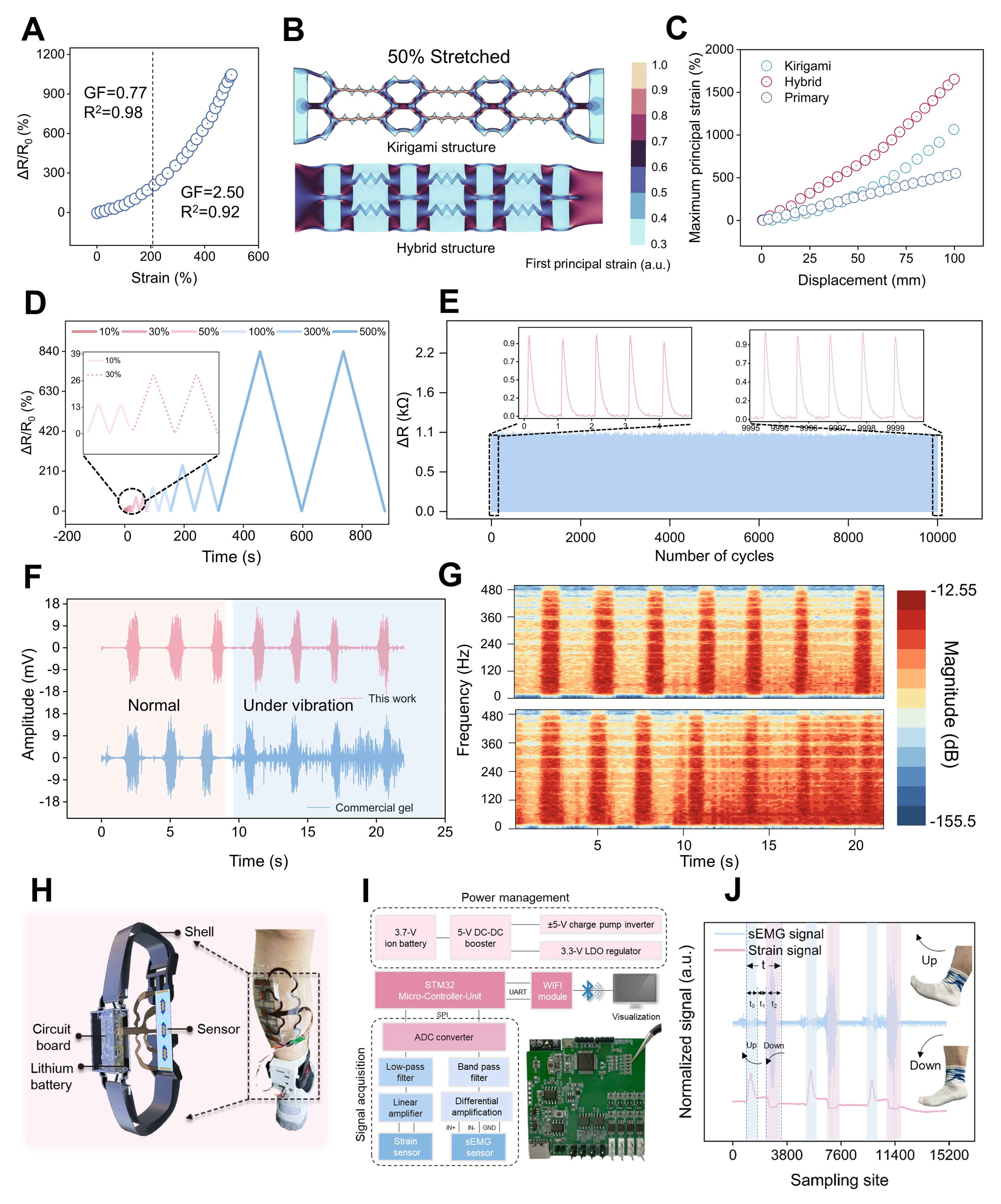
Figure 4. (A) Determination of the sensor gauge factor (GF); (B and C) Finite element simulation analysis of the principal strain distributions in the proposed pristine, kirigami, and soft-hard hybrid structure; (D) Dynamic sensing response of the strain sensor under varying tensile strains ranging from 10% to 500%; (E) Long-term cyclic stability evaluation over 10,000 loading-unloading cycles; (F) Time-domain sEMG signals recorded using the developed eutectogel electrode and a commercial gel electrode under both static and vibration conditions; (G) Corresponding short-time Fourier transform (STFT) spectrograms of the sEMG signals obtained under static and vibration states; (H) Exploded schematic illustration and photographic image of the wearable sensing systems; (I) Schematic representation of the integrated circuitry and overall system workflow; (J) Normalized bimodal sensing signals recorded during gait-related movements. sEMG: Surface electromyography; R2: coefficient of determination; DC: direct current; LDO: low dropout regulator; STM32: STMicroelectronics 32-bit microcontroller; UART: universal asynchronous receiver/transmitter; WIFI: wireless fidelity; ADC: analog-to-digital converter.