




fig10
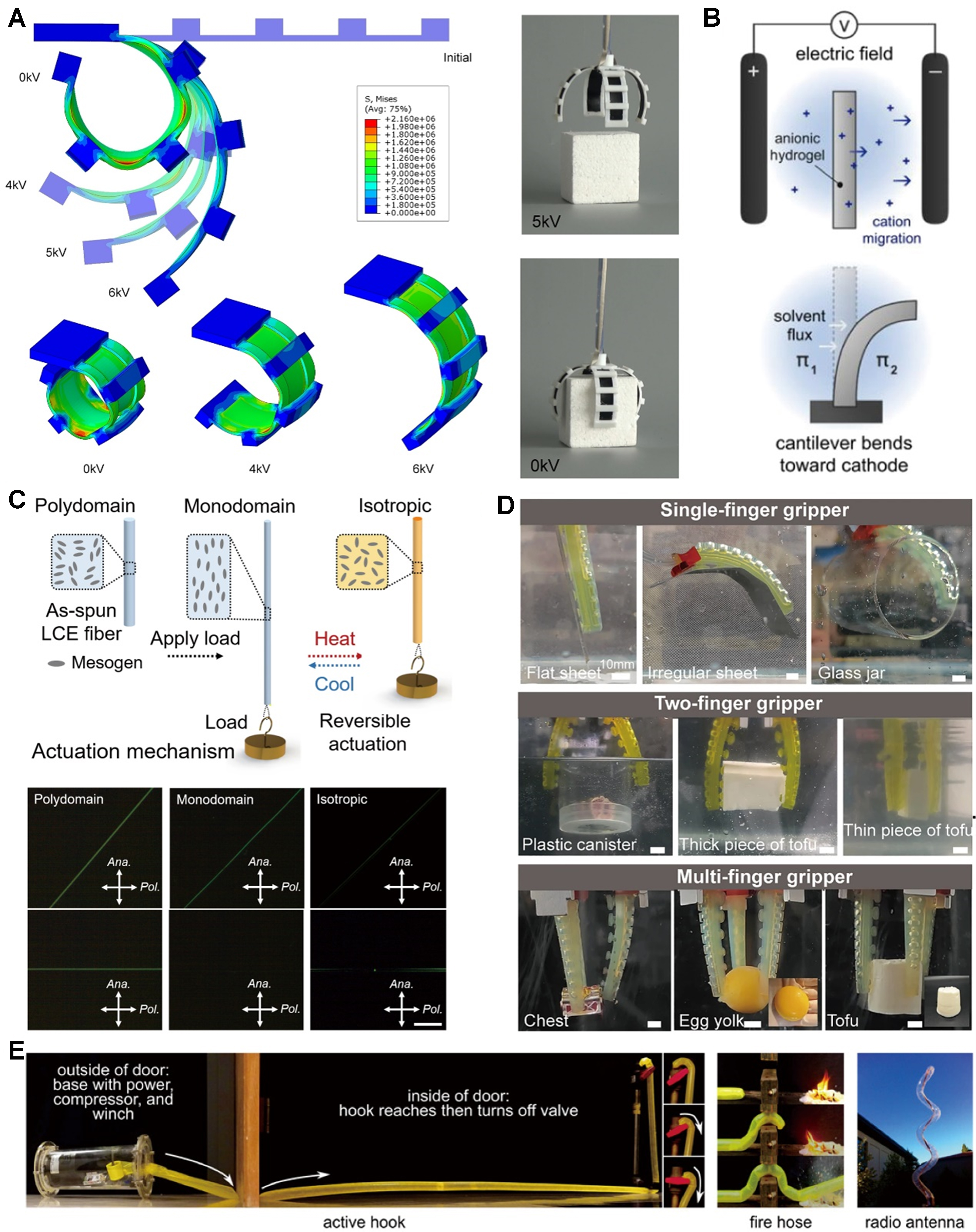
Figure 10. Actuation mechanism and motion complexity and structural design. (A) DEA soft gripper grips a cube[295]. Copyright 2019, Elsevier; (B) Illustration of electro-osmotic actuation mechanism[296]. Copyright 2022, American Chemical Society; (C) Top: Actuation mechanism of LCE fiber; bottom: POM images of polydomain, monodomain, and isotropic states of LCE microfibers observed at two different angles with respect to the analyzer[300]. Copyright 2021, The American Association for the Advancement of Science; (D) Designed and manufactured single-finger, two-finger, and multi-finger hydrogel soft grippers for handling objects of different shapes (spheres, cylinders, and cubes), surfaces (flat, curved, and folded) and stiffness attributes (stainless steel, glass, plastic, and ultra-soft foods like tofu and egg yolks)[314]. Copyright 2026, Springer Nature; (E) The soft robot demonstrates the ability to lengthen into useful 3D structures[315]. Copyright 2017, The American Association for the Advancement of Science. DEA: Dielectric elastomer actuator; LCE: liquid crystal elastomer; POM: polarized optical microscopic.