




fig6
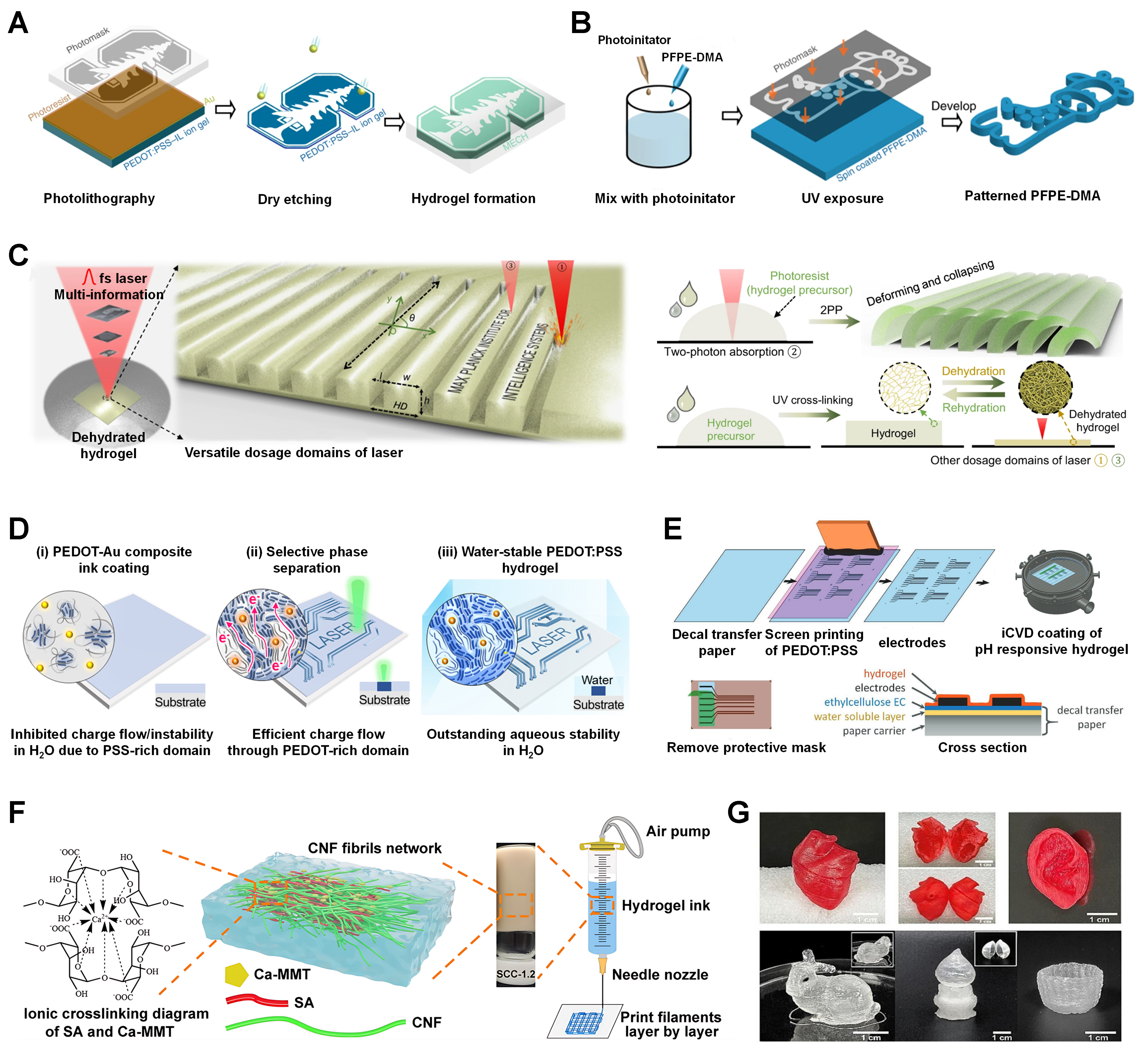
Figure 6. (A) Lithographically assisted method for hydrogels. cellulose hydrogels; (B) Stepwise depiction of hydrogel lithography. (A and B) are reprinted with permission from Ref.[159]. Copyright 2019, Springer Nature; (C) Laser technology for the dehydrated hydrogel film[160]. Copyright 2023, Springer Nature; (D) Laser-induced method for conducting polymer[163]. Copyright 2022, The American Association for the Advancement of Science; (E) A transferable temporary tattoo[169]. Copyright 2022, Wiley-VCH; (F) Direct-ink-writable hydrogel systems[174]. Copyright 2024, Elsevier; (G) 3D-printing regenerated cellulose hydrogels[175]. Copyright 2022, Elsevier. PEDOT:PSS: Poly(3,4-ethylenedioxythiophene):poly(styrenesulfonate); IL: ionic liquid; MECH: micropatterned electrically conductive hydrogel; PFPE-DMA: UV-crosslinked dimethacrylate-functionalized perfluoropolyether; UV: ultraviolet; iCVD: initiated chemical vapor deposition; EC: ethylcellulose; SA: sodium alginate; MMT: montmorillonite; CNF: cellulose nanofiber.