




fig9
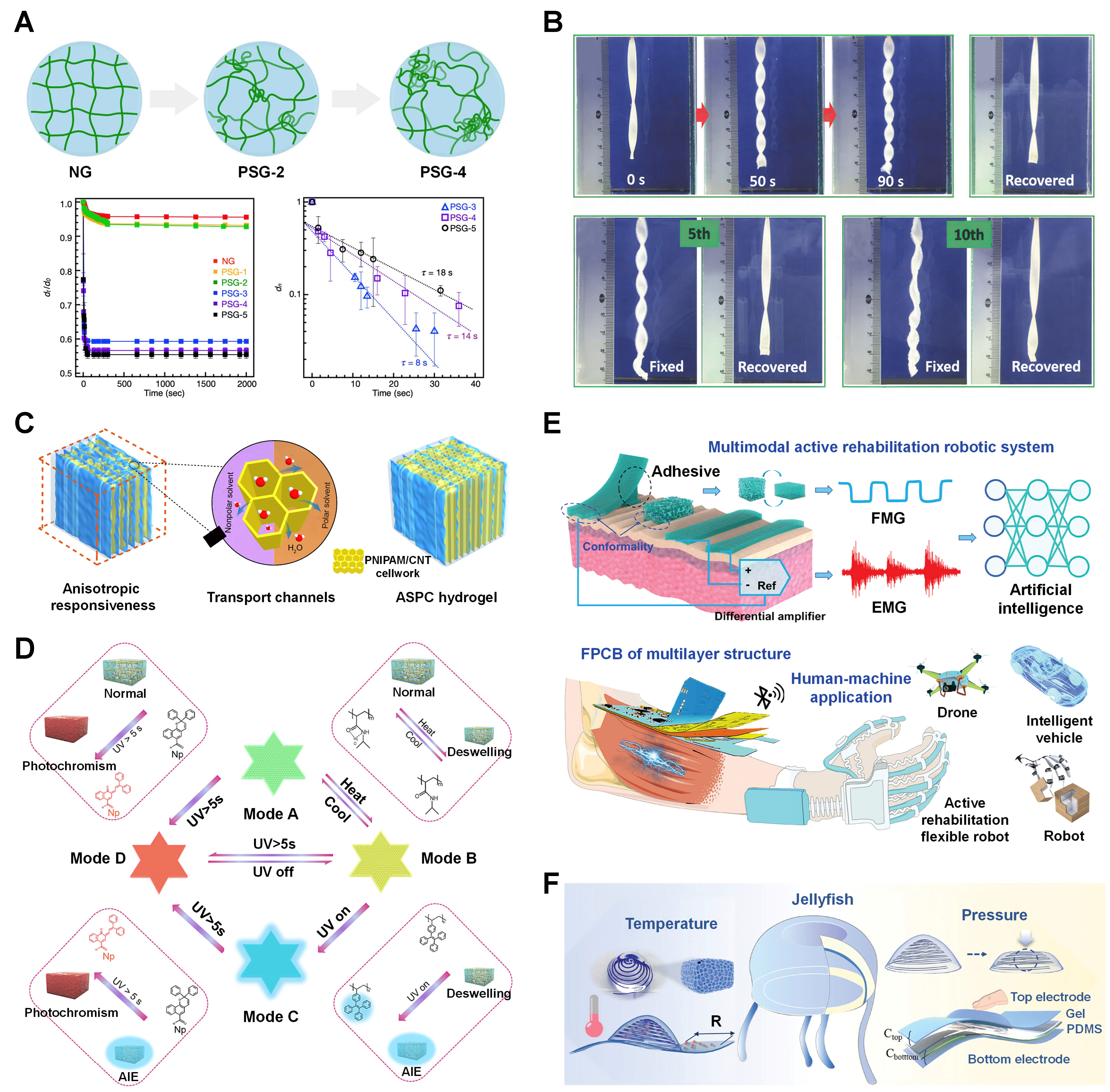
Figure 9. Stimuli-responsive mechanisms, responsivity, and multimodal sensing integration of soft hydrogels. (A) Network structures with phase separation and shrinking kinetics of normal hydrogel (NG) and phase-separated hydrogel (PSG)-1 to PSG-5 after a temperature jump from 20 to 45 °C, showing dn vs. time with relaxation times from the slopes[209]. Copyright 2021, MDPI; (B) Reversible twisting and recovery of M1S0.5A0.5 hydrogel in 0.1 M HCl and NaOH solutions, demonstrating consistent shape-memory behavior over at least 10 cycles[218]. Copyright 2018, Wiley-VCH; (C) Schematic of anisotropic ASPC hydrogel deformation in different solvents, facilitated by rapid water transport through low-tortuosity porous channels[219]. Copyright 2024, Springer Nature; (D) Multistage responsive behavior of CdS photonic crystal organohydrogel[228]. Copyright 2024, Elsevier; (E) The wearable human–machine interaction interface design using hydrogel-based EMG and pressure sensors for an AI-assisted active rehabilitation robotic system[259]. Copyright 2024, Wiley-VCH; (F) A jellyfish-inspired biomimetic hydrogel sensor device for temperature and pressure sensing[278]. Copyright 2025, Wiley-VCH. ASPC: Ag/Sa (sodium alginate)/PNIPAM [poly(N-isopropylacrylamide)]/CNT (carbon nanotube); EMG: electromyogram; PNIPAM: poly(N-isopropylacrylamide); CNT: carbon nanotube; UV: ultraviolet; AIE: aggregation-induced emission; FMG: force myography; FPCB: flexible printed circuit board; PDMS: polydimethylsiloxane.