


Volume 6, Issue 1 (2026) – 22 articles
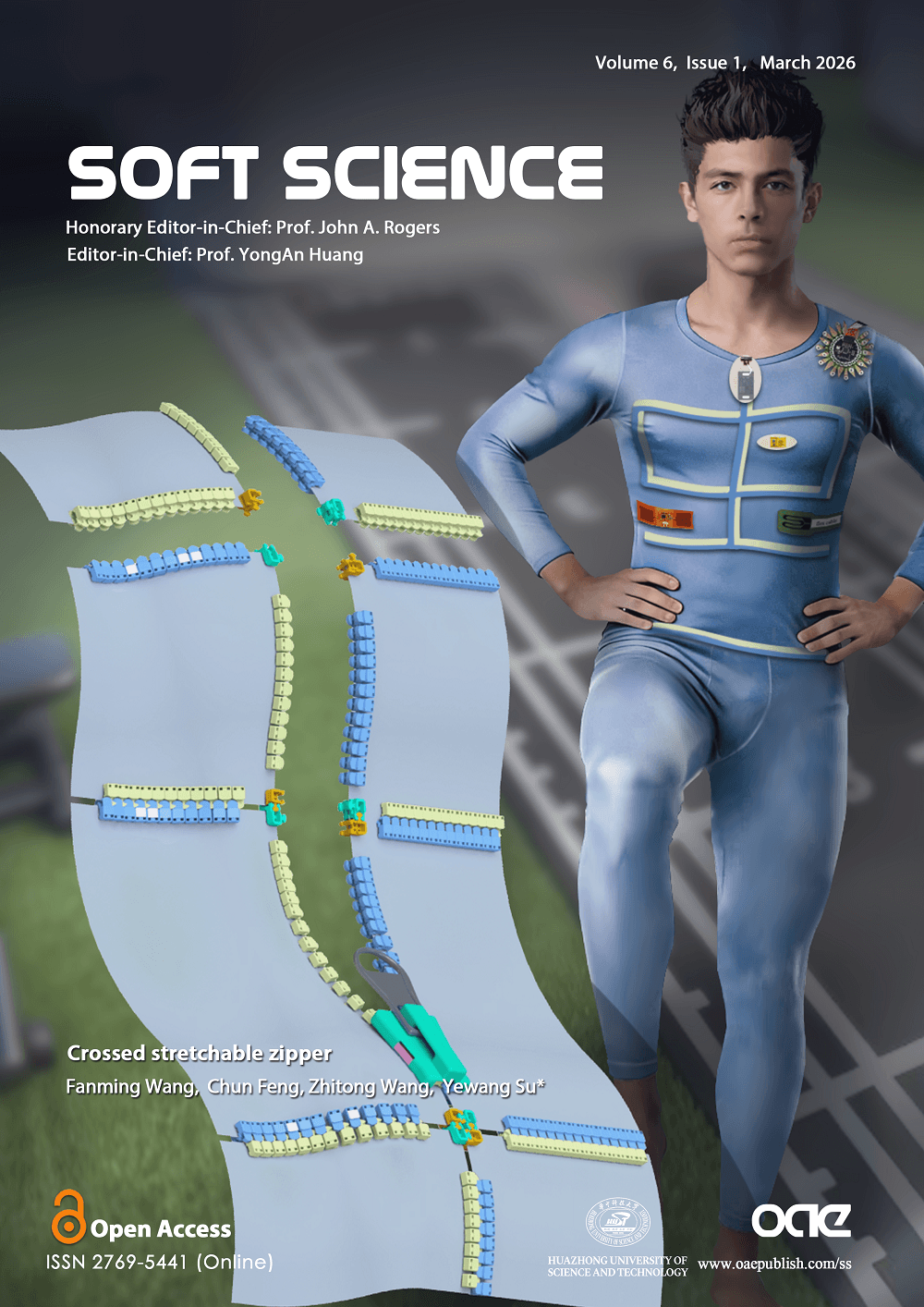
Cover Picture: As a classic mechanical fastening system, zippers are widely used in applications ranging from daily life to biomedicine. Conventional zippers, however, have limited deformation compatibility due to their unidirectional zipping and nonstretchable interlocking mechanism, highlighting their insufficient structural adaptability in scenarios involving cross-connections or multi-directional dynamic deformation. Here, we report a crossed stretchable zipper that enables zipping in overlapping areas via a cross adapter, prevents structural failure through latch-slot and suture-joint mechanisms, and closes separated fabrics while maintaining stretchability. This design allows a two-dimensional mesh configuration without compromising the inherent stretching performance of the zipper, significantly enhancing flexibility and adaptability. In hemiplegia rehabilitation wearables, modularity based on the crossed stretchable zipper offers advantages in personalized deployment and conformability, highlighting its potential for the personalized and widespread development of wearable systems.
view this paper 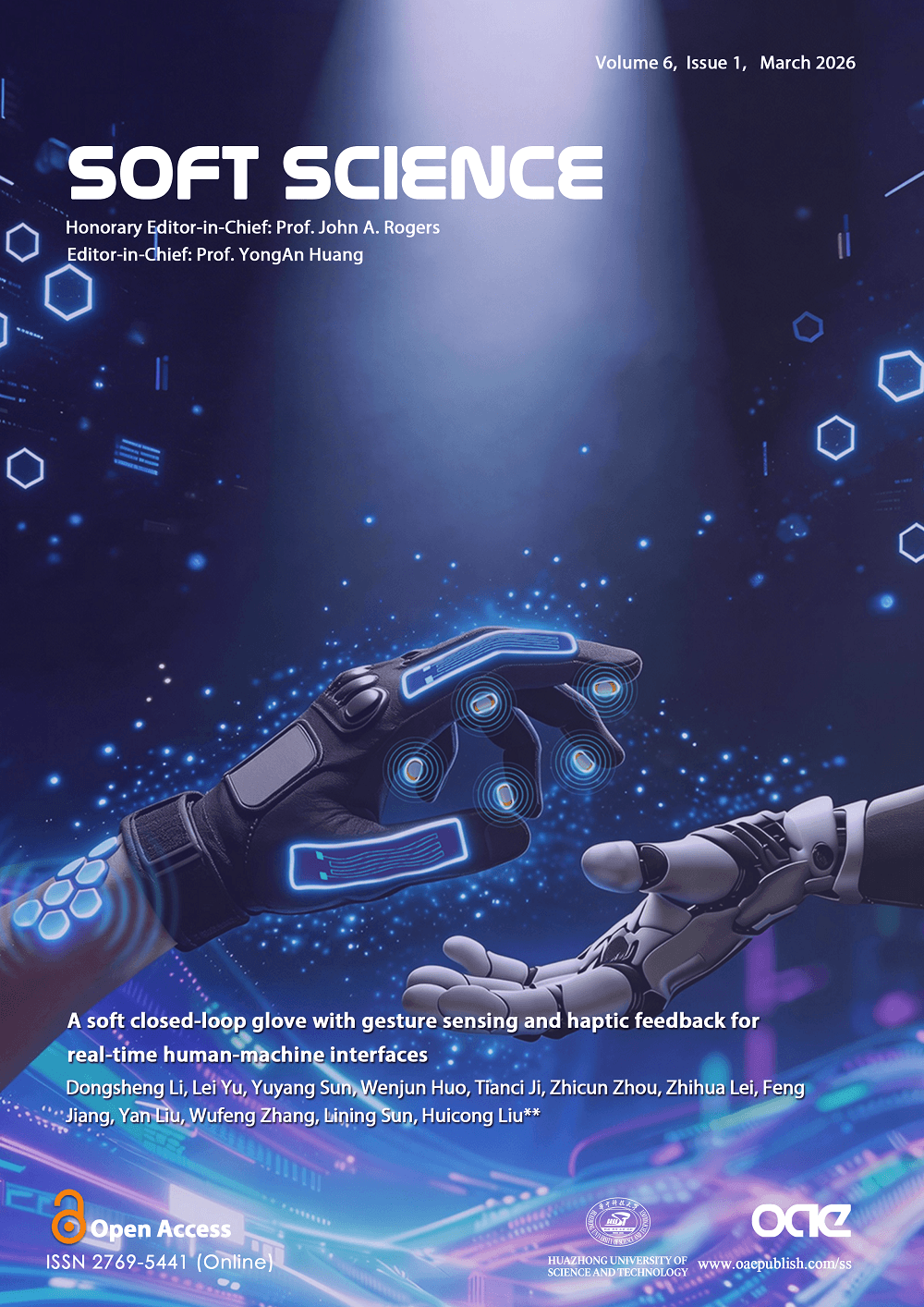
Back Cover Picture: Human-machine interfaces (HMIs) are essential tools facilitating effective interactions between users and intelligent systems. However, current wearable HMIs, particularly smart gloves, often face challenges in precisely recognizing subtle finger movements and delivering real-time tactile feedback, limiting their operational effectiveness and user immersion. To overcome these challenges, we propose an intelligent glove system integrating highly stretchable liquid metal-based strain sensors and programmable electromagnetic feedback actuators to realize closed-loop immersive human-machine interaction. The strain sensors achieve superior stretchability (over 200%), linear response, minimal hysteresis, and robust durability, effectively capturing complex hand movements. Gesture recognition, performed by a convolutional neural network, achieves an accuracy of 98% across common gestures, demonstrating exceptional precision and robustness. Furthermore, the glove integrates soft programmable electromagnetic actuators that generate an output force greater than 0.25 N, providing adjustable and precise tactile feedback via pulse-width modulation. This allows users to intuitively perceive tactile sensations in human-machine interaction scenarios, including robotic manipulation and motion guidance tasks. Comprehensive experiments confirm the intelligent glove system’s superior real-time responsiveness and adaptability in dynamic environments. This advanced closed-loop HMI glove significantly enhances operator immersion, operational accuracy, and interaction realism, demonstrating strong potential in robotics, virtual reality, and remote teleoperation applications.
view this paper